Artwork
A Girl Asleep
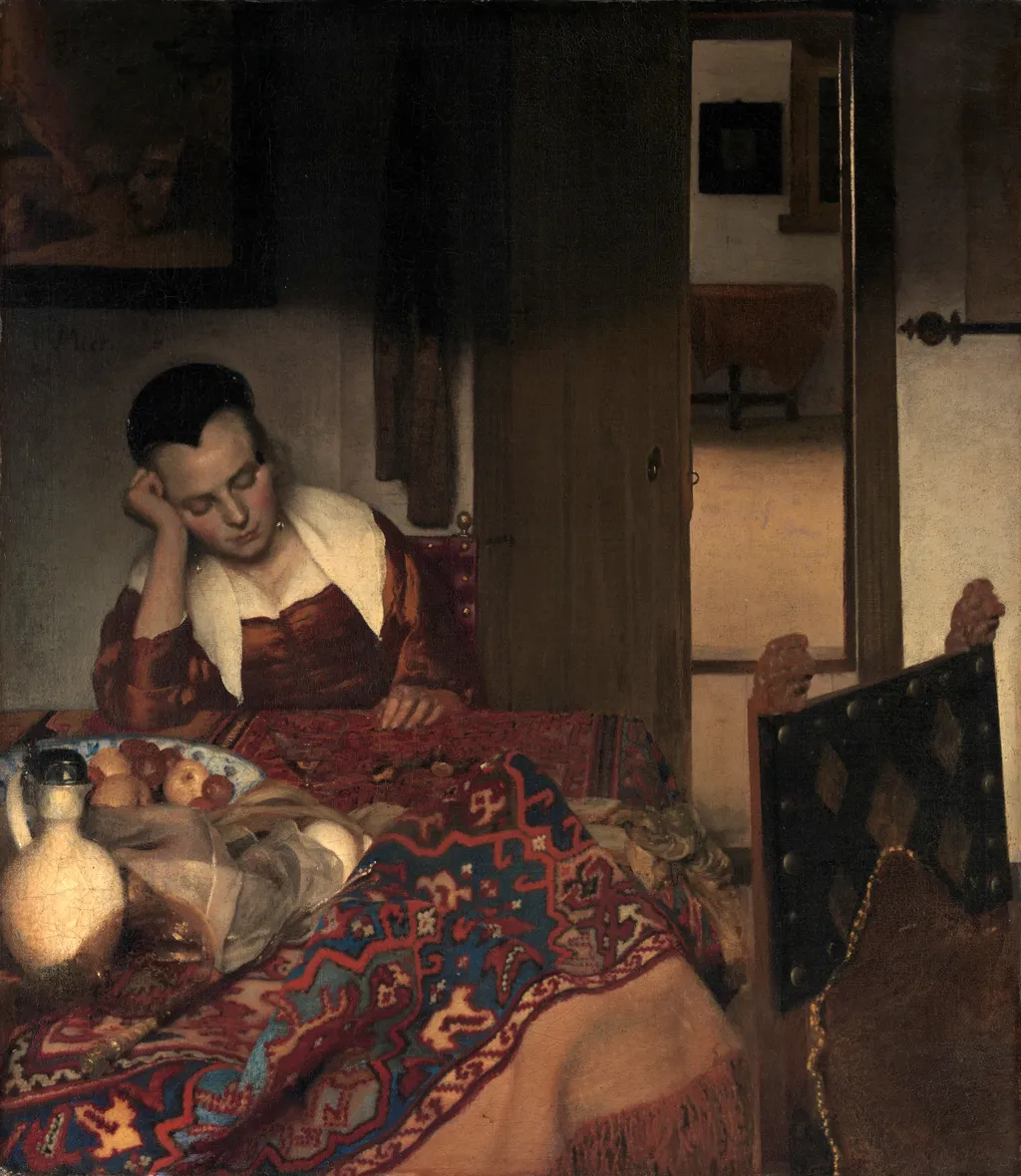
A Girl Asleep is an oil painting by the Dutch Golden Age artist Johannes Vermeer. It dates from 1657 and is held in the collection of the Metropolitan Museum of Art.
About this work
A young woman in an orange gown has drifted off at a table draped with an Oriental carpet, her head propped on her hand in Johannes Vermeer's A Maid Asleep.
A young woman in an orange gown has drifted off at a table draped with an Oriental carpet, her head propped on her hand in Johannes Vermeer's A Maid Asleep. Painted around 1656–57 in Delft, the canvas now hangs in the Metropolitan Museum of Art as accession 14.40.611. X-radiographs reveal Vermeer originally placed a male suitor in the rear doorway and a dog nearby, but later painted them out, replacing them with a mirror and a chair bearing a pillow. An overturned glass and wine jug hint at interrupted company.
Subject & Meaning
The painting depicts a young woman dozing or daydreaming at a table, surrounded by objects rich in symbolic meaning. A Chinese fruit bowl alludes to temptation, while the wine pitcher, overturned glass, and a displaced cushion on a nearby chair suggest recent company and potential romantic or sensual indulgence. The background includes a painting of Cupid, possibly referencing love or disillusionment, and originally featured a man and a dog (later painted over), which would have reinforced themes of fleeting relationships.
Vermeer intentionally removed these figures, heightening the ambiguity: the scene could represent a drunken maid, a moral lesson on idleness, or a contemplative study of light and introspection. Unlike contemporary moralizing genre pieces, Vermeer offers no explicit judgment, leaving the interpretation open.
Technique & Style
The painting is an oil on canvas (87.6 × 76.5 cm). X-ray and technical examination reveal that Vermeer originally included a man and a dog in the background, later overpainting them with a mirror and an angled chair, a compositional change that shifted the narrative toward ambiguity. The tableau employs a strong repoussoir: an oriental rug draped over the table separates the viewer from the sleeping woman, while a doorway opens into a sparsely furnished rear chamber.
Vermeer's early palette in this work leans on browns and deep reds, with the woman's red dress and white collar standing out against muted walls. The treatment of light is subdued yet diffuse, creating an intimate, still atmosphere. Multiple restorations have caused the still-life elements on the table to lose much of their original definition, diminishing the crispness of details like the overturned glass and fruit bowl.
History & Provenance
Painted circa 1657, A Girl Asleep (also called A Woman Asleep or A Maid Asleep) is a genre scene by Johannes Vermeer. It likely originated in the collection of Vermeer's patron, Pieter van Ruijven of Delft, and passed to his daughter and son-in-law Jacob Dissius. The painting was sold from Dissius's estate in Amsterdam on May 16, 1696.
Its whereabouts are then unknown until after 1873, when it belonged to John Waterloo Wilson in Paris. In 1881, Charles Sedelmeyer's gallery purchased the work and sold it that same year to Rodolphe Kann (also Paris). The Duveen Brothers acquired it from Kann's heirs in 1907 and sold it in 1908 to American collector Benjamin Altman, who brought it to New York in 1909.
Altman bequeathed the painting to the Metropolitan Museum of Art upon his death in 1913, where it remains. Under the terms of Altman's bequest, the work may not be lent to other institutions.
Context
A Girl Asleep marks a transitional work in Vermeer's career, shifting from traditional history painting to the more modern genre scene. Scholarly discussions highlight Vermeer's departure from the moralizing narratives typical of contemporaries like Nicolaes Maes; whereas Maes's comparable works invite judgment, Vermeer's composition dwells on light, texture, and atmosphere, creating an intimate yet ambiguous scene. X-rays revealing an originally painted man and dog, later replaced by a mirror and chair, underscore this studied ambiguity, which scholars such as Liedtke interpret as alluding to fleeting sensory experience and temptation.
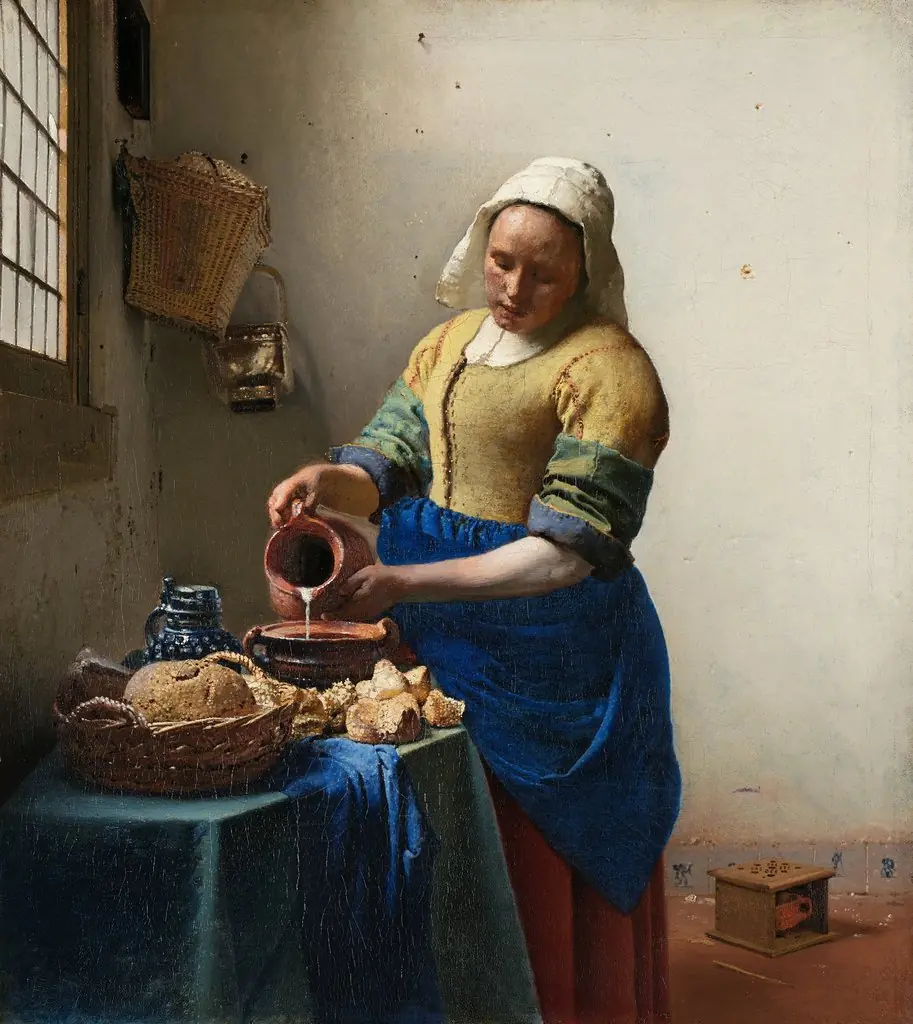
The work also demonstrates Vermeer's evolving style through motifs, such as the Chinese fruit bowl, Persian carpet, and open door, that recur in his later paintings. Its ownership by Van Ruijven, patron of The Milkmaid, ties it to a network of patronage and a more sympathetic depiction of domestic service than was conventional. As a product of the Dutch Golden Age, the painting exemplifies the era's interest in genre scenes that transcend simple didacticism.
Legacy
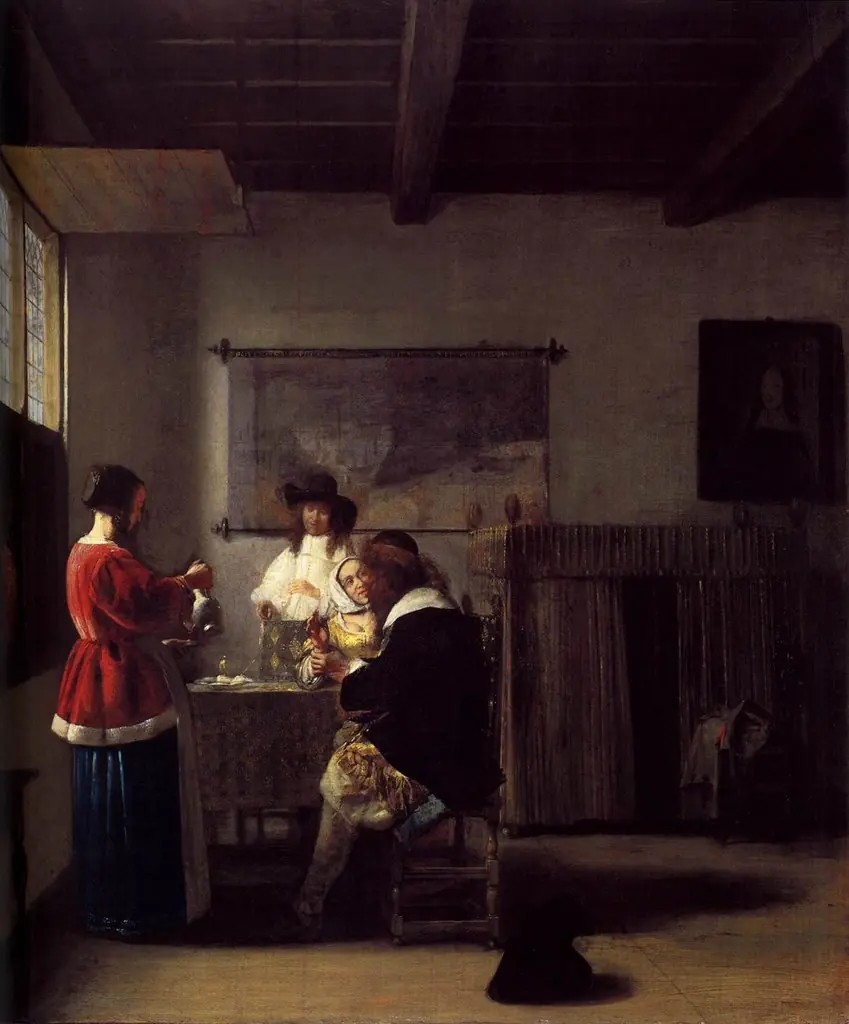
Since its acquisition by the Metropolitan Museum of Art in 1913 under Benjamin Altman's bequest, A Girl Asleep has remained a cornerstone of the museum's Dutch Golden Age collection, with the bequest terms prohibiting its loan. Art historians regard the painting as a pivotal transition in Vermeer's career from history painting to the modern genre scene, setting the intimate, non-moralizing tone that distinguishes his mature work. Its reputation is further shaped by celebrated comparisons to contemporaneous genre scenes by Nicolaes Maes and Pieter de Hooch.
Technical studies revealing Vermeer's removal of a male figure and dog have deepened scholarly appreciation of his compositional evolution, making the painting a key object of study.
Overview
Johannes Vermeer's oil painting, "A Girl Asleep," created around 1656–57, depicts a young woman in an orange dress who has fallen asleep at a table. This work, also known by several other titles including "A Woman Asleep," is a notable example of the Dutch master's domestic scenes. It is currently housed in the Metropolitan Museum of Art in New York City, where it remains a significant part of their collection.
Own this work as a print
Artist & collection
Artist
Johannes Vermeer ( vər-MEER, vər-MAIR, Dutch:; see below; also known as Jan Vermeer; October 1632 – 15 December 1675) was a Dutch painter who specialized in domestic interior scenes of middle-class life.