Artwork
The Milkmaid
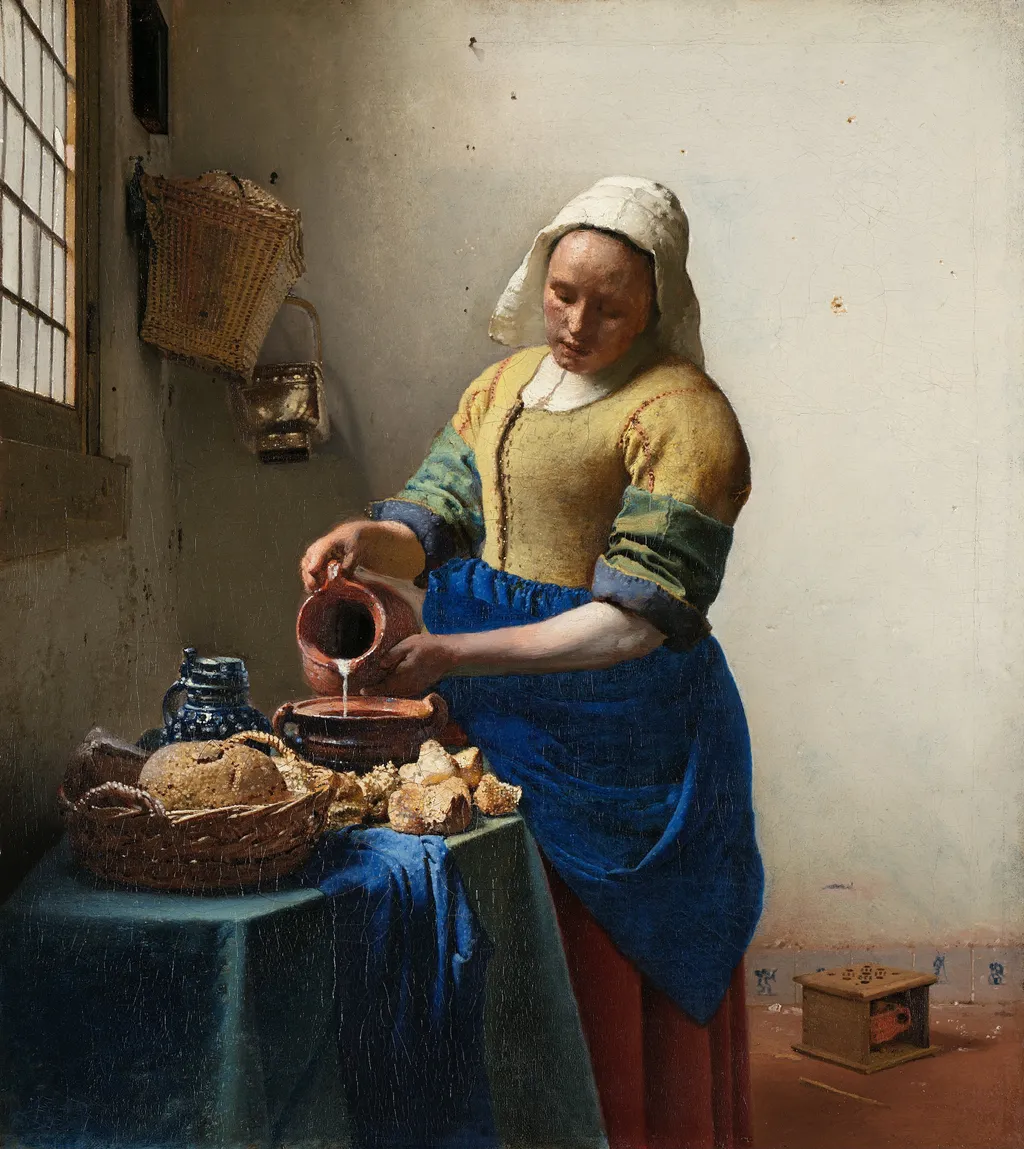
The Milkmaid is an oil painting by the Baroque artist Johannes Vermeer. It dates from 1660 and is held in the collection of the Rijksmuseum.
About this work
A maidservant pours milk in a plain kitchen, her yellow bodice and blue apron catching light from a broken leaded window.
A maidservant pours milk in a plain kitchen, her yellow bodice and blue apron catching light from a broken leaded window. Johannes Vermeer painted this quiet moment around 1660, dotting thick paint across bread and stoneware. X-rays show he removed a wall map and a clothes basket, leaving only a footwarmer and Delft tiles around her. Now at the Rijksmuseum, it is one of his most studied single-figure scenes.
Subject & Meaning
The Milkmaid depicts a domestic kitchen maid, not a specialized milkmaid, pouring milk in a sparse room. While the subject draws on a Dutch tradition of kitchen maids associated with erotic symbolism (the milk itself, the wide-mouthed jug, a foot warmer, and a Delft tile depicting Cupid), Vermeer treats the figure with unusual dignity and empathy, focusing on her absorbed concentration. The bright, illusionistic light and the maid's downcast eyes create a sense of calm domesticity while leaving her emotions ambiguous, a 'Mona Lisa effect' that invites speculation.
The painting thus balances traditional amorous iconography with a respectful portrayal of everyday labor, elevating a humble task into a timeless, enigmatic image.
Technique & Style
Painted in oil on canvas, The Milkmaid measures 45.5 by 41 cm. Vermeer employed a carefully constructed perspective system, using a chalked string from a nail at the central vanishing point above the maid’s hand to guide the composition. The handling is notably vigorous: the maid’s face is modeled with bold, visible brushstrokes and juxtaposed colors, ochre, brown, gray-green, and white, giving a sculpted quality, contrasting with the smoother surfaces of his later portraits. Light entering from the left models volumes and textures, from the rough bread crusts to the heavy folds of the maid’s blue apron and red skirt, rendered in primary colors.
Radiographic studies reveal that Vermeer overpainted an originally planned wall rack and fire basket, simplifying the background to focus attention on the figure and her action.
History & Provenance
The Milkmaid has been held at the Rijksmuseum in Amsterdam since its acquisition in 1908. It is displayed in the museum's Gallery of Honour. The painting has been featured in exhibitions such as 'Vermeer and the Masters of Genre Painting. Inspiration and Rivalry.'
Context
Vermeer's The Milkmaid has been celebrated as an iconic masterpiece of the Dutch Golden Age, with art historian Ernst Gombrich praising its ability to reveal the quiet beauty of a familiar scene. The painting is widely regarded as one of the Rijksmuseum's finest attractions, though modern viewers often find an enigmatic quality reminiscent of the Mona Lisa, as noted by curator Walter Liedtke. Scholarly analysis, including radiography and infrared studies, has uncovered Vermeer's compositional adjustments, such as overpainting a wall rack and a fire basket to focus attention on the maid.
Within art history, the work represents a dignified departure from the eroticized depictions of maids common in Netherlandish genre painting. Its enduring fame is evidenced by its use as a corporate logo for Nestlé's dairy products.
Legacy
The Milkmaid gained early renown, described in 1719 as “the famous milkmaid” and fetching a high price at Vermeer’s estate sale. Now considered one of Vermeer’s supreme achievements, the Rijksmuseum calls it “unquestionably one of the museum’s finest attractions.” Its modern reception often invokes a “Mona Lisa effect” of enigmatic appeal.
The painting’s iconic status extends to commercial use: Nestlé has long employed the image on its La Laitière dairy products, even registering the entire painting as a trademark. Its acquisition by the Rijksmuseum in 1908, preventing its sale to the United States, secured its place as a Dutch national treasure.
Overview
Johannes Vermeer's oil-on-canvas painting, known as The Milkmaid or The Kitchen Maid, portrays a domestic maidservant engaged in a simple kitchen task. Created around 1657-1661, this work is recognized as a significant example of the Dutch artist's single-figure genre scenes. It is currently housed in the Rijksmuseum in Amsterdam, where it remains a prominent piece in their collection.
Own this work as a print
Artist & collection
Artist
Johannes Vermeer ( vər-MEER, vər-MAIR, Dutch:; see below; also known as Jan Vermeer; October 1632 – 15 December 1675) was a Dutch painter who specialized in domestic interior scenes of middle-class life.