Artwork
Woman Holding a Balance
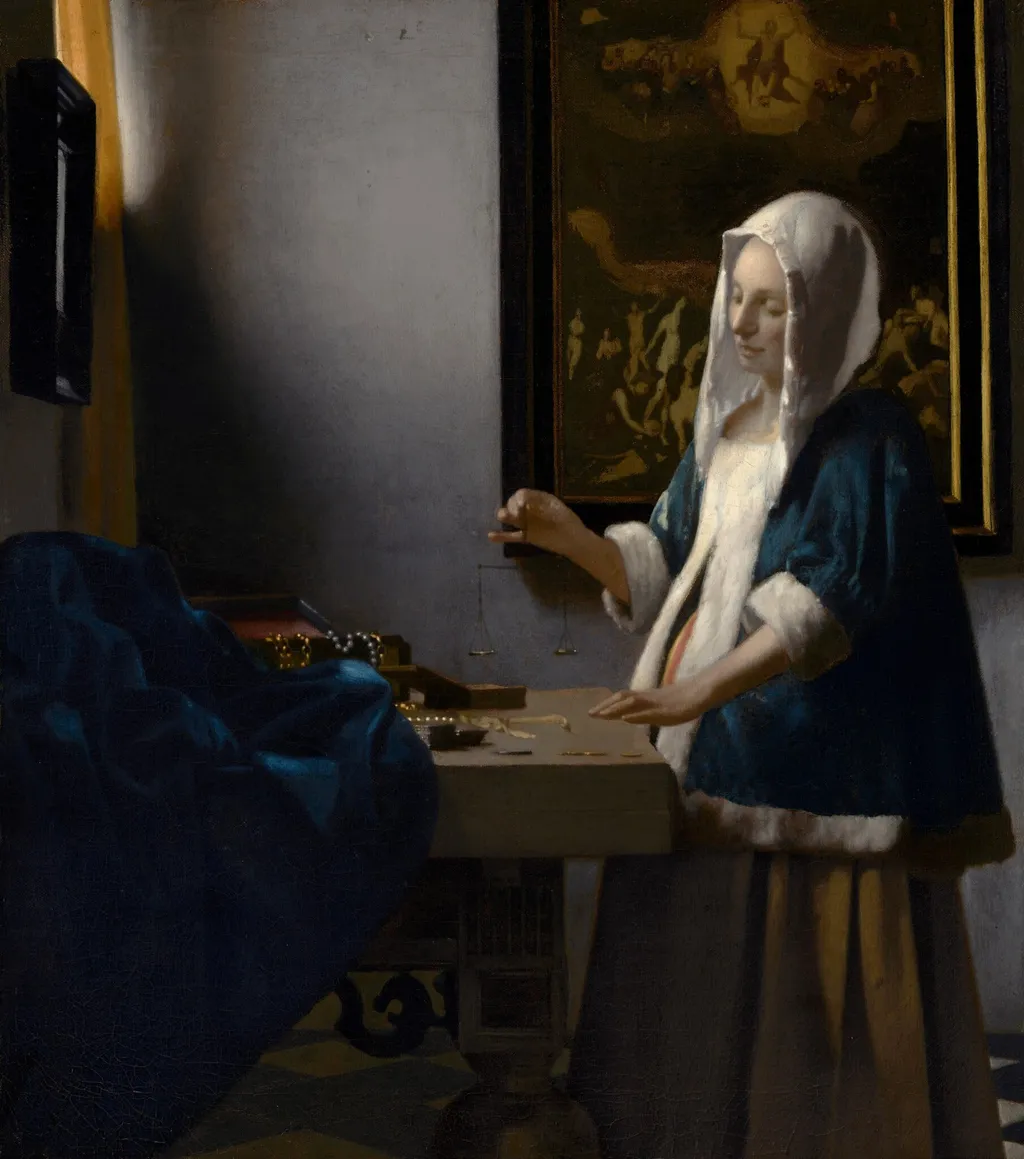
Woman Holding a Balance is an oil painting by the Baroque artist Johannes Vermeer. It dates from 1664 and is held in the collection of the National Gallery of Art.
About this work
Subject & Meaning
Art historian John Michael Montias viewed the woman as "symbolically weighing unborn souls," and some critics identify her as a figure of the Virgin Mary.
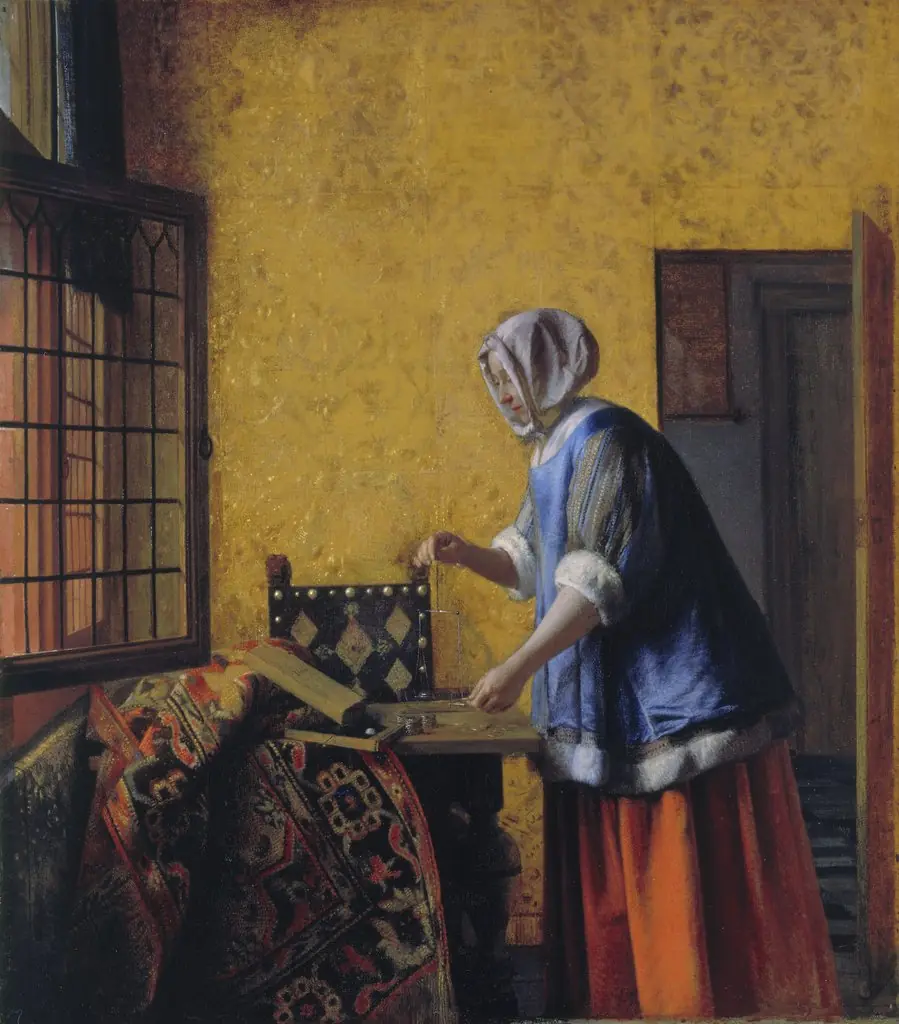
The painting depicts a woman, often described as pregnant, holding an empty balance before a table laden with a jewelry box, pearls, gold, and coins, with a mirror on the wall and a painting of the Last Judgment behind her. The empty scales and the juxtaposition with the final judgment have inspired multiple symbolic readings: some interpret the scene as a vanitas warning against earthly vanity, while others see an allegory of divine truth, justice, or the need to balance worldly possessions with spiritual piety. Art historian John Michael Montias viewed the woman as "symbolically weighing unborn souls," and some critics identify her as a figure of the Virgin Mary.
The coins on the table, noted in earlier titles like Woman Weighing Gold, reinforce the tension between material wealth and moral reckoning.
Technique & Style
Johannes Vermeer's Woman Holding a Balance (c. 1664) is executed in oil on canvas. The original painted area is approximately 39.7 × 35.5 cm, but the canvas was later extended by roughly five centimetres on each side to its current 42.5 × 38 cm. Vermeer employed a refined technique: pigment analysis reveals costly ultramarine for the blue tablecloth, lead-tin-yellow for the luminous yellow curtain and gold frame, and lead white for the gray wall; darker shadows contain yellow ochre and charcoal. The handling is smooth and precise, with soft light modeling the woman's face.
The composition is geometrically rigorous, centered on the empty balance, with diagonals and parallel horizontals creating a serene, balanced structure. Microscopic evaluation confirms the scales are empty, reinforcing the painting's contemplative formality.
History & Provenance
Johannes Vermeer executed Woman Holding a Balance around 1664. Its earliest recorded provenance begins with the Delft collector Pieter Claesz van Ruijven. The painting passed through inheritance to Jacob Dissius, in whose estate sale it was sold in Amsterdam on 16 May 1696 to Isaac Rooleeuw.
Following Rooleeuw's bankruptcy in 1701, it entered the collection of Paolo van Uchelen. After a succession of European owners, it was acquired by Peter A. B. Widener and eventually entered the National Gallery of Art in Washington, D.C. No specific commission is recorded.
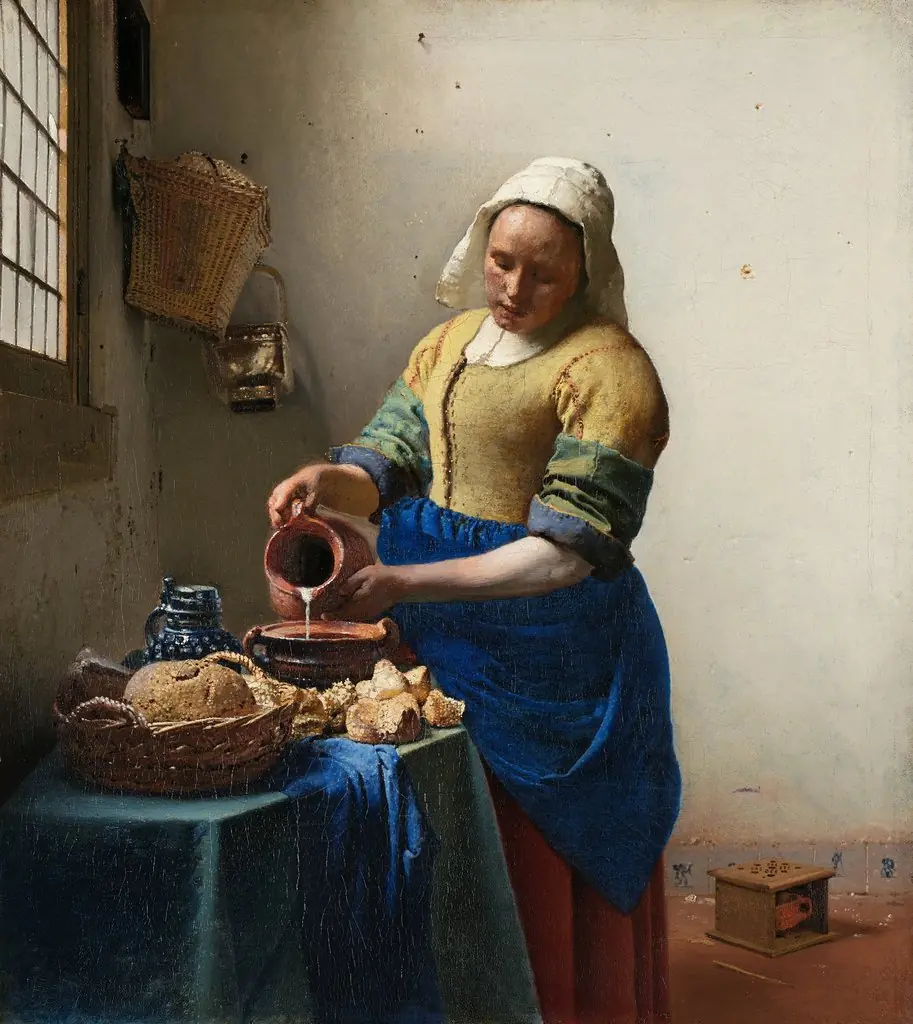
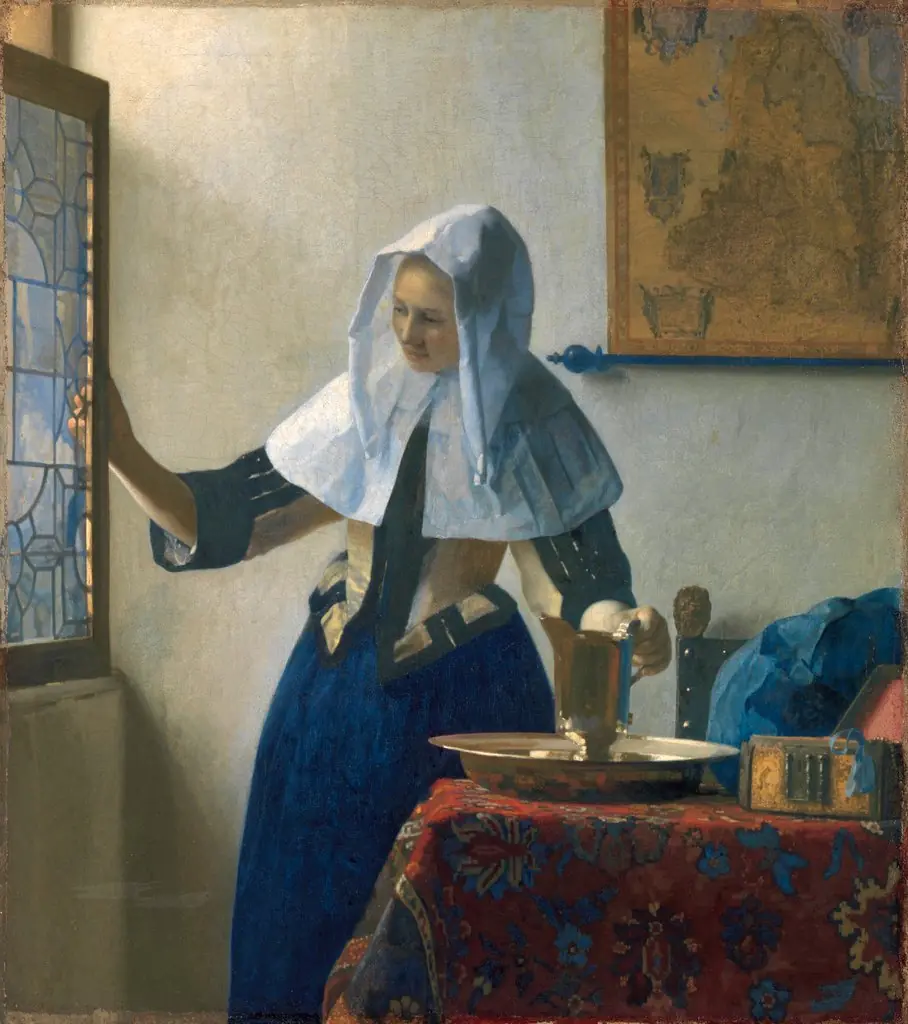
Woman Holding a Balance is held at the National Gallery of Art in Washington, D.C., as part of the Widener Collection, having entered the museum in 1942. It was exhibited at the Rijksmuseum, Amsterdam, from 11 March to 1 June 2009, alongside other Vermeer works including The Milkmaid (Het melkmeisje).
Context
Scholarship on Woman Holding a Balance has evolved significantly, notably through microscopic analysis revealing the balance's empty pans, leading to the revised title from Woman Weighing Gold. Interpretations vary widely: it has been read as a vanitas image, a meditation on divine judgment, or a call to a balanced life. The juxtaposition of the woman with a Last Judgment painting behind her and an empty balance has fueled debate on themes of earthly versus spiritual values.
Some scholars see the woman as a figure of Mary or as representing self-knowledge. The painting sold for 155 guilders in 1696, indicating its relative value among Vermeer's works. It has been exhibited alongside other Vermeers at the Rijksmuseum, underscoring its canonical status.
Legacy
The work's legacy is defined by a significant interpretive shift. Initially known as Woman Weighing Gold, microscopic analysis revealed the balance is empty, altering scholarly readings from a vanitas emblem to a meditation on divine judgment or balance. Traditional titles like Die Perlenwägerin were also abandoned as understanding evolved.
Its enduring importance is underscored by major exhibitions; in 2009 it was reunited with Vermeer's The Milkmaid at the Rijksmuseum, a pairing not seen since the 1690s.
Overview
Johannes Vermeer's painting, Woman Holding a Balance, created around 1662–1663, depicts a solitary figure engaged in a moment of quiet contemplation. Rendered in oil on canvas, this work is housed in the National Gallery of Art in Washington, DC. The central subject, a woman, stands before a table, carefully holding an empty weighing scale, inviting viewers to consider the nature of her action.
Own this work as a print
Artist & collection

Artist
Johannes Vermeer ( vər-MEER, vər-MAIR, Dutch:; see below; also known as Jan Vermeer; October 1632 – 15 December 1675) was a Dutch painter who specialized in domestic interior scenes of middle-class life.