Artwork
Woman with a Water Jug
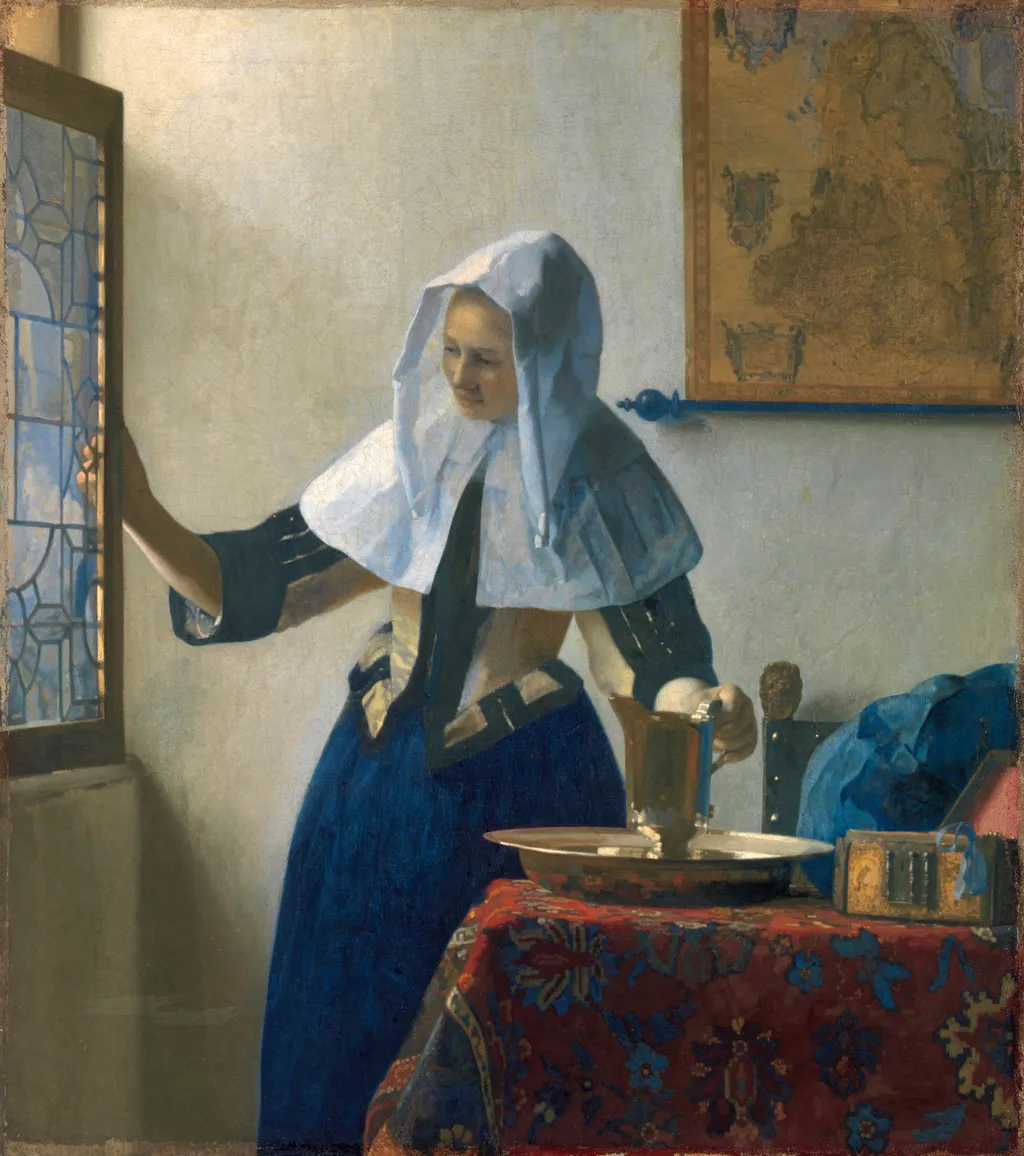
Woman with a Water Jug is an oil painting by the Dutch Golden Age artist Johannes Vermeer. It dates from 1660 and is held in the collection of the Metropolitan Museum of Art.
About this work
Technique & Style
The painting belongs to the early‑mid 1660s series in which the artist abandoned strict linear perspective and let illumination dictate the composition.
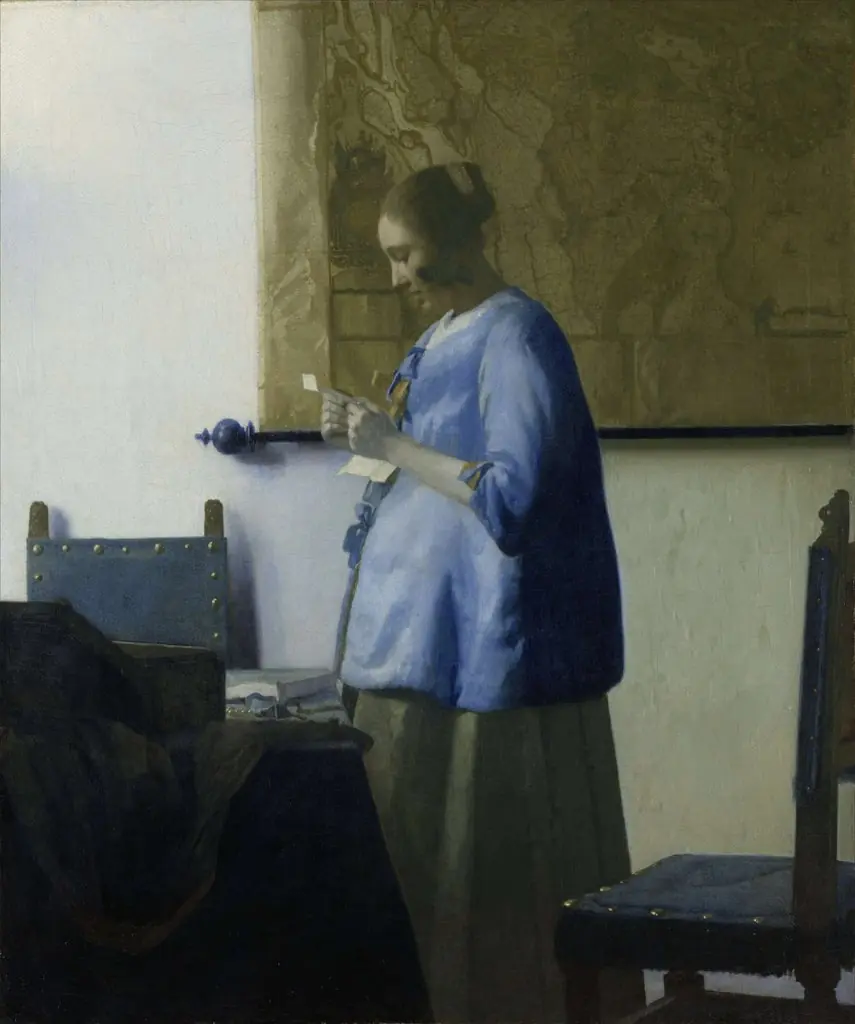
Vermeer executed Woman with a Water Jug in oil on canvas, a support noted in the work’s technical record. The painting belongs to the early‑mid 1660s series in which the artist abandoned strict linear perspective and let illumination dictate the composition. Light enters through an open window and illuminates the jug, the red‑patterned rug and the blue drapery, creating subtle colour interactions that Vermeer treated as interdependent hues.
The canvas measures 45.7 × 40.6 cm and has been part of the Metropolitan Museum of Art’s permanent collection since 1889, remaining well‑preserved. Formal features include a centrally placed young woman opening a window, a water jug resting on a larger platter, a blue‑toned interior, a map on the wall and a predominantly blue palette that unifies the scene.
History & Provenance
Painted by Johannes Vermeer, the work's creation is dated variously between 1660 and 1665, with specific estimates ranging from 1660–1662, 1662–1665, or 1664–1665. The painting remained unattributed to Vermeer until the late 19th century; it was first definitively recorded in 1877 at a Christie's auction in London, where it was misidentified as a work by Gabriel Metsu and later Pieter de Hooch. By 1878, during an exhibition at the Royal Academy in London, experts began correctly attributing it to Vermeer.
In 1887, American collector Henry Gurdon Marquand purchased the canvas at a Paris gallery for $800, still under the attribution of de Hooch. This acquisition marked the first Vermeer to enter the United States. Marquand subsequently donated the piece to the Metropolitan Museum of Art in New York City, where it has remained part of the permanent collection since 1889.
The painting Woman with a Water Jug is held in the permanent collection of the Metropolitan Museum of Art in New York. It entered the museum in 1889 as part of the Henry G. Marquand donation, following Marquand’s 1887 purchase of the work from a Paris gallery for $800; this made it the first Vermeer acquired in America. The work was first publicly exhibited at the Royal Academy in London in 1878, when it was still attributed to another artist, and has remained on view at the Met ever since.
Its provenance is documented in the museum’s catalogue, which records the acquisition and subsequent display as a cornerstone of the Met’s Dutch Golden Age holdings.
Context
Scholarship has long situated Woman with a Water Jug within Vermeer’s mature oeuvre of the early to mid-1660s, when he moved away from linear perspective toward a restrained, light-centered compositional approach. Critical reception emphasizes the work’s quietude and technical refinement, particularly the interplay of reflected blues and the symbolic resonance of the water jug as purification. The painting’s reception history is marked by erratic early attributions, initially to Gabriel Metsu and later to Pieter de Hooch, before Vermeer’s authorship was broadly accepted by 1878.
Its transatlantic trajectory began in 1887 when Henry Gurdon Marquand acquired it in Paris, making it the first Vermeer in the United States upon donation to the Metropolitan Museum of Art in 1889. Posthumous reinterpretations include Herman Braun-Vega’s Buenos Dias Vermeer (1981), which recontextualizes the composition within Cold War hemispheric critique.
Legacy
The painting’s attribution solidified after 1878, when scholars confirmed it as a Vermeer work, shaping its reputation as a key example of his late domestic scenes. Its 1887 purchase by Henry Gurdon Marquand made it the first Vermeer acquired in America, establishing a precedent for later collections. The work entered the Metropolitan Museum of Art in 1889, influencing the museum’s early modern holdings.
20th‑century scholarship highlighted its poetic handling of light and symbolic water jug, reinforcing Vermeer’s status as a master of interior illumination. Contemporary artists have referenced the composition to comment on cultural exchange, demonstrating its lasting legacy.
Overview
Johannes Vermeer's painting, Woman with a Water Jug, completed between 1660 and 1662, depicts a solitary figure engaged in a domestic moment. This oil on canvas work, measuring 45.7 by 40.6 centimeters, is a notable example of Dutch Baroque art. It is currently housed in the collection of the Metropolitan Museum of Art in New York, where it is known by several titles, including Young Woman with a Water Pitcher.
Subject & Meaning
The composition centers on a woman standing within a sunlit interior. Dressed in a blue garment and a white headscarf, she holds a large ceramic jug in her right hand while her left arm rests on a window frame adorned with stained glass. A table draped in a red, floral-patterned cloth occupies the foreground.
The natural light highlights her face and the jug, contributing to an atmosphere of quiet introspection, suggesting a moment of private thought.
Own this work as a print
Artist & collection
Artist
Johannes Vermeer ( vər-MEER, vər-MAIR, Dutch:; see below; also known as Jan Vermeer; October 1632 – 15 December 1675) was a Dutch painter who specialized in domestic interior scenes of middle-class life.