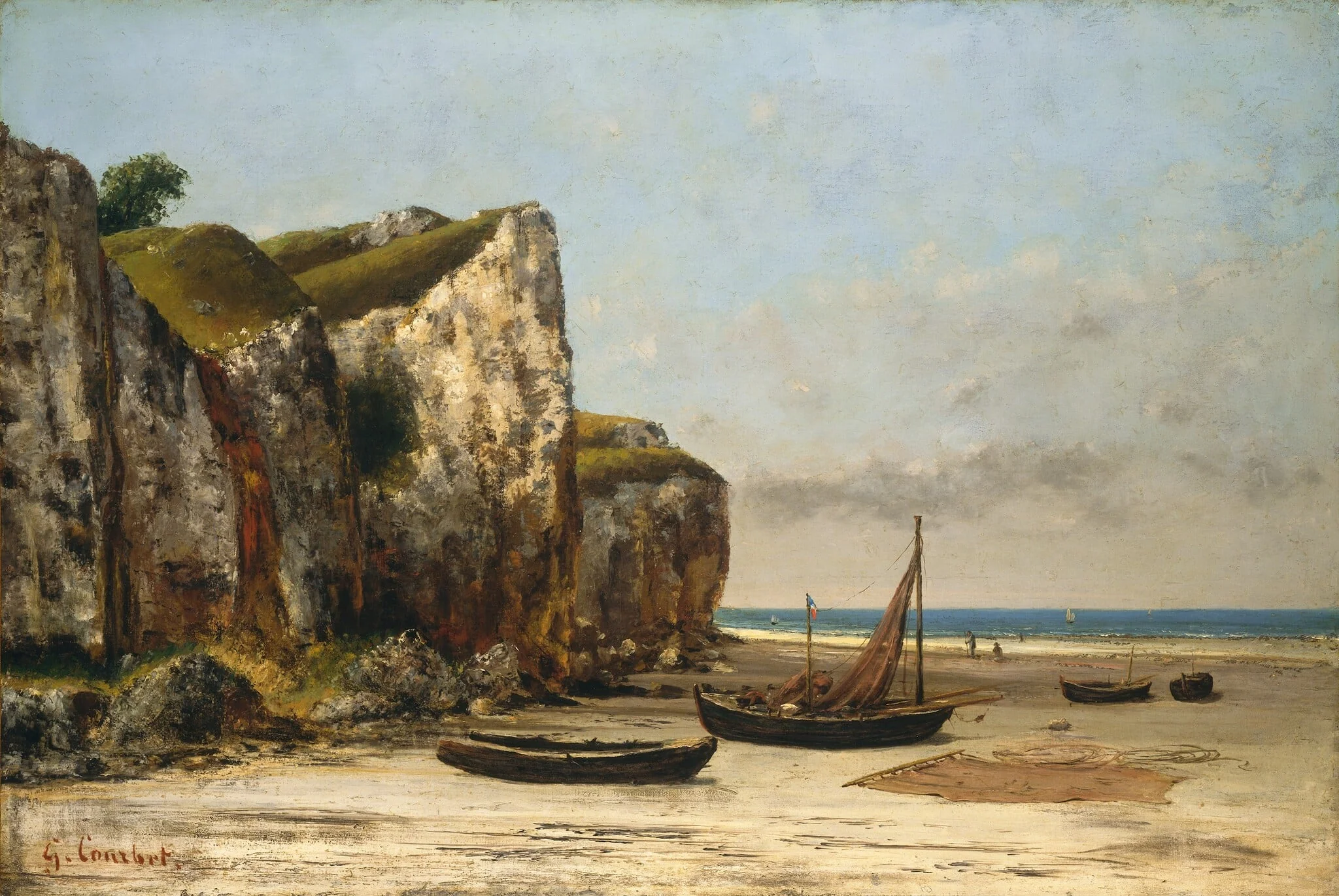
A Gustave Courbet painting announces itself first as a physical thing. Before you read the funeral, the hunt, or the bare stretch of Channel coast, you register a surface that has been built rather than described: pigment dragged with a knife, troweled into low ridges, left sitting on the weave instead of dissolving into it. The familiar account makes Courbet a revolutionary of subject matter, the man from Ornans who put village mourners and field laborers onto canvases the size of altarpieces. That is true, and it is only half the story. The break he forced on French painting happened on the surface itself, in the grammar of how paint meets cloth.
My claim is plain. Courbet's realism is a fact of paint before it is a fact of peasants. The composition flattens. The light stops behaving like a window onto deep space and starts behaving like a weight pressed against the picture plane. The handling refuses the licked, invisible finish the Salon treated as a moral good. Read his work this way and the marines, the still lifes, and the hunting pictures stop being minor footnotes to the big social machines. They become the room where the formal argument is worked out most nakedly, with the least cover from a story.
The surface as argument
Consider how the academic tradition wanted paint to behave. A history painting by a Salon master was meant to be a clear pane: brushwork smoothed away, the hand of the maker hidden, so the eye passed straight through to the subject. Finish carried a charge. A polished surface signaled discipline and idealization, the lifting of nature into something nobler than itself. Courbet attacked at exactly that point. He let the trowel show. He loaded pigment until it cast its own small shadows under raking light. The viewer's eye keeps catching on the matter of the picture, and that catch is the meaning. The painting insists it is paint, mixed and laid down by a specific man with a specific set of tools, in a specific province with grey weather and dark interiors. Look closely and you can almost reconstruct the gesture, the angle of the blade, the instant a fresh load of pigment was pressed home and pulled sideways.
The label came before the fully formed pictures. The novelist Champfleury gave the tendency its name in the 1840s, and in painting it found its example in the work of his friend Courbet, by Tate's account of the term. What that word covered, formally, was a double refusal: a refusal of the elevated subject and a refusal of the elevated surface. The two went together. You cannot paint a heavy, ordinary, present-tense world with a brushstroke designed to vanish. The matter of common life asked for matter on the canvas, and Courbet gave it. Champfleury wrote toward the new kind of picture, and the new kind of picture answered back, each confirming the other in print and on the wall.
A beach reduced to bands
Set Beach in Normandy in front of you and the lens of composition, light, and handling snaps into focus. Courbet gives the sky most of the field and lets it sit there, grey going to dirty pearl, the cloud laid in with broad horizontal pulls so the weather reads as a slab rather than a vault. The horizon runs flat and low. Beneath it the Channel is a narrow dark strip, and the beach comes forward as a wedge of wet ochre and grey-brown, scraped thin in places so the tooth of the canvas shows through. A few fishing boats are hauled up on the sand, their hulls blunt and weighted, built from a handful of decisive strokes instead of coaxed into detail. There is no anecdote, no figure inviting you into a tale. The drama is entirely tonal: how much light the sky holds, how little the sea returns it, how the sand catches a cold gleam near the waterline. Hold the eye on that gleam and you start to feel the cold of the place, the early hour, the wind that has pressed the sea down to a strip.
Notice what the composition does to space. The picture is organized as horizontal bands stacked parallel to the surface, and Courbet does almost nothing to push you back into depth. There is no framing tree, no diagonal road, no repoussoir figure in the foreground to measure the distance. The recession that a marine painter would normally engineer is simply withheld. The result is a coast that feels close, frontal, and material, pressed up against the plane. A marine in the academic sense was meant to flatter the navy or stage a storm. Courbet wanted neither. He wanted the fact of the shore. He is painting the pressure of maritime weather as a physical condition, and he does it by making the paint itself feel damp and dense. The knife that lays the sky is the same instrument a plasterer would use, and the kinship is not an embarrassment to the picture. It is the picture's honesty.
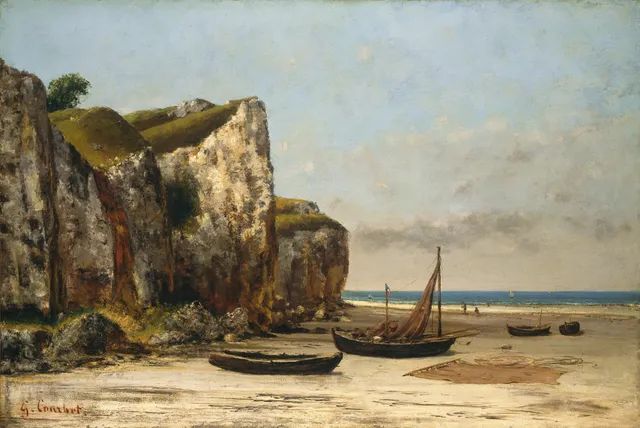
The same logic runs through the other Channel pictures. In Boats on a Beach, Etretat, the cliffs and craft are again massed as broad tonal shapes, the light overcast and even, the handling frank about its own thickness. Courbet did not go to the coast to record a view. He went to test whether a beach could be made to hold still as a built object, the way he had earlier insisted a café or a funeral could. The marine, supposedly a lighter genre, turns out to carry the heaviest part of the formal program.
What the knife knows
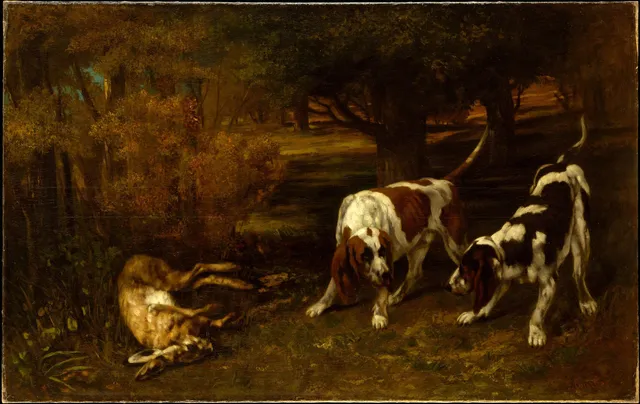
Courbet was a hunter before he was a celebrity, a man of the Franche-Comté who knew the weight of game and the look of a dog working in snow. The hunting pictures are where his handling is most carnal. Stand before Hunting Dogs with Dead Hare and watch how he builds an animal. The dogs' coats are not drawn hair by hair. They are dragged and dabbed, lighter pigment skidded over a darker ground so the fur catches a damp sheen exactly where a real flank would. The dead hare hangs as deadweight, its limpness conveyed by the way the paint slackens, thinned and pooled rather than tight and described. He is painting mass and texture as values of the medium, not as outlines filled in. Up close the marks read as nothing, smears and skids of brown and cream; step back and they cohere into wet fur and slack weight, and the trick is never quite hidden from you.
Set that beside After the Hunt. Here the trophy and the figures emerge from a deep, almost unreadable dark, and the picture trades on contrast between dense shadow and a few sharply lit passages. This dark-ground manner is Courbet's debt to the old masters he studied in the Louvre, the Spanish and Dutch painters who pulled a body forward out of brown gloom. You can read the lineage through the hubs in this collection: the tenebrism of Caravaggio, the loaded, breathing flesh of Peter Paul Rubens, the grave restraint of Diego Velázquez, and above all the way Rembrandt let a face surface from shadow as if it were being remembered. Courbet took the dark ground and stripped the piety from it. Where the old masters used the gloom for drama and devotion, he used it as a flat material condition, a brown weight against which a cold light could register.
Light pulled from the dark
The portraits make the point at intimate scale. Alphonse Promayet, a likeness of the musician who was a friend from Ornans, sets a long pale face against a near-black field. The light does not fill the space evenly. It arrives on the brow, the cheekbone, and the hand, and it dies everywhere else, so the sitter reads as a thing modeled out of darkness rather than placed within a lit room. The paint is restrained here, the surface quieter than in the hunting pictures, but the conviction is identical: light is a substance that lands on matter, not an atmosphere that fills a void. A face is what the dark gives back when paint catches it.
Then there is the great awkward machine of the early career, Young Ladies of the Village. Critics mocked its space, and the mockery is instructive, because what they read as incompetence was the formal break in plain sight. The figures of the three women sit oddly large against a landscape that seems to drop away too fast behind them. The little herd of cattle looks miniature, the scale relations refuse to resolve into a smooth, measured recession. Courbet has done to a sunny meadow what he did to the Normandy beach: he has declined to stitch foreground and distance into one seamless illusion. The picture holds its parts as discrete, frontal facts. Academic perspective is a system for making a flat surface lie convincingly, and Courbet keeps catching the lie before it completes. That is not failure. It is a different idea about what a painting owes the eye.
The manifesto and the counter-Salon
Courbet understood that a formal program needs a public stage. In 1855, when the official Exposition Universelle in Paris would not show his work as he wanted it shown, he put up his own building, the Pavillon du Réalisme, as a one-man counter-exhibition opposite the state event, and printed a realist statement in its catalogue, as the record of that gambit shows. The gesture is usually told as an episode in art politics. It is also a claim about surface and scale. He was demanding that the kind of paint he made, on the subjects he chose, deserved the wall space and the seriousness the academy reserved for myth and martyrdom. Earlier, A Burial at Ornans had recorded an ordinary provincial funeral in his hometown on the vast canvas traditionally given to history painting, and Courbet treated that picture as his manifesto, as Smarthistory frames it. The provocation was the scale married to the frankness of the handling. A real burial, life-size, painted thickly, with no one elevated into a hero.
The shape of the whole career is visible in the holdings here. Artifact World Gallery carries 175 works under Courbet's name, spread across 41 venues, a run that begins around 1840 and closes in 1877. That spread is itself an argument. A painter remembered chiefly for two or three monumental social pictures turns out, across the collection, to be overwhelmingly a maker of landscapes, marines, portraits, game, and still life. The formal break did not live in the famous machines alone. It was rehearsed and refined hundreds of times, in modest pictures where there was no scandal of subject to distract from the scandal of the paint.
Works discussed in this article
Apples behind bars
Politics caught up with the painter. During the Paris Commune of 1871 Courbet, who had argued for taking down the Vendôme Column as a monument to imperial war, was associated with its fall on 16 May of that year. When the Commune was crushed he was arrested, sentenced to six months in prison and fined, and the state later pursued him for the cost of re-erecting the column, a debt that drove him into exile in Switzerland, where he died at the end of 1877. The biographical wreck is well known. What matters for the surface is what he painted inside the cell.
Courbet spent those six months making still lifes, many of them apples, work he carried on after his release and sent to the Salon, where the jury turned it away, as the record of his life sets out. Think about those pictures as the end-state of the whole argument. Stripped of crowds, of coastline, of any subject the state could find dangerous, the painter is left with fruit on a cloth, and the radicalism is entirely in the handling. An apple becomes a small dense weight of paint, its skin troweled and flecked, its roundness a matter of how light loads onto a built lump of pigment. Earlier flower pieces had already pointed this way, among them the Bouquet of Flowers in a Vase of 1862 now in the Getty. The Salon rejected the prison apples, and the rejection is almost too neat, because it confirms the thesis from the other side. The official eye could forgive Courbet a peasant. It could not forgive him an apple painted as honestly as one. A man could be jailed for politics and still hand the jury a bowl of fruit they were unable to stomach, and the second fact tells you more about the painting than the first.
The break that held
The Metropolitan Museum credits Courbet, through the force of his realism, as a pioneering figure in the history of modernism who broke the primacy of history painting at the official Salons. The judgment is right, and the reason it is right sits in the handling more than the headlines. What he passed forward was permission: permission to let the knife show, to keep the surface frontal, to treat light as a thing that lands on matter, to organize a picture as bands and weights rather than as a polished window. Generations of landscape and figure painters who took the canvas as an object with its own crust were working ground he had already opened. You can feel his pressure even on painters far from his politics, the American observers of weather and rock such as Asher Brown Durand and John William Casilear, whose careful luminism reads as the very tradition of the dissolving, invisible brush that Courbet set out to break. Place a Courbet beach beside one of their polished vistas and the difference is not taste but doctrine, two opposed beliefs about what the eye is owed.
Go back to the beach one last time. No story, a low horizon, a sky laid in as a single grey slab, sand scraped thin enough to show the cloth. There is nothing there to argue about except the paint, and the paint is the argument. The next painters who treated a canvas as a surface with its own weather, its own thickness, its own flat refusal to be a window, were standing on ground a hunter from Ornans had already broken open with a knife.
Sources & further reading
- Realism (art term) — Tate
- Courbet and the 1855 Pavillon du Réalisme (exhibition catalogue) — Internet Archive / McMullen Museum of Art, Boston College
- Gustave Courbet, A Burial at Ornans — Smarthistory
- Gustave Courbet — Wikipedia
- Gustave Courbet (1819-1877) — The Metropolitan Museum of Art
- Bouquet of Flowers in a Vase (1862) — The J. Paul Getty Museum