Artwork
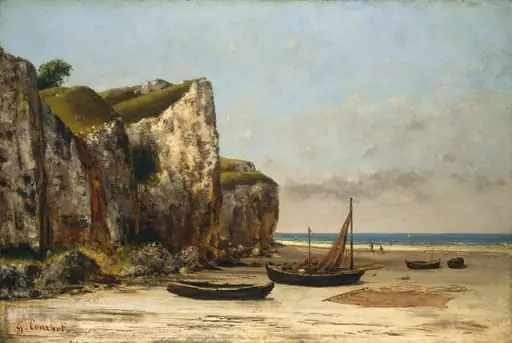
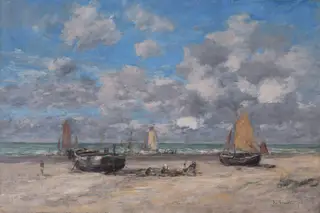
Boats on a Beach, Etretat
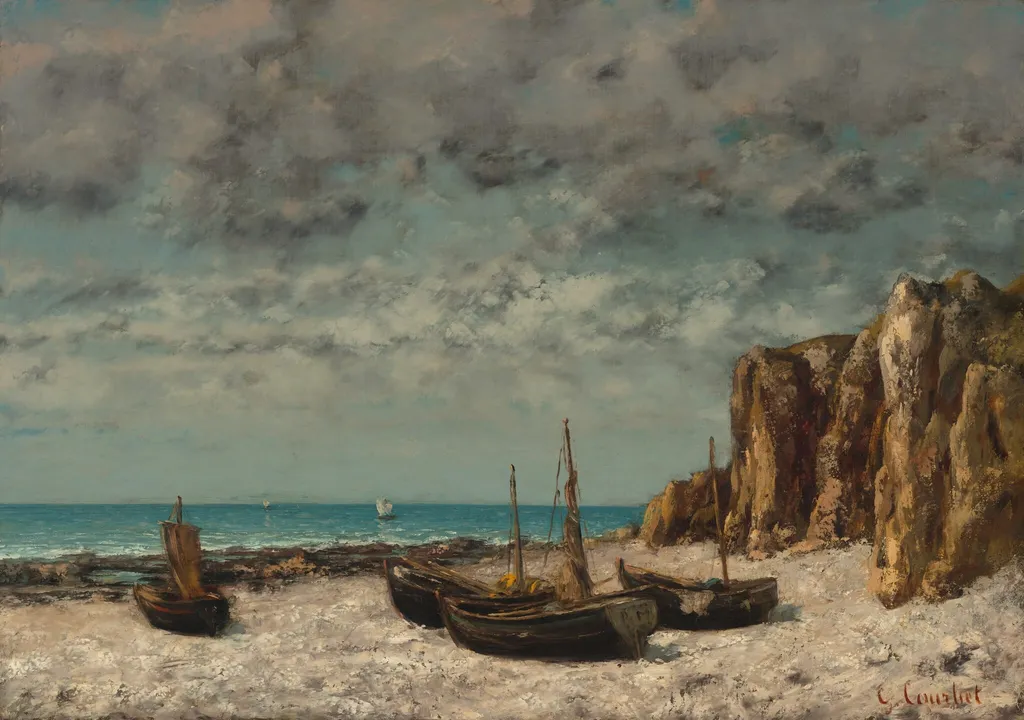
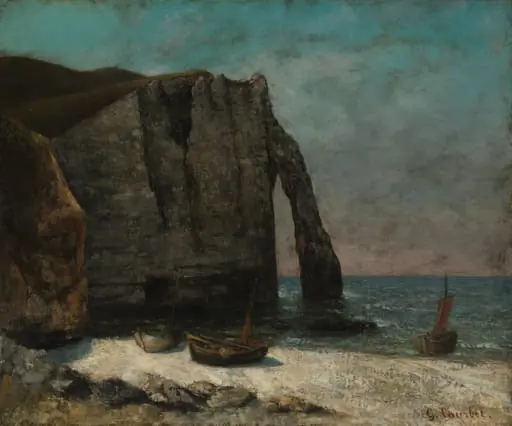
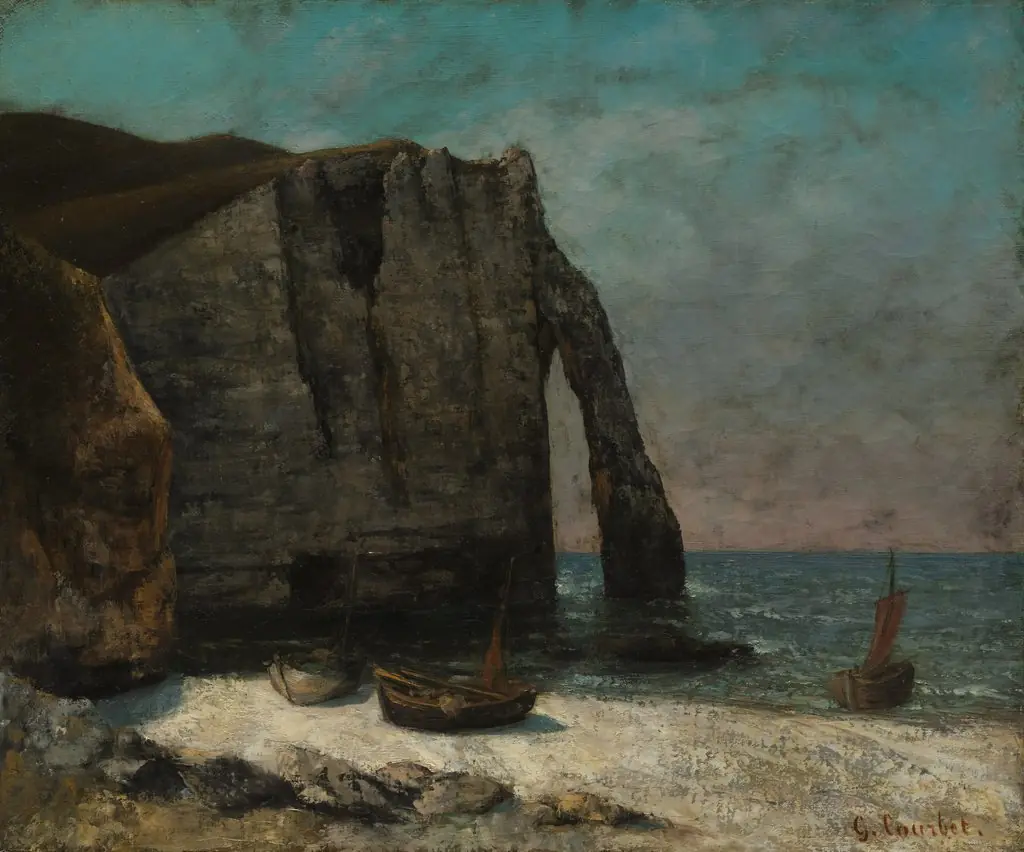
Boats on a Beach, Etretat is an oil painting by the Impressionist artist Gustave Courbet. It dates from 1874 and is held in the collection of the National Gallery of Art.
- Inscription
- Inscribed:lower right: G. Courbet
About this work
Subject & Meaning
Boats on a Beach, Étretat portrays a coastal scene at the chalk cliffs of Étretat, France, featuring several small boats drawn onto the sand beside the Porte d'Amont formation. The composition captures the fleeting interplay of sea, sky and rock, reflecting Courbet’s realist interest in ordinary maritime activity and the transient qualities of light on water. By rendering the beach and watercraft with meticulous detail, the work suggests both the everyday labor of fishermen and the poetic ephemerality of the shoreline, themes that recur in his seascapes.
History & Provenance
Gustave Courbet's 1873 oil painting, Boats on a Beach, Etretat, is currently held in the collection of the National Gallery of Art in Washington, D.
The work was painted by Gustave Courbet in 1873. By 1938 it was held in a private London collection and exhibited by Rosenberg & Helft Galleries. It moved to Paul Rosenberg and Co., New York, by 1943 and was offered for sale there.
On 10 June 1946 the painting was acquired by Marie N. Harriman and W. Averell Harriman, New York. It later entered The W. Averell Harriman Foundation, New York, and was gifted to the National Gallery of Art, Washington, D.C., in 1972.
Gustave Courbet's 1873 oil painting, Boats on a Beach, Etretat, is currently held in the collection of the National Gallery of Art in Washington, D.C. The work entered the museum's holdings in 1972 as a gift from the W. Averell Harriman Foundation. Prior to its donation, the painting was owned by Marie N. Harriman and W. Averell Harriman of New York, who acquired it on June 10, 1946. Its exhibition history includes a showing at the Rosenberg & Helft Galleries in London in 1938 and an exhibition at Paul Rosenberg & Co. in New York in 1943, where it was also offered for sale.
The painting measures 64.8 by 91.4 centimeters and depicts the Beach of Étretat, the Porte d'Amont, and watercraft.
Context
The work titled Boats on a Beach, Étretat, painted by Gustave Courbet in 1873, is an oil on canvas measuring 64.8 cm by 91.4 cm and depicts the shingle beach of Étretat with the Porte d’Amont and small watercraft. It was first shown by Rosenberg & Helft Galleries in London in 1938 and subsequently offered for sale by Paul Rosenberg & Co. in New York in 1943. The painting entered the Harriman collection through a 1946 purchase by Marie N. Harriman and W. Averell Harriman, later passing to the W. Averell Harriman Foundation before being gifted to the National Gallery of Art in 1972, where it remains on display in Washington, D.C.
Overview
Painted in 1874, Boats on a Beach, Etretat captures a maritime scene at the Normandy coast during Gustave Courbet's final years. The composition centers on two small fishing vessels hauled onto a pebbly shore, positioned against the imposing backdrop of the Porte d'Amont chalk cliffs. Courbet employs his characteristic realist approach, rejecting idealized landscapes in favor of a direct, tactile engagement with the physical environment.
The artist utilizes heavy impasto, applying thick layers of oil paint to render the rough textures of the boat wood, the wet stones, and the churning sea with palpable density. This technique emphasizes the material reality of the scene, inviting the viewer to sense the weight and resistance of the elements. Created shortly before the artist's death, the work reflects his enduring commitment to depicting the natural world without romantic embellishment.
It stands as a significant example of his late coastal studies, where the rugged geology of Étretat serves not merely as a setting but as a dominant, almost sculptural presence. The painting demonstrates Courbet's mastery in translating the raw energy of the French coastline into a dense, textured surface that bridges the gap between observation and physical sensation.
Technique & Style
Courbet employed a distinctive technique to render the tactile qualities of the scene. He applied paint thickly, a method known as impasto, to create a palpable sense of texture for elements such as the weathered wood of the boats, the wet stones on the beach, and the impression of a wild sea. This approach enhances the painting's physical presence, while the depiction of light suggests a raw, almost stormy atmosphere, further contributing to the unvarnished realism.
Own this work as a print
Artist & collection
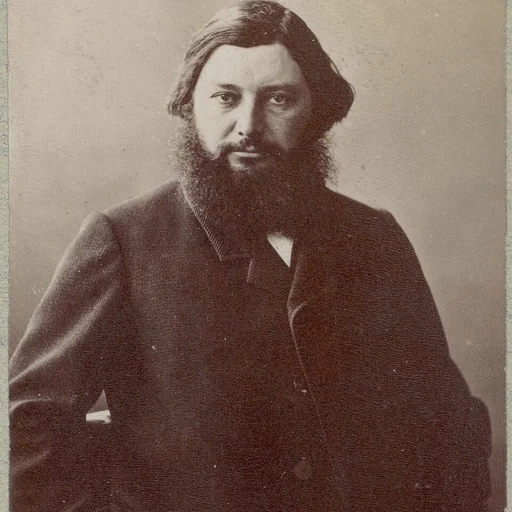
Artist
Jean Désiré Gustave Courbet (UK: KOOR-bay; US: koor-BAY; French:; 10 June 1819 – 31 December 1877) was a French painter who led the Realism movement in 19th-century French painting.