Artwork
Beach in Normandy
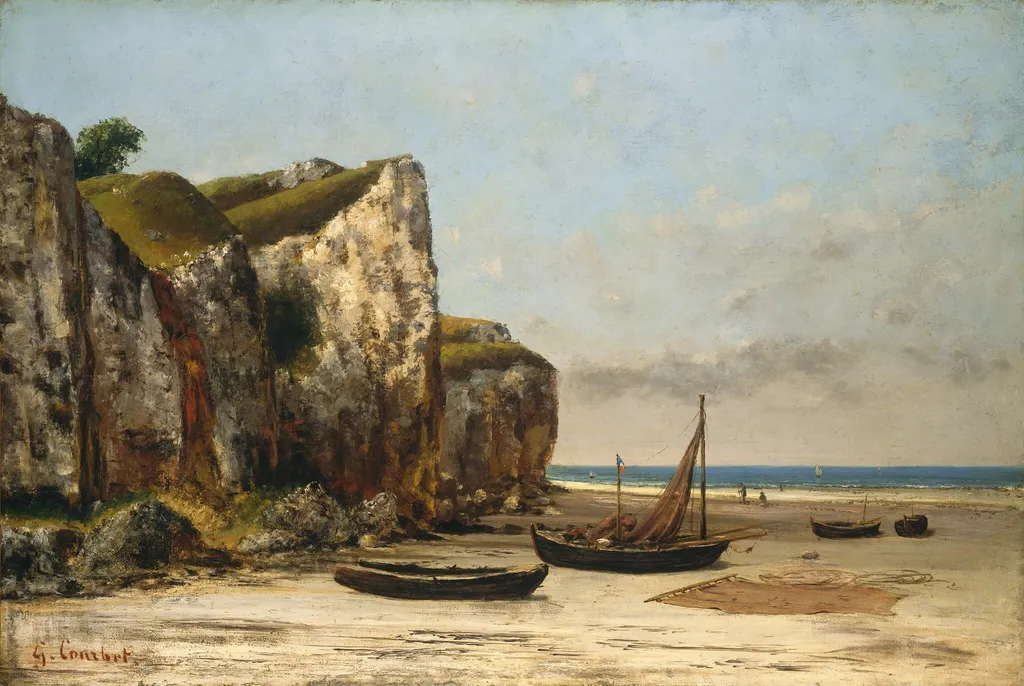
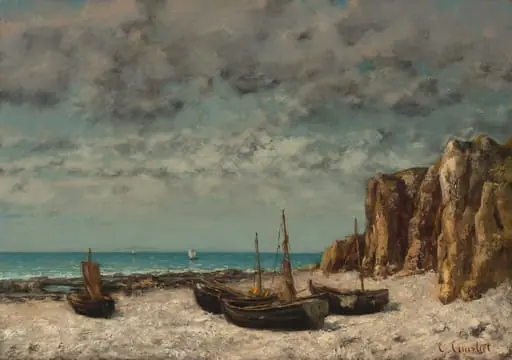
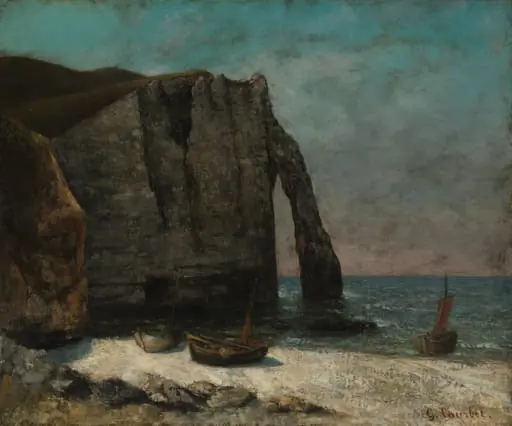
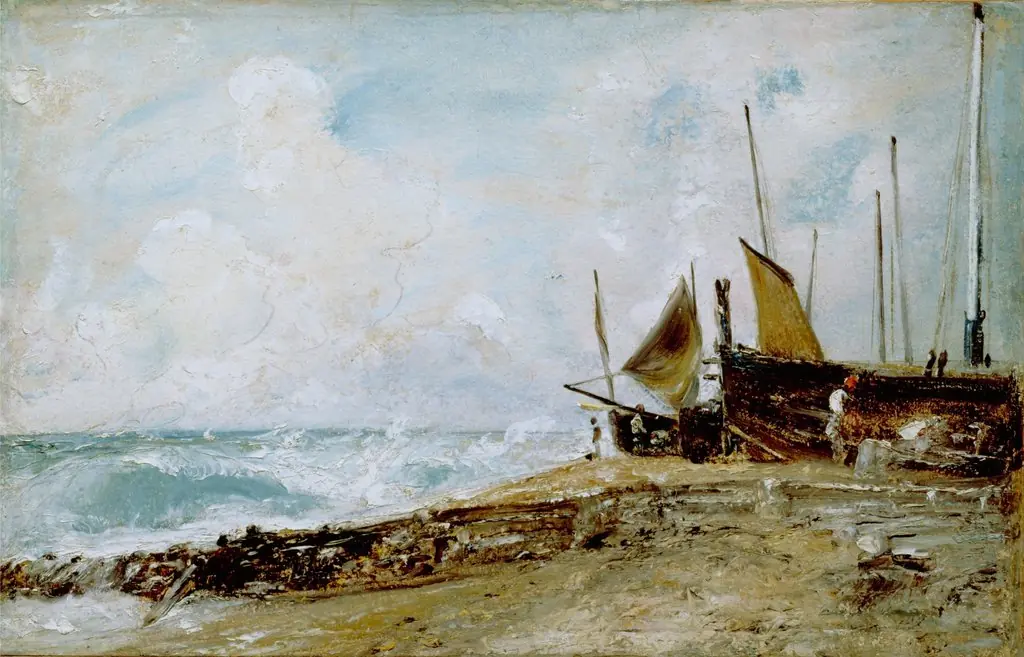
Beach in Normandy is an oil painting by the Impressionist artist Gustave Courbet. It dates from 1874 and is held in the collection of the National Gallery of Art.
- Inscription
- Inscribed:lower left: G. Courbet.
About this work
Sheer cliffs loom over a sunlit beach scattered with boats, the palette-knife surface catching light like the Normandy coast. Gustave Courbet painted the view around 1872 to 1875, likely in his studio from earlier sketches made at Étretat. Chester Dale gave the canvas to the National Gallery of Art in 1963.
Subject & Meaning
Gustave Courbet's Beach in Normandy (1874) depicts the coastline near Étretat, showing cliffs, a sandy beach, a fishing vessel, and the English Channel under a broad, cloud-filled sky. As a marine painting from the artist's late career, the work exemplifies Courbet's Realist commitment to direct observation of nature, avoiding idealization or overt narrative. The inclusion of a fishing boat suggests the everyday maritime life of the region, while the expansive sea and sky emphasize the natural grandeur of the Normandy coast.
The painting's meaning resides in its faithful recording of a specific locale, a characteristic focus of Courbet's seascapes, which sought to capture the unadorned beauty of the French shoreline.
History & Provenance
The work later entered the inventory of Galerie Jacques Dubourg, Paris, which sold it on 18 July 1952 to Chester Dale of New York.
Gustave Courbet painted Beach in Normandy in 1874. The painting's earliest known appearance is at the M. F. sale at Hôtel Drouot, Paris, on 27 May 1891 (lot 18, as Marine). It next belonged to a collector recorded as either Delafond or Delafons.
The work later entered the inventory of Galerie Jacques Dubourg, Paris, which sold it on 18 July 1952 to Chester Dale of New York. Dale bequeathed the painting to the National Gallery of Art in 1963, where it remains. Neither the sources nor the known record indicate a commission; the work appears to have been created for the open market.
Overview
Gustave Courbet's Beach in Normandy depicts a dramatic coastal scene, featuring towering cliffs that dominate the left side of the composition. Below, a sunlit beach is dotted with small boats, suggesting human activity against the powerful natural backdrop. This oil on canvas work, executed between approximately 1872 and 1875, exemplifies Courbet's engagement with landscape subjects and his distinctive approach to rendering natural forms.
Technique & Style
Courbet's mature technique is evident in this work, particularly in his application of paint. He employed a palette knife to lay down thick impasto, especially on the cliff face, creating a highly tactile and almost sculptural surface. This method imparts a tangible weight and texture to the depicted forms.
Such a robust, direct approach often challenged the refined sensibilities of academic critics, yet it inspired a bolder stylistic direction for artists like Édouard Manet.
Context
While earlier National Gallery of Art catalogues identified this work as Beach at Étretat, contemporary scholarship places its creation between 1872 and 1875. This later dating is supported by observations that the painting's atmospheric qualities and generalized rendering of the cliff lack the directness characteristic of Courbet's immediate outdoor studies. It suggests the artist developed the scene in his studio, likely drawing upon the detailed sketches he made during his earlier visits to the Normandy coast.
Own this work as a print
Artist & collection
Artist
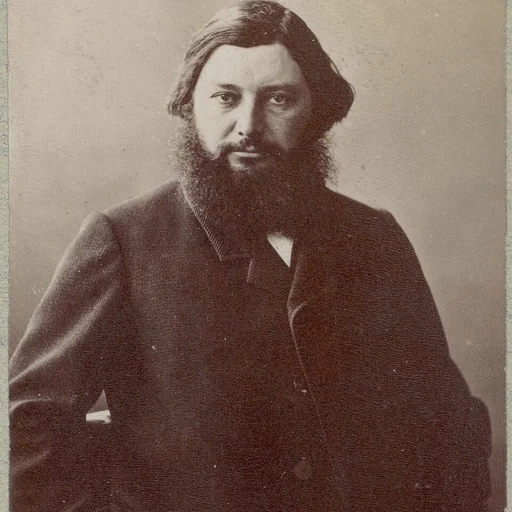
Jean Désiré Gustave Courbet (UK: KOOR-bay; US: koor-BAY; French:; 10 June 1819 – 31 December 1877) was a French painter who led the Realism movement in 19th-century French painting.






 Compared in the Color & Light course