Artwork
Young Ladies of the Village
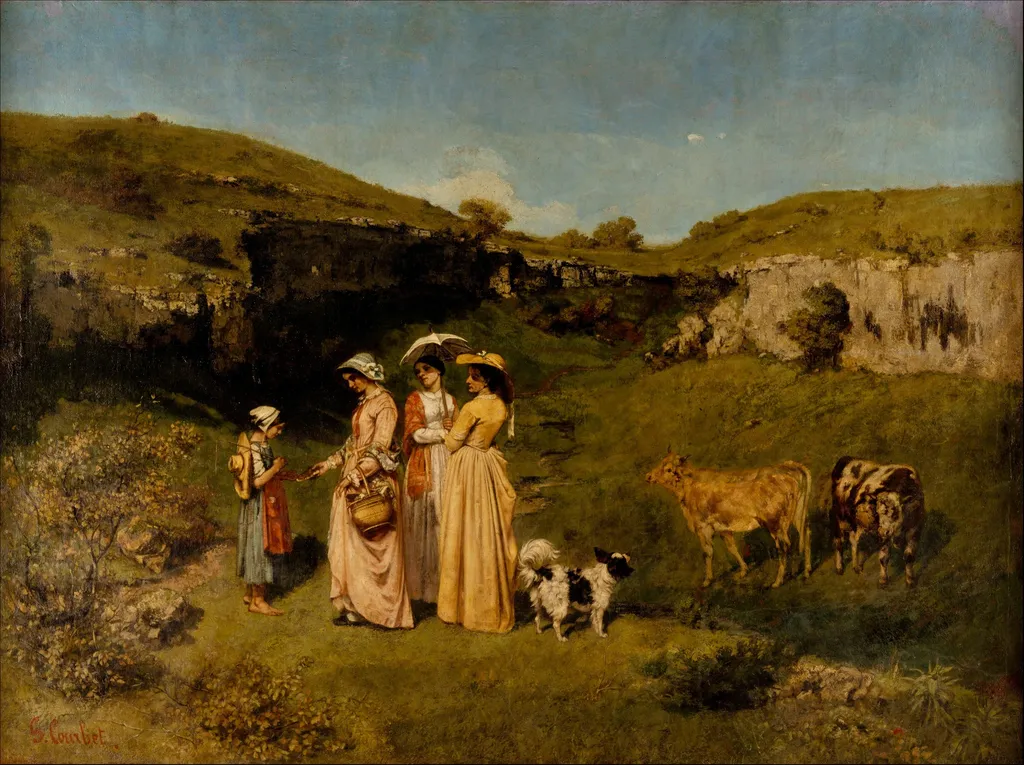
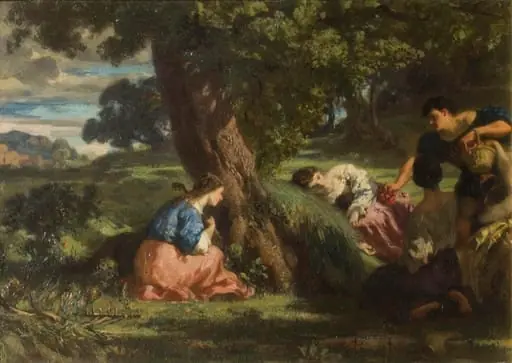
Young Ladies of the Village is an oil painting by the Academic Art artist Gustave Courbet. It dates from 1851 and is held in the collection of the Metropolitan Museum of Art.
About this work
Zelie Courbet offers bread to a barefoot cowherd while her sisters Zoe and Juliette wait nearby in a rocky valley outside Ornans. Gustave Courbet painted his own sisters in 1851 on a canvas nearly two meters high, dressing them in dated, un-crinolined costumes that Salon critics mocked as countrified and ugly, along with the dog and the undersized cattle.
Subject & Meaning
The painting shows three young women, modeled after Courbet's sisters Zoé, Zélie and Juliette, offering food to a barefoot peasant girl while one holds a parasol; a dog stands behind them and two cows graze to the right in a hilly Ornans landscape under a bright sky. The dog has been read as a symbol of the arrogant middle class, the calves as emblematic of the oppressed peasantry poised for revolt, and their tense gaze underscores a class struggle. The work reflects the fraught politics of the late Second Republic, presenting the republican Franche-Comté as a potential threat to bourgeois city-dwellers and serving both as a moral image of charitable generosity and as a deliberate provocation that signaled Courbet's emerging political engagement.
Technique & Style
Stylistically, the work rejects academic conventions, abandoning the high level of finish and glossy, sentimental aesthetic typical of the period.
Gustave Courbet executed Young Ladies of the Village using oil paint on canvas, with the composition signed in red or orange at the bottom left. Stylistically, the work rejects academic conventions, abandoning the high level of finish and glossy, sentimental aesthetic typical of the period. Critics like Théophile Gautier noted this lack of finish, considering the canvas under-finished.
The painting also flouted traditional rules of perspective; contemporary critics argued the figures were disproportionately small relative to the cows, rendering the women incongruously diminished. Courbet amplified the format and line, creating a large-scale work measuring 194.9 by 261 centimetres. A preparatory sketch reveals he reorganized the composition, moving the figures forward from a vegetation-dominated landscape to the final, more spatially ambiguous arrangement.
History & Provenance
The work was created in 1851 and painted for presentation at the Paris Salon of 1852, where it debuted under the title The Village Maids give alms to a cowherd in a valley near Ornans. After its debut the painting was purchased by the duc de Morny, resold at the Hôtel Drouot in 1878 for 5,000 francs, exhibited by Paul Durand-Ruel in New York in 1906, and acquired from Harry Payne Bingham in 1940 by the Metropolitan Museum of Art, where it remains. A preparatory sketch from 1851 is held at Leeds Art Gallery.
Context
Young Ladies of the Village provoked immediate controversy at the Salon of 1852, with critics such as Théophile Gautier, Gustave Planche, Eugène Loudun, and Louis Énault attacking its perceived unfinished surface, its flouting of perspective through the smallness of the figures relative to the cattle, and the portrayal of the women as "rather ugly" and incongruously dressed. Renewed criticism followed its display at the 1855 Exposition universelle, where the depiction of provincial women in Parisian fashion unsettled viewers. According to scholar Michael Fried, the painting stands among Courbet's "breakthrough canvases," part of a deliberate strategy to arouse scandal comparable to the impact of A Burial at Ornans.
The hostile reception is read against the political climate of the late Second French Republic: the Franche-Comté, Courbet's republican homeland, embodied a rural constituency that wealthy Parisian bourgeois viewers preferred to ignore. Some interpreters see the work as the inception of Courbet's political engagement and a meditation on class struggle, while others view it as a distanced restatement of the charity archetype, set against the polished finish of academic and Catholic aesthetics.
Legacy
Upon its 1852 Salon debut, the painting ignited immediate controversy, with critics like Théophile Gautier deeming it unfinished and others condemning its perspective and figures as ugly. This hostile reception, which continued at the 1855 Exposition universelle, stemmed from the work's unidealized portrayal of rural life and class tensions. Art historian Michael Fried later identified the canvas as a deliberate breakthrough in Courbet's strategy to provoke scandal, generating discourse comparable to his Burial at Ornans.
Some scholars interpret the tense interaction between the ladies' dog and the grazing calves as an early manifestation of Courbet's political engagement and depiction of class struggle. The work eventually entered the American market via dealer Paul Durand-Ruel in 1906 before being acquired by the Metropolitan Museum of Art in 1940.
Overview
Gustave Courbet's Young Ladies of the Village, an oil painting from 1851–52, portrays three women in a rural setting. This large-scale work, now housed at the Metropolitan Museum of Art, features the artist's own sisters in a scene set near his hometown. The canvas, signed by Courbet, was first exhibited in 1852, drawing considerable attention and critical commentary for its unconventional depiction of everyday life.
Own this work as a print
Artist & collection
Artist
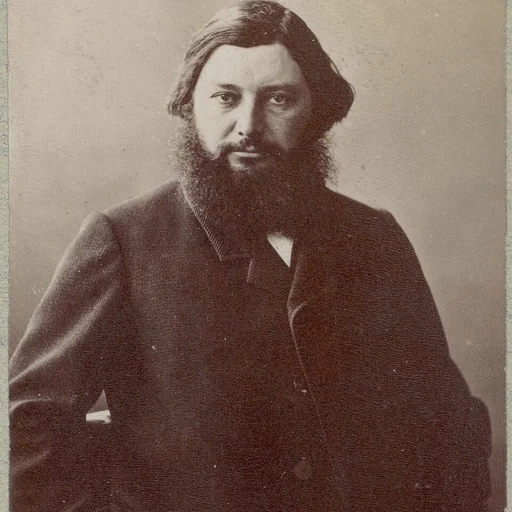
Jean Désiré Gustave Courbet (UK: KOOR-bay; US: koor-BAY; French:; 10 June 1819 – 31 December 1877) was a French painter who led the Realism movement in 19th-century French painting.