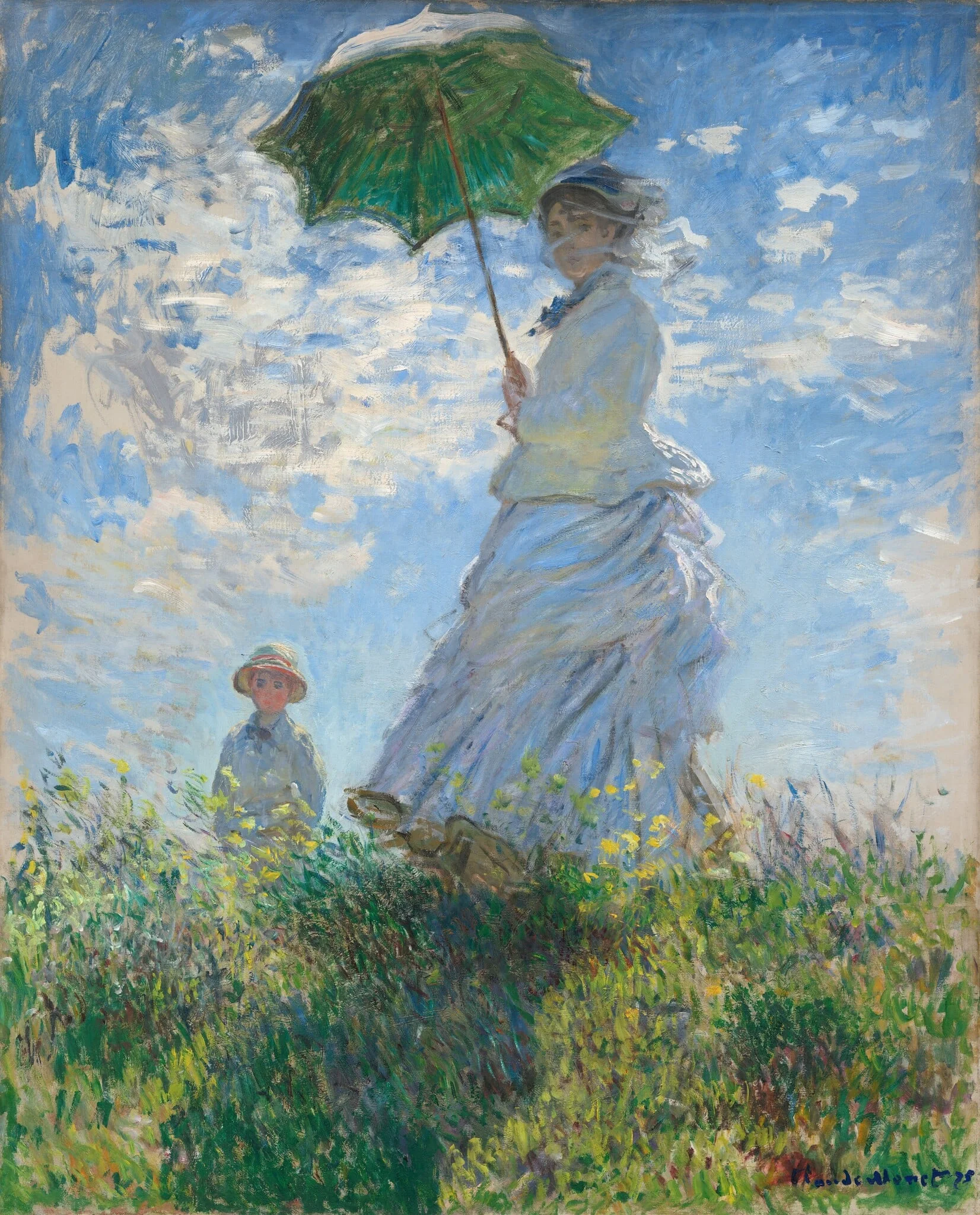
The quickest way into the art of Claude Monet's paintings is to stop treating him as the painter of pretty gardens and stand in front of one canvas long enough to watch it come apart. Pick the 1875 picture of his wife and small son on a windy hillside. Everything Monet would chase for the next fifty years is already settled in it: the figure surrendered to weather, the light treated as the actual subject, and the paint laid down fast enough to keep a moving afternoon from escaping. He is not recording a person on a walk. He is recording an hour of air, with a person standing inside it.
That is the argument here. Monet did not slowly discover his subject across a long life. He found it early, fixed it in a handful of mid-1870s pictures, and then spent decades testing how far it could be pushed before a painting stopped being a view and turned into pure sensation. The late water-lily walls in Paris are not a break from the young man's beaches and riverbanks. They are the same idea with the horizon taken away. Read the early work closely and the famous late work stops being mysterious. You can see the whole career rehearsed in a figure under a parasol. The Metropolitan Museum's account of his life runs from a Le Havre boyhood to the pond at Giverny as one unbroken line of inquiry, and that continuity is exactly what the canvases confess if you let them. (Met, Heilbrunn)
One painting, the whole program
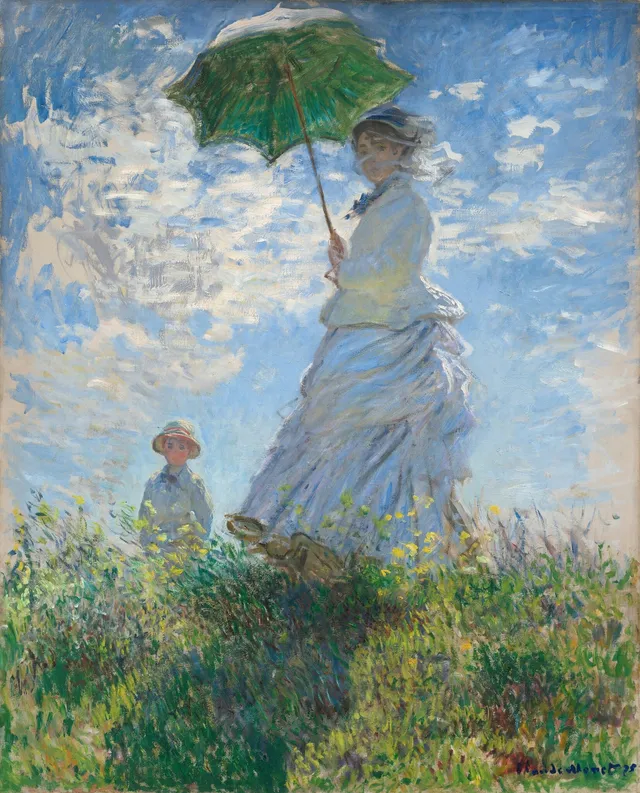
Stand close to Woman with a Parasol. Camille Monet stands on a rise and is seen from below, so she reads against the sky rather than against the ground. The viewpoint is the first decision, and it is a strange one. Monet drops his easel low and tilts his sightline up, which turns a casual stroll into something monumental and faintly unstable, as if she might step off the edge of the slope and into the clouds. Her parasol throws a green shadow down over her face, and he refuses to correct it. The face is barely a face. A veil blurs it further. He cares more about the blue-green light bouncing up from the grass onto her jaw than about any expression she might be wearing.
The wind does the real compositional work. Her white dress billows left, her scarf streams the same way, and the grass at her feet leans with it, all of it stroked in long diagonal marks that never resolve into single blades. Red and yellow flecks sit in the green, flowers implied rather than drawn. Lower and to the right, her son Jean stands half-sunk in the rise, smaller and quieter, almost an afterthought, present mainly to give the hill a measurable depth the rest of the picture spends its energy denying. The clouds behind her are not a calm backdrop. They are scrubbed in with visible haste, the same paint quality as the dress, so that woman, cloth, grass, and sky all belong to one continuous skin of pigment. Trace any single passage and you lose the thing it describes, because no edge in the painting is allowed to harden into an outline.
A conventional portrait would have pinned Camille's features and let the landscape recede politely behind her. Monet does the reverse. He dissolves the person into the conditions around her and lets the light win the contest. He worked at speed, and the clock is legible in every mark. This is my point about the whole career in miniature: the painting is not about a woman, and it is not about a hillside. It is about a single passing state of weather that happened to have his family in it. The wager is that a brush moving as fast as the wind can hold an instant the human eye is too slow to keep, and the canvas is the proof he won the bet.
Where he learned to look
Monet did not arrive at this instinct alone. As a teenager in Le Havre, known locally for sharp caricatures, he fell in with the marine painter Eugène Boudin, who painted skies and beaches outdoors and who, by the National Gallery of Art's account, talked the reluctant young man into working directly from nature. (NGA, Claude Monet) Boudin's lesson was simple and permanent. The sky is the event. Weather changes by the minute, and no studio can fake the change. The Dutch painter Johan Jongkind sharpened the same habit a few years later, teaching Monet to register the broken, shifting light on water before it moved on. Between the two of them, the young painter was handed his whole future subject before he was twenty, and he never traded it for anything more respectable.
You can watch the training take hold in Garden at Sainte-Adresse of 1867. Monet sets a flowered terrace high in the frame and pushes the sea and sky into stacked horizontal bands, a flattening borrowed straight from the Japanese prints then arriving in France. Two flags snap in the breeze, the seated figures barely move, and the whole scene is organized for clarity of light rather than depth. The red gladioli at the left burn against the blue water with no transition between near and far, because Monet wants the surface to read as a pattern of color before it reads as a place. The companion Regatta at Sainte-Adresse turns the same coastline into a study of sails and chop, the boats tipped at the angle of a fresh wind, the water cut into short facets of green and white. These are not yet dissolved pictures, but the priorities are already set. He is sorting the world by its light, not by its stories.
The summer the brush broke open
The decisive change came in 1869 at a riverside bathing and boating spot on the Seine, where Monet set up beside Renoir and the two painted the same scene. La Grenouillère is the moment his touch stops describing things and starts standing in for them. The water is built from short, blunt horizontal dabs of slate, white, and bottle-green, laid side by side so the eye assembles the shimmer that the brush never literally draws. A little round island, nicknamed the camembert, anchors the middle. Bathers and boaters become quick vertical ticks of paint, weightless and provisional. The moored rowboats in the foreground are the most solid things present, and even they are summarized in a few loaded strokes rather than drawn. Nothing is finished in the academic sense, and that is the discovery. A surface of separate strokes can carry the sensation of flickering light more honestly than a smooth, blended one.
This put Monet at odds with the painting his elders prized. Gustave Courbet had built a realism out of solid, palpable matter, and Jean François Millet had given peasant labor the weight of scripture. Monet kept their commitment to ordinary modern life and threw away the solidity. His near contemporary Edouard Manet was running a parallel revolt inside the figure painting of the Salon; Monet ran his out of doors, in front of the river, where the motif would not sit still. The Tate's definition of the movement that grew out of this work puts the emphasis exactly where Monet put it, on the fleeting effect of light and the open, unblended mark. (Tate)
An insult that became a banner
In 1874 Monet and a group that included Pissarro and Degas refused to keep begging the official Salon for room and mounted their own show, organized under the deliberately dry corporate name Société Anonyme des Artistes, Peintres, Sculpteurs, Graveurs. (Getty Museum) One Monet canvas there, a fog-bound view of the harbor at Le Havre called Impression, Sunrise, drew particular ridicule from a hostile press, and a critic's sneer at the word impression handed the whole circle the label it would carry forever. (Tate) The picture is little more than a smoky orange sun and its broken reflection over a gray-blue port, the boats reduced to shorthand, and that thinness was exactly the provocation. Smarthistory's reading of the canvas makes the case that the apparent slightness is the whole content: a record of a particular light at a particular minute, painted as if the minute were about to end. (Smarthistory)
Works discussed in this article
The cliff, and the instinct for series
By the 1880s Monet was working the Normandy coast for motifs sturdy enough to be painted over and over. The Manneporte near Étretat fixes on the largest of the chalk arches there, a giant rock leg striding into the sea. Monet frames it so the arch nearly fills the canvas, with a wedge of bright water and sky showing through the opening. The cliff is built from dragged, crusted strokes that catch the salt glare; the water below is restless, stroked in broken greens and violets that refuse to settle. He plays the bulk of the rock against the weightless light pouring through the gap, and the scale reads as immense precisely because he gives you no tidy foothold in the foreground. There is no path, no boat, no figure to measure against, only the wall of chalk and the sea working at its base.
The cliff matters beyond its drama because it taught Monet the method that defines his last forty years. If a motif holds its shape, the painter can return to it at different hours and in different weather and let the changing light become the real subject across a whole sequence. That instinct produced the great series that followed: grainstacks, poplars, the cathedral front at Rouen, and finally the water garden at Giverny. Each is the parasol idea industrialized. One stable thing, painted again and again, so that light can be studied as it moves. The cathedral at Rouen, painted some thirty times from the same window, is the figure under the parasol stripped of the figure, the stone standing in for Camille as the fixed object across which weather is timed.
The scale of the surviving output is part of the story. Artifact World Gallery alone holds 439 works under Monet's name, spread across 52 separate venues and spanning roughly 1850 to 1926, which is to say the better part of his entire working life is scattered through dozens of museums on several continents. That dispersal is itself a verdict. The painter the press mocked in 1874 lived to see his pictures hung as the standard of modern French painting, and by the time he died in 1926 the studio at Giverny had become a place of pilgrimage rather than a joke. (Wikipedia) A major retrospective volume assembled long after his death runs to hundreds of plates and still cannot fit the whole sequence between two covers. (Internet Archive) No single city owns him, because in the end nearly every serious collection wanted a share of the light.
He could turn the same eye on the city. Landscape: The Parc Monceau takes a fashionable Paris park and treats its lawns and trees the way he treated the riverbank, with sunlight breaking through the canopy in loose patches and the strollers reduced to a few warm dabs. The park is groomed and bourgeois; the painting is not. It is the looser, faster Monet of the open coast, brought back inside the city walls and aimed at dappled shade. The trees are not described leaf by leaf. They are massed as zones of green that brighten and darken with the moving sun, and the people beneath them are incidents of color, there to be touched by light rather than to be portrayed.
What the late walls inherit
Put the early and late work in the same room and the supposed gulf between them closes. The water-lily panels that fill a pair of oval rooms in Paris are often described as the moment Monet finally let go of the world and painted pure abstraction. Look at the paint instead of the legend and you find the riverbank from 1869 enlarged to the size of a wall. The same broken horizontal dabs that built the shimmer at La Grenouillère build the reflected sky on the Giverny pond. The same refusal to give the eye a hard edge governs both. What changed is the scale and the nerve, not the method. Monet removed the far bank, removed the horizon, and turned the surface of the water into the entire field of vision, so that the viewer stands where the sky and the pond meet with nothing to hold onto.
The figure followed the same logic toward the vanishing point. After Camille died young, Monet returned to the parasol motif with a different model, the face this time turned away entirely, the body even more anonymous, the light even more clearly the point. He kept circling the same problem because he had identified it correctly the first time. A painting can hold a single instant of changing weather if the brush moves as fast as the light does. From the harbor fog at Le Havre to the arch at Étretat to the pond at Giverny, that is the through-line, and it runs straight back to a windy afternoon and a green shadow on a woman's cheek.
Back to the parasol
Return now to Camille on her hill. She is the key the whole career turns on. Everything Monet built afterward, the cliffs, the cathedrals, the grainstacks, the lilies, is an attempt to do to a fixed object what the wind already did to her dress, to make a solid thing read as a passing condition of light. The young painter who tilted his easel up at his wife was not warming up for the real work. He was already doing it, in the most concentrated form he would ever find. The rest is the same sentence said louder.
If you want to test the claim, do it with your own eyes rather than mine. Find the parasol picture, then find a late water-lily panel, and look at the paint, not the date. The marks are cousins. The young man on the riverbank and the half-blind old man stooping over his pond were solving the same equation, and the answer was always the same: catch the light before it changes, and let everything else go.
Sources & further reading
- Impressionism (art term) — Tate
- Claude Monet's Impression, Sunrise — Smarthistory
- Claude Monet (biography) — National Gallery of Art
- Claude Monet (person record) — The J. Paul Getty Museum
- Claude Monet (1840-1926) — The Metropolitan Museum of Art, Heilbrunn Timeline of Art History
- Claude Monet — Wikipedia
- Monet: A Retrospective (1986) — Internet Archive (Park Lane / Crown Publishers)