Artwork
Garden at Sainte-Adresse
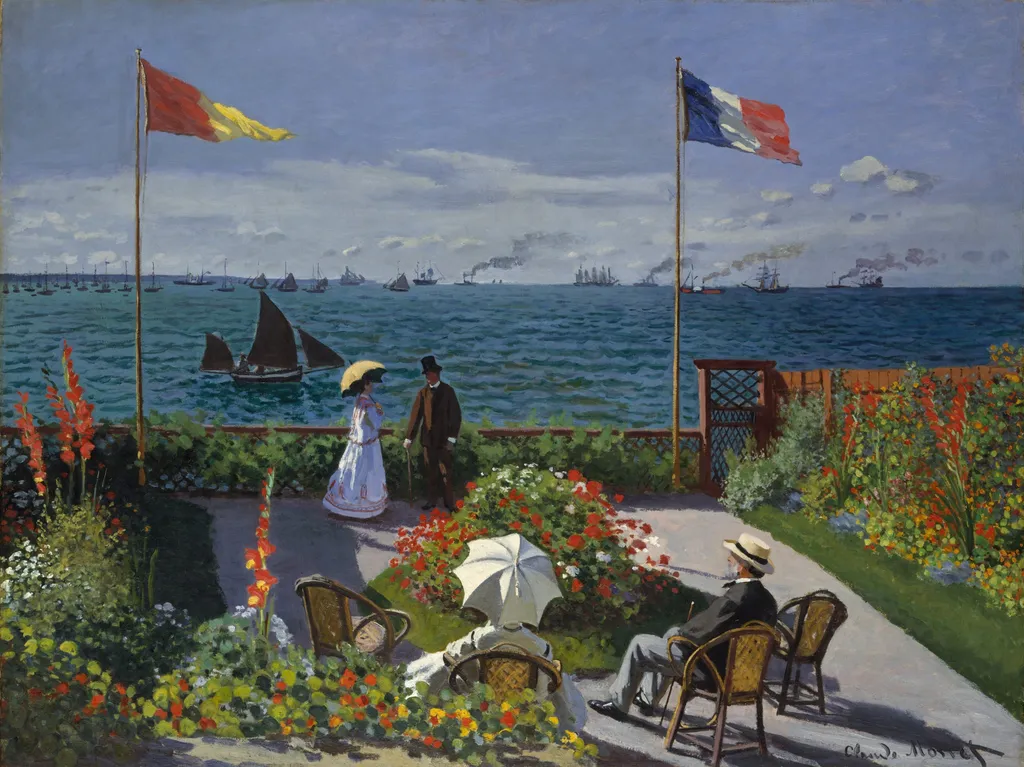
Garden at Sainte-Adresse is an oil painting by the Impressionist artist Claude Monet. It dates from 1867 and is held in the collection of the Metropolitan Museum of Art.
About this work
Subject & Meaning
Blooming flowers, garden chairs, a parasol, and two flagpoles, one flying the French tricolor, anchor the scene.
The painting depicts a sunlit garden terrace in Sainte-Adresse overlooking the English Channel, with four figures enjoying the seaside: traditionally identified as Monet's father Adolphe (seated), his cousin's wife Jeanne-Marguerite Lecadre (standing at the fence), and possibly other relatives. Blooming flowers, garden chairs, a parasol, and two flagpoles, one flying the French tricolor, anchor the scene. Although the composition suggests affluent domestic leisure, Monet's relationship with his father was tense that summer due to disapproval of his liaison with Camille Doncieux.
The work also reflects Japanese woodblock print influence, as Monet called it 'the Chinese painting in which there are flags,' and its three flat horizontal bands of color emphasize two-dimensionality, blending realism with decorative abstraction.
Technique & Style
Claude Monet executed Garden at Sainte-Adresse in oil on canvas, measuring 98.1 × 129.9 cm (38.6 × 51.1 in). The work combines smooth, traditionally rendered areas with rapid, separate brushstrokes and spots of pure color, characteristic of Monet's emerging Impressionist technique. The composition is divided into three dominant horizontal bands, terrace, sea, and sky, which, combined with the elevated vantage point, emphasize the painting's two-dimensionality and reflect the influence of Japanese woodblock prints.
Strong horizontal, vertical, and oblique lines (such as the flagpoles and the ruler-straight diagonal of the terrace edge) create a balanced, almost symmetrical structure. Shadows cast from a low afternoon sun fall as broad blue-gray streaks, and Monet's signature appears in the shadow of a chair. Contours are generally sharp except for the indiscernible faces, and the palette employs realistic hues: bright greens in the foreground and subdued blue-grays in the sky and sea.
History & Provenance
Claude Monet painted Garden at Sainte-Adresse in the summer of 1867 while staying at the resort town of Sainte-Adresse, near Le Havre. The scene likely depicts his father, cousin, and other relatives. Monet first sold the work to Victor Frat of Montpellier.
It later passed through the collections of Paul Durand-Ruel, Geoffrey Agnew, and Theodore Pitcairn before being acquired by the Metropolitan Museum of Art at Christie’s, London, on December 1, 1967, for £588,000. The painting was exhibited at the Fourth Impressionist Exhibition in Paris in 1879 under the title Jardin à Sainte-Adresse.
The painting is held at the Metropolitan Museum of Art in New York, where it entered the collection in December 1967 after being purchased at Christie’s, London, for £588,000 (equivalent to approximately $1.6 million at the time). It was previously owned by Victor Frat (before 1879), then by dealer Paul Durand-Ruel (from 1913), and later by collector Theodore Pitcairn (from 1926). The work was exhibited at the Fourth Impressionist Exhibition in Paris from April 10–May 11, 1879, as number 157 under the title Jardin à Sainte-Adresse.
It was also shown in the centennial exhibition “Impressionism: A Centenary Exhibition” at the Metropolitan Museum in 1975.
Context
Painted during a summer of familial tension over Monet's relationship with Camille Doncieux, Garden at Sainte-Adresse was later shown at the fourth Impressionist exhibition in 1879, cementing its association with the nascent movement. The work's composition, divided into bold horizontal bands, has been linked to the Japanese ukiyo-e prints collected by Monet and his circle; the artist himself referred to it as his 'Chinese painting with flags,' while Renoir called it 'the Japanese painting.' Scholars such as John Rewald have praised Monet's ability to capture light's vibration, and the painting's combination of smooth rendering with rapid, separate brushwork and pure color is seen as a hallmark of early Impressionism.
Its flat, two-dimensional structure would remain a lasting feature of Monet's style, marking a decisive step in the evolution of modern painting.
Legacy
Exhibited at the landmark 4th Impressionist exhibition in 1879, the painting was central to the movement's early reputation. Acquired by the Metropolitan Museum of Art in 1967 for £588,000, a record at auction, it entered a major public collection and has since been featured in authoritative scholarly publications such as the museum's centenary catalog. Its ownership by notable collectors and its consistent presence in institutional exhibitions underscore its enduring status within Monet's oeuvre and Impressionist history.
Overview
Claude Monet's oil painting, Garden at Sainte-Adresse, captures a vibrant coastal scene. This work, measuring 98.1 by 129.9 centimeters, depicts figures enjoying a sunny day in a seaside garden overlooking the ocean. It exemplifies the artist's early engagement with Impressionist principles, focusing on light and atmosphere, and is recognized as a significant piece by the French painter.
Own this work as a print
Artist & collection
Artist
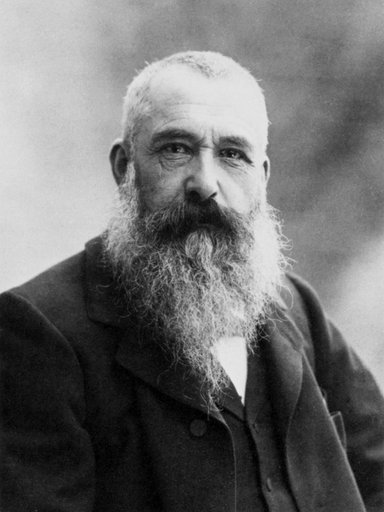
Oscar-Claude Monet was a French painter and founder of Impressionism who is seen as a key precursor to modernism, especially in his attempts to paint nature as he perceived it.



 Studied in the Impressionism course
  Compared in the Color & Light course