The painter and the account book
To follow Raphael of Urbino through his working life is to read an account book as much as a portfolio of pictures. Every panel he signed answered to someone with money. A duke wanted a devotional jewel small enough to hold in one hand. A Florentine merchant wanted a Virgin for the wall of his bedchamber. A young banker wanted his own face fixed against time. Two popes wanted the walls of their private apartments to argue theology and statecraft on their behalf. The claim of this essay is blunt: Raphael's style never floated free of these transactions. It bent to them. The intimate scale of his Florentine Madonnas, the lacquered finish of his diplomatic panels, the rhetorical sweep of his Vatican frescoes are answers to particular questions put by particular buyers.
That makes the familiar story of Raphael as the effortless prince of painters a little misleading. He was also a contractor, and a shrewd one. By the end of his short life he ran the busiest workshop in Rome and held an office that placed him in charge of papal building, decoration, and the care of the city's antiquities, an administrative reach no painter before him had been handed (J. Paul Getty Museum). So the works gathered here are best read by asking two questions at once. Who held the brush, and who signed the payment. The answers rarely line up the way the legend prefers.
Works discussed in this article
Urbino: born inside the court
Raphael was born in Urbino in 1483 and died in Rome in 1520, by report on Good Friday, having just turned thirty-seven (Wikipedia). The first fact of his career is the place. Urbino under the Montefeltro was a small state with an outsized appetite for refinement, and Raphael's father, Giovanni Santi, was the court's resident painter and a writer of verse who chronicled the dukes' taste. A boy raised in that household did not learn art as a trade picked up off the street. He learned it as the visual language of a court that prized polish, decorum, and the well-turned compliment. Those values stayed with him. Even his roughest sketches carry a courtier's instinct for what will please.
His formal training came in the Umbrian workshop of Pietro Perugino, then the most sought-after maker of sweet, symmetrical altarpieces in central Italy. The early Raphael is so close to Perugino that connoisseurs still argue over which hand laid down certain passages. Look at the Madonna and Child Enthroned with Saints and the borrowed grammar is plain: the tidy throne, the saints ranged like courtiers in audience, the soft Umbrian light that flatters everyone. What the young painter took from his master was not a manner only. It was a business model. Perugino had built a brand on reliable devotional product, repeated and varied for a steady clientele. Raphael would do the same, then outgrow it.
Florence: the merchant's Madonna
Around 1504 Raphael moved to Florence, and the move changed his customers. Here he worked less for altars and more for private rooms. The Florentine market for small devotional pictures was driven by a prosperous merchant class that wanted a Virgin and Child to hang in the home, an object of prayer and of quiet status. These are not public commissions shouting from a chapel. They are domestic, the size of a window, meant to be looked at close and often. The patron was frequently a married couple, and the picture often marked a betrothal or the hope of children. Scale itself was the brief. A panel meant for a bedchamber wall had to read at arm's length and reward a glance held for years, so Raphael tightened his compositions and warmed his color until the holy family looked like company rather than apparition. The economics were domestic too. A merchant who would never pay for a chapel could still own a Virgin, and Raphael learned to make that smaller ambition feel complete.
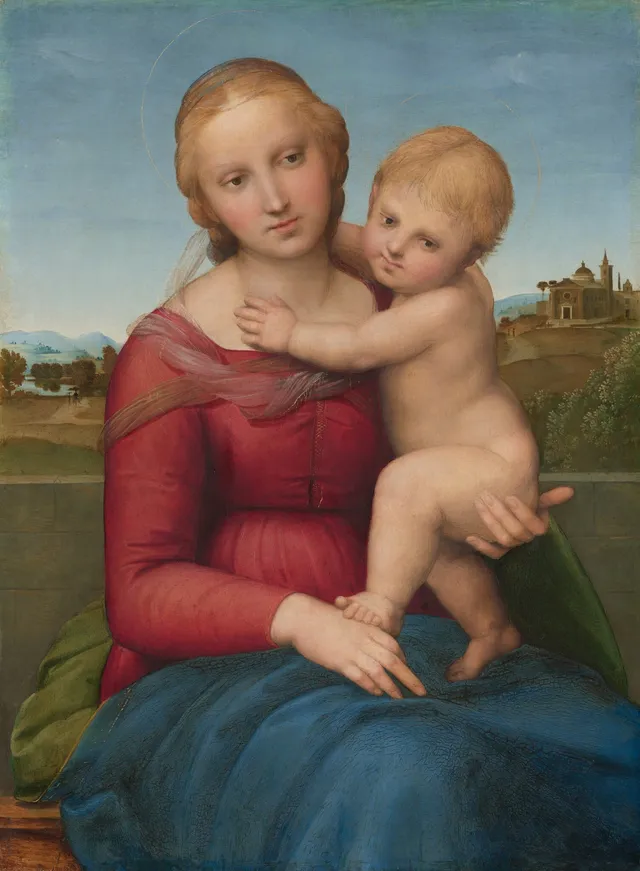
Set the Small Cowper Madonna beside the later Niccolini-Cowper Madonna and you watch a young painter solving the same brief twice for the same kind of buyer. In both a seated Virgin holds a restless child, the landscape opens behind her, the mood is tender and contained. The names attached to these panels are the names of much later English owners, the Cowper earls, not of the Florentine families who first paid for them. That is the ordinary fate of pictures made for private rooms. The original patron is the hardest thing to recover, because no chapel inscription records him. The painting outlives the transaction and takes the name of whoever owned it when scholars started writing things down.
Looking hard: Saint George and the Dragon
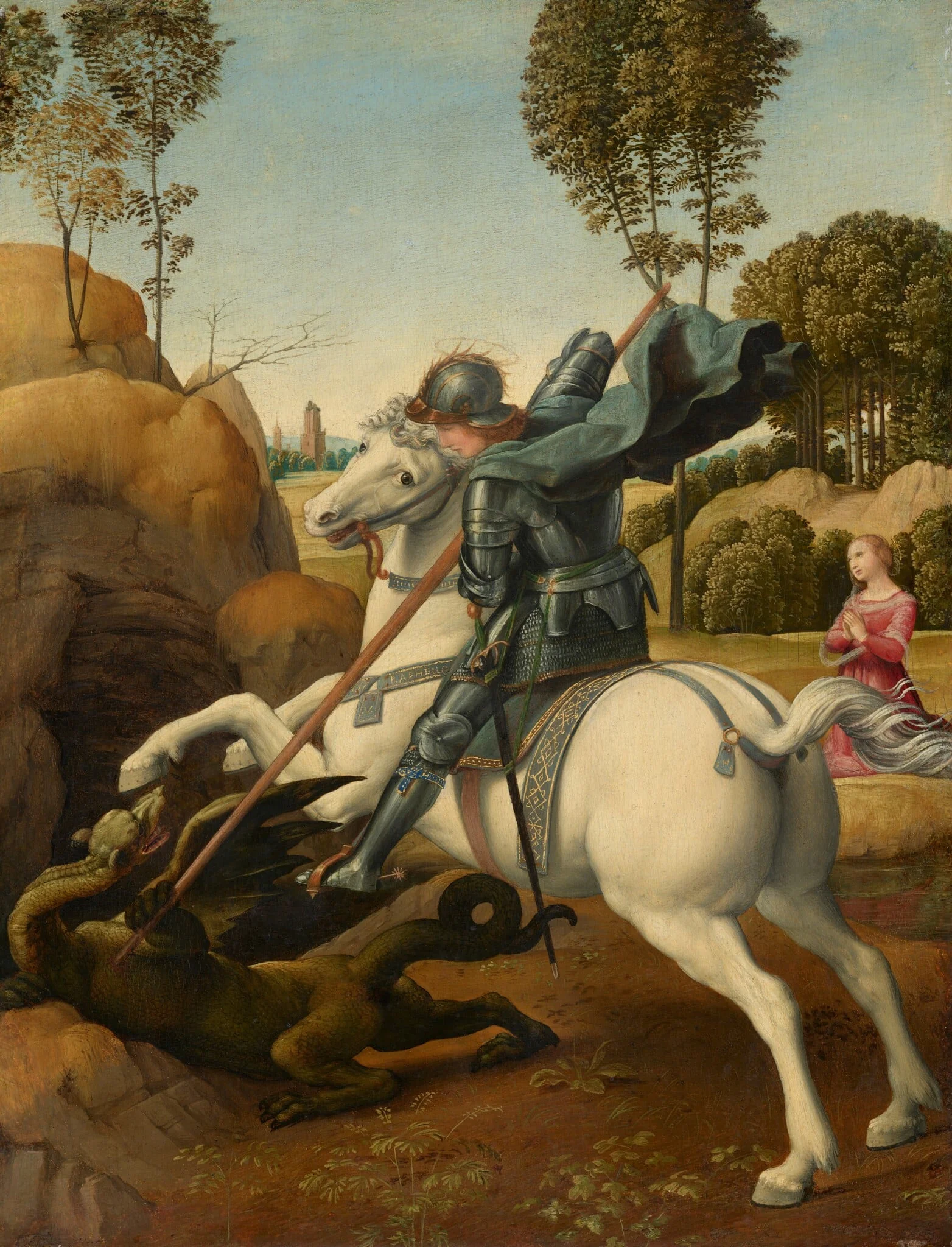
Stop in front of the Saint George and the Dragon and the first thing to register is how small the violence is. This is a panel you could carry under your arm, yet Raphael packs a full battle into it. The white horse rears and twists on its haunches, hooves cutting the air, its neck wrenched so the whole animal seems to spiral. Trace the foreleg and you can see how Raphael drilled the muscle and tendon until the strain is legible, the animal caught at the top of its own panic. George rises in the stirrups with his sword already lifted for the second blow. The lance has done its work and shattered; you can find the broken shaft on the ground, snapped clean, a small piece of evidence that the fight is half over. The dragon coils beneath the hooves, mouth open, one wing dragging. At the left edge the rescued princess hurries away, made tiny so the knight can fill the field. Behind them the landscape recedes in cool blue distance, the soft Umbrian air Raphael learned from his master pressed into the service of a war.
Now look lower, at the knight's left leg. A narrow band is tied below the knee. That detail turns a saint's legend into a diplomatic instrument. The band reads as the insignia of the Order of the Garter, the highest English chivalric honor, and George is England's patron saint. A jewel-like panel of Saint George wearing the Garter is not a generic devotional picture. It is a courtier's gift, the sort of object a small Italian duchy sent to cement a tie with a distant crown. The painting is doing a job: it flatters a recipient, advertises the taste of the sender, and folds politics into piety so smoothly that the politics almost disappears. The brushwork is correspondingly diplomatic, every surface licked to a finish, nothing left rough, because a gift to a king cannot look like studio work.
It is worth holding this panel against the north. Raphael's German contemporary Albrecht Dürer also made small, dense, exportable images that crossed borders as gifts and goods, and the two men knew of each other. Where Dürer drove his meaning through the engraved line, Raphael drove his through grace of pose and the courtier's tact. Both understood that a portable picture is a message with a destination. The dragon-slayer is a letter as much as a legend.
Rome: on the papal payroll
In 1508 Raphael went to Rome, and his patron became the most powerful man in Christendom. Pope Julius II set him to fresco the private apartments of the papal palace, beginning with the room that held the pope's own library, the Stanza della Segnatura. There, between 1509 and 1511, Raphael painted the School of Athens, ranging the philosophers of antiquity under a vast vaulted hall, Plato and Aristotle walking forward at the vanishing point while mathematicians, astronomers, and skeptics cluster in the wings (Smarthistory). The work proceeded in the same years that Michelangelo lay on his back across the corridor painting the Sistine ceiling, a coincidence of genius on one payroll that the period never repeated. The point for a patronage reading is that the program was not Raphael's. A pope who kept his books in that room wanted secular wisdom and sacred truth shown as a single continuous order, and Raphael gave it visible form. He was the most articulate spokesman a patron ever hired.
Under Julius and then under Leo X, the commissions multiplied past what one hand could execute. Raphael answered with organization. He became a designer who supplied compositions to a stable of assistants, men like Perino del Vaga, who carried his manner across walls and across the cartoons for the great woven hangings the popes commissioned, after the master had moved on to the next problem. This is the moment the question who painted it stops having a single answer. A Raphael of these years is often a Raphael invention executed by a workshop he drilled, and the market knew it. The signature value lay in the design, the contractor's stamp, as much as in any square inch of paint.
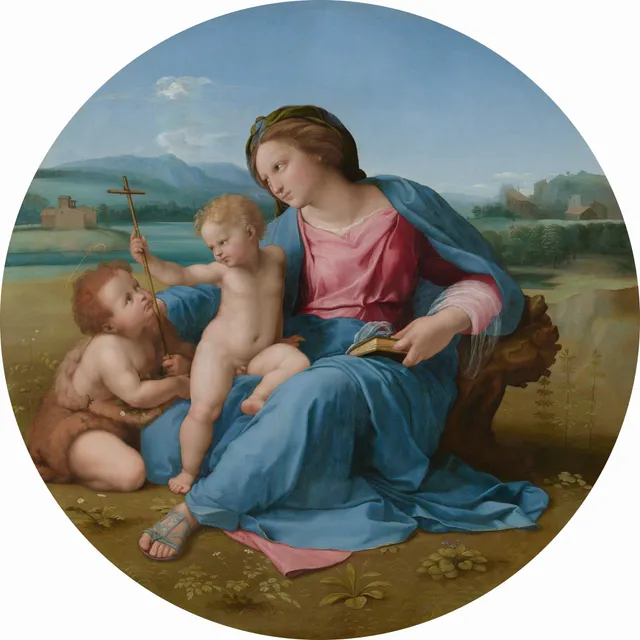
The Alba Madonna belongs to this Roman maturity. Painted around 1510 and now the major work in America from these years, it sets the Virgin, the Christ Child, and the infant Baptist into a low pyramid of figures inside a circular tondo, the seated Mary turning to brace the composition against the curve of the frame (National Gallery of Art). The Child reaches for the slender cross the little Baptist holds out, and that single reach is what knots the three bodies together, one gesture doing the structural work the circle demands. The tondo was a prestige format, expensive and awkward to compose, favored by buyers who wanted to show they could afford difficulty. Raphael makes the hard shape look inevitable. The bodies lean and counter-lean until the circle reads less as a constraint than as a window the family happens to fill.
The banker's face
Papal Rome ran on credit, and the bankers who financed the popes wanted what the popes had: a great painter to record them. The portrait of Bindo Altoviti is the sharpest surviving proof. Altoviti was a young Florentine banker resident in Rome, and Raphael paints him turning back over his shoulder, fair hair falling to the collar, one hand laid against his breast, the gaze level and faintly cool. The pose is theatrical without being loud. Light pools on the temple and the back of the hand and lets the rest fall into shadow, so the face arrives like a remark made quietly by someone who knows he will be heard. Look at the green of the background, a flat curtain of color that throws the pale face forward and refuses any rival incident. Raphael spends nothing on setting. The whole panel is engineered to deliver one young man's confidence to whoever stands in front of it. For a long time the sitter was mistaken for a self-portrait, which tells you how completely Raphael lent his own ease of manner to a paying client. The banker bought not only a likeness but a share of the painter's grace.
The same banking world produced Raphael's most lavish secular patron, Agostino Chigi, whose wealth paid for the painter's decorations in a riverside villa outside the Vatican's reach. Between pope and banker, Raphael's portraits and frescoes record a Rome where art was currency among men who dealt in currency for a living. A portrait by Raphael said you belonged to the circle that ran the city.
The archive and the afterlife
Spread across the collection here, Artifact World Gallery holds 123 works connected to Raphael, distributed across thirty venues and clustered roughly between 1490 and 1520, which is to say across almost the whole of his working span from the Umbrian apprenticeship to the year he died. That spread is itself a portrait of patronage. A single painter's output scattered through thirty institutions on more than one continent is the long settlement of debts and gifts and sales that began the moment a duke or a merchant or a pope first paid him. The number also carries a caution. A famous brand attracts studio products and later copies riding the name, and any tally this size will hold some of both. The clustering of dates at the end, the dense Roman years, marks the period when demand outran the man and the workshop took up the slack. Some of the most revealing survivals from those years are not finished panels at all but chalk studies, like the red-and-black drawing of the Christ Child the Metropolitan dates to about 1513 to 1514, sheets worked up for the stream of Madonna commissions the studio could no longer turn away (The Metropolitan Museum of Art).
It is instructive to set Raphael's machinery beside the Venetians who were his exact contemporaries. Giorgione and his circle, including followers such as Cariani, worked a smaller, more private market of Venetian patricians who wanted mood and poetry over papal rhetoric. Raphael's patrons wanted argument made beautiful, and they wanted a lot of it, fast. The difference in patronage produced two different kinds of painter from one generation.
The afterlife of all this was a reputation so total it eventually provoked rebellion. By the nineteenth century the Royal Academy held Raphael up as the summit of art, the standard against which students were measured, and a group of young English painters took their name precisely from their refusal of him, calling themselves the Pre-Raphaelite Brotherhood to mark a return to the plainer art they believed came before (Tate). To be the painter a later century has to push against is its own kind of patronage, paid in influence rather than coin. The earliest account of where that influence began was written within a generation of his death by Giorgio Vasari, whose life of Raphael remains the near-contemporary source every later biography leans on.
Read the catalog this way and the legend reorganizes itself. Raphael was a great inventor of forms, certainly, but he was also the most responsive supplier of his age, a man who could give a duke a jewel, a merchant a domestic Virgin, a banker his own beautiful face, and a pope a wall that thought out loud. The brush was his. The questions were theirs. The answers are still hanging on the walls, waiting for anyone who will stand close enough to see whose money shaped the paint.
Sources & further reading
- Raphael — Wikipedia
- Raphael, School of Athens — Smarthistory
- The Alba Madonna — National Gallery of Art
- Raphael (Raffaello Sanzio) — The J. Paul Getty Museum
- Studies of the Christ Child — The Metropolitan Museum of Art
- Pre-Raphaelite — Tate
- The Life of Raphael — Internet Archive (Giorgio Vasari)