Artwork
The Alba Madonna
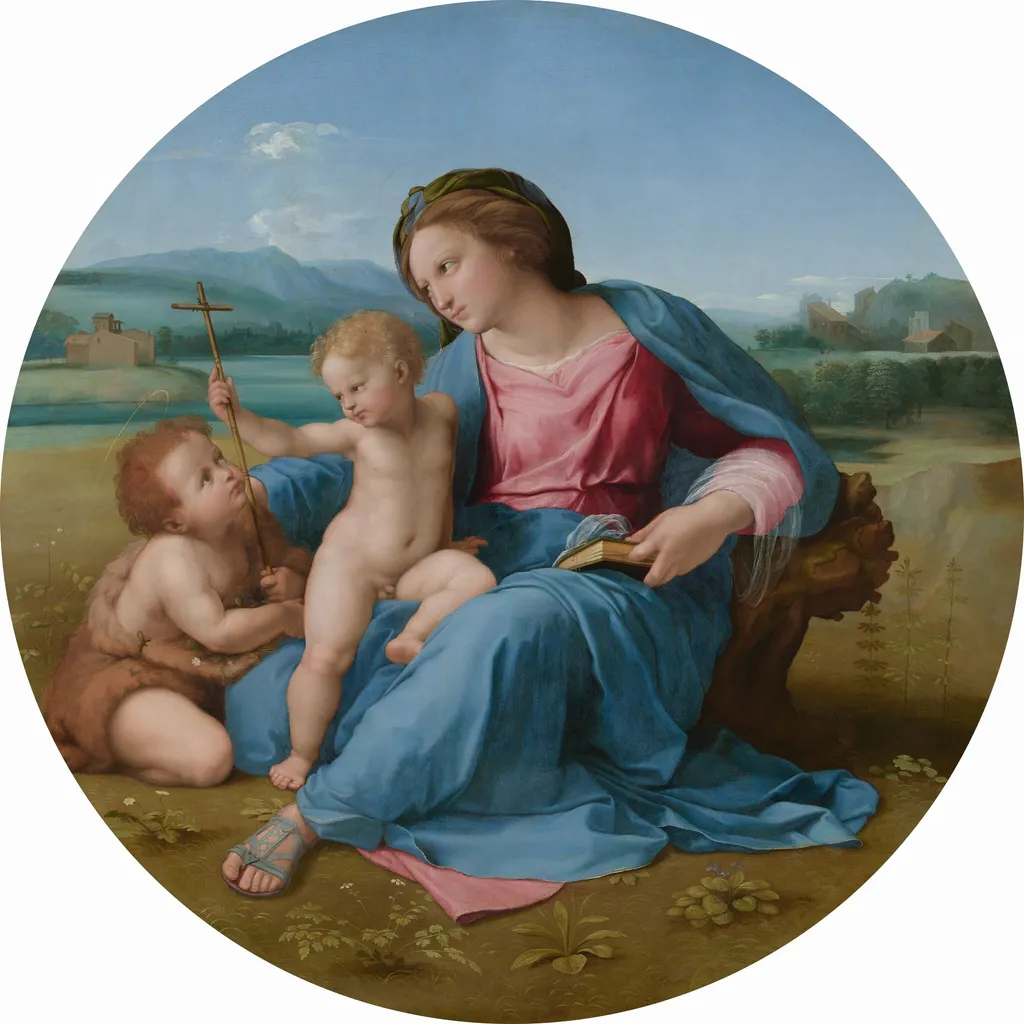
The Alba Madonna is an oil painting by the High Renaissance artist Raphael. It dates from 1510 and is held in the collection of the National Gallery of Art.
About this work
Mellon acquired it from the Soviet government in 1931 and donated it to the National Gallery of Art, where it entered the collection in 1937.
In a sunlit Italian landscape, the Virgin Mary gathers two children into a circular embrace as the infant Saint John the Baptist offers Christ a slender reed cross. Painted by Raphael around 1510, this tondo was transferred from its original wood panel to canvas in the early nineteenth century while housed at the Hermitage in Saint Petersburg. Andrew W. Mellon acquired it from the Soviet government in 1931 and donated it to the National Gallery of Art, where it entered the collection in 1937.
Subject & Meaning
The Alba Madonna depicts the Virgin Mary, the Christ Child, and the young John the Baptist in a tondo composition set in a pastoral landscape. Mary sits on the ground, an iconographic type known as the Madonna of Humility. John holds up a cross, which the infant Jesus grasps, a gesture signifying Christ's acceptance of his sacrificial destiny.
The figures' gazes converge on the cross, making it the compositional and symbolic fulcrum. Flowers at the foreground carry further meaning: lady's bedstraw alludes to childbirth, cyclamen to love and sorrow, violets to humility, and dandelions and red-centered anemones to the Passion of Christ. Mary's outstretched arm holding a book balances the pyramidal arrangement, blending intimate human interaction with profound theological symbolism.
Technique & Style
The Alba Madonna is a tondo (circular) painting executed in oil on a wood panel, later transferred to a square canvas during its stay at the Hermitage in the early 19th century. The original panel, measuring 94.5–98 cm in diameter, had severely split down the center and right side, and the transfer process left visible canvas patterning and damaged the landscape on the far right. Stylistically, the composition is a pyramidal grouping of the three figures balanced by the Madonna’s extended left arm holding a book and her billowing cloak.
The work shows the influence of Leonardo da Vinci’s sfumato in the nuanced rendering of skin tones and of Michelangelo’s plastic, fluid forms. Mary wears pastel-colored garments, a turban, and sandals, while delicate gold lines trace the halos. Symbolic flowers at the figures’ feet, violets, cyclamen, anemones, and dandelions, reinforce the religious narrative.
History & Provenance
The Alba Madonna was painted around 1511, likely commissioned by Paolo Giovio, who became Bishop of Nocera de' Pagani in 1528 and donated it to the Sanctuary of Santa Maria dei Miracoli in Nocera Inferiore. In 1686 it was purchased by Gaspar Méndez de Haro, Viceroy of Naples, and taken to Spain, eventually passing into the collection of the Dukes of Alba, after whom the painting is named. After nearly two centuries in Spain, it was sold via diplomat Edmund Bourke to William Gordon Coesvelt in 1820, then in 1836 to Tsar Nicholas I of Russia, becoming a highlight of the Hermitage Museum.
During its time in the Hermitage, the painting was transferred from its original circular wood panel to a square canvas. In 1931 the Soviet government secretly sold the work to Andrew W. Mellon, who donated it to the National Gallery of Art in Washington, D.C., in 1937.
The Alba Madonna is held at the National Gallery of Art, Washington, D.C., where it entered the collection as part of the Andrew W. Mellon Collection in 1937 (gift of The A.W. Mellon Educational and Charitable Trust). During World War II, from about 1942 to 1944, the painting was evacuated from Washington along with over 100 other works and stored at Biltmore House in Asheville, North Carolina, for safekeeping; it was returned to the Gallery in 1944.
Context
The Alba Madonna, painted around 1511 during Raphael's early Roman period, exemplifies the High Renaissance synthesis of compositional harmony and naturalism. Art historian Andrew Graham-Dixon has praised it as 'a breathtakingly beautiful work of art,' interpreting the Virgin's seated posture as referencing the Madonna of Humility tradition while her statuesque grandeur evokes earlier images of the Madonna della Misericordia. The painting shows a clear stylistic development, likely influenced by Michelangelo's Sistine Chapel frescoes, and reflects the sfumato technique of Leonardo da Vinci, particularly in the nuanced rendering of flesh tones.
Its pyramidal composition and the interplay of gazes converging on the cross reveal a controlled yet spontaneous emotional directness that scholars consider characteristic of Raphael's mature style. A preparatory drawing in the Musée des Beaux-Arts de Lille documents the artist's careful compositional study.
Legacy
The Alba Madonna's legacy is defined by its long-standing reputation as a highlight of the Imperial Hermitage Museum and, after its clandestine sale to Andrew Mellon in 1931, as a cornerstone of the National Gallery of Art's collection. The sale represented one of the most significant art market transactions of the era. The existence of multiple early replicas testifies to its widespread influence and esteem among collectors and artists, ensuring its status as a touchstone of High Renaissance painting.
Overview
Created by Raphael around 1510, shortly after his arrival in Rome, The Alba Madonna is a large circular painting depicting the Virgin Mary, the Christ Child, and the young Saint John the Baptist. The figures are arranged in a sweeping composition within a broad Italian landscape. John presents a reed cross to Jesus, a quiet gesture that subtly alludes to Christ's future Passion, as all three figures contemplate the object.
Own this work as a print
Artist & collection
Artist
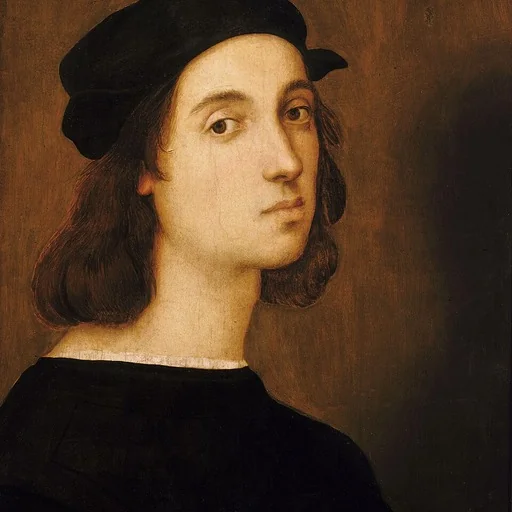
Raphael was born Raffaello Sanzio in Urbino on April 6, 1483, the son of Giovanni Santi, a painter and poet attached to the ducal court.

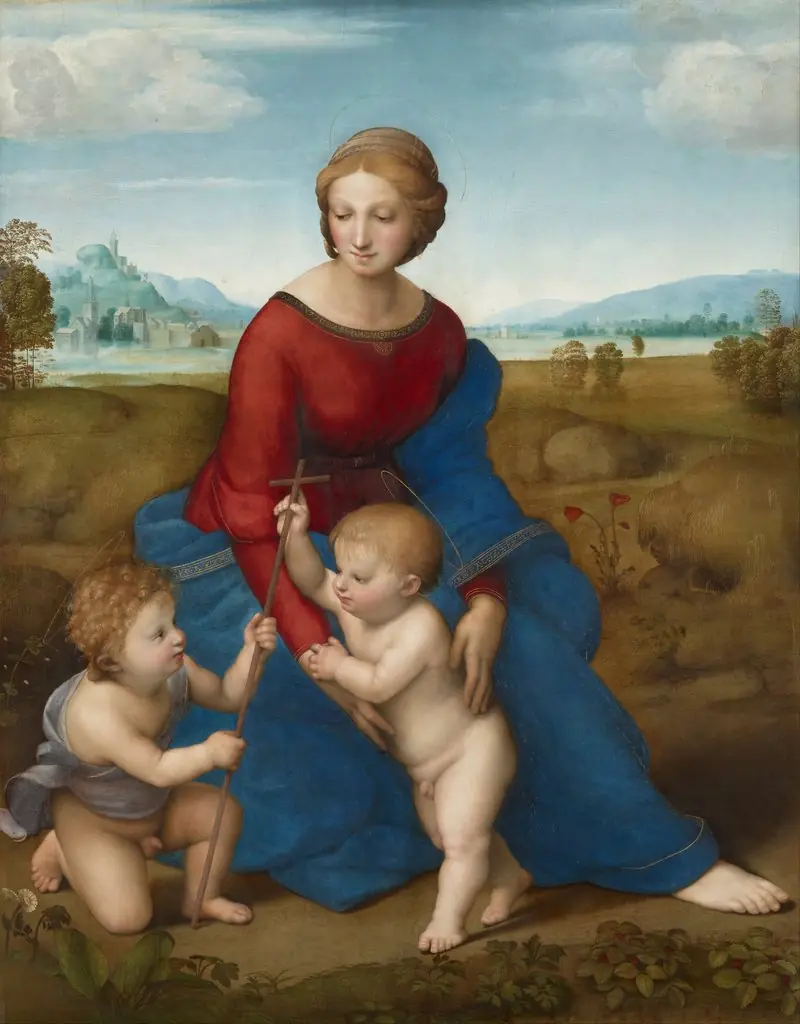 Madonna del Prato
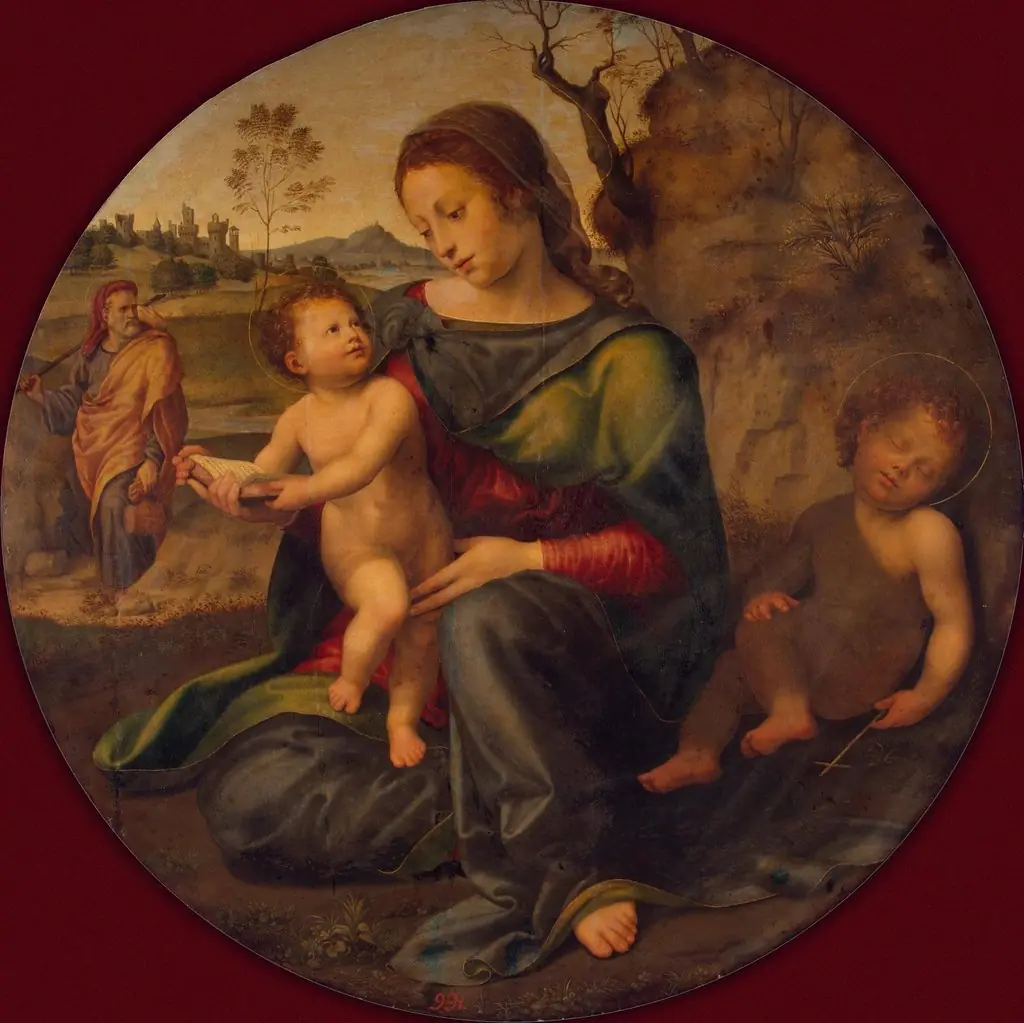 Holy Family with St John the Baptist
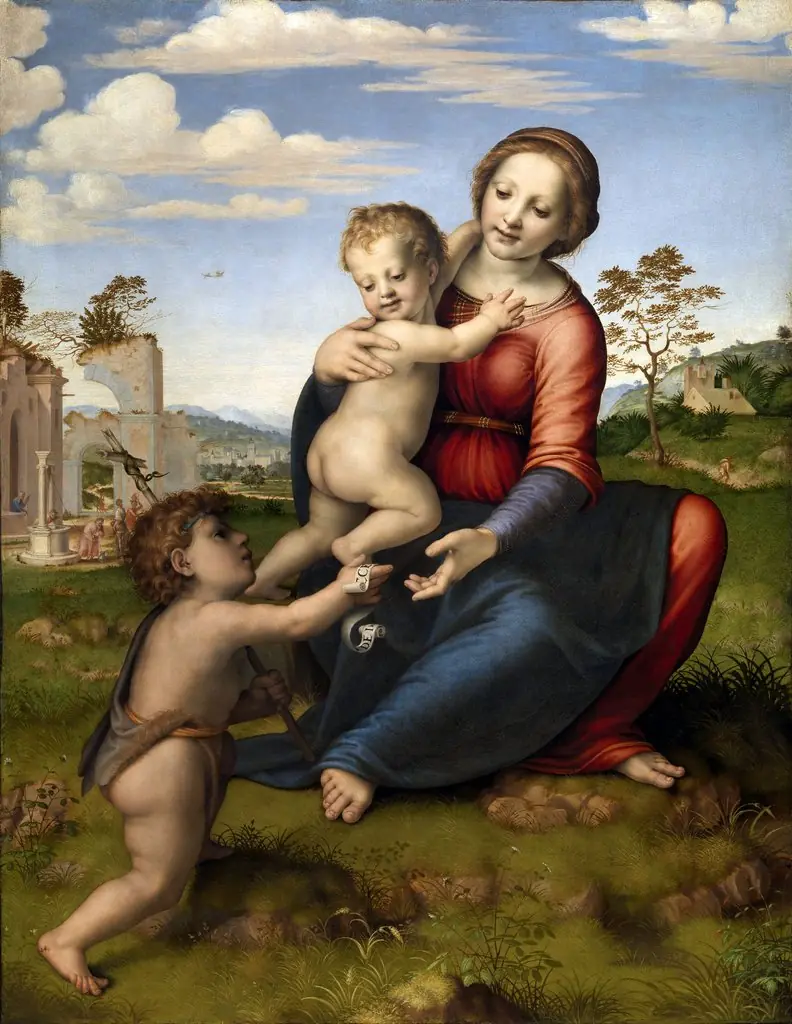 Madonna of the Well or Madonna and Child with the young St. John the Baptist
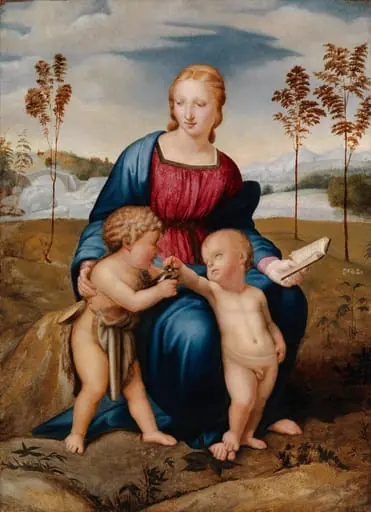 Madonna del Cardellino, kopio Rafaelin (Raffaello Sanzio) mukaan
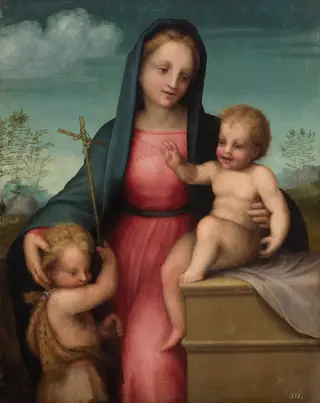 Maria mit Kind und Johannesknaben
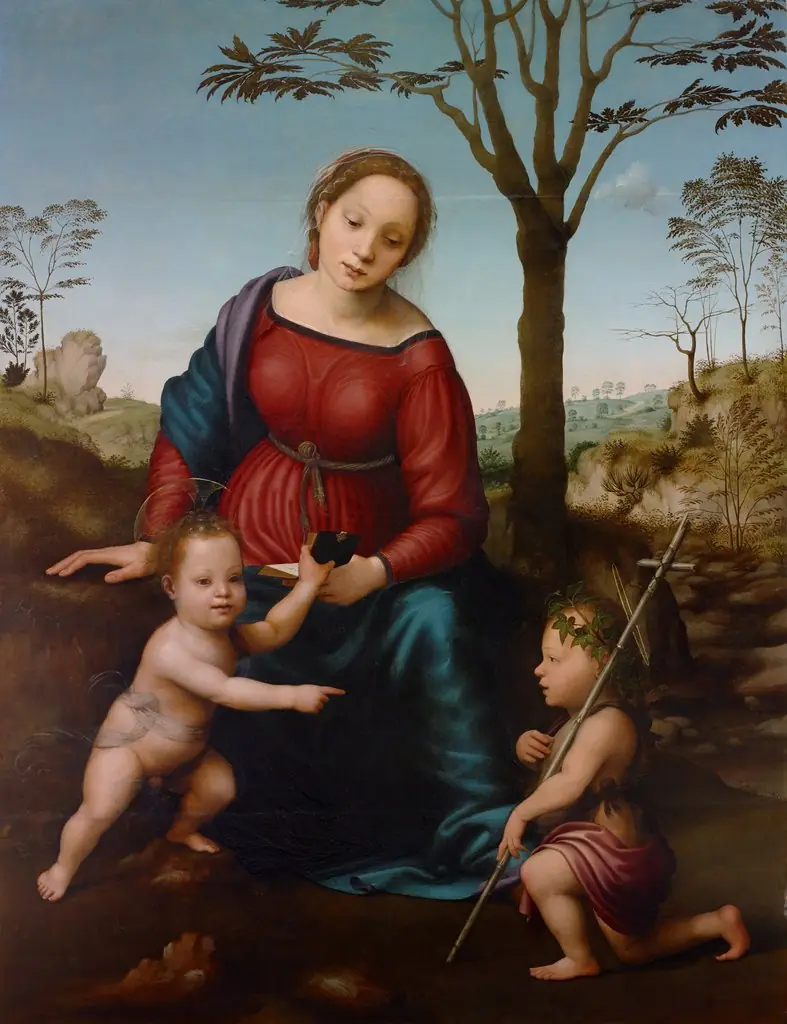 Madonna and Child Seated in a Landscape with Saint John the Baptist
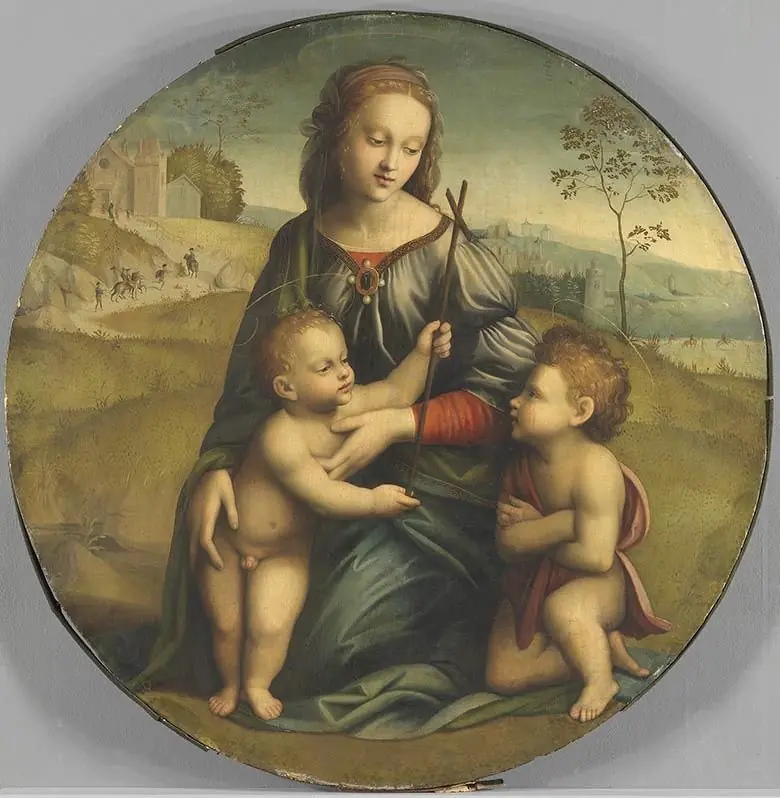 Virgin with child and little John
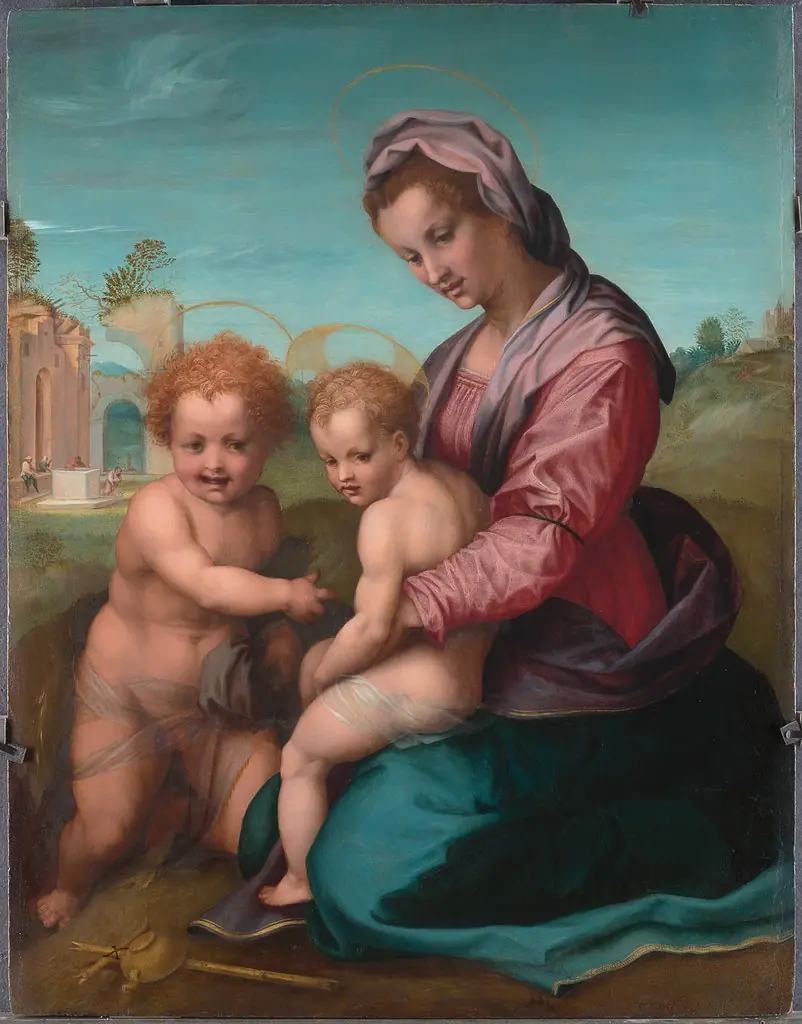 Madonna and Child with John the Baptist
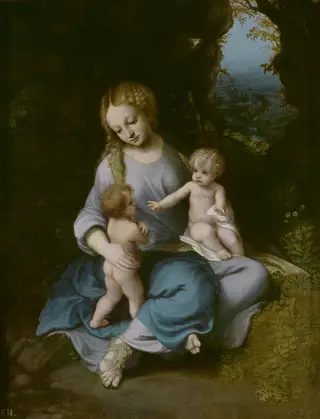 Madonna and Child with the Young Saint John
 Studied in the Renaissance Florence course
  Studied in the Mythology in Art course