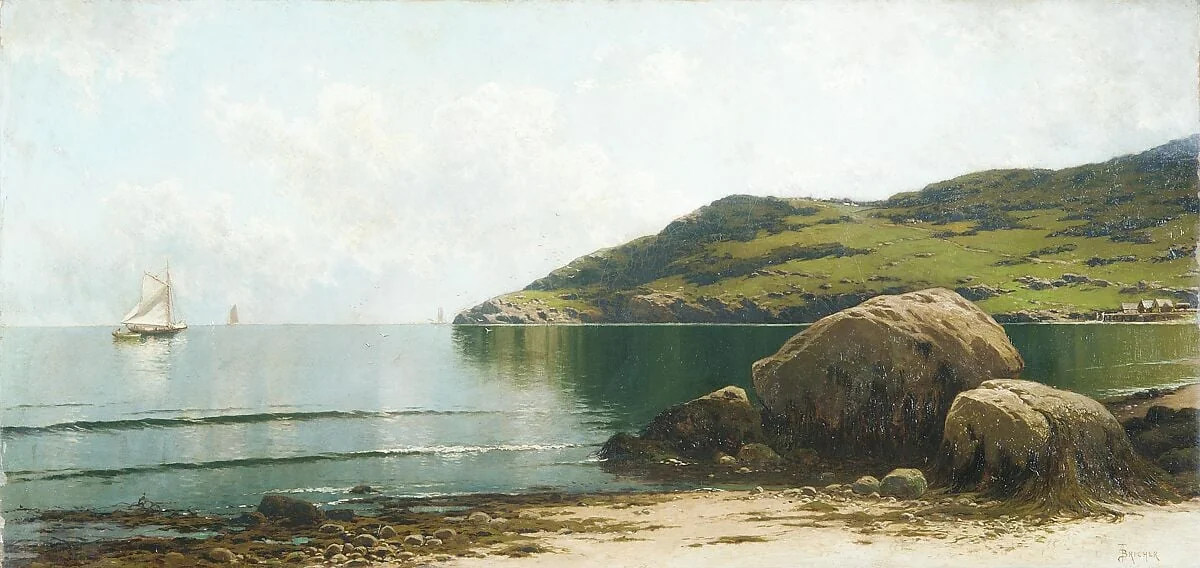
The standard account files American Impressionism under late arrivals: a polite colonial echo of a thing Paris had already finished. That account is wrong about the most interesting part. The broken stroke and the high outdoor key did cross the Atlantic, but American painters did not simply put them on. They argued with them. They kept the loaded brush and the honest light and quietly declined the part of French practice that lets a scene melt into atmosphere. The work that came out of that refusal looks Impressionist from across a room and turns structural the moment you step close.
This essay tests that claim the slow way, through one painting looked at twice. The work is Marine Landscape by Alfred Thompson Bricher, a coastal scene the catalog files with the American Impressionists and that repays the filing in an unexpected way. We will read it once now, build the historical case around it, then come back to the same canvas at the end and find it changed by what we have learned. Here is the thesis to carry: American Impressionism is a negotiation between French dissolve and a native appetite for the solid, and a single stretch of shoreline can show the whole bargain.
First look: a shoreline that refuses to blur
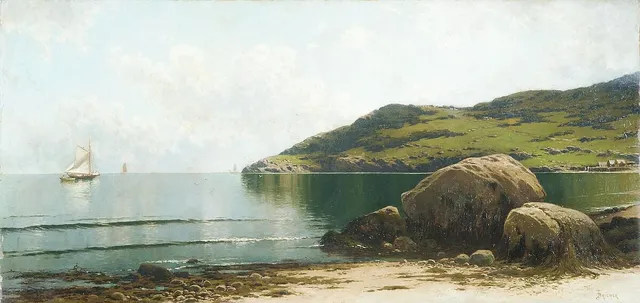
Stand close to Marine Landscape and the first thing you notice is how little it trembles. The horizon runs low and level, a hard seam between water and a pale sky, and Bricher lets it stay a line rather than breaking it into the flicker a French painter would have wanted there. The light is the subject, but it is described, not loosened. Wet sand in the foreground holds a sheen he builds from thin, deliberate films of paint, not a confetti of separate touches. Where a ledge of rock meets the tide he models it in firm planes, giving it weight, a near side and a far side. Gulls and the small incident of foam read as events placed in a measured space, not as sparks dissolving the space itself. The picture breathes Impressionist air, the high key and the attention to one particular hour, while keeping a luminist's conviction that the world out there is built and will hold its shape. Look up and the sky tells the same story. Bricher graduates it from a cooler zenith to a warm band at the waterline in smooth, blended passes, the brush leaving almost no track of itself. There is no broken weather in it, no scumble of competing temperatures, only a clean fall of daylight onto a coast that knows its own dimensions.
Notice what Bricher does with reflection. The water near the shore carries the sky's pallor in long horizontal smears, each one laid down with a flat, controlled drag of the brush, so the surface stays readable as a plane lying back into depth. He never lets the reflection break into the chopped, vibrating dabs that a French painter would scatter across a pond. The shadows under the rock are warm and continuous. The far water cools toward the horizon by even degrees, the oldest trick of an American luminist for making distance feel measurable. You could almost pace it off. That measured recession is the quiet argument of the picture: light can be radiant and the space it falls through can still be trusted and walked. Watch the brush change its mind as it moves inland. Out at the horizon the strokes lie flat and long; on the wet foreground they shorten and thicken to catch the glare, yet they never fracture into the separate sparks of pure color a Giverny canvas would carry. Bricher wants the eye to glide, not to assemble.
The technique that crossed the water
French Impressionism was, before it was anything else, a method. It developed in France across the second half of the nineteenth century and rested on a stubborn practice: finish the picture outdoors, on the spot, in front of the motif, rather than working it up later from studio sketches. The movement's first group exhibition opened in Paris in 1874 (Tate). The method carried a worldview. If you paint the light as it actually strikes the eye in a given minute, the solid edges of things start to come apart, because that is what light does to them. The broken stroke was the tool for catching it. Lay pure color in small separate touches, let the eye mix them at viewing distance, and a wall becomes a shimmer of warm and cool rather than a flat fact. Paint quickly enough and the picture records a single passing condition of weather and hour. French practice made that dissolution a virtue and pushed it hard. The result reads as truth to the instant and indifference to the object. A haystack is no longer a solid mass but the sum of the colored light bouncing off it, and the painter accepts that trade without flinching.
Americans met the method at scale in 1886, when the dealer Paul Durand-Ruel brought a large exhibition of French Impressionist work to New York under the American Art Association (Wikipedia). It was the most concentrated dose of the new painting the country had yet seen in one place. The timing matters. By the early 1890s Impressionism had become a recognized, respectable option for an American painter rather than a foreign provocation (The Met). The speed of that acceptance is the first clue that something other than imitation was going on. A style does not domesticate that fast unless it answers a need the host culture already felt. American painters had spent decades prizing clear, level light and trustworthy distance, the very qualities Bricher holds onto in Marine Landscape. Impressionism handed them a freer wrist without demanding they surrender that clarity.
Some went straight to the source. Theodore Robinson grew close enough to Claude Monet that by 1888 he had taken the house next door at Giverny, and his painting moved decisively toward a full Impressionist manner under that proximity (Wikipedia). What he learned there he carried back, and his American canvases keep the French touch while tightening the drawing under it. Mary Cassatt went deeper into the French world than any of her countrymen, becoming the only American to exhibit as a member of the French Impressionist group in Paris. Yet most of the movement that grew up at home took the lesson and bent it. The brush loosened. The scaffolding stayed.
Colonies, secessions, and a movement that organized itself
The movement put down roots not in a single capital but in a scatter of summer colonies. From the 1890s into the 1910s it flourished in places where painters gathered to work the same harbors and fields under changing weather. A colony was a practical answer to the method's demands. If you have to finish outdoors in front of the motif, you need a place with motifs worth returning to and company that paints the way you do. The colonies supplied both, a boarding house and a stretch of river, and they turned a French studio doctrine into an American summer habit. The best known of them clustered in New England, though the map ran wider than that:
- Old Lyme, Connecticut, the best-known of the New England colonies.
- Cos Cob, Connecticut, a working waterfront turned studio.
- New Hope, Pennsylvania, along the Delaware.
- Brown County, Indiana, proof the style reached well past the coasts.
The painters also organized themselves into something with edges. In 1898 a group later known as The Ten American Painters broke away from the Society of American Artists, which they had come to find unsympathetic to the Impressionist manner they now worked in (Wikipedia). A secession on those terms tells you the style had partisans willing to pay a professional price for it. These were established men leaving an established body to show their loose-brushed light on their own terms. By then American Impressionism was not an import on trial. It was a faction with a banner and a public that came to look.
What the catalog knows
The reach of the term is easier to feel from inside a large collection than from a textbook. Artifact World Gallery holds 2,296 works under the American Impressionism heading, spread across 57 venues and made by 572 distinct hands, with attributed dates running from roughly 1748 to 1965. Fifty-seven venues hold these works, which means no single museum owns the story. Set that two-century footprint against the museum-essay consensus that the style only became firmly established in the early 1890s (The Met), and the gap is the interesting part. A movement the literature dates to a few decades has a catalog span more than eight times as wide. That elastic boundary is not sloppiness. It records how the label works in practice, as a sensibility net rather than a dated period, gathering earlier luminists and later holdouts whose light and touch rhyme with the core years. The 572 hands matter as much as the dates. A movement that genuinely belonged to a handful of Paris-trained stars would not need that many makers to fill it out. The number says the sensibility was broad and easy to join, which is exactly how a borrowed technique behaves once a culture has decided it was theirs all along. Sort the same holdings by venue and the dispersal sharpens the point. No collection hoards the movement; it is scattered across regional museums and house collections the way a popular taste, not a coterie style, tends to spread.
Bricher himself sits at the early, luminist edge of that net. So does Thomas Chambers, whose Threatening Sky, Bay of New York and Lake George and the Village of Caldwell carry a folk-flattened drama closer to the 1840s than to Giverny. Chambers paints water as a set of crisp, repeating ridges and clouds as solid scrolls, the opposite of atmospheric melt, yet the catalog seats him at the same table. At the far figurative edge sit works the net catches by temperament rather than doctrine. Eastman Johnson gives us The New Bonnet, a genre interior built on draftsmanship, the figures modeled in steady light and held by drawing that an Impressionist proper would have let go soft. John Haberle offers A Bachelor's Drawer, a trompe l'oeil so tight it is the exact opposite of a dissolved surface, every pinned scrap and banknote rendered to fool the eye into reading flat paint as real objects. That the catalog files these together is itself an argument. American painting of the period prized the made object over the melted impression, and the filing preserves that preference even when the dates wander.
The grand panoramic strain shows up too. Albert Bierstadt and his The Last of the Buffalo, along with the Italianate views of George Loring Brown, sit at the opposite pole from a Cos Cob garden sketch. Bierstadt stages light as theater, a low sun raking across a plain crowded with incident, every horn and dust cloud sharp enough to count. The catalog keeps these in the same family anyway, because they share the period's hunger for American light at American scale. Brown brings the same readiness to let strong local sun do the composing, and his views arrive in the catalog as one more sign that the heading travels. The same hunger runs under the related luminist tradition the net keeps pulling toward, the one Bricher belongs to by birthright.
Works discussed in this article
The movement's late, public face is the city. By the war years the broken stroke had become civic spectacle in Childe Hassam's flag paintings of New York, of which Allies Day, May 1917 is the best known (Smarthistory). There the loaded brush no longer records a quiet garden. It records a crowd, a procession of banners hung across an avenue, painted in flecks that read as flags from a distance and as pure pigment up close. The French and British and American colors snap above the buildings in the spring light, and the whole avenue lifts toward a hazy, sunstruck top. The technique that crossed the water in 1886 had, by 1917, learned to do something Monet's haystacks never asked of it. It could carry a nation's mood down a street and make patriotism legible as paint. The dissolve the Americans had resisted on the shoreline they were willing to embrace in the city, where the subject was a crowd and a crowd is, in the end, a shimmer.
Second look: the same shoreline, changed
Go back to Marine Landscape with all of that behind you and the painting stops looking like a quiet seascape and starts looking like a position. Bricher keeps the Impressionist's outdoor key, the honesty about a specific light on specific water. He declines the dissolve. The horizon stays a drawn line because he wants you to trust the distance. The rocks keep their planes because he believes a thing seen is a thing built. This is the American bargain in miniature: take the French eye for light, hold the native faith in structure, and let the two brace each other on one band of wet sand. Look again at how the foreground sheen meets the firm rock and you can see the seam of the whole movement running right there, the place where a loosened brush bumps up against a refusal to let go of form. Bricher wants the space deep and trustworthy, and he gets it without giving up a single highlight.
That is why a single canvas is worth revisiting rather than surveying a hundred. The survey tells you when the style arrived. The painting tells you what the painter decided. An early reader of the field, Sadakichi Hartmann in his 1901 history of American art, already treated the Impressionist current as part of the national story and not a borrowed episode (Internet Archive), and Marine Landscape shows you why he was right to. The catalog's 2,296 works and their two-century sprawl add up to the same verdict Hartmann reached by eye: this was never a colony of French practice. It was a conversation in which Americans kept the half of Impressionism they wanted and argued with the rest. Stand close to the seam where Bricher's tide meets his rock and you can watch an American painter choose, touch by patient touch, to be lit by Paris and grounded at home.
Sources & further reading
- Impressionism (art term) — Tate
- American Impressionism — Wikipedia
- American Impressionism (Heilbrunn Timeline of Art History) — The Metropolitan Museum of Art
- Theodore Robinson — Wikipedia
- Mary Cassatt: An American in Paris — National Gallery of Art
- Childe Hassam, Allies Day, May 1917 — Smarthistory
- Ten American Painters — Wikipedia
- A History of American Art (1901) — Internet Archive (Sadakichi Hartmann)