A painter who wanted to be read
A picture by the Neoclassical painter Jacques-Louis David was built to be read before it was admired. When his first audiences pressed into the Salon, they did not ask only whether a figure was well drawn or a fold of cloth convincing. They asked what the canvas was telling them to do. That is the claim this essay defends: David made paintings as public arguments, and his iconography was a language his viewers already knew how to parse, the way a literate Parisian parsed a pamphlet or a sermon. The brushwork served the brief. The brief was always about conduct. A David is a sentence aimed at a crowd, and the crowd was expected to answer.
He had grounds to trust that shared language. Neoclassicism, the style he led in France, was a particularly pure form of classicism that emerged from about 1750, spurred by the excavation of Pompeii and by Winckelmann's history of ancient art. Its working vocabulary of Roman virtue, austere line, and moral plainness was common property among educated viewers. So when David set a sword, a cup of poison, or a folded legal code at the center of a composition, he was not decorating the scene. He was citing a meaning his audience could complete. The pleasure he offered was partly the pleasure of recognition: a viewer who caught the reference felt clever, and a viewer who felt clever felt persuaded. To understand David, then, you have to keep asking a single question of each picture: what did it demand of the people standing in front of it the year it was shown?
Trained to persuade
David was born in Paris in 1748 and died in Brussels in 1825, and he is generally taken as the preeminent painter of the Neoclassical era. The path there was not smooth. He competed for the Prix de Rome four times and lost three before winning in 1774 with a picture of Erasistratus diagnosing the lovesick prince Antiochus. The repeated failure matters to how he thought. A lesser talent might have blamed the judges; David seems to have concluded that the fault lay in legibility, in whether a panel of strangers could grasp the situation at a glance. By the time he reached Rome he had learned that a history painting succeeds or fails on whether the viewer instantly grasps the moral situation, and he spent his Italian years drawing antique sculpture and relief until the grammar of gesture became second nature. He came home with a method: strip the scene to a few large figures, light them like statues, and let the pose carry the meaning. Everything that could distract from the argument was cut.
That method announced itself fully with the Oath of the Horatii, shown at the Salon of 1785 and received as the defining statement of the new style. The composition is brutally clear. Three sons stretch their arms toward their father, the father lifts three swords, and the women of the household sink into grief at the right. The men are rigid as columns; the women are all curves and collapse. David sets the whole drama under three plain Roman arches, one behind each group, so the architecture itself sorts the figures into resolve and sorrow before a single face is read. Nobody in 1785 needed a caption to read the contrast between civic resolve and private feeling. David always insisted he had painted a Roman story, nothing more. His first viewers supplied the rest, and four years before the Revolution they read it as a summons: the body politic asks for sacrifice, and the household pays.
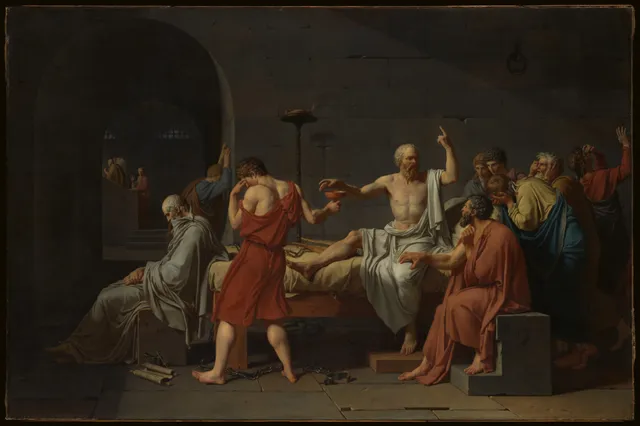
The same machinery runs the Death of Socrates of 1787, now in the Metropolitan Museum of Art. Look at how David stages it. Socrates sits upright at the center, one hand already closing around the cup of hemlock without glancing at it, the other arm thrown up in mid-argument, as if death were a footnote to the point he is making. The disciples cower and weep around him, and one figure on the far left turns away in shame. Note where the light goes. It rakes across the philosopher's chest and raised arm, picking him out as the brightest body in a dim cell, while the grieving men recede into shadow. The philosopher is the only calm body in the room. To a viewer on the eve of 1789 the iconography read as a lesson in standing by a principle against unjust authority, and the unbothered reach for the poison was the whole argument.
The cup, the corpse, the cockade
When the Revolution came, David did not merely paint it. He governed inside it. As a Jacobin deputy in the National Convention he voted for the execution of Louis XVI and sat on the Committee of General Security during the Terror, which gave his pictures of those years an authority no studio commission could. He was not illustrating events from a safe distance; he was a man whose signature helped send people to the scaffold, painting for the regime he helped run. The clearest case is the Death of Marat of 1793, painted to memorialize the murdered journalist and now in the Royal Museums of Fine Arts of Belgium. David borrowed the body of a dead Christ from centuries of religious painting and emptied it of religion. The arm hangs over the side of the bath the way Christ's arm hangs in a Pietà, the wound is in the chest, the light falls from above onto a face at rest. The upper half of the canvas is a vast, near-empty wall of dark paint, the kind of charged blank space an altarpiece reserves for heaven. He gave a Revolutionary a martyr's iconography on purpose, so that a viewer raised on altarpieces would feel the old reverence pointed at a new saint.
This is the through-line of his Revolutionary work. The objects are signs first and things second. A wooden packing-box becomes a tombstone because David letters it like one. A plain bath sheet becomes a shroud. The picture does the work of liturgy for a regime that had abolished the old liturgy, and the first viewers, many of whom had filed past saints' relics their whole lives, knew exactly which feeling was being requisitioned. David understood that you cannot legislate reverence into existence overnight, so he smuggled it in through forms the eye already trusted. The genius and the cynicism are the same gesture.
Close looking: the Emperor at four in the morning
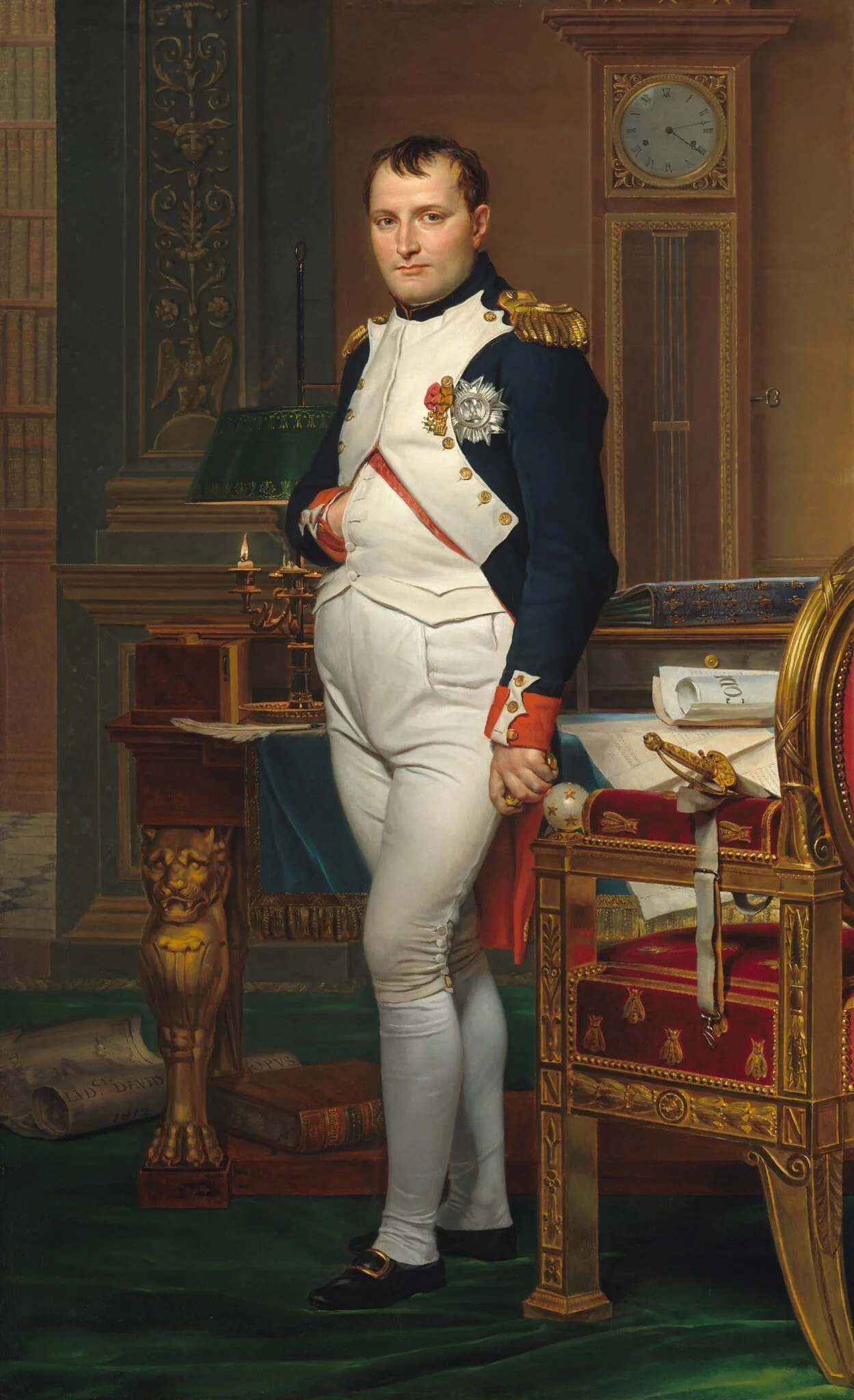
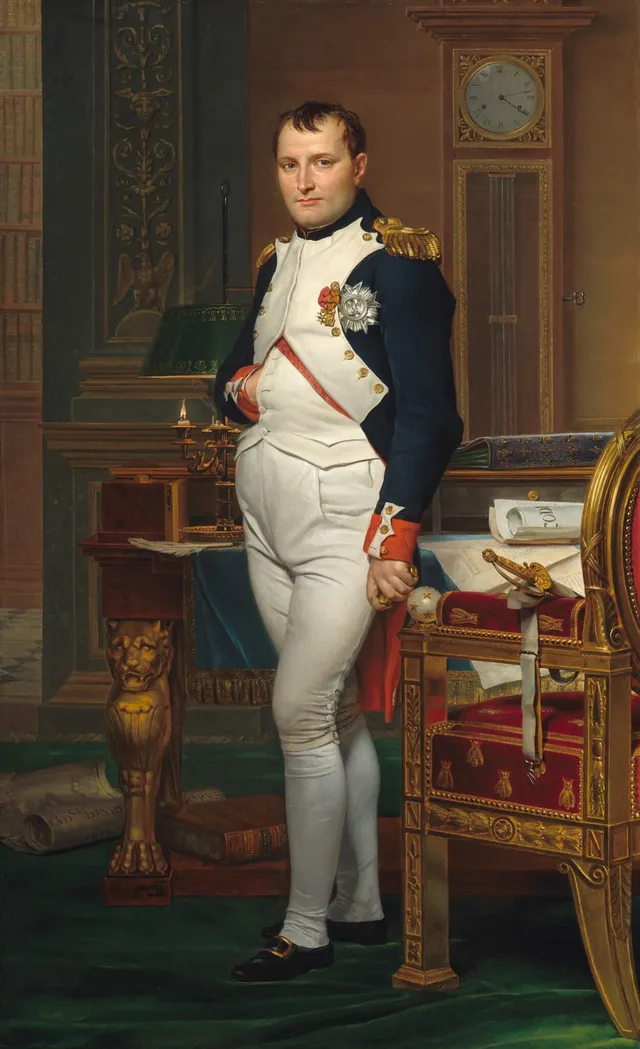
The most instructive single picture for this essay is The Emperor Napoleon in His Study at the Tuileries, painted in 1812 and now in the Samuel H. Kress Collection at the National Gallery of Art in Washington. Stand close and read the props in order. The clock on the wall behind Napoleon reads past four. The candles in the lamp have guttered down to stubs, their wax run low. The Emperor is on his feet, having clearly just risen from the desk, his white breeches creased from sitting, one stocking slipped a little at the calf. His hair is disarranged. He is not posed in armor on a horse. He is caught at the end of a long night of work, and David wants you to notice every sign of that night. The whole picture is a clock made visible, and it has been running toward dawn.
Now read the desk. The quill lies where it was set down. The papers are half-rolled, and on one of them David has lettered the single word that decodes the whole canvas: the legal Code. The sword rests against the chair, unused. The message to the first viewer is exact and flattering. While France slept, the Emperor sat through the small hours not at war but at law, writing the civil code that would outlast the battles. The disorder of the room is the argument. A tidy heroic portrait would have said power; this rumpled one says service. Every detail that looks like accident has been chosen, because David does not do accident. He built an image of a ruler who works for you, and he built it out of a burnt candle and a wrinkled stocking. That is iconography doing political labor in plain sight.
What the archive shows
There is one more way to take David's measure, and it is a counting one. Artifact World Gallery holds 134 works connected to David across 23 venues, spanning roughly 1769 to 1824, which is most of a working life laid out as a single spread. Set that against the Tate's account of Neoclassicism as a movement that crystallized around 1750, and you can watch a whole style being carried by one career. The early date sits near his student years; the late date sits in the Brussels exile. Between them the iconography shifts from Roman duty to Revolutionary martyrdom to imperial service, and the spread of venues shows how thoroughly that argument traveled. A style invented to instruct one Salon ended up scattered across two dozen institutions, still instructing, long after the causes it served had collapsed.
Portraits as arguments
David's portraits use the same readable iconography as his history pictures, only at lower volume. The Portrait of Antoine-Laurent Lavoisier and his wife is a manifesto about the Enlightenment dressed as a double portrait. The chemist's glass instruments sit on the table and the floor in clear view, naming his science. The glass is rendered with a jeweller's care, every reflection precise, as if accuracy of observation were itself the subject. His wife stands at his shoulder, and her hand and gaze tie the pair into a working partnership rather than a husband and an ornament. The lettering and papers point to his writing. A viewer was meant to understand exactly what kind of household this was and what it valued, and the cruel coda is that the Revolution David served would send Lavoisier to the guillotine.
Compare the quieter Madame David, a portrait of his own wife, where the program drops away and what remains is observation: the set of the mouth, the weight of the body in the chair, a likeness rather than a lesson. There is nothing here a stranger is asked to decode, only a face the painter knew too well to flatter. Then the late General Étienne-Maurice Gérard, a marshal of France, where the uniform and bearing do the talking the way the burnt candle did in the imperial study. Read across the three, you see a painter who could turn the iconographic volume up or down at will, loud for a public man, soft for a wife.
The grand public version of the imperial program is The Distribution of the Eagle Standards, a coronation-era pageant in which the army swears loyalty to the new eagles. Here the oath gesture David had invented for the Horatii returns, scaled up to a regime: arms reach, bodies lean toward the source of authority, and the Roman idiom of the sworn vow is grafted onto a French empire that wanted Rome's prestige. The crowd of officers is arranged in a great surging diagonal, a forest of raised arms all pointed one way, so that the eye is swept toward the standards before it can stop to think. The same hand that taught Revolutionary France to read a swearing arm as virtue now taught imperial France to read it as obedience. The sign held; the master it served changed.
Works discussed in this article
Exile and the cooling of the sign
When the empire fell and the monarchy returned, David, the man who had voted to kill the king, left for Brussels and stayed. The exile changed what his pictures were for. The Farewell of Telemachus and Eucharis of 1818, in the J. Paul Getty Museum, shows two mythological lovers at the moment of parting. There is no civic instruction in it. The iconography has gone private and tender, the bodies polished to an almost erotic smoothness, the subject chosen for sentiment rather than for any message to a nation. The young man's gaze drifts past his companion toward the voyage ahead, and the picture asks only that we feel the pull of two desires, not that we choose between them. A painter who had spent thirty years telling crowds how to feel about the state now painted a goodbye for its own sake. The public language quiets to a whisper because there is no longer a public to address.
The reading habit he left behind
David's studio was the most powerful in Europe, and it carried his habit of legible meaning into the next generation. François Gérard took the readable portrait into the salons of the Restoration, and Jean Auguste Dominique Ingres inherited the master's line while bending it toward something cooler and stranger. The miniaturist Jean-Baptiste Isabey and the interior painter François Marius Granet carried fragments of the same training into smaller formats. None of them painted quite as David painted, but all of them assumed what he assumed. What they absorbed was less a technique than a conviction: that a picture is addressed to someone, and that the someone should be able to read it.
That conviction is what to carry to the next David you stand in front of. Do not start with the finish of the paint. Start with the props and the poses, and ask what the first viewer was being asked to do with them, because that viewer was meant to walk out of the room having decided something. The burnt candle wanted you to trust the Emperor. The reaching arms wanted you to swear. The cup wanted you to hold your ground. Two centuries on, the regimes are gone and the arguments have lapsed, yet the instructions are still legible on the canvas for anyone willing to read instead of admire.
Sources & further reading
- Jacques-Louis David — Wikipedia
- Neoclassicism (art term) — Tate
- The Death of Socrates — The Metropolitan Museum of Art
- The Emperor Napoleon in His Study at the Tuileries — National Gallery of Art
- Jacques-Louis David, Oath of the Horatii — Smarthistory
- The Farewell of Telemachus and Eucharis — The J. Paul Getty Museum
- Le peintre Louis David, 1748-1825 — Internet Archive (Getty Research Institute)
- Jacques-Louis David, The Death of Marat — Smarthistory