Petrus Christus inherited a city and a problem he could not put down. Jan van Eyck had died in Bruges in 1441, leaving behind panels so densely worked that they seemed painted under a jeweller's lens. Three years later Christus bought his Bruges citizenship and stepped into the role of the town's leading painter. He could copy van Eyck's effects, and the early panels prove he had studied them closely. The harder question, the one his whole career keeps circling, was whether those effects were ever the point.
Here is the argument I think his paintings are having. Northern painting under van Eyck had bet everything on plenitude, on the idea that truth lived in the accumulation of detail until a surface could hold no more. Christus pushed back. He thinned the density, cooled the color, and quietly slid a measuring instrument under the whole enterprise. Where van Eyck filled a room, Christus built one. That shift, from a world described inch by inch to a world constructed as coherent space, is the predecessor-argument that makes him the hinge of his generation rather than its echo. Read his panels in sequence and the shift looks less like a style and more like a sustained line of reasoning.
The city van Eyck left behind
On July 6, 1444, Christus presented himself at the burghers' lodge in Bruges to complete the formalities of citizenship, the step that let him enter the painters' guild and take commissions in the city, as the Metropolitan Museum's Heilbrunn essay records. The timing matters. He arrived as the recognized heir to van Eyck's position, the painter the Met calls van Eyck's principal successor in Bruges, holding the leading workshop from the early 1440s until Hans Memling settled there around 1465. For two decades the look of Bruges painting was largely his to define.
Bruges in the 1440s was a wealthy trading port, a place where Italian bankers, Hanseatic merchants, and Burgundian courtiers all wanted their faces and their patron saints painted. The leading workshop in such a town was a commercial position before it was an artistic one. Christus supplied portraits, devotional panels, and altarpieces to a clientele that had learned from van Eyck to expect miracles of finish. The pressure to imitate must have been constant. What is striking is how steadily he declined to.
What survives is small and concentrated. The catalogues that hold up under critical scrutiny number only around thirty panels, and Artifact World Gallery's own archive gathers 26 works under his name across 11 venues, a single attributed hand, clustered between roughly 1445 and 1475. That is nearly the entire argument, fewer than three dozen objects against which we read a man rethinking the most admired painter in Europe. The scarcity is part of why his contribution stayed underrated for so long. There is not enough of him to drown out the master he followed, and for centuries his best panels were simply filed under van Eyck or left anonymous. Spread those 26 works across 11 separate collections and you also see why no single museum visit ever made the case for him. The argument was scattered before anyone could read it.
Van Eyck's gift, and his trap, was that he could make paint disappear. Brocade, sweat, the bristle of fur, the warp of glass, each was rendered with such even attention that no part of the picture relaxed. The eye never rests because nothing in the surface is subordinate. It is a vision of the world in which everything is equally, exhaustingly present. Christus seems to have decided that a painting which refuses to rank its parts also refuses to compose them. His correction was structural. He gave the eye somewhere to go, and a reason to go there.
The cooling is literal. Christus drains some of the saturated reds and golds van Eyck loved and works in grayer middle tones, blues that sit back, whites that read as light rather than as cloth. He also leaves room empty. A van Eyck interior tends to be furnished to the corners. Christus will give you a plain plastered wall, a swept floor, a single window, a closed door, and trust the geometry to hold your attention. Emptiness, for him, is a tool. It is the negative space that makes the measured intervals visible, the silence around a note that lets you hear its pitch. Strip the clutter and the structure underneath has to carry the picture, and in his best work it does.
Building a room: the Carthusian in his corner
Look at the Portrait of a Carthusian, dated 1446 and painted within a couple of years of his arrival. A lay brother in a white habit sits against a warm red field, his beard forked into two points, his eyes turned just off the viewer as though listening rather than posing. So far this is Eyckian, the kind of close, unflinching face van Eyck had made the standard. Then notice the floor and the two walls. Christus has set the sitter into the corner of an actual room, with a wooden ledge running along the bottom edge. On that ledge he has painted a fly. The insect casts a tiny shadow and sits on the painted sill as if it had landed on the frame itself, a small joke about where the picture stops and the world begins.
That corner is the whole thesis in miniature. By turning the two background walls into receding planes, Christus converts a portrait into a measured box. The sitter now occupies depth that can be reasoned about rather than merely admired. The fly seals the trick by claiming the front plane, the boundary the room recedes from. Van Eyck pinned his sitters to a flat dark ground. Christus pins his to a place. This is a painter thinking about construction at a moment when most of his predecessor's followers were still thinking mainly about finish.
The fly rewards a second thought. A painted insect on a painted ledge is a wager about illusion, the artist daring you to brush it away. But set that wager next to the receding corner and it does more than show off. The fly marks the front plane, the pane of glass we look through; the corner marks the depth behind it. Between the two, Christus has defined a measurable distance. He has told you exactly how far back the sitter sits. Van Eyck's dazzling surfaces rarely volunteer that information.
His portraits carry the same experiment across the board. The sitter once trapped against darkness now turns up in a believable interior, lit from a window, set at a slight angle in a corner. The panel known as the Portrait of a Man in a Turban, argued over in the attribution literature, belongs to this family of faces that Christus tries to place rather than only record. The corner becomes his signature idea, repeated until it reads as the default way a Northern sitter should be shown.
The Lamentation: grief on a measured stage
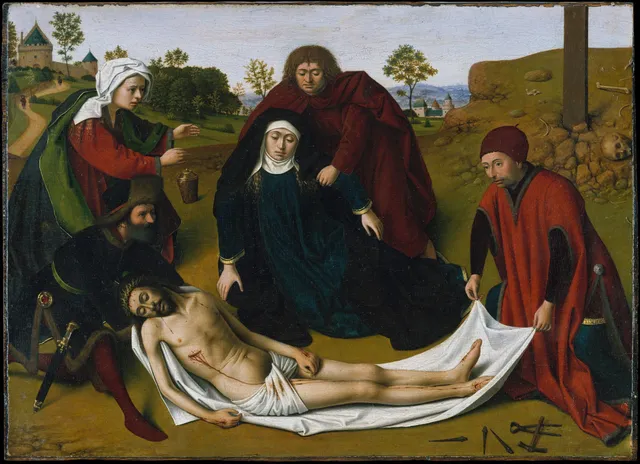
The argument turns monumental in the Lamentation. Christus lays the scene out horizontally, almost as a frieze. The dead Christ has been brought down and lowered toward a white shroud whose corners are held by Joseph of Arimathea and Nicodemus, the cloth stretched flat enough to read as a plane. The Virgin has collapsed into the arms of the women while John steadies the group. The Magdalene stands slightly apart with her jar. A bare cross rises behind, a ladder still leaning against it. The horizon sits low, so the figures are spaced across a shallow green stage that opens onto a quiet town and a band of pale sky. A skull lies near the front edge, the old reminder that this ground is Golgotha, the place of the skull.
What is missing is operatic grief. The faces are swollen and still rather than contorted. Christus stages sorrow as arrangement, distributing the bodies at careful intervals so the eye reads the event as a measured sequence across the panel. Van Eyck would have crowded the moment and let the detail carry the feeling. Christus clears space around each figure and lets the spacing carry it. The restraint is deliberate, and it springs from the same conviction as the Carthusian's corner, that meaning comes clearer when the picture is built to be walked through. He trusts the architecture of the scene to do what an anguished face would do in a lesser painter's hands.
A Goldsmith in His Shop
The boldest move is A Goldsmith in His Shop, signed and dated 1449 and now in the Met's Robert Lehman Collection, where the museum's object record confirms the signature and date. A young couple stands at the counter of a goldsmith who weighs a ring on his scale. The woman, in a brocaded gown, leans toward the counter; the man rests a hand near her back. The shelves behind the goldsmith carry his stock, raw crystal, branches of coral, loose rings, a porphyry dish, vessels of worked metal and a row of pewter. The materials are inventoried with van Eyck's old precision, each one given its proper weight and gleam. On the counter sits a round convex mirror, and in it two figures pass in the street outside, pulling the world beyond the shop into the frame. For centuries the panel was read as Saint Eligius, the goldsmiths' patron saint, performing his trade.
That convex mirror is a borrowed device, the same trick van Eyck had used to fold a whole second room into a single picture. Christus turns it outward instead of inward. Where van Eyck's mirror reflected the interior and the painter's own presence, this one reflects the street, two passers-by and a stretch of Bruges daylight that the shop would otherwise wall out. The reflection insists that the transaction at the counter belongs to a living city rather than a sealed sacred chamber. It is a small adjustment with a large consequence for what the picture is about.
Recent scholarship, including the reading laid out by Smarthistory, treats it instead as a secular image of a trade, a vocational portrait of commerce in Bruges. That re-reading is itself part of the argument with van Eyck. Christus takes the Eyckian apparatus, the mirror that doubles the room and the inventory of luxurious materials, and points it at a working transaction rather than a sacred one. The holy is not banished. The saintly ancestry lingers in the composition. But the panel's real subject is exchange, the weight of the ring and the moment money changes hands. He kept his predecessor's tools and changed what they were for. A generation later, that worldly attention would help open the door to Northern genre painting.
Works discussed in this article
Perspective as an argument
Run the panels together and a program appears. In The Nativity, held by the National Gallery of Art and treated there as one of his most important devotional works, Christus frames the manger inside a sculpted stone archway, with grisaille figures standing in the spandrels above as if they were carved sculpture. The National Gallery's catalogue entry sets the panel at the center of his devotional output. The arch does real work. It is a proscenium that fixes the viewer's position and sets the depth of the holy scene behind it, separating our space from the sacred space while letting us look straight through. The painted stone is colorless on purpose, so the living color of the Nativity reads as a vision held inside a frame of carved law.
In The Annunciation he again gives Gabriel and the Virgin a defined architectural threshold rather than a gold or abstract ground, a room with a measurable floor and a doorway that opens onto further depth. The encounter happens in a place you could pace out. Even the angel's arrival is staged spatially, the messenger set at the edge of an interior the Virgin already occupies, the distance between them made part of the meaning.
Across these works Christus reaches, sometimes awkwardly, toward a single governed recession, the kind of one-point construction being codified in Italy in the same decades. He does not always get the orthogonals to agree, and his tiled floors can wobble where an Italian theorist's would lock shut. The interest is that he tries at all, on the far side of the Alps, with no treatise to copy from. His technical instincts had roots in the disciplined small-scale craft of manuscript illumination, the milieu Getty's scholarship places him near, and that miniaturist's control of a contained space may be exactly what let him think of a panel as a room to be ruled rather than a field to be filled. The argument he was having with van Eyck was, at bottom, an argument about geometry, about whether a picture is a surface or a space.
What the argument settled
The argument did not end with him, but it set terms others used. When Memling rose in Bruges after about 1465, he worked in calmer, more rationalized spaces than van Eyck had, the kind Christus had spent two decades arguing for. The younger painter inherited a Bruges where the measured interior was already the going idiom. Recognition for its author came slowly. The first museum exhibition to take Christus on his own terms arrived only in 1994, the Met's Petrus Christus: Renaissance Master of Bruges, which gathered the scattered panels onto a single set of walls and made the case for him as an innovator rather than a copyist. Seeing the corner portraits and the architectural altarpieces in one room did what no library of photographs had managed. The subtitle was the argument turned into a wall label.
Stand in front of the Carthusian and the wager is still legible. The fly waits on the painted ledge, and behind it the walls fall back into their corner while the sitter holds a depth that van Eyck never quite granted his own faces. Christus did not out-paint his master. He asked a different question, whether a picture should overwhelm the eye or guide it, and the answer he built into the floorboards is the one the next century of Northern painting would walk across.
Sources & further reading
- Petrus Christus (active by 1444, died 1475/76) — The Metropolitan Museum of Art (Heilbrunn Timeline of Art History)
- A Goldsmith in His Shop — The Metropolitan Museum of Art
- Petrus Christus, A Goldsmith in his Shop — Smarthistory
- The Nativity — National Gallery of Art
- Petrus Christus — Wikipedia
- Petrus Christus: Renaissance Master of Bruges (1994 catalogue) — Internet Archive / The Metropolitan Museum of Art
- Illuminating the Renaissance: The Triumph of Flemish Manuscript Painting in Europe — Getty Publications