Artwork
The Nativity
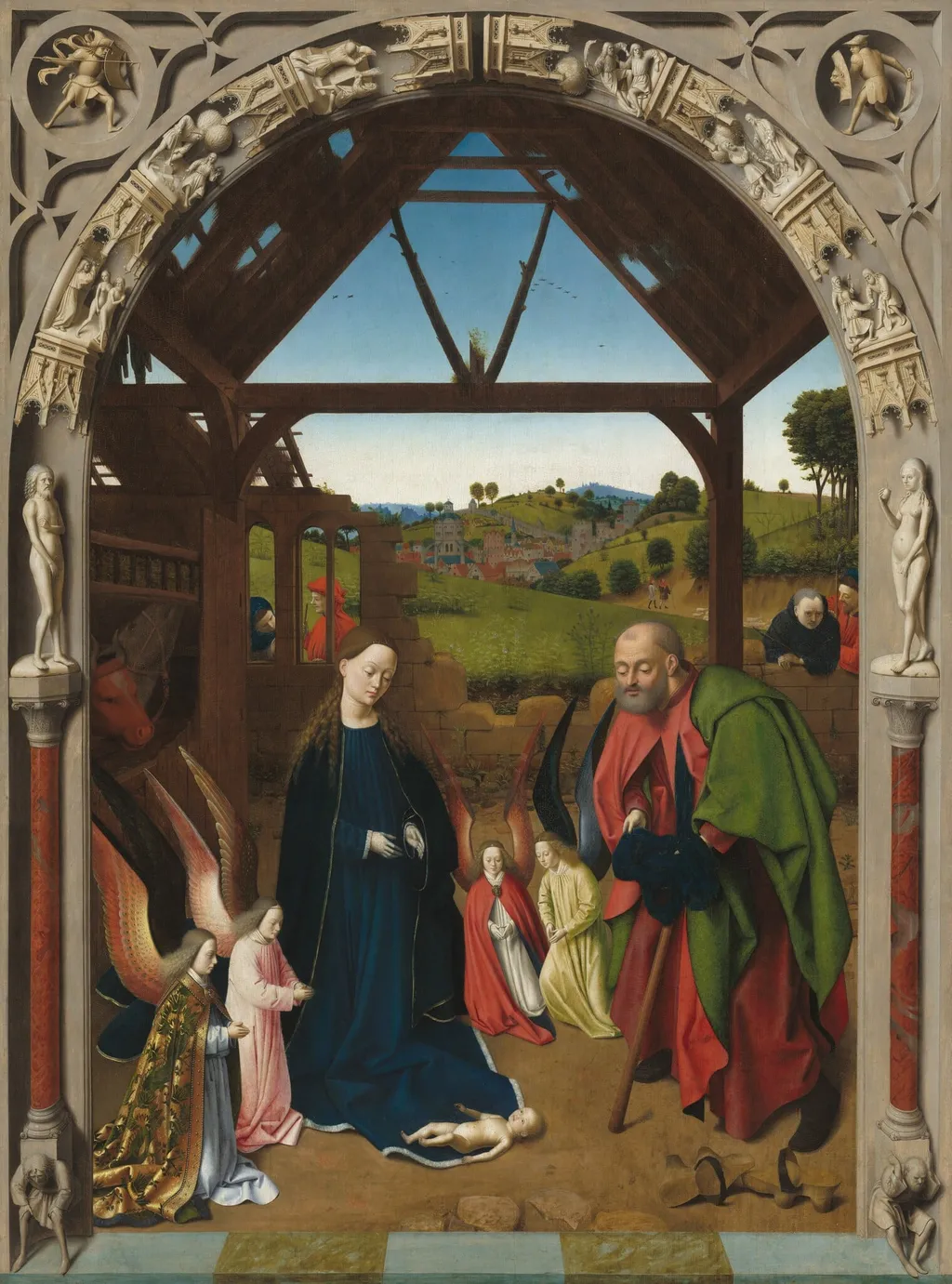
The Nativity is an oil painting by the Northern Renaissance artist Petrus Christus. It dates from 1450 and is held in the collection of the National Gallery of Art.
About this work
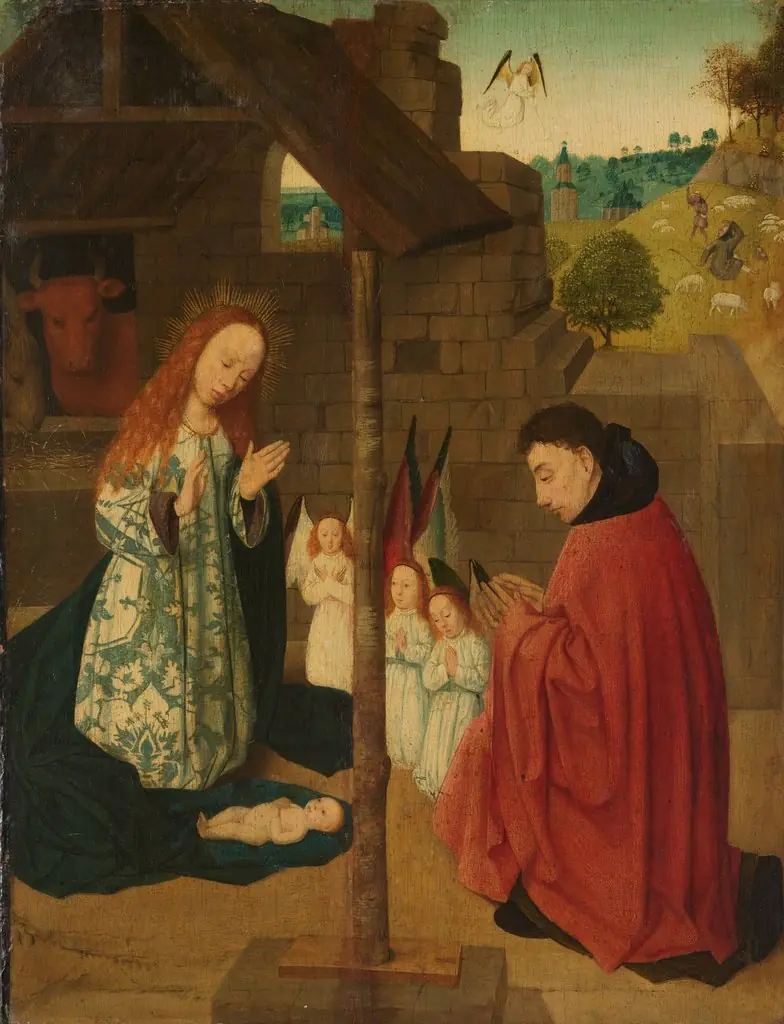
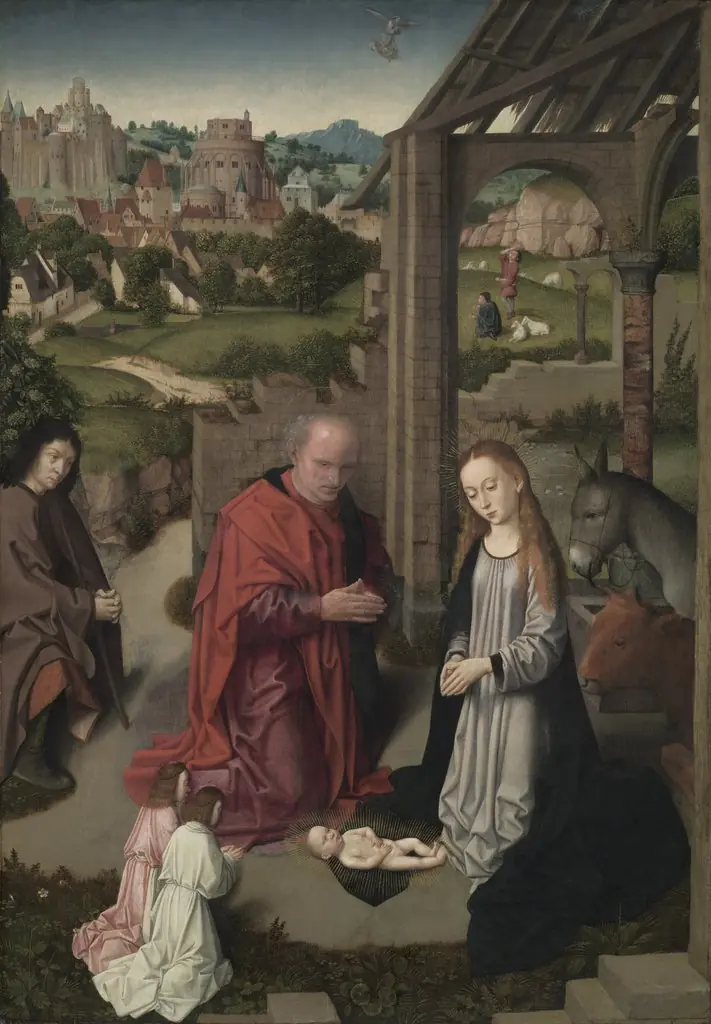
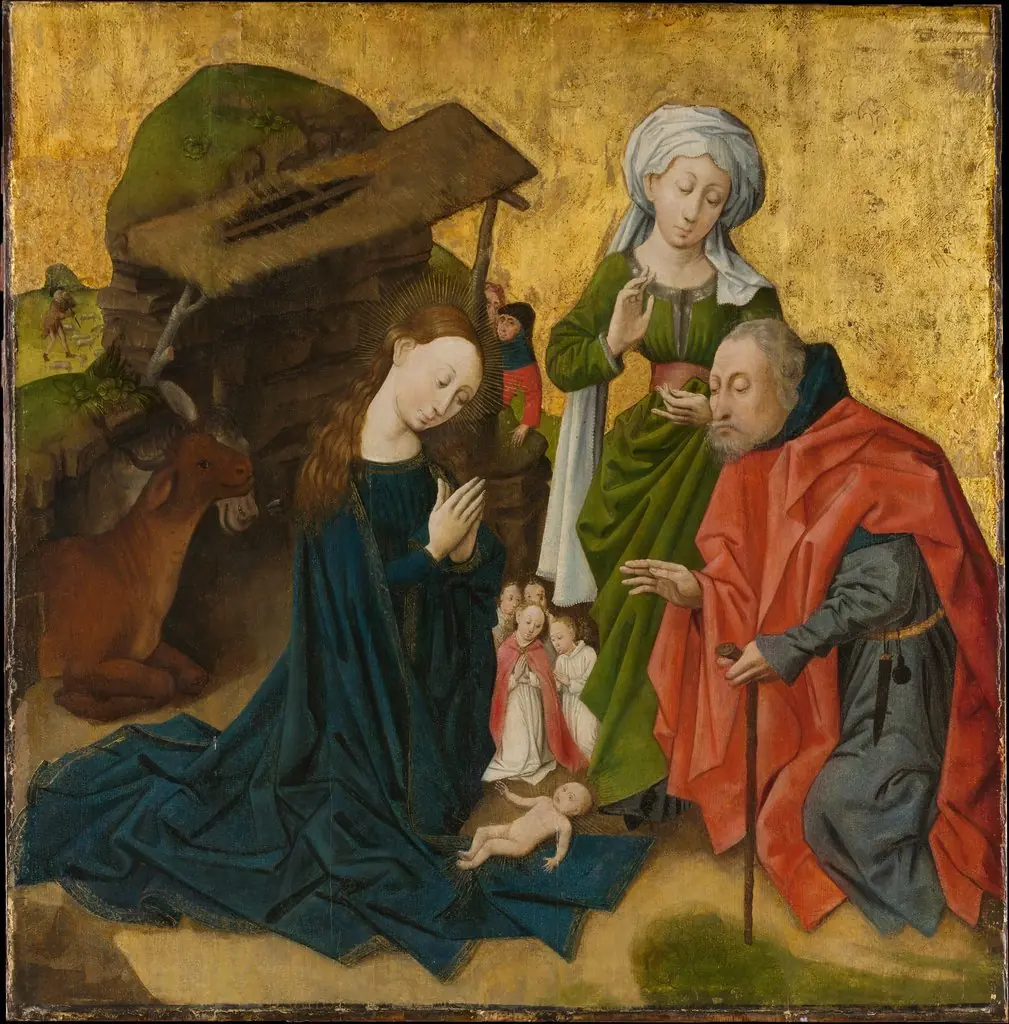
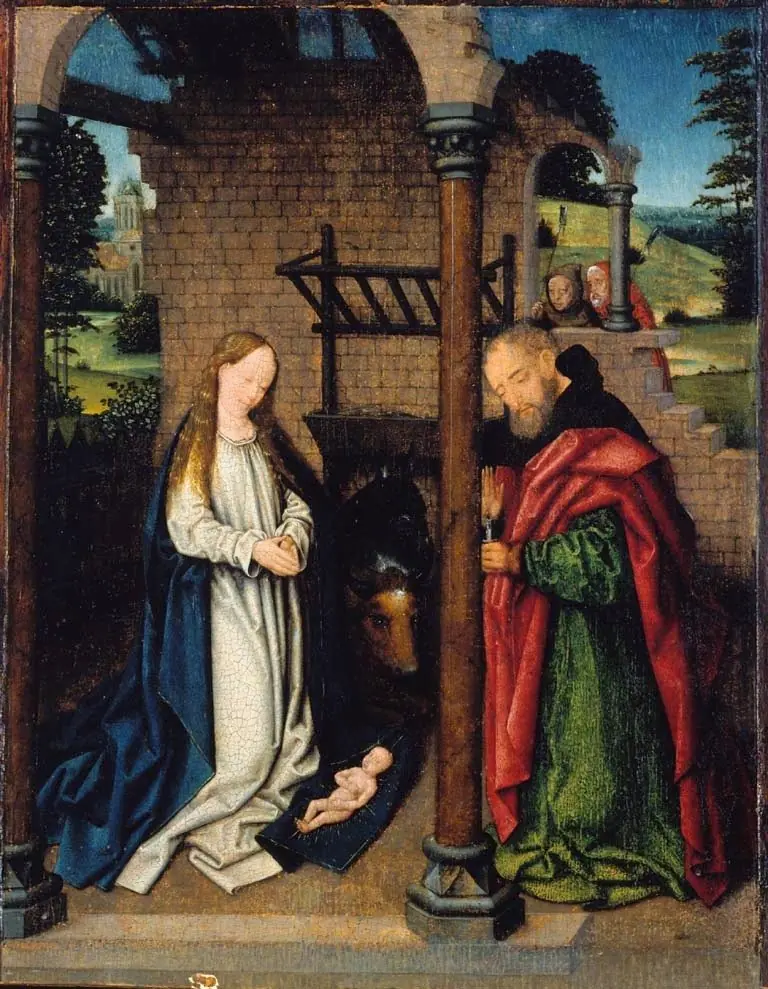
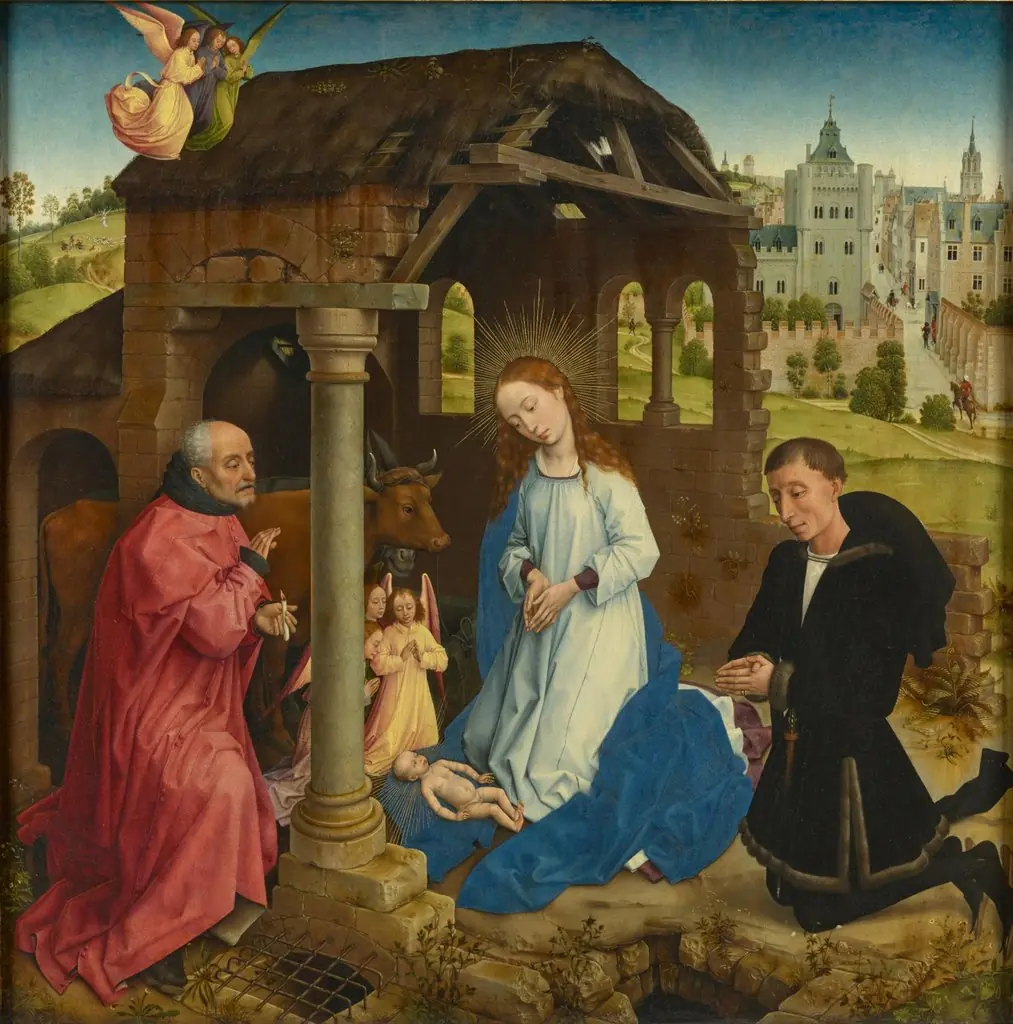
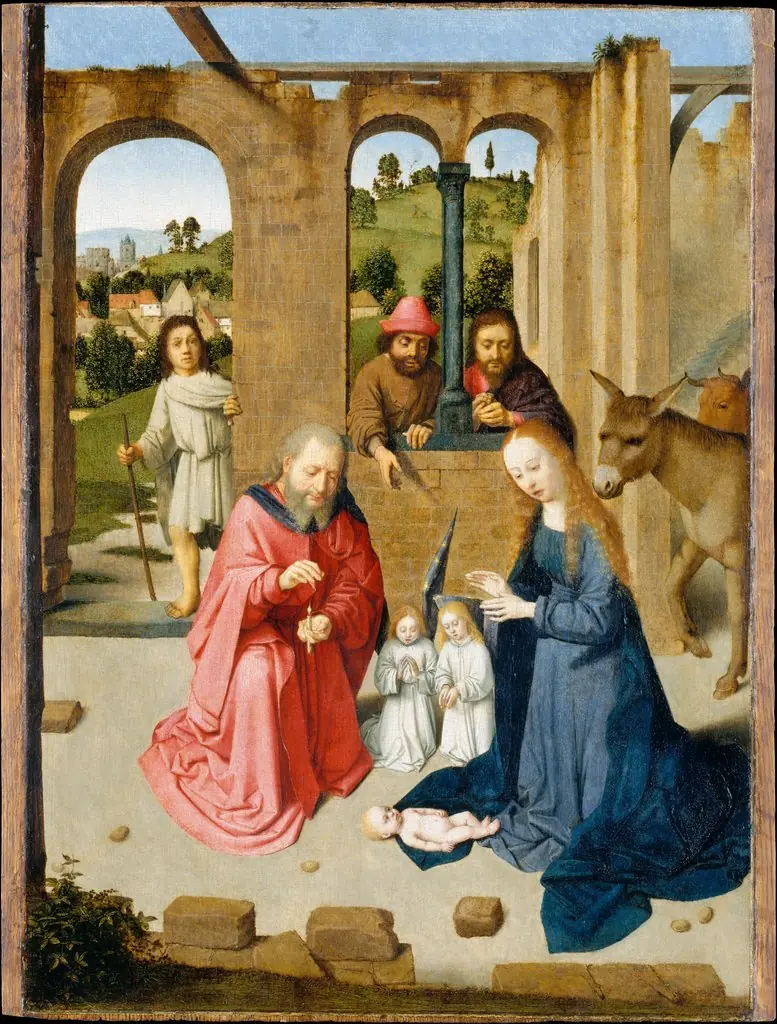
A quiet night scene: Mary kneels by the Christ Child in a stable, Joseph stands in shadow, and an ox and donkey peer in from the left. Petrus Christus painted it around 1450 for a private home, the Child glowing softly under Mary's blue cloak.
Subject & Meaning
Beyond the shed, a Netherlandish town with domed buildings (symbolizing Jerusalem) links the Nativity to Christ’s Passion, reinforcing the redemptive arc.
Petrus Christus’s The Nativity (c. 1450) presents the Christian narrative of Christ’s birth through a layered iconography that juxtaposes Old Testament sin with New Testament redemption. The central scene depicts the Holy Family, Mary in blue, Joseph humbly barefoot, adored by four angels, while the Christ Child lies on Mary’s robe, signaling divine incarnation. Surrounding this sacred space, grisaille archways frame trompe-l'œil sculptural reliefs illustrating the Fall of Man: Adam and Eve’s expulsion, their labor, and Cain and Abel’s story.
These scenes underscore the theological message of humanity’s fall and Christ’s future sacrifice. Beyond the shed, a Netherlandish town with domed buildings (symbolizing Jerusalem) links the Nativity to Christ’s Passion, reinforcing the redemptive arc. The composition’s one-point perspective and monumental scale (127.6 × 94.9 cm) amplify its devotional function, reflecting the Devotio Moderna emphasis on meditative piety.
Technique & Style
The Nativity is painted in oil on a multi‑board oak panel, originally assembled from four planks and measuring about 128 × 95 cm, and was intended as a central altarpiece panel (1,2). The composition is framed by a painted grisaille archway with trompe‑l’œil relief, within which six Genesis scenes are carved in low relief, linking Old Testament sin to New Testament redemption (3). The composition arranges the interior shed with a single‑point perspective, aligning the roof beams and the figures on a central vanishing point, producing a harmonious, naturalistic space that emphasizes simplicity, serenity and a restrained palette (3).
The handling of light suggests an early‑morning glow, while the angels and the Adam‑Eve figures introduce symbolic contrast. Technical study shows paint loss at the panel seams and a 1990s conservation treatment that removed earlier overpaints and stabilized the surface (4).
History & Provenance
Created by Petrus Christus around 1450 to 1458, the panel is dated variously by scholars, with dendrochronology suggesting the oak was felled between 1442 and 1448 and a probable completion near 1455 or 1458. The large dimensions suggest it was intended as a central altarpiece panel, though its specific commission and original patron remain unknown. Max Friedländer definitively attributed the work to Christus in 1930.
Provenance records indicate the painting was owned by Señora O. Yturbe in Madrid before being acquired by Berlin dealer Franz M. Zatzenstein. It was sold to the Duveen Brothers in 1930, purchased by the A.W. Mellon Educational and Charitable Trust on December 15, 1936, and subsequently gifted to the National Gallery of Art in Washington, D.C., in 1937. The work underwent significant restoration in the early 1990s.
The Nativity has been held by the National Gallery of Art in Washington, D.C., since 1937, as part of the Andrew W. Mellon Collection. The provenance traces from Señora O. Yturbe in Madrid to Franz M. Zatzenstein (founder of the Galerie Matthiesen, Berlin, and later London), who sold it in 1930 to Duveen Brothers; the painting was purchased on 15 December 1936 by The A.W. Mellon Educational and Charitable Trust in Pittsburgh and gifted to the NGA in 1937. Max Friedländer definitively attributed the panel to Petrus Christus in 1930.
The painting underwent significant restoration in the early 1990s for the 1994 Metropolitan Museum of Art exhibition "Petrus Christus: Renaissance Master of Bruges," where it was one of thirteen works displayed.
Context
Petrus Christus's The Nativity (c. 1450–1458) is widely regarded as the artist's most significant work, with Max Friedländer asserting in 1930 that it surpasses all other known creations by the master in scope and importance. Situated within the Early Netherlandish tradition, the panel synthesizes influences from Jan van Eyck and Rogier van der Weyden, particularly adapting the latter's architectural framing devices from the Miraflores and Saint John Altarpieces. Scholars note the painting's sophisticated integration of Devotio Moderna spirituality, juxtaposing Old Testament scenes of the Fall with the New Testament redemption.
While dendrochronology suggests a date near 1458, art historians like Maryan Ainsworth argue for a later completion around 1465 based on the softness of facial features and advanced perspective. The work's monumental scale, unusual for a single panel, implies a central altarpiece function, marking a high point in Christus's mature style and the evolution of mid-15th-century religious art.
Legacy
Max Friedländer definitively attributed the work to Petrus Christus in 1930, declaring it superior in scope and importance to all other known creations by the master. Recognized as one of the artist's most significant achievements, the panel is distinguished as the "Washington Nativity" to separate it from his other versions in Bruges and Berlin. Art historians regard the piece as a pinnacle of Early Netherlandish painting, noting its sophisticated synthesis of Jan van Eyck and Rogier van der Weyden's influences into a unique mid-15th-century sensibility.
Its legacy includes its prominent role in the 1930s acquisition by Andrew Mellon, which secured its place in the National Gallery of Art in Washington, D.C. The work's reputation was further cemented by a major restoration in the early 1990s for the exhibition "Petrus Christus: Renaissance Master of Bruges" at the Metropolitan Museum of Art, where its complex iconography of the Fall and Redemption was highlighted for modern audiences.
Overview
Petrus Christus's The Nativity, an oil-on-panel painting from the mid-1450s, presents a devotional depiction of the birth of Christ. This significant work by the Early Netherlandish artist showcases the era's characteristic simplicity and naturalism. It is recognized for its balanced composition and visual complexity, integrating elements that were both contemporary and reflective of earlier Netherlandish masters. Art historians consider it among Christus's most accomplished creations.
Own this work as a print
Artist & collection
Artist
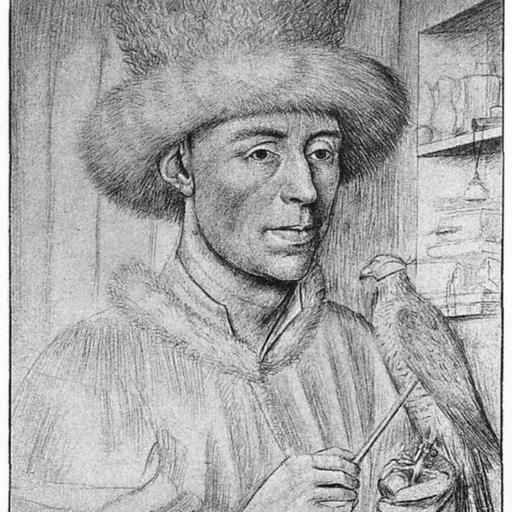
Petrus Christus (Dutch:; c. 1410/1420 – c. 1475/1476) was an Early Netherlandish painter active in Bruges from 1444, where, along with Hans Memling, he became the leading painter after the death of Jan van Eyck. He was…