Artwork
The Annunciation
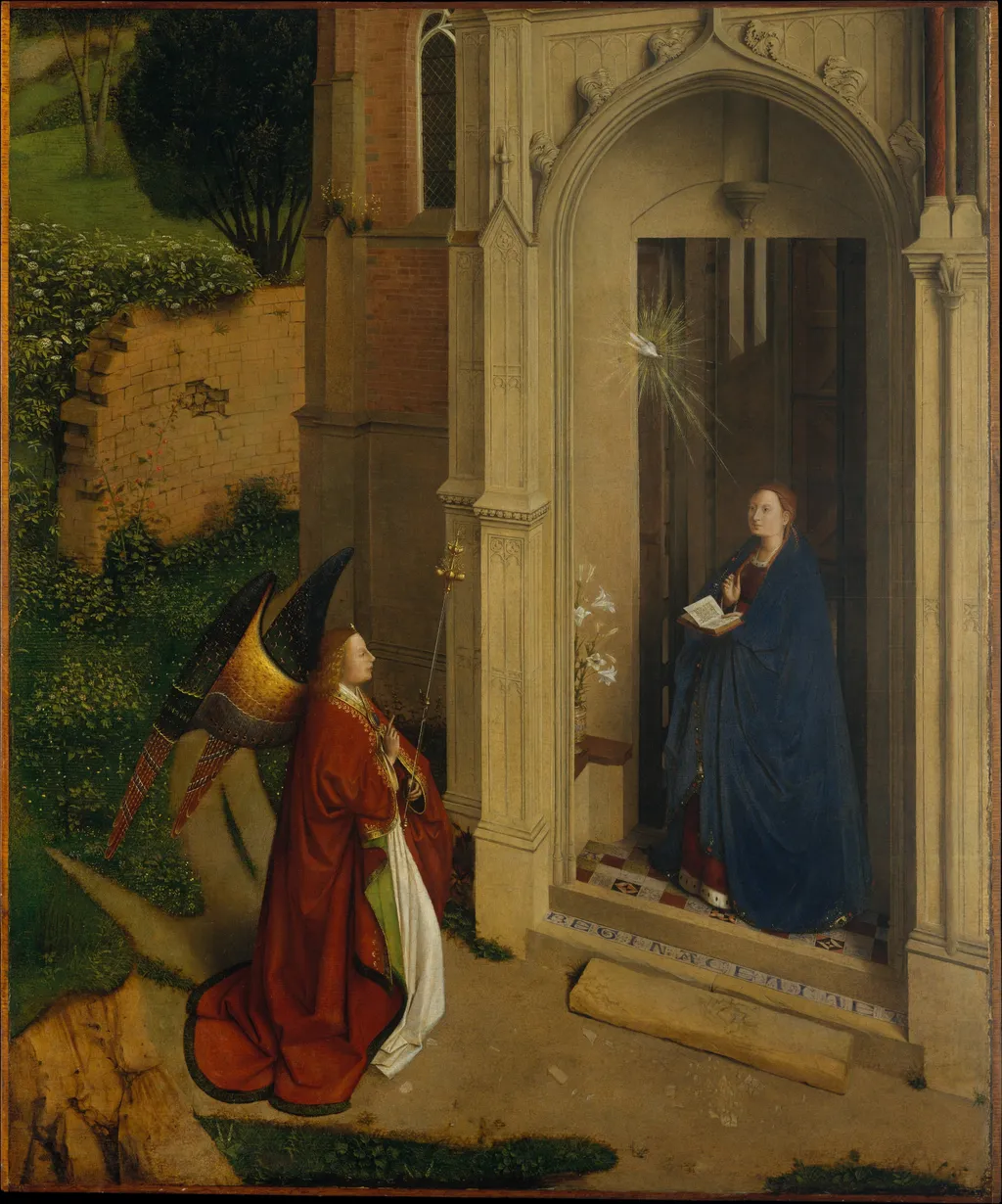
The Annunciation is an oil painting by the Northern Renaissance artist Petrus Christus. It dates from 1450 and is held in the collection of the Metropolitan Museum of Art.
About this work
Subject & Meaning
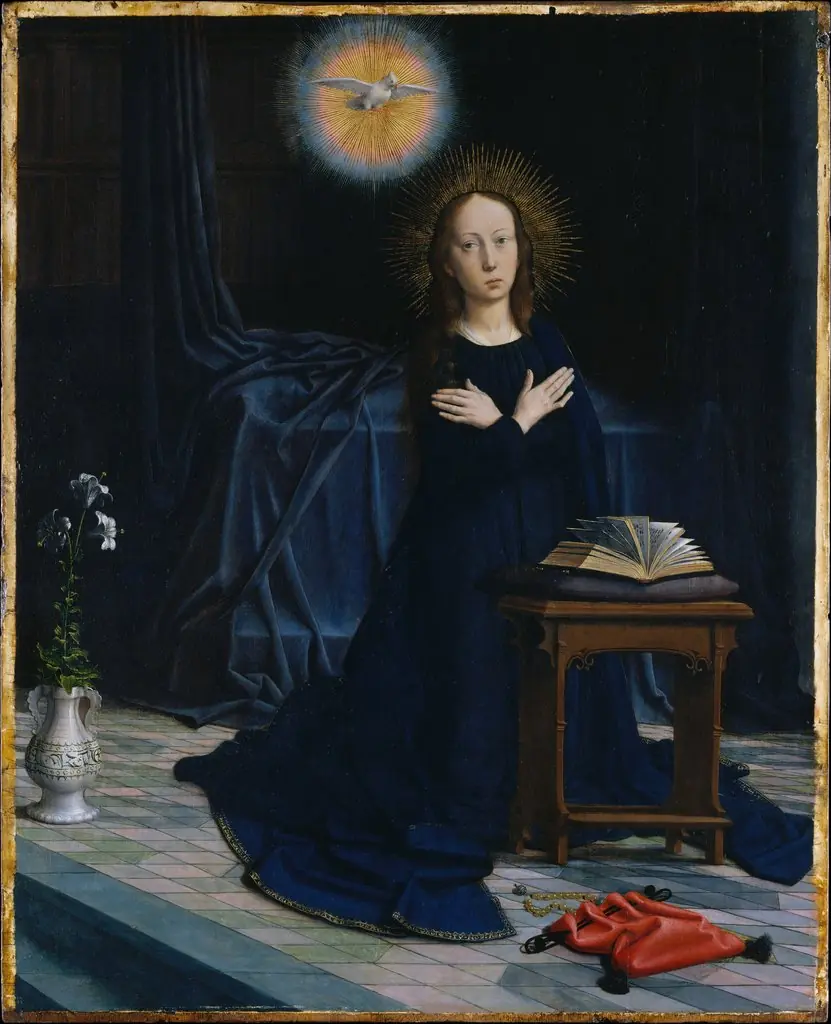
White lilies in a glass vase represent Mary's purity, while the crumbling wall and unmanicured flora signify the pre-Advent era before Christ's restoration.
The work depicts the biblical Annunciation, where the archangel Gabriel informs Mary she will conceive Jesus through a virgin birth. Set unusually in a semi-enclosed, wild garden outside a church rather than a domestic interior, the scene utilizes rich symbolism. White lilies in a glass vase represent Mary's purity, while the crumbling wall and unmanicured flora signify the pre-Advent era before Christ's restoration.
The church architecture combines Romanesque and Gothic styles, interpreted as the transition from the Old Testament (Judaism) to the New Testament (Christianity), with the Virgin acting as the intercessor between these eras. Gabriel wears red and white liturgical vestments and holds a scepter, while a dove descending from above symbolizes the Holy Spirit. Inscriptions on the steps read "REGINA CELI LET[ARE]" and display the letters "A" and "M" for Ave Maria, identifying Mary as the Queen of Heaven and the spiritual gateway to salvation.
Technique & Style
The Annunciation is executed in oil paint on an oak panel, a typical support for Early Netherlandish works. The painting shows a bird's-eye view and subtle perspective anomalies that scholars attribute to its having been cut down on three sides from a larger left-hand wing of a triptych. The handling is meticulous: Gabriel's liturgical vestments, the multicolored tiled steps, the inscribed "REGINA CELI LET[ARE]" and the vase of white lilies are rendered with fine detail, while the surrounding garden contains precisely depicted wildflowers, daisies, strawberries, orchids, each carrying symbolic meaning.
Stylistically, the work blends Romanesque and Gothic architectural elements, uses light to delineate space, and exemplifies the naturalistic yet symbolic approach of the Flemish primitives.
History & Provenance
Created circa 1445 to 1450, this oil-on-oak panel is currently attributed to Petrus Christus, though its authorship was historically contested. Throughout the nineteenth century, it was ascribed to Hubert van Eyck, with early twentieth-century scholars alternatively proposing Jan van Eyck or dating it as early as 1420. Debates continued into the 1930s between experts favoring Christus versus the Van Eycks, with some suggesting it was a copy by Christus of a lost Jan van Eyck original.
Technical analysis in 1994, including dendrochronology by Peter Klein, confirmed a post-1426 date consistent with Christus's activity in Bruges, solidifying his attribution. The work, likely a cropped fragment from a larger triptych wing, entered the Metropolitan Museum of Art in 1931 via bequest from collector Michael Friedsam.
The painting is held by the Metropolitan Museum of Art in New York, where it has been on view since the Friedsam bequest of 1931, documented in the museum's European paintings collection. It was included in the museum's 1994 exhibition 'Petrus Christus: Renaissance Master of Bruges,' which presented it alongside other early Netherlandish pieces to illustrate the development of the style.
Context
Scholarship on this panel, commonly known as the Friedsam Annunciation, has long centered on its disputed attribution. While nineteenth-century critics favored Hubert van Eyck, early twentieth-century debate shifted between Jan van Eyck and Petrus Christus. Prominent scholars Erwin Panofsky and Max Jakob Friedländer represented opposing views, with Panofsky initially supporting Jan van Eyck based on stylistic links to earlier works, while Friedländer argued for Christus, possibly copying a lost original.
Technical analysis in the late twentieth century, including dendrochronology by Peter Klein and studies of the underdrawing during a 1994 exhibition, ultimately confirmed Christus's authorship, dating the work to circa 1445–1450. Art historians interpret the painting's unique exterior setting and architectural hybridity, blending Romanesque and Gothic elements, as symbolic of the transition from the Old to the New Testament. Its spatial anomalies and cropped edges suggest it was originally the left wing of a larger triptych.
Legacy
The painting, commonly known as the Friedsam Annunciation, has significantly influenced art historical discourse regarding Early Netherlandish attribution. Throughout the 19th and early 20th centuries, scholars debated its authorship, variously assigning it to Hubert van Eyck, Jan van Eyck, or Petrus Christus. This contention peaked in the 1930s between leading experts Erwin Panofsky and Max Jakob Friedländer, reflecting a broader resurgence of interest in the field.
The work's complex perspective and spatial anomalies have made it a focal point for analyzing the transition from Eyckian models to Christus's style. Modern technical studies, including dendrochronology and underdrawing analysis conducted for a 1994 exhibition, ultimately confirmed Christus's authorship, establishing the panel as a key example of his early adaptation of Jan van Eyck's visual language while introducing innovations in linear perspective.
Overview
The Annunciation, often referred to as the Friedsam Annunciation, is an oil painting on an oak panel created around 1445. This work is generally attributed to the Early Netherlandish artist Petrus Christus. It depicts the biblical moment when the Archangel Gabriel informs the Virgin Mary that she will miraculously conceive Jesus Christ, a pivotal event in Christian theology. The painting's composition presents several distinctive visual characteristics, including an unusual perspective.
Own this work as a print
Artist & collection
Artist
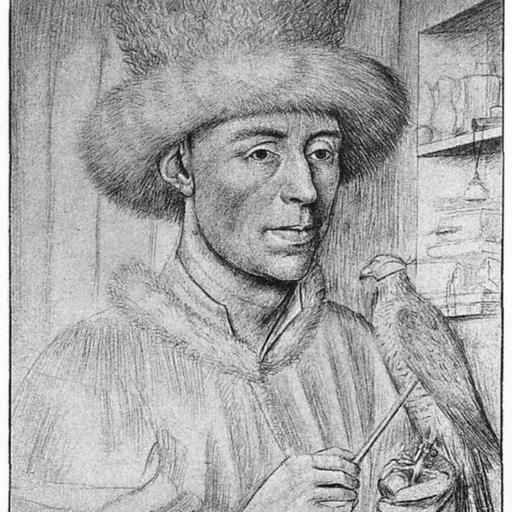
Petrus Christus (Dutch:; c. 1410/1420 – c. 1475/1476) was an Early Netherlandish painter active in Bruges from 1444, where, along with Hans Memling, he became the leading painter after the death of Jan van Eyck. He was…