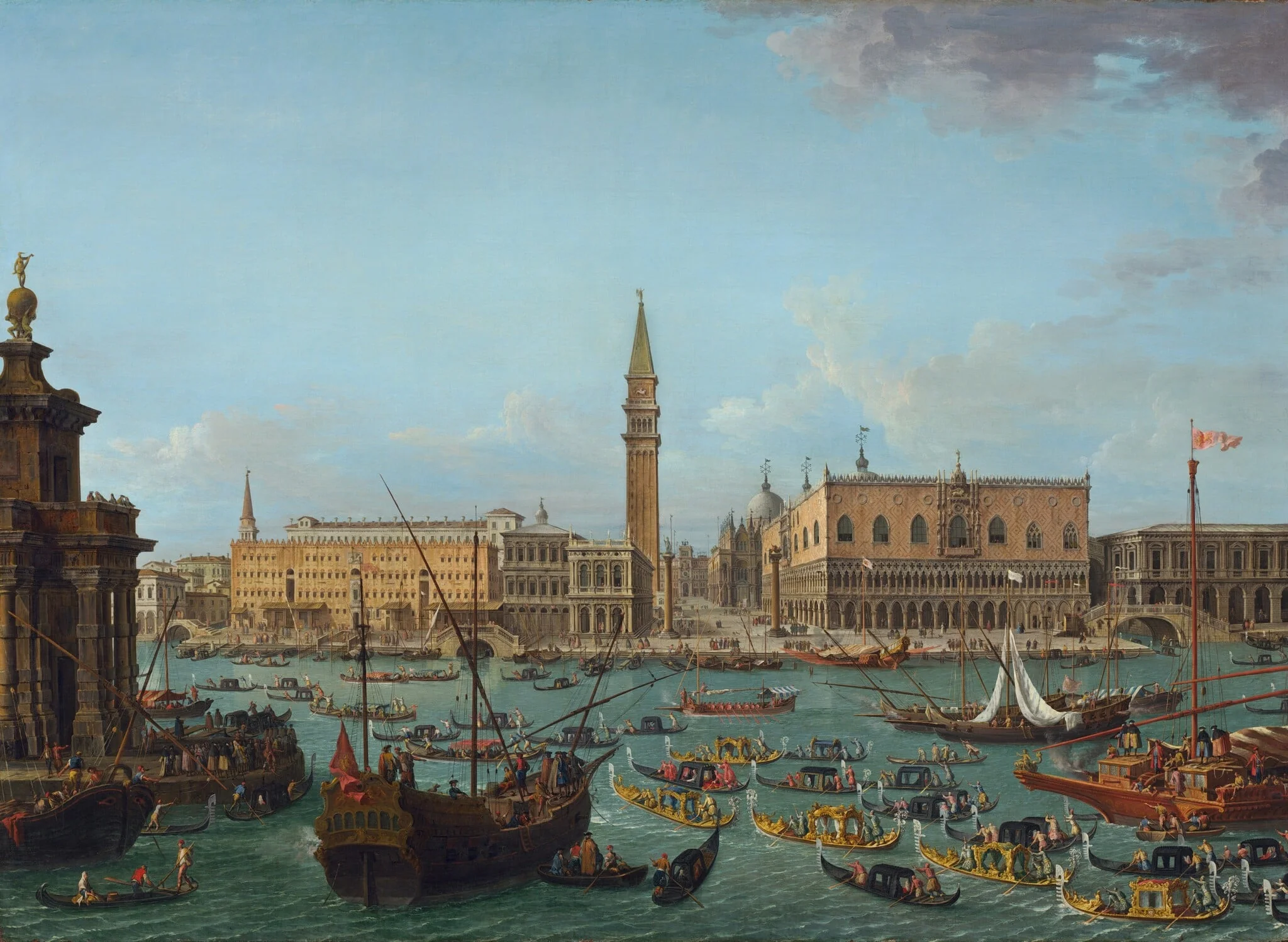
The cityscape as a painted genre asks to be read the way a city is actually seen: slowly, from one vantage, with the eye returning to the same stones until they give something up. Survey histories of the form move at the speed of a tour bus. They name Bruges, then Rome, then Venice, Delft, Paris, and pull away before any of those places comes into focus. This essay takes the opposite wager. It stays with one painting, Antonio Joli's view of gondolas crossing the Bacino di San Marco, and treats that single canvas as the whole argument. Look long enough at how a view painter ordered water, masonry, and crowd, and the deep grammar of the genre shows itself without a single date being recited from memory.
Here is the claim the essay will defend. A cityscape is never a neutral record of a place. It is a built argument about how a city wishes to be seen, and the painter's decisions about where to stand, what to raise, what to flatten, and where to let the light fall carry that argument from first brushstroke to last. The accurate-looking view is the most rhetorical kind of picture there is. To prove it, I revisit Joli's Bacino three times across these paragraphs, then test the reading against Canaletto, Turner, Pissarro, and Jean Béraud, each of whom inherited the same problem: how to turn a real address into a composition that holds.
First look: the Bacino as a stage
Begin with the water. Joli sets the horizon low, a little below the midline, so the Bacino opens as a broad sheet of pale grey-green that fills the bottom third of the canvas. Across it a line of gondolas moves in procession, their black hulls the darkest notes in the whole picture, each curved prow repeating the one ahead so the eye is tugged rightward toward the domes. The boats are not scattered the way a real harbor scatters them. They are ranked, evenly spaced, turned at almost identical angles, a fleet arranged for legibility rather than for traffic. On the right the customs point of the Dogana cuts into the water, and behind it the campanile and the bulk of San Marco rise into a sky kept deliberately quiet, so that nothing in the air competes with the architecture. Joli trained as a scene painter for the opera house before he became a vedutista, and the canvas never hides it. The buildings stand like flats, the water reads like a polished forestage, and the daylight comes in flat and even, as if thrown from the wings.
That theatrical order is the argument, not a flaw in it. Venice on an ordinary working morning did not arrange its boats into a frieze. Joli imposed the frieze because a procession reads as ceremony, and ceremony is what a foreign buyer wanted to carry home: proof that he had stood at the threshold of the most theatrical city in Europe and watched it perform. Notice what the painter suppressed to get there. The far shore is generalized into a low band, detail thinning as it recedes so the eye never snags on a wrong window. The crowd on the quay is summarized in quick touches of warm color, present as texture, absent as individuals. Everything bends toward a single effect, the city as a slow pageant gliding past a viewer who has been given the best seat. See the painting in full at its gallery page for Joli's Bacino, and the staging becomes hard to unsee.
How the view learned to be exact
Joli's stagecraft did not appear from nowhere. The detailed city view, the veduta, grew out of Northern habits of patient observation. The genre took early root in Flanders, where painters such as Paul Bril were producing topographical views as far back as the sixteenth century, according to the standard account of the veduta. The decisive shift toward measured accuracy came with the Dutch-born Gaspar van Wittel, who settled in Rome and worked under the Italian name Vanvitelli. He helped codify the veduta esatta, the exact view, in which a monument or a stretch of city is rendered with topographical precision and the human figures are demoted to staffage, small markers of scale and life rather than subjects in their own right.
Underneath that documentary surface sat an older, stranger ancestor: the ideal city of the Italian Renaissance, the architectural view built entirely from one-point perspective. An early panel of this kind, an architectural veduta attributed to Francesco di Giorgio Martini, shows a town square with no inhabitants at all, every cornice and paving stone obedient to a single vanishing point. The picture is a proof of geometry dressed as a place. This is the genre's hidden DNA. Long before painters claimed to be copying a real skyline, they were using the city as a frame on which to demonstrate that space itself could be made to obey. When Joli ranks his gondolas, he is drawing on both lines of descent at once, Vanvitelli's accuracy and the geometer's love of an ordered ground plane.
Canaletto and the souvenir city
If one painter turned the exact view into an industry, it was Canaletto, the most celebrated vedutista of eighteenth-century Venice. His clientele was specific and well documented. The National Gallery of Art's account of Canaletto notes that his Venetian views were bought above all as souvenirs by wealthy British men on the Grand Tour, who were his most reliable customers. That economic fact reshapes how we read the paintings. A Canaletto is a luxury memory, calibrated to a buyer who needed his Venice to look like the Venice he had paid to visit. Sharpness, sunlight, and a flattering distribution of famous landmarks were not aesthetic accidents. They were the product specification.
Set Canaletto's Entrance to the Grand Canal from the Molo beside the Joli and the kinship is immediate. Again the water is a wide, clean foreground; again the great buildings are ranged along a receding diagonal, the dome of Santa Maria della Salute anchoring one side while the palaces step back toward a luminous distance. But look at the difference in the light. Canaletto floods the scene with a hard, even brilliance that picks out the string-courses of every façade and the rigging of every moored boat. Shadows fall in crisp geometric blocks. The reflections in the canal are ruled almost as carefully as the architecture above them. Where Joli softens the far shore into atmosphere, Canaletto keeps the deep distance legible, every campanile accounted for. His Venice is a city without weather, held in a permanent clear noon so that the buyer's memory will never blur.
The studio output was vast, and the gallery's holdings reflect it: this archive alone gathers ninety-eight works under Canaletto's name, a body deep enough to watch his formulas repeat and vary across the lagoon. The same hand and the same market produced canvases now scattered across the great collections, among them a Grand Canal view from Palazzo Flangini to Campo San Marcuola, painted about 1738, which now hangs in Los Angeles. The repetition is the point. A souvenir genre needs a recognizable house style, and Canaletto built one precise enough to survive being copied by his own workshop and by his nephew Bernardo Bellotto across half of Europe.
Turner lets the city dissolve
A generation later, Turner went to Venice and attacked the exact view from inside. His Venice: The Dogana and San Giorgio Maggiore takes the very motifs Canaletto sold, the customs point and the island church across the water, and refuses to hold them still. The architecture is there, but it is half-eaten by light. The Dogana reads as a pale silhouette rather than a measured structure; San Giorgio floats on its own reflection with no firm waterline to separate stone from sea. Turner has kept the topography and thrown away the contract that came with it. He is not selling a clear memory. He is recording the moment when a famous skyline stops being a set of buildings and becomes a condition of the air. The exact view and its dissolution are two ends of one argument about what a city is for: a place to be possessed, or a place to be lost in.
It is worth pausing on how radical that move was within the genre. The whole eighteenth-century apparatus, from Vanvitelli's measured monuments to Canaletto's ruled reflections, had been built to make the city more knowable than it is in life. Turner inherited every one of those tools and turned them against their purpose. The result still counts as a cityscape, because the subject is unmistakably a real place at a real hour. What has changed is the painter's loyalty. Turner is loyal to the light first and the address second, and that reordering of priorities is the hinge on which the modern city picture would soon swing.
The street replaces the monument
The nineteenth century moved the cityscape off the ceremonial waterfront and into the ordinary street. Tate, defining landscape as one of the principal genres of Western art, also records how that category was pushed and widened in the modern era to take in the urban and the industrial, the scene with smoke and traffic in it. Two Paris pictures in this archive show the shift in action. Across the gallery the genre runs unusually deep here, with 3,205 cityscape works by 1,176 artists held across 122 venues, the earliest reaching back to about 1490 and the latest close to 2020, which is room enough to follow the form from the ideal city all the way to the wet pavement.
Pissarro's The Louvre, Afternoon, Rainy Weather is the exact view turned inside out. Pissarro painted it from a high window, looking down at a city damp and grey, the long palace front softened by mist, the trees along the quay bare, the road below shining with rain. The figures and carriages are reduced to dark commas of paint, true to the eye of a watcher several floors up rather than to any single passerby. Where Canaletto banished weather, Pissarro makes weather the entire subject. The Louvre matters here less as a monument than as a grey mass that catches the failing afternoon light. With thirty-four works under his name in this collection, Pissarro can be seen returning to this elevated city motif again and again, the same square or boulevard restudied under changing skies, a method closer to a meteorologist's notebook than to a souvenir.
Béraud comes at the modern city from street level. His Paris, rue du Havre stands the viewer on the pavement amid top hats and hurrying skirts, a horse-drawn omnibus pressing forward, the Saint-Lazare district crowding in on both sides. The architecture has retreated to a backdrop; the true subject is the crowd and its momentum. Béraud paints the friction of a working city, the jostle and the glance, the wet shine of the road, the smudge of breath and smoke. Joli's gondolas had been arranged for the eye; Béraud's pedestrians arrange themselves, and the painter's job is to catch them mid-stride before the arrangement breaks. The genre that began as a proof of geometry has become a report on velocity.
Works discussed in this article
Second look: what the single work was hiding
Return now to Joli, knowing what the others did. The procession that first read as charming reads differently once Pissarro and Béraud have shown what a real street looks like. Joli's crowd is not a crowd; it is a decorative hem along the bottom of the architecture, present so the city will not look deserted. His water carries no current, his sky no weather, his boats no urgency. The painting is a piece of governance as much as a piece of observation. It tells the viewer that Venice is orderly, eternal, and available, that the city will hold its pose for as long as you care to look. That is the quiet politics of the souvenir view, and it runs from the ideal city of the Renaissance straight through Canaletto's clientele.
This is why the single-work method earns its keep. A survey would have set Joli, Canaletto, Turner, Pissarro, and Béraud side by side as five entries in a timeline and let the reader assume they were doing roughly the same thing with different brushwork. Staying inside one canvas, then carrying its specific choices to the next, exposes the real fault line. The question is never whether a cityscape is accurate. The question is what the accuracy is for, who paid for it, and what the painter had to leave out of the frame to make the city behave.
There is one more reason to trust the long look. A cityscape rewards return in a way few genres do, because a real place keeps offering new evidence against the painter's claim. Stand in front of Joli's Bacino a third time and the gondolas no longer glide; they hold position, frozen in a parade that never quite departs. The city he promised was permanent turns out to be a city that cannot move. That stillness is the deepest thing the painting knows about itself, and no survey, racing past, would ever have let it surface. The next time you meet a famous skyline on a wall, stay with it past the moment of recognition. Watch for the boat that sits a hair too forward, the shore that thins too conveniently, the noon that never ends. The argument is always in there, waiting to be caught mid-pose.
Sources & further reading
- Veduta — Wikipedia
- Architectural Veduta (attributed to Francesco di Giorgio Martini) — Smarthistory
- Canaletto — National Gallery of Art
- Landscape (art term) — Tate
- Venice and Northern Italy, 1600-1800 — The Metropolitan Museum of Art, Heilbrunn Timeline of Art History
- The Grand Canal in Venice from Palazzo Flangini to Campo San Marcuola (about 1738) — The J. Paul Getty Museum
- View of Delft — Wikipedia
- Vedute di Roma, vols. 1-2 (1779) — Internet Archive