Artwork
Procession of Gondolas in the Bacino di San Marco, Venice
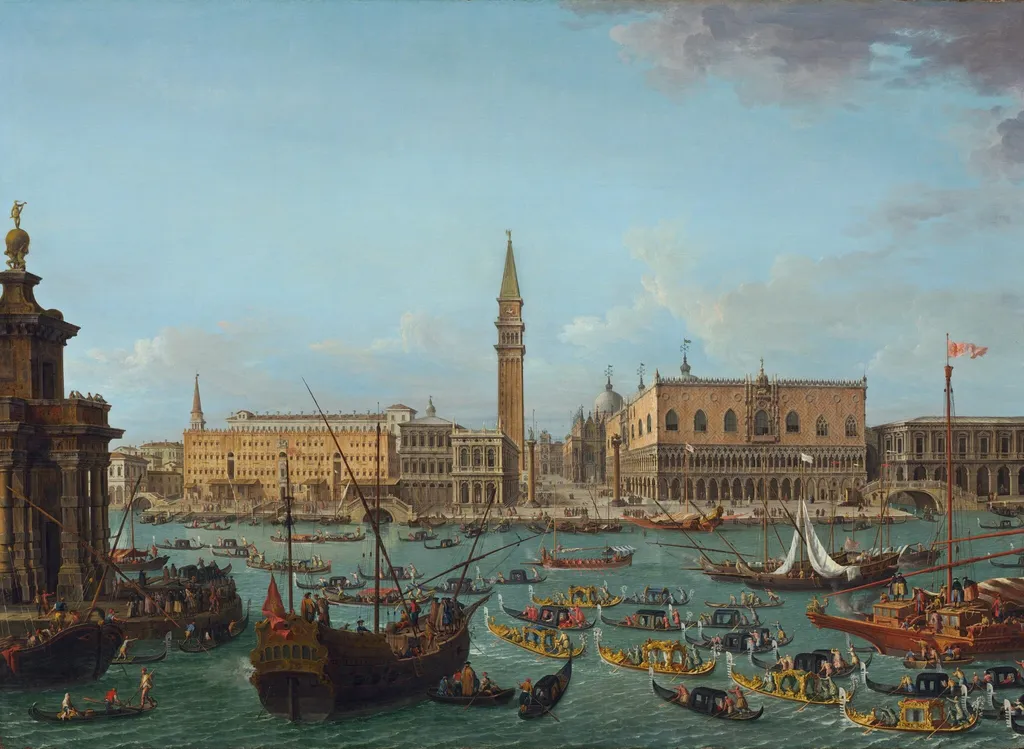
Procession of Gondolas in the Bacino di San Marco, Venice is an oil painting by the Baroque artist Antonio Joli. It dates from 1742 and is held in the collection of the National Gallery of Art.
About this work
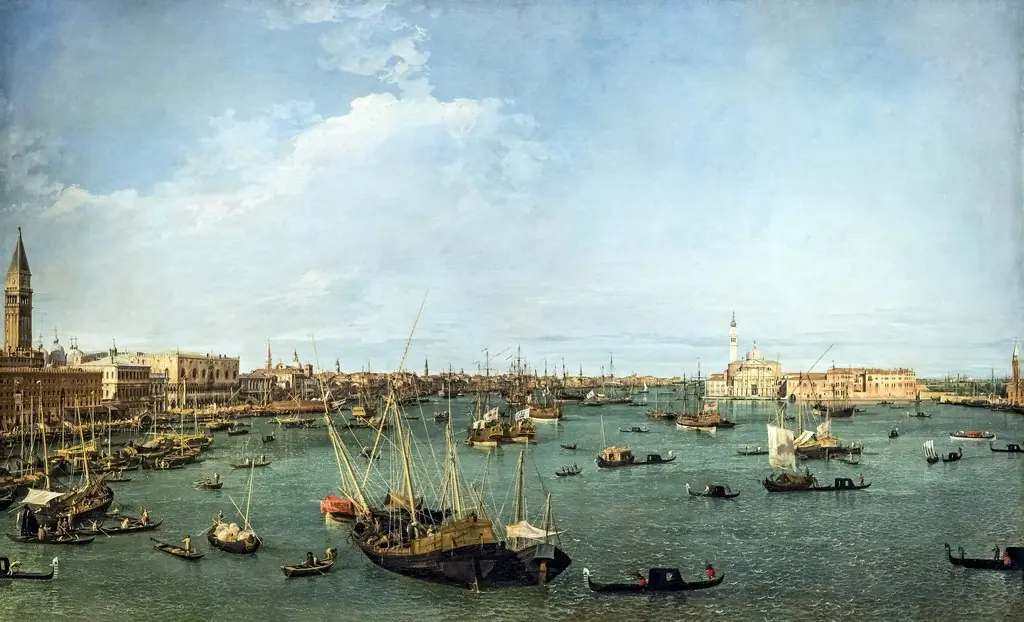
Gondolas thread through the aquamarine Bacino di San Marco beneath the Doge's Palace, their oars catching the light as Venice turns a civic ritual into theater.
Gondolas thread through the aquamarine Bacino di San Marco beneath the Doge's Palace, their oars catching the light as Venice turns a civic ritual into theater. Antonio Joli painted the procession around 1742 or later, capturing the Republic's maritime pageantry with the sweeping perspective of a man who designed opera sets. The canvas runs nearly two and a half meters wide, crowded with ceremonial watercraft against the familiar waterfront.
Subject & Meaning
This painting depicts a ceremonial procession of gondolas on the Bacino di San Marco, framed by the city's most recognisable landmarks: the Doge's Palace, St. Mark's Basilica and Campanile, and the Piazzetta. As a veduta, it merges topographical accuracy with a celebratory view of Venetian civic and maritime life. The gondolas, typical of Venetian transport, here form an orderly flotilla, likely alluding to official festivities such as the annual Wedding of the Sea ceremony or a state regatta.
The composition directs the viewer's gaze across the basin, underscoring Venice's relationship with the lagoon and its architectural splendour. Thus the work functions both as a detailed record of the city and an emblem of its grandeur and ceremonial traditions.
History & Provenance
This painting was created in 1742 by Antonio Joli. Its provenance begins with a possible ownership by Cardinal Gianfrancesco Stopani (d. 1774) in Rome, then by inheritance to Marchese Schiuchinelli in Cremona, and later with Giuseppe Castagna and Felice Ponzio in 1836. Subsequent owners included Lady Mary Baillie of Polkemmet and Admiral Johnston Stewart of Polkemmet.
The work was sold at Christie's in London on 21 June 1912, bought by C. H. Thrift for Arthur Tooth and Sons, then sold on 14 July 1925 to Viscount Gabriel Chabert. It was with Arnold Seligmann in London in the early 1930s, sold to Barbara Hutton, and gifted by her to the National Gallery of Art in 1945.
Context
Though long associated with Canaletto in early scholarship, the painting is now firmly attributed to Antonio Joli, a leading Venetian vedutista active in the same milieu. A 1836 letter by Stefano Ticozzi, quoted by Constable, described what he believed were Canaletto works of similar subject and size, but scholarly reassessment has identified Joli as the true creator. The work belongs to the flourishing tradition of 18th-century Venetian vedute, which Joli practised alongside contemporaries like Canaletto and Guardi.
Its grand scale (160.7 x 221.6 cm) and detailed depiction of the Bacino di San Marco align with the genre's emphasis on topographical accuracy and ceremonial spectacle. The painting's place in art history is thus within the canon of Venetian view painting, reflecting both Joli's individual style and the broader market for such celebratory cityscapes among Grand Tour patrons.
Overview
Antonio Joli's "Procession of Gondolas in the Bacino di San Marco, Venice" is an oil on canvas painting created around 1742 or later. This large-scale work captures a vibrant civic ceremony unfolding on the Venetian lagoon, showcasing the Republic's maritime grandeur. Joli, known for his theatrical sensibilities, transforms the event into a dramatic spectacle, merging precise architectural details with dynamic light and lively figures.
Technique & Style
Joli's background as a theatrical scenographer profoundly shaped his approach to veduta painting. In this work, he combines meticulous architectural rendering with a dramatic use of light and shadow, creating a sense of depth and spectacle. The bustling "staffage" of numerous small figures animates the scene, transforming a static cityscape into a vibrant, dynamic tableau that evokes the energy of a stage production.
Own this work as a print
Artist & collection

Artist
Antonio Joli painted grand, sunlit views of Italian ruins and landscapes in the 1700s.