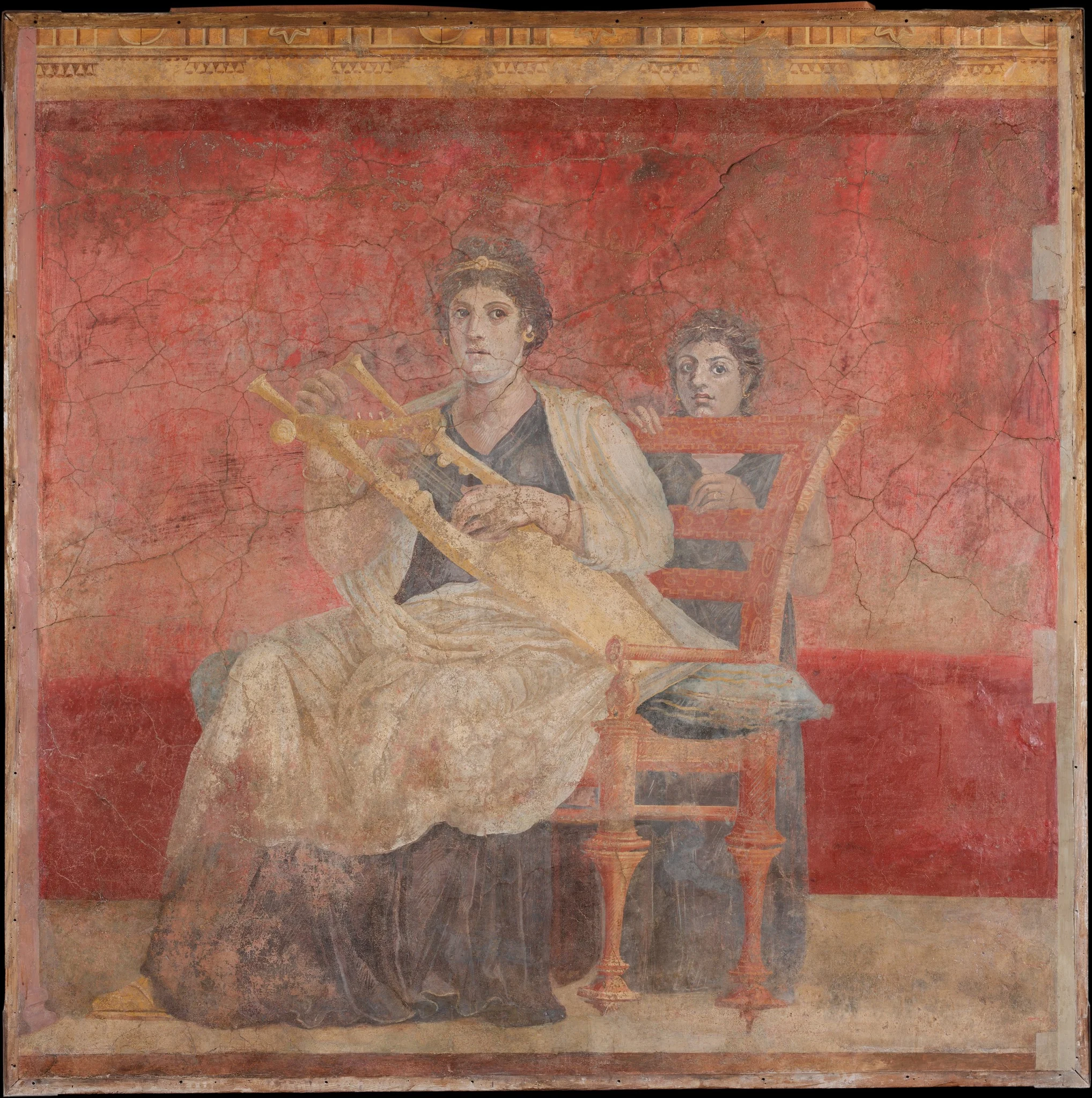
The painters of classical antiquity had already solved problems that European art would spend the next thousand years forgetting and then relearning. By the middle of the first century BC, a workshop in the Bay of Naples could open a solid plaster wall into a sunlit colonnade, set a glass bowl of fruit on a painted ledge so convincingly that the eye reaches for it, and load a brush with enough confidence that you can still read the speed of the stroke two thousand years later. That is the claim this essay defends: the formal achievement of antique painting was illusion, atmosphere, and a frank, visible hand, and the version of the classical that we inherited, all white marble and serene proportion, is a later invention that buried the paint. Recover the paint and the period stops looking like a museum of restraint. It starts looking like a workshop of working illusionists.
Most of what survives compounds the misunderstanding. Greek panel painting, the prestige art the ancients themselves prized, is gone almost without trace; we know Apelles and Zeuxis only from description. Panels were portable, painted on wood, and fragile. War, damp, fire, and simple reuse erased them, while the wall paintings survived only because a volcano buried them and the portraits survived only because dry Egyptian sand kept the wax intact. Survival selected against the very works the ancients ranked highest. What remains is the second tier as the Greeks would have ranked it: Roman wall decoration sealed by the eruption of Vesuvius in 79 AD, and a few thousand encaustic mummy portraits from Roman Egypt. Sculpture survived better, and so sculpture became the face of antiquity. The formal break worth naming runs in two directions at once. Antique painters broke toward illusion, and the early modern scholars who canonized them broke away from it, recasting a lost, painterly art as a doctrine of restraint.
A wall that opens
Step into the cubiculum from the Villa of P. Fannius Synistor at Boscoreale, painted around 50 to 40 BC and now reassembled at the Metropolitan Museum. The back wall does not behave like a wall. A row of slender columns, wrapped in gilded vines, stands forward of the plane, and behind them the surface drops away into a rocky sanctuary: a grotto, a small fountain, a circular tower glimpsed past a low parapet. The painter has set a painted ledge across the lower register and then let the architecture climb and recede above it, so the room you stand in seems to give onto a second, sunlit room that was never built. Fruit rests on stone. A theatrical mask hangs high in the design. Nothing is labeled, nothing is explained, and the effect is of looking through the bedroom into a walled garden at the hour before noon.
Up close the architecture is painted with economy. A column shaft is two or three confident sweeps of ochre with a single cool line down its shaded side, and the vine that spirals up it is dabbed in, leaf by leaf, without fuss. The painter is not laboring over detail. He places just enough information for the eye to complete the rest, which is the trick every later illusionist would have to learn for himself.
Two things in that wall matter for the argument. First, the recession is constructed but not unified. The orthogonals of the colonnade slant toward depth, yet they do not converge on a single vanishing point the way a Renaissance perspective box would demand; the painter is reasoning toward space empirically, fixing each passage by eye rather than by rule. Second, the light is consistent. Shadows fall the same way across the whole field, the columns catch a warm highlight along one edge, and the grotto sinks into cool shade. A Roman decorator working two generations before Augustus already understood that a painted world holds together through light before it holds together through geometry. That is a sophisticated instinct, and it is precisely the instinct the medieval West would mislay.
The composition breaks toward depth
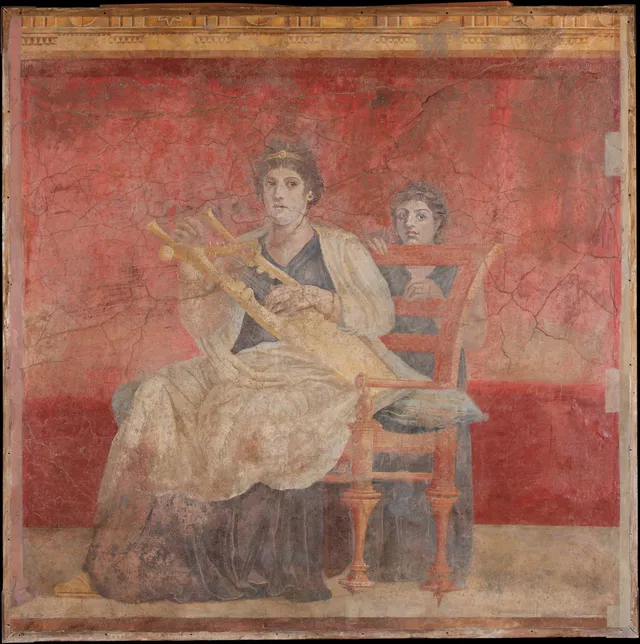
The Boscoreale room belongs to what scholars call the Second Style of Roman wall painting, the phase in which the decorated surface tries hardest to abolish itself. Earlier Roman walls imitated marble veneer, a flat lie about cladding. The Second Style raises the ambition: it pretends the wall is not there at all, replacing it with columns, podia, and deep architectural views. Read against the long history of European painting, this is the formal break stated plainly. Centuries before Giotto tilted a floor or Brunelleschi codified one-point perspective, a Campanian workshop was opening interior walls into measured, shadowed distance and trusting the viewer to walk in with their eyes. The achievement is empirical rather than theoretical, and that is part of what makes it so easy for later ages to overlook. A rule can be taught, written down, and inherited. A hard-won instinct that lives only in a workshop dies with the workshop.
The companion panels from the same villa make the system legible. The wall painting from the west wall of Room L, also at the Met, repeats the vocabulary at a different pitch: framing columns, a recessed aedicula, planes of saturated red and black that read as architecture under raking light. Set the two rooms beside each other and you see a workshop with a repeatable grammar of depth, not a single lucky picture. This is craft knowledge, transmitted and applied. The Roman painter here is closer to a stage designer than to a draftsman. The goal is a convincing place, lit and inhabitable, and the brush is bent entirely to that end.
Light, and the loaded brush
For the handling of paint itself, turn from the wall to the face. The Portrait of a Woman from second-century Roman Egypt is a mummy portrait, painted in encaustic, pigment suspended in hot wax and worked while still warm. Look closely at the surface. The flesh is built from short, directional strokes that never blend into a porcelain finish; you can see where the brush or the heated spatula dragged the wax, leaving ridges that still catch light. A bright accent sits on the bridge of the nose and along the lower lid, placed wet and left alone. The eyes are large, dark, frontal, fixed on the viewer with an attention that feels uncomfortably present. The painter wanted a likeness that would outlast the body, and got there not by smoothing the paint but by trusting it.
Encaustic forced decisions. The wax cooled fast, so a stroke laid was a stroke kept, with little scope for the patient glazing a later oil painter would use to dissolve every transition into the next. The medium rewarded a painter who could commit. What reads to a modern eye as boldness is partly the plain honesty of a technique that would not let you fuss. The painter had to know exactly where the highlight went before the wax stiffened under the spatula.
This is the second half of the break, and the more surprising one. Antique painters were not afraid of the mark. Roman wet-plaster technique rewarded speed, because pigment had to be laid into damp lime before it set, and the fresco passages from Campania carry that velocity in every confident contour. The encaustic portraits carry it in built-up touches of colored wax. Stand a Fayum head next to a fifteenth-century Flemish panel and the antique work can look, paradoxically, the more modern of the two: looser, faster, more willing to let the means show. The myth of the classical as cold and licked smooth dissolves the moment you get within a foot of an actual antique painted surface.
The word arrived late
None of the people who made these works called themselves classical. The dates we hang the period on are conventional: classical antiquity runs roughly from the eighth century BC, the era of the earliest recorded Greek epic, to the fall of the Western Roman Empire in 476 AD, as the standard reference overview of the period sets it out. The label came much later. The decisive turn arrived in 1764, when Johann Joachim Winckelmann published his history of ancient art and, together with the freshly excavated ruins of Pompeii, set off the intense eighteenth-century flourishing of classicism we now call Neoclassicism. The thing came first by some two thousand years; the category that organizes our museums came after.
Winckelmann's achievement was real and his distortion was lasting. His History of Ancient Art, still readable in full today, taught Europe to see Greek sculpture as the summit of human form and to prize a calm, restrained grandeur in the figure. The trouble is that he built that ideal almost entirely from sculpture, much of it Roman marble copied from lost Greek bronze, stripped by time of its original color. He never saw the Greek originals he praised. He reasoned from copies, from casts, from the marble that Rome had made of Greek bronze, and he reasoned brilliantly, but always at one remove from the thing itself. His Greece was a Greece of plaster and prose. The antique statues he revered had in fact been brightly painted. The whiteness was an accident of survival, and Winckelmann mistook the accident for the essence. The doctrine of classical restraint that descends from him is, in a real sense, a theory of the missing paint.
Works discussed in this article
What the archive actually holds
This is where our own holdings sharpen the picture. Artifact World Gallery catalogs 12,249 works under classical antiquity, drawn from 128 venues and 2,595 named or anonymous hands, with dates spanning from roughly 1249 to 2000. That last figure should stop you. A period that textbooks close in the fifth century carries, in a working image corpus, objects stamped across seven centuries of the second millennium. The reason is that the bucket is built from dates and subject matter, not from a European syllabus, and the result is more honest than the syllabus. It gathers what the ancient world made together with what later ages made about the ancient world, and it refuses to pretend the category was ever sealed.
Spread those 12,249 works across 128 venues and you get a thin, wide distribution. No single collection owns the period; the evidence is scattered through museums that each kept whatever fragment came their way. The 2,595 hands are mostly anonymous, which is itself a fact about antiquity rather than a gap in our records. The named master is the exception and the workshop is the rule, exactly as the unsigned Boscoreale walls and the unsigned Fayum faces would lead you to expect.
It also refuses to pretend antiquity was only Mediterranean. Inside the same period sit works from the far ends of Eurasia. The Hills of Kuaiji, a handscroll after Gu Kaizhi, carries a Chinese landscape tradition whose founding figure worked in the fourth century AD, a contemporary of the late Roman world. The Iconographical Drawing of the Mandala of the Wisdom King Aizen preserves a Buddhist image-lineage of comparable depth, and the corpus's East Asian holdings extend forward through ink masters such as Tesshū Tokusai. None of these is Greek or Roman, and including them is the point. Antiquity was plural, and a corpus assembled from evidence rather than from canon surfaces the parallel achievements the white-marble story leaves out.
Antiquity's long afterlife
Sculpture, meanwhile, kept the antique line alive precisely because it could be copied. Polykleitos's Doryphoros, the Spear-Bearer, survives only as Roman marble versions after a lost Greek bronze of about 450 to 440 BC, as the Smarthistory account of the statue details, and those copies became the standing demonstration of ideal proportion and contrapposto for every later academy. A canon you can replicate in marble travels through time in a way a single fresco on a buried wall cannot. The fifth century BC acquired a near-mythic status as the moment the human figure was solved. When the National Gallery of Art gathered original fifth-century marbles and bronzes for its 1992 exhibition The Greek Miracle, the title said the quiet part aloud: this was treated as the dawn from which everything else descends.
The collecting that built our museums followed the same gravity. J. Paul Getty began buying antiquities in Rome in 1939, concentrating on Greek and Roman marble statues, reliefs, bronzes, and mosaics, the holdings now shown at the Getty Villa. The afterlife reaches into unexpected corners of the corpus. A portrait of George Washington sits inside the same period bucket, and it belongs there by descent rather than by date. The founders posed for a republic that imagined itself in Roman dress, Cincinnatus called from the plow, the toga as the costume of civic virtue. Antiquity had become a usable language for the present, which is exactly what the neoclassical revival was built to provide.
The honest conclusion is uncomfortable for the textbook. The painting of classical antiquity was a fast, illusionistic, light-driven art that we mostly lost, and the idea of classical antiquity is a serene, sculptural, restrained art that we mostly invented. The Renaissance did not so much continue the antique as reopen a sealed room and reconstruct what the Romans already knew about depth and shadow. The next time a painted Roman wall comes within reach, stand close enough to read the brush. The grandeur is real, but the surprise is the speed of the hand, still legible after two thousand years, still ahead of its reputation.
Sources & further reading
- Classical antiquity — Wikipedia
- Neoclassicism — Tate
- History of Ancient Art (Geschichte der Kunst des Alterthums), trans. G. H. Lodge — Internet Archive
- Polykleitos, Doryphoros (Spear-Bearer) — Smarthistory
- Classicism — Tate
- Roman Copies of Greek Statues (Heilbrunn Timeline of Art History) — The Metropolitan Museum of Art
- The Greek Miracle: Classical Sculpture from the Dawn of Democracy, the Fifth Century B.C. — National Gallery of Art
- Antiquities at the J. Paul Getty Museum — The J. Paul Getty Museum