The paintings of Paul Cézanne were made on a road. He spent his adult life moving between Paris, where the new painting was being argued into existence, and Aix-en-Provence, the dry limestone country where he was born and meant to die. The pictures carry that distance inside them. A motif seen in the south had to survive the trip into the studio and onto the canvas, and Cézanne treated that survival as the central problem of his art. He was forever lugging a perception from one place to another, and the question that occupied him was whether it could arrive intact. Most painters of his generation asked how a scene looked on a given afternoon. Cézanne asked something stranger and harder, namely how a scene could be made to stay once the afternoon was over.
Here is the claim this essay defends. Cézanne's real subject was transit: the act of carrying a sensation from the world to the canvas without letting it come apart on the way. He grew to distrust how Impressionism let a scene melt into light, and he spent three decades building a method that would hold the journey steady. That method is visible in everything from the tilt of a tabletop to the way a far mountain refuses to recede. After his death in 1906 the work traveled again, this time without him, into the studios of younger Parisians who pried his planes apart and named the result Cubism. The Metropolitan Museum's Heilbrunn Timeline essay on Cézanne places him among the Post-Impressionists on exactly these grounds, crediting his construction of form through color as the lever the Cubists and Fauves would later pull. So the story runs twice. A man carries Provence north, and a method carries itself into the next century.
Two cities, one shuttle
Cézanne was born in Aix-en-Provence on 19 January 1839, the son of a hatter who became a banker, and he died in the same town on 22 October 1906. Between those dates he kept a metronome going between the south and the capital. In Paris he fell in with the future Impressionists and with his boyhood friend, the novelist Émile Zola, who had grown up beside him in Aix and understood the pull of the place. His work appeared in the first Salon des Refusés in 1863, the exhibition Napoleon III opened for pictures the official jury had turned away. The official Salon then rejected his submissions every year from 1864 to 1869, a run of refusals that would have ended a less stubborn career. He did not give up Paris and he did not give up Aix. He commuted between them, and the commute became the shape of the work.
That double life was not a matter of indecision. Paris gave him the argument, the company of painters who were tearing up the rulebook in real time, and the friction of a jury that kept saying no. Aix gave him the motif, the same hard light falling on the same rock year after year. He needed both, and the back-and-forth taught him to think of a painting as something that begins in one world and has to be completed in another. The studio was where the journey ended, and the ending was the hard part.
His early painting is heavier and darker than anything the Impressionists would make. He loaded pigment with a palette knife and built figures out of slabs of black and earth, closer to Gustave Courbet than to the feathery touch of the boulevards. These canvases have a bruised, sculptural force. They also show a young man trying to make paint behave like mass, a concern he never abandoned even after his palette brightened. The romantic violence of the early subjects, the abductions and murders and storms, faded as he aged. The appetite for weight stayed. You can already feel him wanting the paint to push back, to sit on the surface like something you could lift.
Learning to distrust the shimmer
In the early 1870s Camille Pissarro took Cézanne in hand at Pontoise and Auvers, and the older man's patience with light loosened the younger man's brush. Cézanne lightened, broke his color into separate touches, and learned to paint outdoors beside the very Impressionists whose program he would soon outgrow. He showed in the first Impressionist exhibition of 1874 alongside painters like Alfred Sisley, whose dissolving river light is the exact effect Cézanne came to suspect. Tate dates Post-Impressionism to the changes that overtook Impressionism from about 1886, the year of the last Impressionist group show in Paris, as the gallery's own glossary explains. By roughly that date Cézanne had already turned away from the capital and gone home to the mountain. He had taken what Pissarro gave him, the bright separated touch, and bent it toward an end Pissarro never had in mind.
What did he distrust, exactly? An Impressionist canvas records a single hour of weather. The light is true, and the scene is gone the moment the cloud moves. A haystack at noon is a different object from the same haystack at dusk, and the Impressionists made a virtue of that fact. Cézanne wanted something the method could not give him on its own. He wanted the truth of the sensation and the permanence of the thing at the same time. He wanted a painting that felt observed and felt built, freshly seen and solid as a wall. That double demand cannot be satisfied cleanly, and the productive friction of it drives every major picture he made after 1880. He kept the broken Impressionist color and threw out the Impressionist impermanence. The shimmer had to set into stone.
What the table does
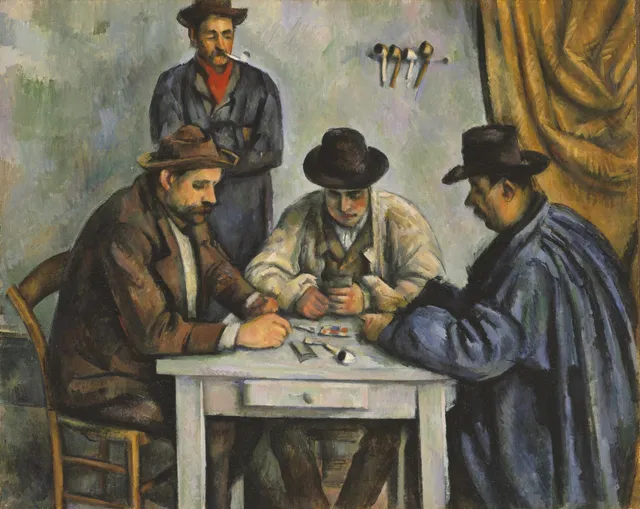
Look hard at The Card Players. Smarthistory dates the Metropolitan's canvas to 1890 through 1892 and counts it among a series Cézanne devoted to the subject, in its essay on the painting. Two laborers sit across a narrow table, each folded over his hand of cards. The table edge tilts up toward us, flattening the depth the rest of the room insists on. The bottle at the center sits a hair too far forward, a vertical that pins the two men in place like a hinge. Their jackets are built from the same blue and ocher bricks as the wall behind them, so the figures and their setting are made of one continuous masonry of paint. Even the shadows have heft. The brim of one man's hat, the slope of a shoulder, the dark wedge between the two bodies all read as carpentry, fitted joints rather than fleeting effects.
Nothing here is anecdote. There is no money on the table, no cheating, no story to read off the surface. Cézanne has taken a Dutch tavern subject, the kind of scene where seventeenth-century painters packed in drunkenness and trickery, and drained the genre out of it, leaving only weight and balance. The men are heavy. The cards are light. The whole picture holds its breath. He is not recording a café. He is rebuilding one, plane by plane, into something that will not move when you look away. Stand with it long enough and the silence starts to feel like the point. These two figures will be playing this hand forever, frozen at the exact moment the paint decided to hold.
The scale of his return to a small set of motifs is easy to underestimate until you count. Artifact World Gallery holds 309 works under Cézanne's name, gathered from 38 separate venues and spanning roughly 1865 to 1906, and the striking thing about that spread is how few distinct subjects it contains. The same mountain, the same bathers, the same apples and card players recur across four decades and dozens of collections scattered around the world. He was not chasing variety. He was revising one sensation until it held. A lesser painter treats repetition as a failure of imagination. Cézanne treated it as the only honest way to get a thing right, circling back to the same motif the way a writer rewrites a single difficult sentence.
The mountain that would not move
No subject shows the method better than the mountain east of Aix. Mont Sainte-Victoire and the Viaduct of the Arc River Valley sets the limestone ridge behind a valley stitched with fields, a viaduct, and a single pine whose branches reach across the top of the canvas like a frame drawn from inside the scene. The far mountain and the near tree are painted with equal firmness, so distance stops behaving like distance. The eye is held at the surface even as the valley pretends to recede. The pine is not a repoussoir trick to push the mountain back. It is a second structure given the same density as the first, so foreground and background press against each other instead of falling into ordered depth. Cézanne returned to this peak again and again over the last twenty years of his life, and the late versions push the rebuilding further, until the rock is a stack of colored facets and the sky carries the same solidity as the ground.
He did the same to the coast. At L'Estaque, the fishing town on the Gulf of Marseille, he painted the bay as a wall of flat color. Le Golfe de Marseille vu de l'Estaque sets a foreground of orange roofs against a slab of blue water so dense it reads as a vertical plane rather than a receding surface. The sea, which should be the emptiest part of the picture, becomes the most physical. In Houses in Provence: The Riaux Valley near L'Estaque the buildings lock into the hillside like cut stone, their walls and the rock around them sharing one geometry. There is no soft transition between what people built and what the land already was. The south gave him hard light and bare structure, and structure was the thing he wanted. The motifs that travel best, it turns out, are the ones with the strongest bones.
Apples that refuse to roll
The still lifes carry the argument indoors. Still Life with Milk Jug and Fruit arranges a jug and a scatter of fruit on a cloth, and the longer you look the less the table obeys ordinary perspective. The rim of the jug, the lip of a plate, and the fold of the cloth each seem drawn from a slightly different angle, as if Cézanne had walked around the table and recorded several vantage points in one image. This is not clumsiness. A photograph fixes a single eye in a single instant, and he wanted more of the object than a single eye can hold. The fruit is built from patches of warm color laid side by side rather than blended, so each apple has weight without a single hard outline. These objects are not going to roll off the cloth. He has wedged them into place with paint, and the wedging is the picture. A bowl of fruit becomes a problem in masonry, and the solution is so quiet you almost miss how radical it is.
Harlequin: the figure as architecture
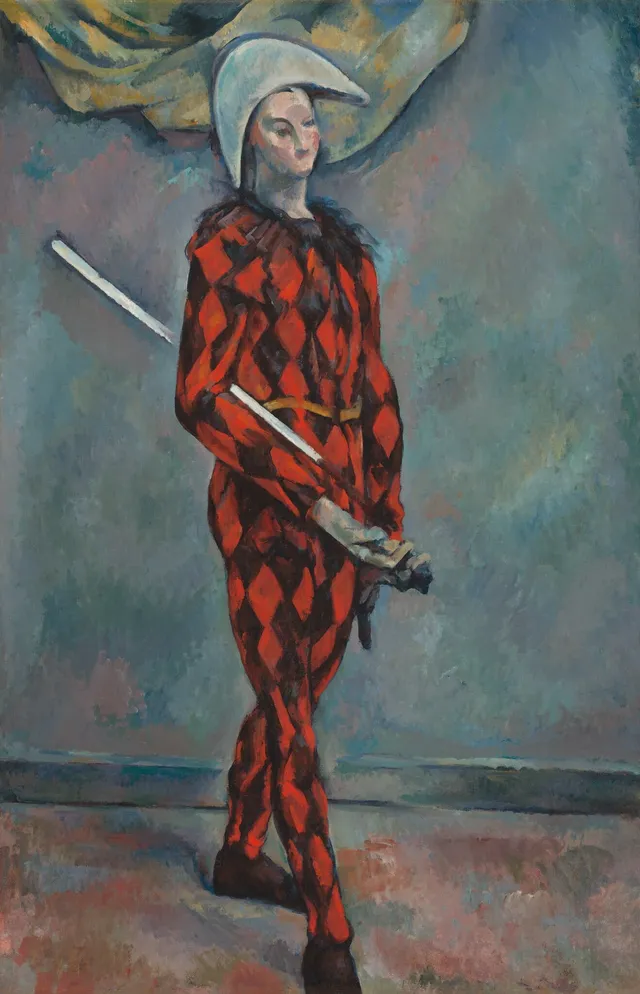
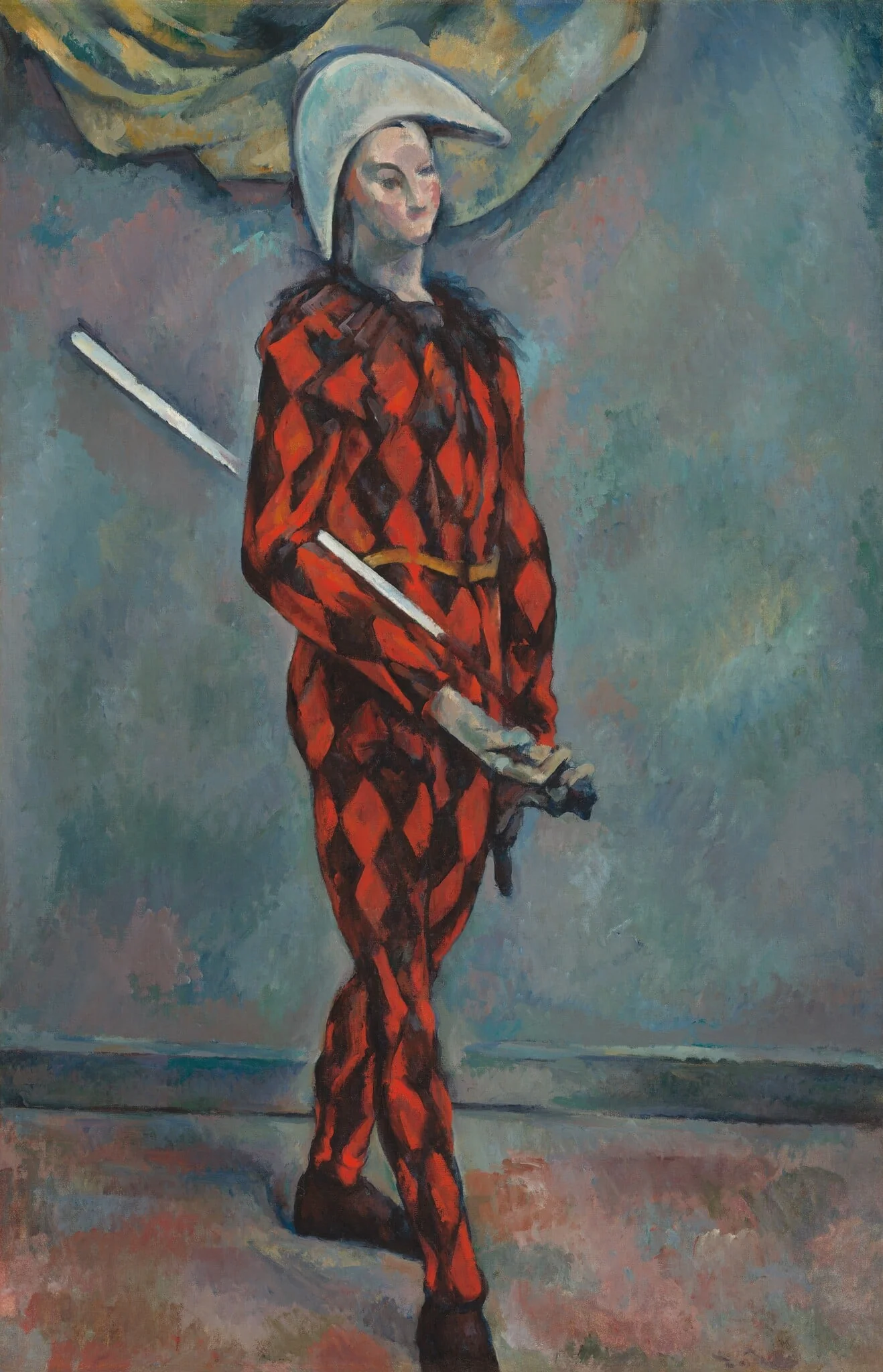
The same instinct governs his figures. Harlequin shows a single performer in the diamond-patterned costume of the commedia dell'arte, standing nearly full length and turned at a slight angle. The body is long and faintly unstable, the stance tipped as though the floor were not quite level. That tilt is deliberate. It gives the figure a slow torque, a sense of a solid thing caught mid-turn. The red and black lozenges of the suit are not decoration laid over a form. They are the form, a grid that wraps the torso and the legs and tells you exactly how the volume turns in space. Where the diamonds compress, the body curves away from us; where they stretch, it faces us. The face is closed and grave. None of the gaiety the costume promises survives Cézanne's handling. He uses the harlequin the way he uses a mountain, as a structure to be built rather than a character to be charmed by.
How the work traveled after him
Cézanne sold little and showed rarely in his lifetime, and the wider art world met him mostly through the dealer Ambroise Vollard, who gave him a one-man show in Paris in 1895. For most of his career he was a rumor as much as a presence, a name passed between younger painters who had seen a canvas or two and could not forget them. His reputation traveled faster than his body ever did. The Neo-Impressionists around Paul Signac had already broken color into a system, and the intimist generation of Édouard Vuillard was learning to treat a domestic interior as a flat field of pattern. Cézanne's lesson sat alongside theirs and outlasted them. Where the others flattened for decorative effect, he flattened to make the picture hold.
The poster-flat designs of Henri de Toulouse-Lautrec and the hard-edged interiors of Félix Vallotton belong to the same Post-Impressionist moment, each artist pushing painting away from the window-on-the-world toward the picture as a made thing. But it was Cézanne's faceted construction that the next generation seized on most directly. In 1907, the year after he died, a memorial retrospective in Paris put his work in front of every ambitious young painter in the city, and within two years his planes had been pried open into the first Cubist canvases. What the young men saw was permission. If a mountain could be a stack of facets and a jacket the same stuff as a wall, then the whole apparatus of illusion was optional. The motif had finally completed its longest journey, from a mountain near Aix to a studio in Montmartre, and it arrived rebuilt.
The critic Roger Fry, who did as much as anyone to carry Cézanne's reputation into the English-speaking world, built his whole formalist account around the conviction that the painter was after structure rather than appearance. His study of Cézanne's development remains one of the founding documents of that reading. The verdict has hardened into orthodoxy since, and like most orthodoxies it leaves something out. The paintings keep resisting any single theory. The structure is real, but so is the doubt in the touch, the sense of a man checking and rechecking a sensation he is not sure he has caught. They were made by someone who walked the same roads and painted the same peak until the act of seeing and the act of building became one gesture.
Stand in front of a late Mont Sainte-Victoire today and the mountain is still arriving. The facets of rock and sky have not quite resolved into a view, and they never will, because Cézanne stopped them at the moment of transit, half sensation and half architecture. He found the one place where a picture can be both freshly seen and permanently built, and he refused to push it past that point into either tidy illusion or pure design. That suspended arrival is what the twentieth century inherited. The road from Aix to Paris is gone, but the picture is still on it.
Works discussed in this article
Sources & further reading
- Paul Cézanne (1839-1906) — The Metropolitan Museum of Art (Heilbrunn Timeline of Art History)
- Paul Cézanne, The Card Players — Smarthistory
- Post-impressionism — Tate
- Cézanne, Mont Sainte-Victoire — Smarthistory
- Cézanne: A Study of His Development (Roger Fry) — Internet Archive