A century that hands itself over one frame at a time
Stand in front of one canvas long enough and a whole era begins to surrender its arguments. That is the wager of this essay. The Early 19th Century period in art is usually taught as a relay race of labels, with Neoclassicism handing a baton to Romanticism, Romanticism passing it to Realism, and a dozen national schools sprinting in the lanes between. That survey is tidy and it is also nearly useless, because it teaches the names of movements without teaching the experience of looking. The thesis here is narrower and, I think, more honest: the half-century from roughly 1800 to 1859 is best understood not through a taxonomy but through close-looking at a single defining work, read slowly, until its contradictions become the contradictions of the age.
I will defend that claim with one painting carried through the whole piece, Thomas Cole's view of the oxbow bend in the Connecticut River, and I will keep returning to it the way you return to a face in a crowded room. The argument is that this period's real subject was a quarrel about what a picture is for. Is it an instrument of reason, a flattering record of power, a faithful transcript of a particular meadow on a particular afternoon, or a vehicle for feeling so large it cannot be reasoned with? The early nineteenth century did not settle that quarrel. It painted it. And a viewer who learns to see the quarrel inside one frame will recognize it everywhere else, which is why the single-work method earns its keep.
What the archive actually holds
Before the close-looking, a number worth sitting with. Artifact World Gallery holds 31,249 works tagged to the Early 19th Century, drawn from 154 venues and made by 5,954 separate artists, the whole span sitting between about 1800 and 1859. That spread is the first piece of information-gain on offer, because it quietly contradicts the survey. Five thousand nine hundred painters do not constitute a movement. They constitute a population, and a population does not march in step. When a textbook tells you the period "was" Romantic, the archive answers with portrait miniaturists, court painters in Beijing, genre comedians in New York parlors, and topographical landscapists who would have found the word Romantic embarrassing. The era is plural before it is anything else.
Keep that plurality in mind, because the discipline of looking at one work is not a way of pretending the other 31,248 do not exist. It is the opposite. You choose a defining work precisely so that every other canvas in the holding can be measured against it, agreeing or dissenting. Cole's picture is useful as that yardstick because it argues with itself in plain sight.
The Oxbow, read slowly
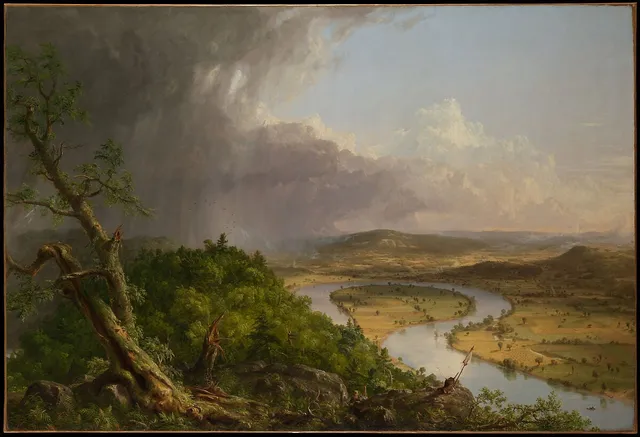
Look at Cole's Oxbow, painted in 1836 and now in the Metropolitan Museum of Art (metmuseum.org). The first thing the canvas does is break itself in half along a diagonal. On the left, the foreground rears up into wilderness: a storm still dragging its grey skirts across the hilltop, a blasted tree trunk shattered and clawing at the sky, undergrowth tangled and dark, the paint thick and agitated. On the right, past the ridgeline, the land drops away into a sunlit valley where the river loops back on itself in that famous oxbow, and the whole plain is parceled into pale fields, smoke rising from cleared lots, everything ordered and small and luminous. One painting, two weathers, two moral climates.
Now find the figure. Down in the middle distance, almost lost against the dark slope, Cole has painted himself at his easel, a tiny man under a tilted umbrella, palette in hand, turning back toward us as if we had interrupted him. He is the hinge of the picture. He sits on the wild side and looks toward the cultivated side, and his presence converts a landscape into a question about who is doing the looking and what they intend to do with the land. The brushwork tells the same story the composition does: loose, slashing, almost violent on the storm-side, then tightening into patient little strokes for the hedgerows and haystacks of the valley. The handling of paint is itself an argument about wilderness and use.
There is one more detail, easy to miss. On the far hillside the clearings have been cut into shapes that read, if you let them, almost as marks, as though the land were being inscribed. Cole, who feared what unchecked settlement would do to the American forest, has let the meadow carry a faint suggestion of writing, a signature of human appetite scratched across the green. The picture does not scold. It weighs. That weighing, conducted in pigment rather than prose, is the early nineteenth century thinking out loud.
Spend twenty minutes with that single canvas and you have already met the period's governing tension: observed fact set against felt meaning, the meadow you could survey set against the storm you can only submit to. Everything that follows is a way of testing how widely that tension holds.
Romanticism was an argument, not a paint-handling trick
The word that hovers over Cole's storm-side is Romanticism, and it is worth being precise about it, because the term gets used as if it meant nothing more than dramatic skies. The Metropolitan Museum dates the aesthetic to literary criticism around 1800, gathering force as a painted movement in France and Britain across the early decades and burning brightest until mid-century (metmuseum.org). Tate puts the high point of the shift away from the classical tradition between about 1780 and 1830, a generation-long swing in sensibility rather than a single dated event (tate.org.uk). The National Gallery of Art frames it as a deliberate revolt, artists placing emotion and intuition ahead of reason in reaction against Enlightenment rationality.
That last framing matters for the single-work method. Romanticism was not a look. It was a position in an argument with Neoclassicism, and the two need each other to make sense. The clearest contemporaneous evidence sits in the criticism of the day. William Hazlitt delivered his lectures on the English poets at the Surrey Institution and published them in 1818 (archive.org), and reading them you feel the new premium placed on gusto, on the felt particular, on the artist's temperament as a legitimate subject. The painters were doing on canvas what the critics were doing on the page, which is to insist that intensity of feeling could be a form of truth.
You can watch the argument turn violent elsewhere on the Continent. Francisco Goya painted his execution scene of 1808 in 1814, now in the Prado, where a man in a white shirt throws his arms wide before a faceless firing squad and the whole machinery of reasoned order is shown doing something unforgivable (smarthistory.org). Cole's New England storm and Goya's Madrid wall are not the same painting, but they share the conviction that feeling, faced honestly, tells a truth a balanced composition would lie about. That is the Romantic side of the quarrel. The period's interest lies in how stubbornly the other side held its ground.
Constable's lawn, and the truth of plain observation
Walk from Cole's storm to John Constable's Wivenhoe Park, Essex and the temperature drops, in the best way. Constable, who is represented in the holding by hundreds of works, was a Romantic by date and almost an anti-Romantic by temperament. There is no blasted tree here, no sublime threat. There is a particular English park on a particular cloud-shuffled morning: a sheet of water with cattle standing in the shallows, a low bright bank of trees, a fence running its modest line across the middle ground, and a sky doing the real work, those scudding cumulus shadows that Constable studied the way a meteorologist studies a chart.
Set that beside the Oxbow and the period's split opens cleanly. Cole organizes a landscape to mean something. Constable tries to record what a place actually looks like when light moves across it, trusting that fidelity will carry its own feeling without being told to. Both are responses to the same Enlightenment inheritance. One answers by heightening, the other by attending. The early nineteenth century is the room where those two answers argue, and the archive's five thousand painters mostly fall somewhere along the line drawn between them rather than at either pole.
Power, painted: David's Napoleon
Now bring in the third use of a picture, the one Cole and Constable both refuse. Jacques-Louis David's portrait of Napoleon in his study at the Tuileries is a machine built to make you believe something. David, the great Neoclassicist and the most politically useful painter of his generation, gives us the Emperor standing in candle-lit early-morning disarray, the clock reading past four, the candles guttered down, papers on the desk, one stocking slightly twisted. The argument is wordless and complete: while you slept, he worked for France. Every prop is a sentence.
This is reason marshaled in the service of power, the classical tradition lending its authority to a modern strongman. It is the exact thing Goya's firing squad indicts and the exact thing Cole's wilderness stands outside of. Put David's controlled, finished, persuasive surface next to the slashing storm-side of the Oxbow and you are looking at the period's deepest fault line. One painter believes a picture should compose the world into an argument you cannot refuse. The other has begun to suspect that the world's truth leaks out precisely where composition fails, in the storm, in the broken tree, in the weather that will not hold still to be surveyed.
The wider room: a parlor, a court, a lake
The single-work method would be a cheat if it only worked on the canonical heavyweights, so test it on the quieter holdings. Francis William Edmonds's The New Bonnet is a small American genre scene, a domestic comedy of vanity and thrift set in a plain interior, the kind of picture that never threatens the sublime and never wants to. Edmonds was a bank officer who painted, and his work belongs to the same decades as Cole's storm yet answers a completely different need: not awe, not power, but recognition, the pleasure of seeing ordinary social life observed with a wink. Hold it up to the Oxbow and you see how capacious the period really is. The same years that produced wilderness theology produced parlor jokes.
Then step entirely outside the European argument. Archery Contest, a Qing-dynasty court painting in the holding, was made within the same span but inside a pictorial system that owes nothing to Salon Neoclassicism or to the cult of feeling. Its conventions of space, its handling of figures and ground, its sense of what a painting is meant to commemorate, all proceed from a separate tradition. This is the corner where the textbook label quietly fails. "Early nineteenth century" is a calendar, not a style, and the 154 venues in the holding span continents that were not having the same conversation. The Romantic quarrel is real and central in Europe and America. It is also provincial, and the archive will not let you forget it.
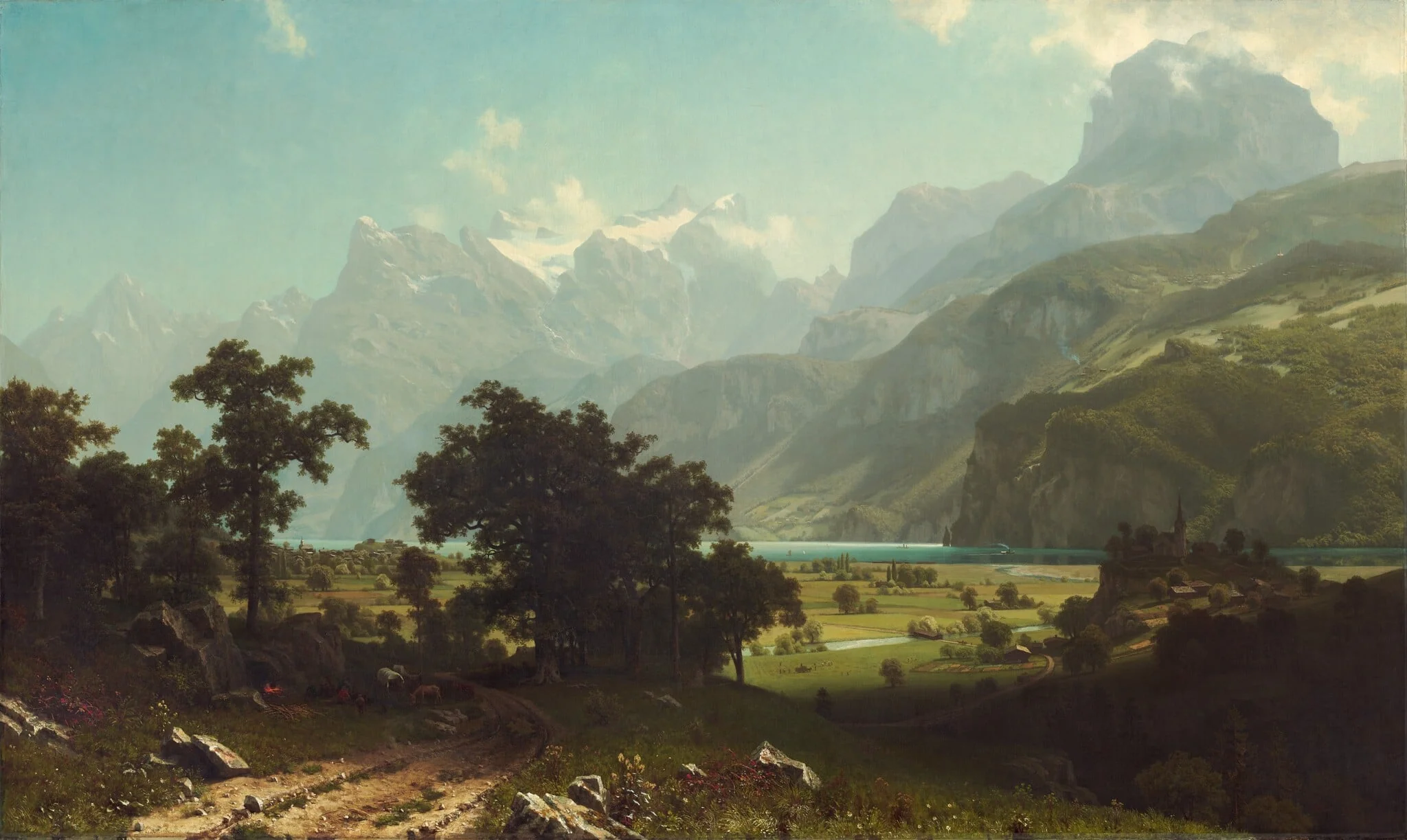
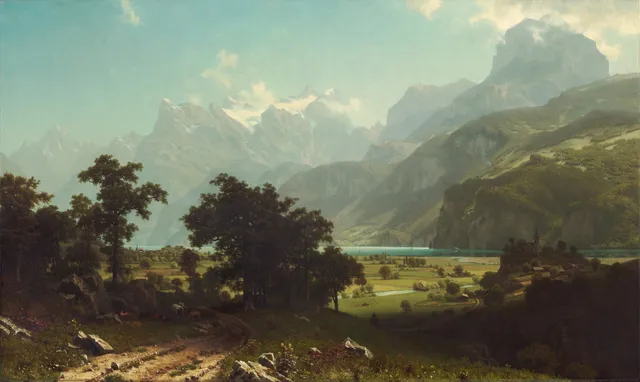
Which brings the loop back to where it started, by way of Albert Bierstadt's Lake Lucerne. Bierstadt is the inheritor of Cole's storm, the man who took the American taste for the sublime and inflated it to operatic scale. In the Lucerne canvas the mountains pile up in cool blue distance, the water lies flat and mirror-still in the foreground, and the light is staged like a finale. Where Cole weighed wilderness against settlement and felt genuine dread, Bierstadt, a generation on, has begun to sell the sublime as spectacle. The storm has become scenery. That drift, from Cole's moral anxiety to Bierstadt's grand entertainment, is one small slice of what the close-looking method lets you track: not a list of names, but a feeling changing its mind across fifty years.
Works discussed in this article
Why one work, looked at hard, beats a survey
The case for the single-work method is finally a case about how knowledge enters through the eye. A survey gives you a map with the territory removed. You learn that Romanticism reacted against Neoclassicism, that landscape rose in status, that genre painting flourished in the young American republic, and you retain none of it, because nothing in the list was ever seen. The Oxbow reverses the order. You see the storm and the tilled valley split across one diagonal, you find the tiny painter under his umbrella choosing which way to look, and only then do the abstractions arrive, already attached to something your eye can hold.
- Choose a work that argues with itself. The Oxbow earns its place because the storm-side and valley-side are painted by what feel like two convictions in one hand.
- Read the handling, not just the subject. Loose violent strokes for wilderness, patient small ones for cultivation. The brush carries the meaning before the iconography does.
- Measure everything else against it. Constable's attention, David's persuasion, Edmonds's comedy, the Qing court's separate grammar all come into focus as agreements or dissents.
Do that, and the period stops being a corridor of labels and becomes what it was to the people inside it: an unresolved fight about whether a painting should compose the world or confess it. The 31,249 works in this corner of the holding are 31,249 votes in that fight, most of them cast quietly, by painters no survey will ever name. The way to hear them is not to read faster. It is to look at one canvas until it looks back, and then to walk the room asking each new picture the questions the first one taught you. Start with the storm and the river. The rest of the century is waiting on the far hillside, already being cut into shapes.
Sources & further reading
- View from Mount Holyoke, Northampton, Massachusetts, after a Thunderstorm, The Oxbow (object page) — The Metropolitan Museum of Art
- Romanticism (Heilbrunn Timeline of Art History) — The Metropolitan Museum of Art
- Romanticism, Art Term — Tate
- Goya, The Third of May, 1808 — Smarthistory
- Lectures on the English Poets (1818) — Internet Archive (William Hazlitt)
- Romanticism — National Gallery of Art
- The Raft of the Medusa — Wikipedia
- Wanderer above the Sea of Fog — Wikipedia