A period that could not stop arguing
The Late 19th Century in European and American painting tends to get taught as a relay race, one style handing a baton to the next: Realism to Impressionism to whatever came after, each faster and freer than the last. The story is tidy and mostly wrong. What actually binds these decades together is not a smooth succession but a long argument, conducted in paint, between a generation and the one that raised it. Every movement in this period defined itself by picking a fight with its immediate predecessor. And it almost always fought using a weapon the predecessor had forged.
Here is the claim this essay defends. The coherence of the period lies in its quarrelsomeness. The painters kept inheriting the same instrument, honest observation of the unidealized world, and kept turning it against the conclusions the previous generation had reached with it. Gustave Courbet used the seen world to attack academic idealism. Édouard Manet used it to attack the heavy solemnity of Realism. The Impressionists used it to attack the finished Salon surface itself. Then a younger cohort used the same candor about looking to accuse Impressionism of dissolving the world into vapor. Seen this way, the era is not a parade of victories. It is one sustained disagreement about what a painting owes the eye and what it owes its own making.
The quarrel begins at the Salon door
To understand the fight you have to stand where it started, which was the jury room of the official Paris Salon. For most of the century the Salon was the only door to a career, and the men who guarded it wanted history painting: gods, martyrs, Napoleonic glory, all of it rendered with a porcelain finish that hid the brush. Courbet's heresy was to point his considerable craft at a stonebreaker, a country burial, a provincial bourgeoisie, and to refuse to make any of it noble. When some of his canvases were turned away from the 1855 Exposition Universelle, he did something a painter was not supposed to do. He built his own room.
Courbet erected a private Pavilion of Realism beside the official exhibition and hung roughly forty of his own pictures inside it, including the enormous allegory of his studio, charging admission to see what the state had declined to show (documented at length in the standard accounts of his career). The gesture mattered more than any single canvas. It established the argument's first rule: if the institution will not host your disagreement, host it yourself. Eight years later the pressure had grown so loud that Napoleon III ordered a relief valve. The Salon des Refusés of 1863 displayed the rejected works in another wing of the Palace of Industry, letting the public judge the jury, and it gathered pictures by Manet, Pissarro and others the official taste had spurned (the imperial decree is preserved in the historical record). The refused had been handed a stage. They never gave it back.
What Manet kept and what he threw away
Manet is the hinge. He admired Courbet's nerve and the older Spanish masters Courbet loved, yet he found Realism too earnest, too willing to build a scene like a stage set. His answer was to flatten. Look at The Dead Toreador. A man in a matador's costume lies on his back across an empty stretch of ground, his pale face tipped toward us, one hand slack near the hilt of his sword, the dark sash and the cape pooling around him in a few decisive strokes. There is no crowd, no bull, no anecdote of how he died. The floor behind him reads almost as a vertical wall, the perspective so steep that the body seems pinned to the surface rather than lying in a deep room. Manet has taken Realism's ordinary mortality and stripped away its narrative scaffolding. He keeps the unidealized corpse. He throws away the story that would have made it comfortable.
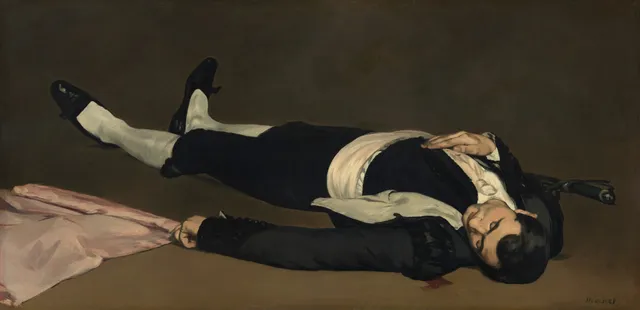
That compression is the move the next generation would inherit and abuse. Manet had shown that a painter could keep the honest, contemporary subject while abandoning the deep, modeled, theatrical space the academy demanded. The young painters who gathered around him in the cafés of the Batignolles took the lesson further than he wanted them to. They decided the surface was not a constraint to be respected but the entire arena. The disagreement was about to leave the subject and move into the paint.
An American footnote that is really a thesis
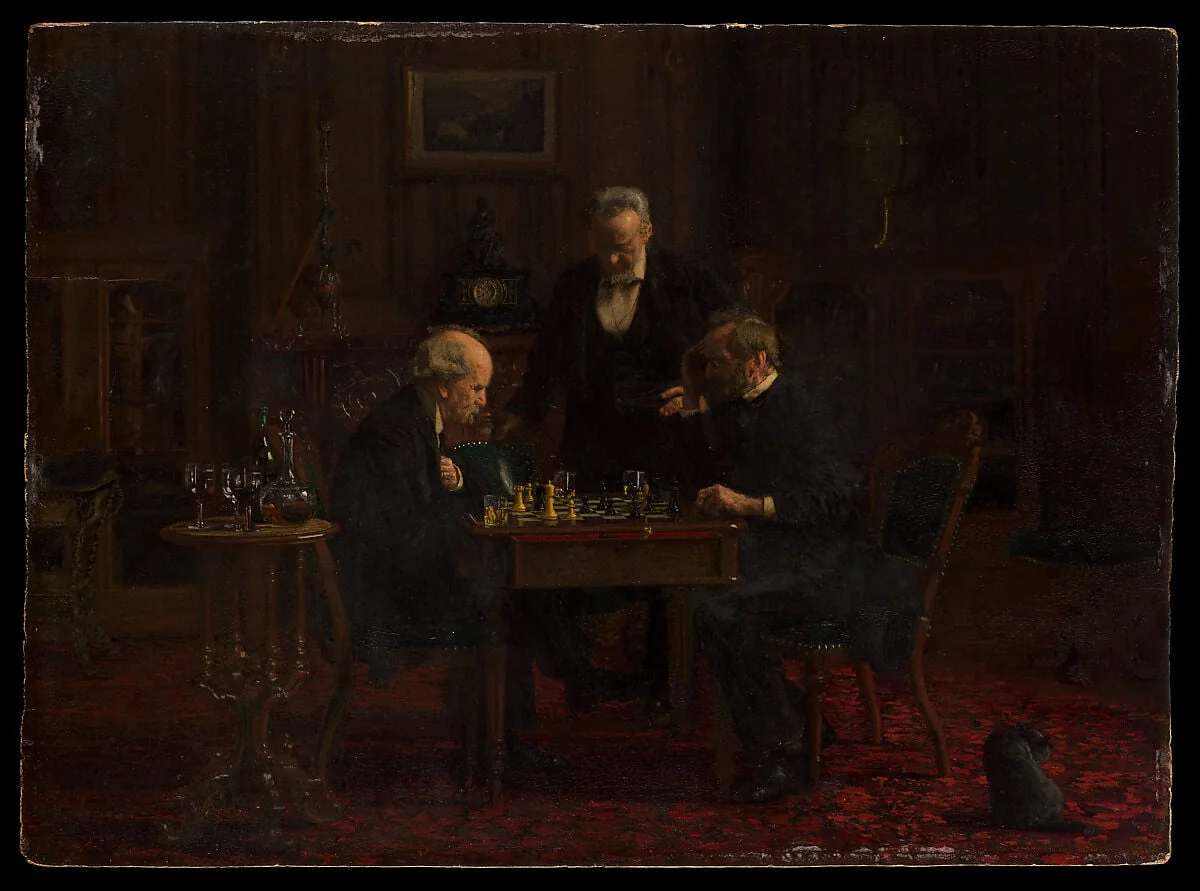
Before following the Impressionists, it is worth crossing the Atlantic, because the period's argument was not confined to Paris and the opposite case sharpens the point. Thomas Eakins trained in Paris in the late 1860s, then went home to Philadelphia and drew exactly the wrong conclusion from everything happening in France. Where his contemporaries were dismantling finish, he doubled down on it. His The Chess Players is a small panel and a deliberate provocation against the loosening taste of its decade.
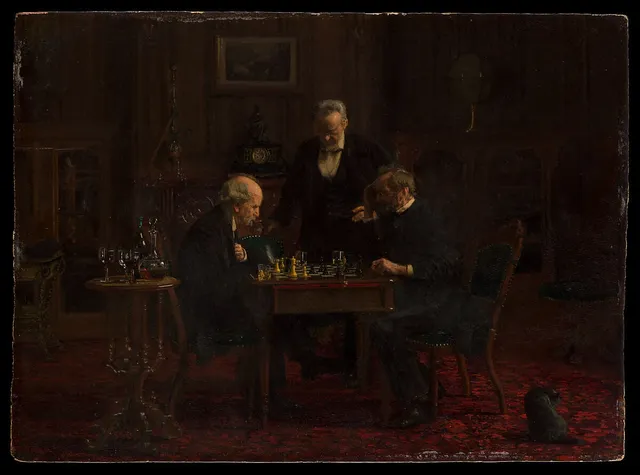
Look at how it is built. Two older men bend over a chessboard in a warm, lamplit Victorian interior, and a third figure, the painter's father, stands behind them watching the game. The light comes from a single source low on the table, so the faces glow against a deep brown gloom that swallows the corners of the room. Eakins renders everything the eye could want a name for: the carved leg of the table, the figured rug, the chessmen ranged across a board that tilts up toward us just enough to read every square. He even inscribed his signature in mock-carved letters on the table itself, dedicating the picture to his father, so that the act of making is folded back into the furniture of the scene. Nothing dissolves. Nothing shimmers. This is a painter insisting that patient looking should produce solidity, weight, the feel of a real chair in a real room. While Paris argued that observation should free the brush, Eakins answered that observation should anchor it. The same word, realism, was pulling two ways at once.
Impressionism's argument with the solid world
Back in France the loosening accelerated. In 1874 a group calling itself the Anonymous Society of Painters, Sculptors and Printmakers mounted its own show outside the Salon system, with Claude Monet, Edgar Degas, Renoir, Morisot, Sisley and Pissarro among the founders (the Met dates this first independent exhibition to 1874). They had taken Courbet's pavilion idea and made it a recurring institution. The visual argument they pressed was against permanence. A scene was not a fixed arrangement of solid things. It was a single charge of light hitting the retina at one moment, and the honest painter recorded the sensation before the brain tidied it into objects.
Monet's Woman with a Parasol is the case made plain. His wife Camille stands on a grassy rise, seen from below against a high blue sky streaked with fast cloud, her veil and skirt blown sideways so the whole figure seems caught mid-gust. Her face is barely a face, shaded under the parasol to a few greenish strokes, and the green of the meadow throws its color up onto the underside of her white dress. The grass is not drawn blade by blade. It is dragged on in quick verticals that record wind more than botany. Set that beside Eakins's lamplit table and the quarrel is visible in a glance. Eakins gives you a room you could measure. Monet gives you a minute you could not hold. Degas, the most classically disciplined of the group, kept arguing from inside it: his The Dancing Class uses the same off-center, snapshot framing, the floor sweeping up at a steep diagonal and the dancers scattered as if the eye walked in mid-rehearsal, yet every pose is drawn with a draughtsman's rigor that the looser Impressionists were happy to abandon. The movement was never one mind. It was a room full of people who agreed on the enemy and disagreed about almost everything else.
What the corpus shows that the textbook hides
The survey narrative compresses this period into a half-dozen famous names, and that compression is itself a distortion the archive can correct. Artifact World Gallery's holdings for these years run to 27,542 works, made by 4,411 separate artists and held across 186 venues, with the dates clustering between roughly 1860 and 1899. Set that number against the handful of painters who carry the standard timeline and the proportion is startling. The men whose disputes we narrate were a thin loud current inside a very wide river. Thousands of competent Salon machinists, regional landscapists, society portraitists and academic history painters were producing the work the public actually bought, and the avant-garde was arguing as much with that silent majority as with each other.
Two artists in our holdings make the point. Henri Regnault's Salome is everything the Impressionists were rebelling against and everything the 1870 public adored: a sumptuous Orientalist fantasy, the young woman seated with a charger and a blade across her knees, the fabrics worked to a high gloss, the eroticism wrapped in biblical alibi. Henry Lerolle's The Organ Rehearsal sits in the middle ground, a large, sober, modern-life scene painted with a restrained naturalism that absorbed some Impressionist air without ever breaking the surface. These were the successful pictures of their moment. The corpus keeps them visible, and they remind us that the famous quarrel was a minority report. The argument felt urgent precisely because most painting was carrying on as if nothing had changed.
The market becomes the referee
An argument needs a way to be won, and the Salon jury was no longer the only judge. The new arbiter was the dealer. Paul Durand-Ruel bought the Impressionists in quantity when almost no one wanted them, held the inventory through lean years, staged solo shows, and crucially carried the work abroad, opening the American market that would eventually rescue the group's finances (his role is reconstructed in the National Gallery and Philadelphia exhibition catalogue on the subject). This was a structural change as decisive as any brushstroke. Once a painter could reach buyers through a dealer's network, the Salon's verdict stopped being final. The disagreement could now be settled by sales and by the slow conversion of collectors, which gave the dissenters something they had never had before: time, and a reason to keep painting against the official grain.
The argument turns inward
By the mid-1880s the Impressionist victory had become its own problem. If a painting was only a record of fleeting light, the world risked melting into atmosphere with no structure left to hold. The next disagreement came from painters who had absorbed Impressionism's high color and then accused it of formlessness. Georges Seurat answered with the opposite of spontaneity. His large Sunday on the Grande Jatte, worked up across 1884 to 1886, rebuilt the riverbank from countless small touches of pure color placed according to optical theory, freezing the casual crowd into something monumental and still (Smarthistory traces the picture's debt to optical science). Seurat kept Impressionism's broken color and used it to attack Impressionism's looseness. The weapon was inherited. The target was the teacher.
Others pushed in the opposite direction, toward feeling rather than system. Vincent van Gogh, painting one of his last self-portraits in 1889, stands in his blue smock holding palette and brushes against a field of restless swirling strokes, the whole surface alive with a turbulence that is plainly about an inner state rather than an optical fact (the National Gallery of Art identifies it among his final self-portraits). The critic Roger Fry would later gather these dissenters under a single retrospective label when he organized a London exhibition in 1910 and coined the term Post-Impressionism for it (Tate credits Fry with the 1910 coinage). The name papered over a real split. Seurat wanted more order than Monet allowed. Van Gogh wanted more emotion. They agreed only that Impressionism had stopped too soon, and they took its color forward toward two incompatible destinations.
Works discussed in this article
There is a longer lineage worth naming here, because the period's quarrel did not begin with Courbet out of nothing. Jean Baptiste Camille Corot had spent the 1850s and 1860s painting silvery, atmospheric landscapes that loosened the academic surface a generation before the Impressionists made loosening a manifesto. Corot belonged to no faction and ended up admired by all of them, which is its own kind of evidence. The most radical innovations of the period were often quiet refinements that one wing hardened into doctrine and another wing rejected. The fight was loud. The actual evolution was a chain of small adjustments to how much the world had to be obeyed.
Where the argument was heading
By 1899 the question had migrated from the easel to the entire designed environment. Art Nouveau, the sinuous plant-derived line that ran through the Belle Époque between about 1890 and 1910, carried the same impulse into posters, ironwork, glass and architecture, insisting that the honest modern surface belonged on a métro entrance as much as a museum wall (its dates and reach are well established). The argument that began with Courbet refusing to ennoble a stonebreaker had become an argument about whether the boundary between fine art and made things should exist at all.
That is the through-line worth carrying out of the period. The late nineteenth century did not progress so much as it disputed, each generation keeping its parents' tool and rejecting its parents' verdict. Stand again in front of Eakins's lamplit chess players and Monet's wind-blown meadow and you are not looking at two stops on a single road. You are watching two people answer the same question, what does looking honestly oblige a painter to do, and walk away certain the other was wrong. The twentieth century would inherit that disagreement unresolved, which is precisely why it had so much left to paint.
Sources & further reading
- Impressionism: Art and Modernity — The Met, Heilbrunn Timeline of Art History
- Salon des Refusés — Wikipedia
- Gustave Courbet — Wikipedia
- Inventing Impressionism: Paul Durand-Ruel and the Modern Art Market — National Gallery / Philadelphia Museum of Art catalogue (Internet Archive)
- Georges Seurat, A Sunday on La Grande Jatte (1884) — Smarthistory
- Self-Portrait (1889) — National Gallery of Art
- Post-Impressionism — Tate
- Art Nouveau — Wikipedia