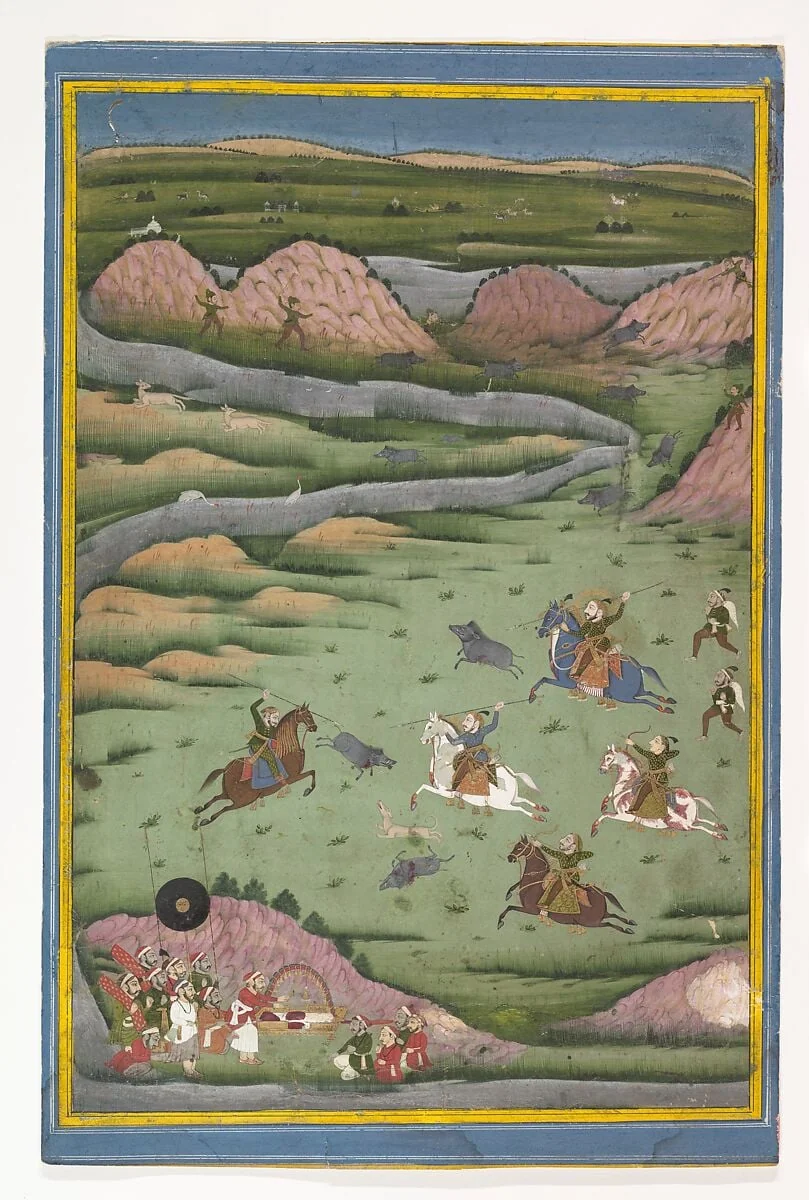
Open almost any survey of Mughal painting and the chapters carry the names of emperors: Akbar, Jahangir, Shah Jahan. The throne gets the byline. That habit answers the question of who paid and quietly pretends it has also answered the question of who painted. It has not. The argument of this essay is that the two questions pull apart, and that the Mughal page is far more interesting once you let them. The emperor set the brief and chose the eye. He did not hold the brush. The brush belonged to a salaried workshop of men whose names we can often recover, and whose hands a trained looker can still tell apart on the paper.
Two facts make the revision worth doing. First, the imperial atelier was a multi-confessional payroll, with Hindu and Muslim painters and a pair of Persian masters working side by side, so the most courtly art of an Islamic empire was largely drawn by Hindu hands. Second, the patronage that funded this art did not die with the dynasty's decline. It scattered outward to the Rajput and Pahari courts, where individual painters became more visible, not less, and where the family name on a page can matter as much as the raja who commissioned it. Follow the money and you get the emperors. Follow the paint and you get a far longer, stranger story that runs from the imperial karkhana to a hill studio in the Punjab foothills.
A workshop, not a single genius
The best period witness to how the studio worked is Abu'l-Fazl Allami, Akbar's chronicler, whose Ain-i-Akbari describes the imperial establishments and names the leading painters the emperor kept. The text matters because it treats painting as administration. Artists drew salaries, were ranked, were reviewed weekly, and were rewarded by grade. This was a bureau with a brush, not a garret of lone visionaries. Abu'l-Fazl's account survives in full and can be read today, and its description of the painting bureau still reads like a personnel file rather than a romance of genius. The conventional account that hangs each masterpiece on an emperor's taste is half right and half a category error: the emperor was the commissioning authority, but the labor was institutional, collective, and accountable.
The Metropolitan Museum puts the social composition plainly. Akbar was the first great Mughal patron of the arts of the book, and the artists who worked for him included Persians as well as Indian Muslims and Hindus, according to the museum's essay on Mughal art before 1600. The two Persian masters who set the studio's grammar, Mir Sayyid Ali and Abd al-Samad, had followed the dynasty from Safavid Iran, and the great productive run of the imperial style spans Akbar, Jahangir, and Shah Jahan, as Wikipedia's overview of the tradition summarizes. What that roster produced was a method. A senior designer laid out the composition. A colorist filled it. A specialist often painted the faces. One finished page could carry three or four hands, and the museum record sometimes preserves all of their names in the margin.
Akbar's laboratory: the Hamzanama
If you want to watch the Mughal style being invented rather than admired, the place to look is the Hamzanama, the enormous illustrated cycle of the adventures of Hamza begun under Akbar. It is vast and physically unusual. Smarthistory describes a project of roughly 1,400 large paintings, each about 69 by 54 centimeters, painted on cloth, in its introduction to the Mughal painting tradition. Those numbers are the whole point. A run of more than a thousand pages, executed by a large team over more than a decade, is not a series of finished statements. It is a laboratory. Persian convention, Indian color sense, and a new appetite for spatial depth got argued out, page after page, until something that had not existed before settled into a house style.
The catalyst for that change was foreign and unexpected. The Getty Research Institute notes that Mughal painting began in the middle of the sixteenth century as an offshoot of Persian painting, then was transformed within a few decades through contact with European Renaissance art, in its account of the exchange that reshaped the medium. European prints arrived at court through Jesuit missions and trade, and the studio absorbed what it found useful: modeling that gave figures weight, atmospheric recession, the trick of a horizon. The Mughal page never surrendered the flat, jewel-bright Persian surface entirely. It learned to hold both at once, a high decorative plane and a pocket of believable depth, and that productive tension is the signature of the imperial manner at its height.
Jahangir and the connoisseur's eye
Patronage is not a constant. It has a temperament, and the temperament changes the art. Akbar wanted narrative on an industrial scale and got a collaborative workshop tuned for output. His son Jahangir wanted something else. The Metropolitan Museum observes that after Akbar, Jahangir preferred a single painter to work on an image rather than the collaborative method of his father's time, and that he prized realistic portraiture, careful plant and animal studies, and Europeanized subjects, in its essay on the art of the Mughals after 1600. The shift is the hinge of this whole story. A patron who wants one hand per page is a patron who has begun to value the hand. The individual painter steps forward out of the team, and the practice of recording the artist's name moves from bureaucratic habit toward something closer to authorship.
This is why the natural-history pages of Jahangir's reign feel different in kind, not just in quality. A dying bird or a single blossom, observed with patient accuracy and set against a plain ground, is the product of a connoisseur looking over one artist's shoulder. The reign of Shah Jahan then formalized the result into a cooler, more hieratic court manner, all profile portraits and measured durbar scenes. Even there, the habit of inscribing the artist's name persisted, so a Shah Jahan album page can still tell you which hand painted the face and which laid the gold. Across these three reigns the patron's eye did the steering, but the painter's identity rose steadily into view. By the time the empire's grip loosened, the individual Mughal-trained artist was a portable asset, free to carry his training somewhere a new patron could afford it.
What the archive shows
Set the canonical narrative against our own holdings and the long tail of patronage becomes measurable. Artifact World Gallery holds 2,004 works tagged Mughal painting, drawn from 13 venues, attributed across 137 named or notional artists, and spanning roughly 1275 to 1917. Two of those figures deserve a second look. A span that reaches to 1917 is far longer than the imperial heyday the textbooks describe, which tells you the practice persisted in regional and revival contexts well past the dynasty's political twilight. And 137 artist attributions across two thousand pages is a low ratio, the statistical residue of a workshop art in which most pages were never signed and most hands stayed anonymous. The named painter is the exception the archive lets us see precisely because the system was built to make him invisible.
The venue spread is its own kind of evidence. Thirteen institutions holding two thousand pages means this material is dispersed rather than locked in one imperial library, which is exactly what you would expect from an art that left the court and entered the album trade. Pages were cut from manuscripts, remounted, and passed between collectors before they were scattered across museums on more than one continent. The date cluster tells a parallel story. The bulk of the imperial work sits in the long century from Akbar to Aurangzeb, while the tail stretching toward 1917 records the regional and revivalist afterlife, when hill and desert studios kept the idiom alive and, later still, copyists reproduced it for a new market.
These objects belong to the broader category Tate calls the miniature, a small painting, usually a portrait, in its glossary of art terms. The label undersells them. Mughal and post-Mughal pages were made to be held and turned in the hand, read close, passed between connoisseurs in an album. Scale is not the same as ambition.
Close looking: a Kota hand at work
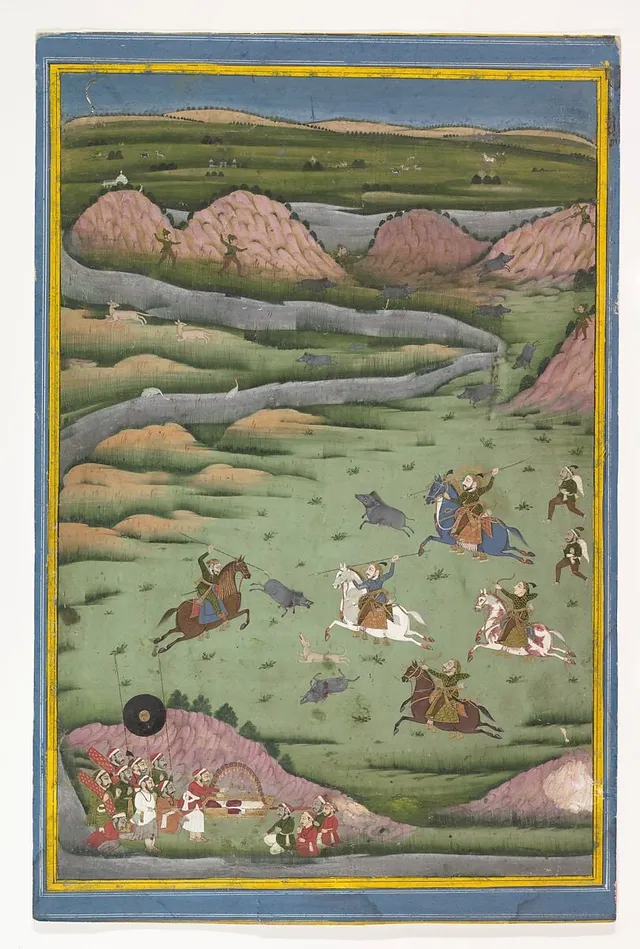
Consider the page held under the Kota Master, an untitled work in the Rajput orbit that descends from Mughal training. Look at how the ground is handled. The terrain tilts up toward you rather than receding, so the foliage reads as a flat curtain of dark green pressed against the picture plane, and the animals are stacked up the surface instead of shrinking into distance. That tilt is a deliberate refusal of the European recession the imperial studio had so carefully absorbed. The Kota hand keeps the depth shallow on purpose, because a hunt seen edge-on is a better design. The line is the second thing to notice. The contour of a tiger or a galloping horse is drawn with a single confident sweep, not built up from corrections, and the brush thins and swells along the spine of the animal the way a calligrapher's pen does. Notice too how little of the sheet is left empty. The Kota hand crowds the frame, letting rocks, water, and beasts interlock so the eye never finds a resting margin and the hunt feels relentless. Color stays saturated and unmixed across most of the sheet, then concentrates into small jewels of bright pigment at the figures, so your eye is pulled to the action and held there. This is not a record of a particular afternoon. It is a built object, organized so that the chaos of a hunt resolves into a pattern you can take in at one glance.
The afterlife: regional courts and named hands
The most telling reply to the throne-centered story is that the Mughal manner outlived the Mughal purse. As imperial funding contracted, painters trained in the idiom found new employers among the Rajput rajas of Rajasthan and the Pahari rulers of the Punjab hills. The style migrated; the patronage diversified; and crucially, the names sharpened. Where an imperial page might dissolve four anonymous specialists into one surface, a regional studio was often a family, and the family was proud of its work. The archive carries several such hands. Chokha, who worked in the Mewar sphere at Devgarh, is the best represented here, with a small body of pages under his name. Nainsukh, arguably the finest of all the Pahari painters, sits in the same holdings, alongside Manak, Bhima, and Mohamed. These are the people the wall labels forget when they name only the emperor.
Chokha repays the attention. His two pages here, one untitled study and a second untitled sheet, show the regional inheritance clearly: the Mughal discipline of the drawn line survives, but the color is bolder and the emotional register warmer than the cool imperial court would allow. The point is not that the hill and desert courts diluted a metropolitan original. The point is that they preserved the painter as a knowable individual at exactly the moment the imperial system that produced him was breaking down. The Mughal achievement, in other words, has two endings. One is the political collapse the history books record. The other is a quiet dispersal of trained hands into studios where, for the first time, the hand routinely got to keep its name.
Works discussed in this article
How to read a page in this tradition
If the two questions of this essay are who painted a page and who paid for it, the page itself usually carries clues to both. A few habits of looking help separate the imperial product from its regional cousins and the named hand from the anonymous team.
- Count the hands. A passage of faces more refined than the bodies, or a sky finished by someone other than the figure painter, usually signals the imperial collaborative method rather than a single regional master.
- Read the depth. A believable middle distance points to the Europeanized imperial studio; a ground that tilts up flat toward you points to a Rajput or Pahari hand who chose pattern over recession.
- Find the margin. Inscriptions and album mounts are where attributions and owners are recorded; the page's social history is often literally written at its edge.
- Weigh the color. Cooler, more measured palettes tend imperial and late; warmer, more saturated ones tend regional, where a family studio answered to a raja rather than a chancery.
Who paid, revisited
Return to the wall label that names only the emperor. It is not wrong, but it answers the smaller question. Who paid is a matter of record, and the record runs from Akbar's chancery to a hill raja's modest treasury. Who painted is harder and more rewarding, because the system that funded this art was engineered to fold the painter into the page. The revision is this: the Mughal achievement was a workshop achievement, drawn largely by Hindu hands inside a Muslim court, shaped page by page in a thousand-leaf laboratory, sharpened by a connoisseur emperor who wanted one artist at a time, and finally carried out of the dying empire by named masters who found new patrons in the desert and the hills. Next time you stand in front of one of these small, dense, brilliant sheets, do the harder reading. Look for the second hand in the faces, the tilt in the ground, the name at the margin. The page will reward you for it, because it was built by someone who expected to be looked at closely, even if he did not expect to be named. The emperor paid. Someone whose name you can often still learn did the work.
Sources & further reading
- The Art of the Mughals before 1600 — The Metropolitan Museum of Art (Heilbrunn Timeline of Art History)
- The Art of the Mughals after 1600 — The Metropolitan Museum of Art (Heilbrunn Timeline of Art History)
- The Mughal painting tradition: an introduction — Smarthistory
- Mughal painting — Wikipedia
- Mughal Painting (Persian roots and European contact) — Getty Research Institute
- Miniature (art term) — Tate
- A rare Deccan miniature in the Rijksmuseum — The Rijksmuseum Bulletin
- Ain-i-Akbari, Vol. 1 (Abu'l-Fazl Allami) — Internet Archive