Every portrait puts a question to you before you reach the wall label: who is this? The face turns, the eyes catch a light source you cannot see, and you find yourself doing exactly what the genre wants, guessing at a person from a collar, a ring, the set of a mouth. Seen from a distance, the long catalogue of portrait painting looks like one patient effort to answer that question better and better, as if the story ran in a clean upward line from stiff Gothic profiles to breathing Victorian flesh. It did not run that way. Look closely and the genre splits into rival answers, each confident, each leaving out the very thing the others thought essential.
Here is the claim I will defend, work by work. A portrait is an argument about what a person most truly is, and the centuries have never settled the argument. One age answers that a person is a verifiable face, a record kept for the family and the law. Another answers that a person is a rank, a costume, a position in a well-furnished room. A third insists the truest self is a borrowed one, the sitter dressed as a saint, a reader, a crowned bride of Christ. The history of the portrait is not the refinement of a single likeness. It is a stack of incompatible theories of the self, painted in good faith and hung side by side, and a gallery is where they go on disagreeing.
Our own holdings make the scale of the disagreement legible. Artifact World Gallery keeps 33,486 portrait works, painted by 7,006 named hands and gathered across 285 venues, the earliest reaching back toward the year 1000 and the latest made in 2022. That is roughly a thousand years of people insisting, in pigment, that they were here. Spread the lot out and the answers do not stack tidily by date. They interleave. A plain New England merchant's wife counted by her children sits a few rooms from an emperor built out of stage properties, and both were painted within a generation of each other. The genre never converged. It kept reopening the same question with new equipment.
The oldest question, and why it never closes
Portraiture is among the very oldest things painters do. The Tate dates the impulse back at least five thousand years to ancient Egypt, where the painted likeness already had a job: to hold a person against time. The most startling survivors of antiquity sharpen the point. The Getty places the Fayum mummy panels in the first through third centuries of the Roman occupation of Egypt, painted in hot wax and pigment and bound over the faces of the dead in place of the older sculpted masks. Their answer is blunt: a person is a face you keep, eyes enlarged and steady, looking out of the linen at whoever survives them. Nothing about status, nothing about role. Just the face, made permanent.
Then the individuated face went quiet in Europe for a long stretch. Medieval painting preferred the type to the man, the donor shrunk and generalized at the edge of a sacred scene. The Metropolitan dates the return of distinctive likeness, with its roots in Greek and Roman practice, to the fifteenth century, when patrons again wanted to be recognizable and not merely present. That fifteenth-century reappearance is usually told as a triumph, the moment art learns to see a particular nose. I want to read it differently. The Renaissance did not solve the portrait. It reopened the argument the Fayum painters had already had, and within a century European painters were giving the old question four or five fresh, contradictory answers at once.
Answer one: a person is a record
The first answer is the documentary one, and it is the answer most of our 33,486 portraits quietly serve. A person is a fact to be entered into the ledger of who existed, what they owned, whom they married. Leonardo's Ginevra de' Benci stands near the austere head of this tradition: the National Gallery of Art notes it is the only painting by Leonardo in the Americas and one of just three of his surviving portraits of women. Leonardo gives Ginevra a pale, unsmiling clarity and rings her head with a spray of dark juniper, a visual pun on her name. The record is exact and the record is coded. Even at this level of genius, the documentary portrait wants you to know precisely who, and it leaves no doubt.
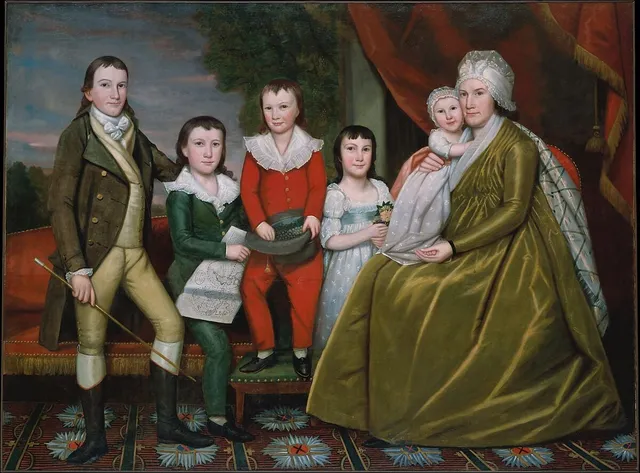
The documentary answer travels far better than the genius answer, which is why it surfaces, almost untouched, in a Vermont parlor two and a half centuries later. Ralph Earl painted American sitters who had no interest in Italian grace and every interest in being counted. In Mrs. Noah Smith and Her Children, Earl seats the mother in a hard, upright chair and arranges her children around her with the candor of an inventory, each child sized and placed, a slice of New England landscape visible past a column and a swag of red drapery. The faces are plain to the point of bluntness, the drawing a little stiff at the elbows. That plainness is not failure. It is the merchant family's own preference, a likeness that reads as honest precisely because it does not flatter. A person, Earl's clients believed, is a standing in the community, set down accurately enough to outlast the sitter.
Answer two: a person is a position
The second answer barely cares about the face at all. Here a person is a rank, an alliance, a place in a room arranged to declare it. The English conversation piece is its native form, and Francis Wheatley worked it with charm. In The Saithwaite Family, the figures are smaller than life and posed across a landscaped setting, the family unit composed like a sentence about its own cohesion. You are not meant to fall into any single face. You are meant to read the group: who stands, who sits, who leans toward whom. The portrait has become a diagram of belonging.
The same answer can be whispered through a single sitter. Richard Cosway, the most fashionable miniaturist of Georgian London, scaled the same logic down to intimacy in his Portrait of Marianne Dorothy Harland, later Mrs. William Dalrymple. The young woman is given the airy, feathered touch of Rococo portraiture, all light hair and lighter ground, marriageable youth turned into an asset on display. The title itself does the work the second answer always does: it carries her from one man's name toward another's. The likeness is real, the position is the point.
Nowhere is the positional portrait pushed harder, or more brilliantly, than in Jacques-Louis David's great piece of statecraft. Stand in front of The Emperor Napoleon in His Study at the Tuileries and David hands you a man and a clock, and tells you to do the arithmetic. The clock behind Napoleon reads past four in the morning. The candle at the left has guttered down to a smoking stub. On the desk a paper is rolled and lettered with the word CODE, the legal code that would carry his name through every courtroom of the next century. Look at his body: the white breeches are creased from sitting, the stockings have slipped, the hair is undressed. The picture is building an argument out of these small disorders. The emperor has been awake all night, working for France while France slept, and he has only now risen from the labor. Nothing on that desk is accidental. David, who once painted the Revolution's martyrs, here assembles a sovereign from stage properties: the candle for vigilance, the clock for sacrifice, the sword leaning ready against the chair. The face is almost the least of it. A person, in this answer, is the office he holds and the toil he is willing to perform in it.
Works discussed in this article
Answer three: a person is a borrowed self
The third answer is the strangest and, to my eye, the deepest. It holds that the truest portrait shows the sitter as someone they are not, because the borrowed identity reveals what the bare face conceals. Rembrandt is its master. In 1661, at fifty-five, he painted himself in the guise of the Apostle Paul, turban on his head, a manuscript at his chest, a sword half hidden in his cloak. He is unmistakably Rembrandt, aging and pouched and tired, and he is also Paul, the imprisoned letter-writer. Both at once. The disguise does not hide the man. It deepens him, the way a good actor finds his own grief inside another's lines.
The borrowed self is not a Northern eccentricity. It runs across whole colonial schools. In the Spanish viceroyalties of the Americas, the genre of the crowned nun, the monja coronada, gave us women painted on the day they took their vows or the day they died, faces ringed with elaborate floral crowns, identity dissolved into the role of bride to Christ. The convention began in the eighteenth century and carried into the early nineteenth, a full tradition of portraits in which the woman's individuality is the offering being given up. Here the borrowed self is total. The sitter becomes the vow.
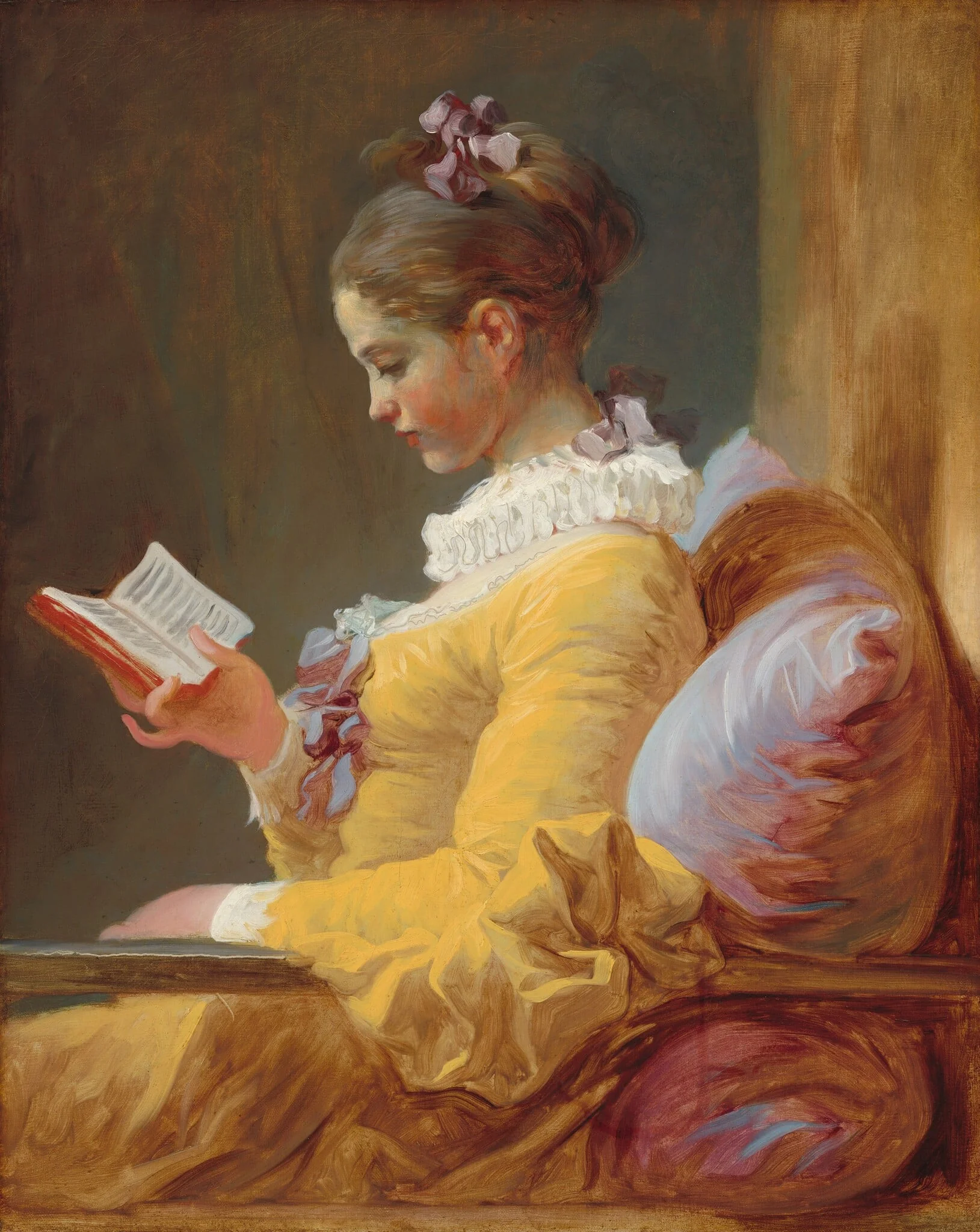
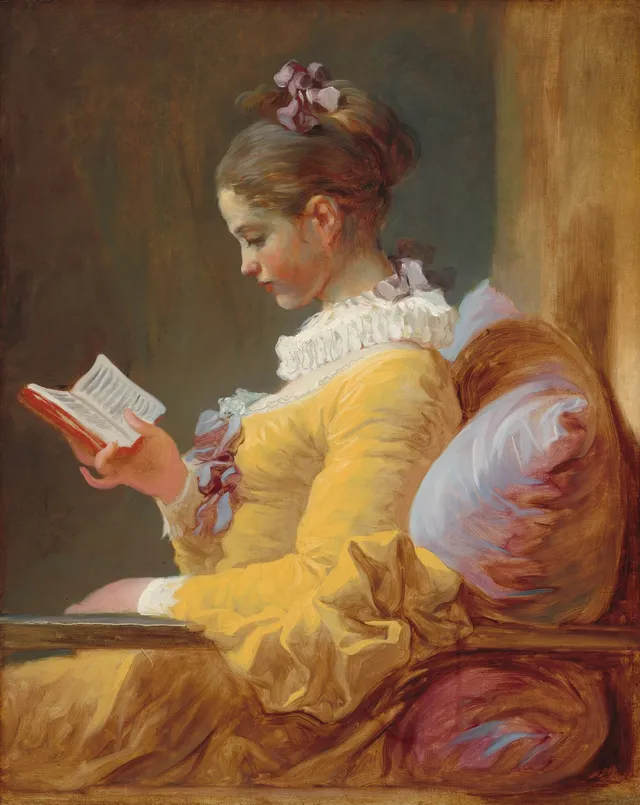
Which brings us to the quietest, and possibly the most radical, picture in our group: Jean Honoré Fragonard's Young Girl Reading. Look hard at it. A young woman sits in pure profile against a warm, almost featureless wall, lit from the left so that her cheek and the page glow and her back falls into shadow. She wears a lemon-gold dress with a ruff at the throat and a soft cuff at the wrist, and she leans into a lavender cushion. In her right hand she holds a small book upright, pinched between thumb and fingers, her whole posture folded inward around it. Now look at how it is made. Fragonard laid the paint down fast and openly. The ruff is not described, it is dashed, three or four loaded strokes of pale impasto that resolve into starched lace only when you step back. The cushion is a few smears of violet. He worked at the speed of an afternoon.
And here is the radical part: she has no name. The picture does not record a particular Mademoiselle. It gives us the reader, a type, a posture, the universal experience of being lost in a page. Fragonard has taken the borrowed-self answer and turned it inside out. Rembrandt borrowed a saint to find himself; Fragonard borrows nobody and lands on everybody. The question the portrait asks, who is this, gets a new and almost insolent reply: it does not matter who, what matters is the state she is in. A person can be a mood held still, an hour of yellow light, an absorption so complete the identity beneath it stops mattering.
Answer four: a person is a body, and paint is paint
The nineteenth century gave a fourth answer, and it was a refusal of the first three. Gustave Courbet and the Realists declined to record a rank, declined to lend the sitter a holy costume, declined even to smooth the documentary likeness into something flattering. A person, for Courbet, is a body occupying actual space, rendered in frank, loaded, visible paint that never pretends to be a window. His self-portraits stare back with a coarse physical presence that earlier centuries would have read as rudeness. The flattery is gone. What remains is weight, skin, the fact of a man in a room, and the painter's hand left openly on the surface. This answer hardens into the modern portrait, where the handling of the medium becomes part of the subject and the sitter is, among other things, an occasion for paint.
It is worth pausing on how stubbornly the documentary answer survived all of this in parallel, especially in the young United States. The portraitist Gilbert Stuart painted more than a thousand likenesses and made the presidential face into a kind of national record, the same Washington reproduced until it became currency. The answers, again, do not replace one another. Courbet's frankness and Stuart's civic record-keeping share the same decades. The genre simply widened to hold both.
And sometimes a portrait turns to face its own machinery. Matthew Pratt did exactly that in The American School, which shows Benjamin West's London studio: young painters at their easels, a master leaning in to correct a drawing, the whole apparatus of learning to make a likeness laid bare on the canvas. It is a portrait of portraiture being taught. Pratt's answer to who is this turns out to be a question about who is doing the looking, and how a hand is trained to turn a face into pigment. The genre, near the threshold of the modern, had begun to study itself.
Why the question stays open
Set the four answers next to each other and the usual story of portraiture, the steady march toward lifelikeness, falls apart. The Fayum painters wanted a face kept against death. The English wanted a position made visible. Rembrandt and the colonial convent painters wanted a borrowed self that told a deeper truth. Courbet wanted a body and an honest mark. These are not stages in a single project. They are different beliefs about what a person fundamentally is, and each produced masterpieces by its own lights. A great positional portrait is not a primitive version of a great Realist one. It is a fully achieved answer to a different question.
That is why the genre never exhausts itself, and why thirty-three thousand of these pictures can hang in one collection without redundancy. Each generation has the argument again, because each generation quietly changes its mind about what we are. The portrait stays alive as long as that question stays unsettled, and it shows no sign of settling. Walk our portrait holdings end to end and you pass a Roman-Egyptian face painted to outlast a corpse and a sitter recorded in 2022, more than a thousand years apart, filed under the same single word, still disagreeing about the answer. The next time a painted face turns toward you across a gallery and asks who is this, notice that you reply before you decide to, and that your reply is a whole century's inheritance talking through you.
Sources & further reading
- Portrait (art term) — Tate
- Roman-Egyptian Mummy Portraits: Introduction — The J. Paul Getty Museum
- Portraiture in Renaissance and Baroque Europe — The Metropolitan Museum of Art, Heilbrunn Timeline of Art History
- Ginevra de' Benci (obverse) — National Gallery of Art
- Self-portrait as the Apostle Paul — Rijksmuseum
- Crowned Nun Portraits: An Introduction — Smarthistory
- Portrait painting — Wikipedia
- Landscape, Portrait, Still-Life: Their Origin and Development — Max J. Friedländer, Schocken Books