The Kunsthistorisches Museum in Vienna answers its own title twice. One answer is the building: a domed palace of art on the Ringstraße, raised so that the public could walk past pictures that had until then belonged to princes. The other answer is the one this essay defends. The building is younger than almost everything inside it, and the collection it holds is less a neutral survey of European painting than a record of Habsburg buying. Who painted these pictures matters. Who paid for them, and why, matters more, because patronage is what put a Flemish winter landscape and a Venetian altarpiece under the same roof a thousand kilometers from where either was made. The title promises art history. What the rooms actually deliver is the history of one family's purchases.
Read the galleries as a map of who paid, and the museum's strange center of gravity stops being strange. A national gallery in Vienna ought, on first guess, to be heaviest in Austrian art. It is not. Its glories are Netherlandish, Venetian, and German, and that imbalance is not an accident of taste in 1890. It is the fossil record of acquisition by Habsburg collectors who ruled, married, and shopped across an empire that reached into the Low Countries and down into northern Italy. The thesis in one line: the Kunsthistorisches Museum is a self-portrait of a dynasty's taste, assembled by patrons across three centuries and only later given a house by an emperor. Every wall is a provenance before it is an aesthetic. Learn to read the labels backward, from where a picture hangs to who first wanted it, and the rooms turn into a family ledger.
A house the emperor paid for
Start with the part that is genuinely the emperor's doing: the building. The two great Ringstraße structures that face each other across Maria-Theresien-Platz, the art-historical and natural-history museums, went up between 1871 and 1891 to designs by Gottfried Semper and Baron Karl von Hasenauer (Wikipedia, Kunsthistorisches Museum). Franz Joseph commissioned them for a blunt and modern reason: to give the Habsburgs' accumulated art collection a suitable home and to open it to the general public. That second clause is the hinge of the whole institution. The pictures had existed for centuries. What changed in the 1880s was that a private dynastic hoard was rehoused as a civic museum, with a grand stair, a Klimt-decorated spandrel cycle, and a public ticket.
So when a visitor stands under the cupola and assumes the architecture and the art are of a piece, the assumption is backward. The marble is Gilded-Age Vienna. The Bruegels are sixteenth-century Antwerp and Brussels. The emperor paid for the frame. His ancestors paid for the canvas. Keeping those two acts of payment separate is the first move toward reading the place honestly, because the building flatters the collection into looking like an imperial program, when in truth it is a salvage operation: four centuries of scattered princely purchases pulled together and made to stand in rows. The dome insists on unity. The provenance files insist on the opposite, a hundred separate decisions to buy, each made in a different city and a different reign.
The collectors behind the collection
Two Habsburgs did more than any architect to determine what hangs here. The first is Emperor Rudolf II, who moved his court to Prague at the end of the sixteenth century and turned it into a collecting engine without rival north of the Alps. Rudolf hired painters as well as bought them. He kept Bartholomeus Spranger and Hans von Aachen on hand as court artists, and he commissioned the allegorical portrait-heads of Giuseppe Arcimboldo, in which the emperor's face is built from fruit and game (The Met, Heilbrunn Timeline on Prague under Rudolf II). The painting now stamped onto every Vienna postcard, Bruegel's snowbound hunters, entered the Habsburg orbit through this Prague appetite for Netherlandish work. The picture is older than Rudolf's reign, but the logic of gathering it up is his.
The second collector is Archduke Leopold Wilhelm, governor of the Spanish Netherlands in the 1640s and 1650s, who used his Brussels post to buy Italian and Flemish pictures by the hundred. We know exactly what his walls looked like because he had his keeper and court painter, David Teniers the Younger, paint them. The gallery pictures Teniers produced are inventories disguised as scenes: the archduke stands in a room crammed floor to cornice with framed canvases, each rendered small but legible, a working catalogue of a collection that would later ride west to Vienna. When you look at one of those Teniers panels, you are looking at the Kunsthistorisches Museum's holdings two centuries before the building existed, already sorted and hung by the man who paid for them. The smaller pictures within the picture are accurate enough that scholars have used them to track individual canvases through later sales.
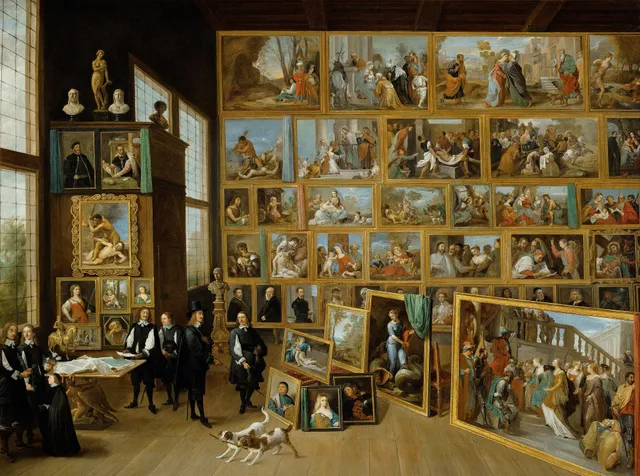
This is why the patronage reading is not a footnote. The same archduke whose collection forms a backbone of the Vienna galleries had himself depicted standing inside it, twice, in compositions that survive as separate works. The act of paying and the act of painting fold together: the patron commissions a portrait of his own purchases. Artifact World Gallery's own index counts 3,050 works tied to this single venue, made by 1,057 different hands and spanning roughly 1400 to 1931, and the shape of that number tells the same story the Teniers panels do. A few hundred painters supply the famous names; the long tail is the accumulated reach of buyers who acquired across half a continent. More than a thousand artists for three thous-odd pictures is not the profile of a curated survey. It is the profile of a hoard, gathered work by work, that only later had a thesis imposed on it.
Looking hard: The Hunters in the Snow
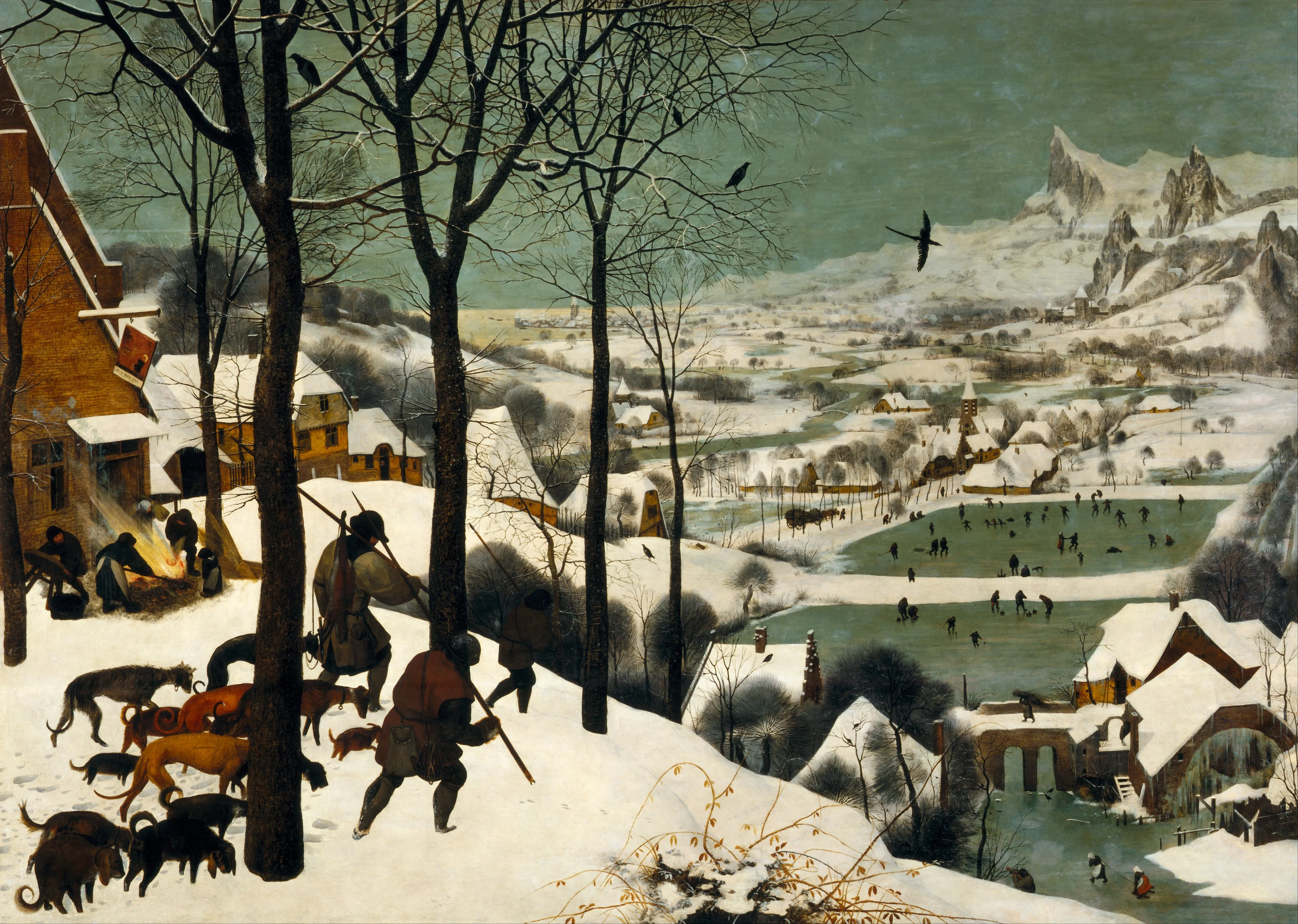
Take the single most reproduced picture in the building and actually look at it. The Hunters in the Snow, painted by Pieter Brueghel the Elder in 1565 in oil on panel, is one of a series tracking the times of the year, of which five survive (Wikipedia, The Hunters in the Snow). Three hunters trudge in from the lower left, their backs to us, shoulders hunched, a clutch of lean dogs threading between their legs. They have caught almost nothing; a single small carcass hangs from one spear. Brueghel sets them at the top of a slope, and a row of bare black trees steps down the hill beside them like a staircase, each trunk a little shorter than the last, walking the eye down into the valley.
Then the picture opens. Below the hunters the land drops to two frozen green-grey ponds where figures the size of grains skate, sweep, and play on the ice. Smoke rises flat from a chimney; to the left, villagers singe a pig over a fire outside an inn whose signboard hangs askew. Far off, jagged alpine peaks rise behind a town that is otherwise pure flat Flanders. Those mountains do not belong to the geography of the Low Countries, and that is the tell. A bird, dark against the white, glides across the central void on spread wings, and your eye rides it from foreground to far distance in one unbroken sweep. Notice how little color Brueghel allows himself. The whole panel runs on white, brown, and a cold sage green, with the red of a distant fire the only warm note, and that restraint is what makes the cold legible.
What looks like a candid glance at a winter day is built. Smarthistory reads the scene as a deliberately orchestrated panorama rather than a snapshot of peasant life, and the construction is visible once you trust it (Smarthistory on Bruegel's winter). The diagonal of the hill, the descending trees, the imported mountains, the single guiding bird: Brueghel has engineered a vantage no real hunter ever had, a god's-eye slope down which the whole season can be surveyed at once. He is not recording a walk home. He is composing the idea of winter so that it holds still and can be read. The chill you feel is a design, and the design is what a sophisticated sixteenth-century buyer was paying for. A patron who hung this on his wall was not buying a souvenir of the countryside. He was buying a mind at work on the problem of how to make a whole season visible in one frame.
The Prague court: who actually held the brush
If the patrons explain why these pictures are in Vienna, the court painters explain how the collection got its peculiar sophistication. Rudolf II's Prague drew a generation of artists who painted for a single connoisseur rather than for an open market, and their work is mannered, learned, and frankly difficult, because the audience was one well-read emperor and his circle. Bartholomeus Spranger supplied elongated, silvery mythologies whose figures twist past the point of anatomy into pure elegance. Hans von Aachen gave the court its smooth allegories and portraits. Our index holds nineteen works apiece tied to these two through this venue, a density that no open market would have produced. It is the signature of captive, salaried genius working to please one paying eye, and it is why the Prague rooms feel less like a gallery than like the private taste of a single difficult patron made visible.
The Italians anchor the other wing of the same logic. Jacopo Tintoretto runs to nearly thirty works in our count of this venue, the residue of Habsburg appetite for Venetian drama, and Guido Cagnacci supplies the late-Baroque sensuality that the Vienna court, by then in the seventeenth century, was happy to pay for. Set beside them the German and Netherlandish painters whose panels the same family kept buying across generations, and the museum's true subject comes into focus: it is a collection about collecting, where the strongest schools are precisely the ones successive Habsburgs could not stop acquiring. A national museum elsewhere reflects a nation. This one reflects a bloodline and its reach.
Works discussed in this article
The range across those few panels is the argument in miniature. Brueghel's Children's Games spreads dozens of small figures across a town square, each knot of children locked into a different game, a catalogue of play built the same way the winter panel is built, by orchestration disguised as observation. The eye is meant to wander and count, not to settle on one hero. Albrecht Dürer's Avarice turns to the close, unflattering study of a face, an old figure clutching at coin, painted with the German appetite for what aging actually does to skin. And Ambrosius Bosschaert's flowers in a blue and white porcelain vase sets a tight, jewel-bright bouquet against darkness, every petal sharp enough to identify the species, blooms from different seasons forced into a single impossible vase. Landscape, moral study, portrait head, still life: four ways of paying close attention, gathered by patrons who valued exactly that attention. The thread running through all four is precision, the one quality the Habsburg eye kept reaching for across schools and centuries.
What the catalogue made visible
There is a precise moment when the Habsburg hoard began to think of itself as a museum, and it predates the Ringstraße building by a century. In 1784 Christian von Mechel rehung the imperial gallery in the Belvedere and published the Catalogue des tableaux de la Galerie impériale et royale de Vienne, the first arrangement of these pictures by school and period rather than by decorative effect (Internet Archive, Mechel 1784). That is the intellectual birth of the institution. Mechel treated the collection as a teaching instrument, a visible history of art, decades before anyone laid a foundation stone on Maria-Theresien-Platz. The emperor's later building simply gave architectural form to a curatorial idea the Enlightenment had already supplied. The hang you walk through today is, in its bones, Mechel's hang, dressed in Semper's marble.
Keeping it on the wall
Paying for a picture is not a single event. It is a standing bill, because a four-hundred-year-old panel or canvas has to be kept physically alive. The museum's conservation history is part of the patronage story, just deferred across generations. Vienna's documented canvas practice records that the heated irons long used to press structural linings onto failing canvases were replaced by a veneer press in the late 1930s, a quiet technical shift in how the institution held its weakest supports together (Getty, Conserving Canvas). It is the unglamorous continuation of the same act that began in Prague: someone, in every century, deciding these objects are worth the cost of survival. A lining table is patronage too, just patronage with the romance stripped out.
The cost reaches into our own decade. Vermeer's The Art of Painting, normally one of the Vienna gallery's anchors, has traveled out as the single subject of a focused exhibition at the National Gallery of Art in Washington, the kind of loan that turns one canvas into an event and quietly reasserts the museum's standing (National Gallery of Art). A picture acquired through dynastic accident in the seventeenth century is still, in the twenty-first, an instrument of prestige. The patron changes from a Habsburg archduke to a modern museum, but the underlying transaction, paying to possess and display the best, has not moved an inch. Lend the right Vermeer and a city across an ocean reorganizes its calendar around it. That is the same power the archdukes were buying, exercised now by an institution instead of a man.
Walk the picture gallery with the patronage map in your head and the building reorganizes itself. The Bruegel room is Rudolf's Prague appetite made permanent. The dense Flemish and Italian holdings are Leopold Wilhelm's Brussels purchases, the same ones Teniers painted while they still hung in the archduke's gallery. Mechel's ghost is in the hang order. The emperor's marble is the latecomer, the wrapper added once the contents were already legendary. None of this diminishes the looking. It sharpens it, because it tells you that a Viennese palace full of foreign masterpieces is not a paradox to be explained away. It is the precise signature of who paid, written across four centuries, and waiting on the wall for anyone willing to read the receipts instead of only the labels.
Sources & further reading
- Kunsthistorisches Museum — Wikipedia
- The Hunters in the Snow — Wikipedia
- Prague during the Reign of Rudolf II — The Met, Heilbrunn Timeline of Art History
- Catalogue des tableaux de la Galerie impériale et royale de Vienne (Christian von Mechel, 1784) — Internet Archive
- Conserving Canvas, ch. 14 (Elke Oberthaler) — Getty Publications
- Pieter Bruegel the Elder, Hunters in the Snow (Winter) — Smarthistory
- Johannes Vermeer's The Art of Painting — National Gallery of Art