Artist
Pieter Brueghel I

Duchy of Brabant
Pieter Brueghel I is a Duchy of Brabant Mannerism artist. 72 works are cataloged here, principally at Catholic University of Leuven.
Pieter Bruegel (also Brueghel or Breughel) the Elder ( BROY-gəl, US also BROO-gəl; Dutch: ; c. 1525–1530 – 9 September 1569) was among the most significant artists of Dutch and Flemish Renaissance painting, a painter and printmaker, known for his landscapes and peasant scenes (so-called genre painting); he was a pioneer in presenting both types of subject as large paintings. He was a formative influence on Dutch Golden Age painting and later painting in general in his innovative choices of subject matter, as one of the first generation of artists to grow up when religious subjects had ceased to be the natural subject matter of painting. He also painted no portraits, the other mainstay of Netherlandish art. After his training and travels to Italy, he returned in 1555 to settle in Antwerp, where he worked mainly as a prolific designer of prints for the leading publisher of the day. At the end of the 1550s, he made painting his main medium, and all his famous paintings come from the following period of little more than a decade before his early death in 1569, when he was probably in his early forties. In the 20th and 21st centuries, Bruegel's works have inspired artists in both the literary arts and in cinema. His painting Landscape with the Fall of Icarus, now thought only to survive in copies, is the subject of the final lines of the 1938 poem "Musée des Beaux Arts" by W. H. Auden. Russian film director Andrei Tarkovsky refers to Bruegel's paintings in his films several times, including Solaris (1972) and Mirror (1975). Director Lars von Trier also uses Bruegel's paintings in his film Melancholia (2011).
Overview
Pieter Bruegel the Elder (c. 1525-1530-9 September 1569) was a Flemish painter and printmaker, one of the most significant artists of the Dutch and Flemish Renaissance. He is renowned for his innovative landscapes and peasant scenes, pioneering the presentation of both subjects as large-scale paintings. Working at a time when religious subjects had ceased to dominate painting, Bruegel helped establish secular genre painting as a major art form and became a formative influence on Dutch Golden Age painting. His work is characterized by intellectual depth, humanist engagement, and a distinctive visual language that moved beyond the Italianate conventions of his contemporaries.
Biography & dates
Bruegel's exact birthplace remains uncertain. Early sources connect him to Breda or to a village called Brueghel near Breda, though modern scholarship has questioned both locations, with some favouring Grote-Brogel near Bree. He was likely born between 1525 and 1530, inferred from his admission as a master in the Antwerp Guild of Saint Luke in 1551. According to Karel van Mander's 1604 Schilder-boeck, he trained under Pieter Coecke van Aelst, though no guild records confirm this. Between 1545 and 1550 he worked in Mechelen, assisting Peeter Baltens on an altarpiece in grisaille.
In 1551 Bruegel became a free master and soon departed for Italy, travelling through France and reaching Rome by 1552. He journeyed as far south as Reggio Calabria, recording a Turkish raid in a drawing, and probably visited Sicily. In Rome he worked with the miniaturist Giulio Clovio, who later owned several of his works. By 1554 he had returned to Antwerp, where from 1555 he worked primarily as a designer of prints for Hieronymus Cock, the leading publisher of northern Europe. He produced over forty print designs, though he rarely worked the plates himself.
In 1563 Bruegel married Mayken Coecke, his master's daughter, in the Kapellenkerk in Brussels, and settled there. The couple had two sons: Pieter, born 1564, and Jan, born 1568. Bruegel died in Brussels on 9 September 1569 and was buried in the Kapellenkerk.
Style & movement
Bruegel's style resists easy categorization under a single term such as Mannerism. His early work drew heavily on Hieronymus Bosch, whose fantastical imagery he frequently quoted in compositions like Dulle Griet and The Fall of the Rebel Angels. However, Bruegel developed a highly distinctive approach that set him apart from both Italianate trends and traditional Netherlandish painting.
From 1559 he dropped the 'h' from his name, signing works as Bruegel rather than Brueghel, and switched from Gothic blackletter to Roman capitals, a change interpreted as an attempt to Latinize his name. His mature work is marked by complex multi-figure compositions, often containing a hundred or more figures, which scholars have called Wimmelbilder. These crowded scenes are nonetheless carefully balanced through sophisticated compositional structures.
Bruegel elevated Flemish landscape painting to new heights and effectively founded the Dutch peasant genre. He also created numerous allegorical works drawing on proverbs, folk culture, and humanist learning. Unlike most Netherlandish artists, he painted no portraits, deliberately eschewing one of the period's principal art forms. His work combined keen observation of peasant life with intellectual and moral content, reflecting his connections to Antwerp's humanist circles.
Major works
Bruegel's famous paintings all date from the final decade of his life, after he made painting his main medium around the end of the 1550s. Among his most celebrated works is Netherlandish Proverbs (Gemäldegalerie, Berlin), which depicts over one hundred Dutch proverbs in often grotesque visual form. His peasant scenes, including wedding celebrations and festivals, became defining images of rural life in the Low Countries.
His landscape paintings, such as the series of months, represent a pinnacle of sixteenth-century Flemish landscape art. Landscape with the Fall of Icarus, now thought to survive only in copies, has achieved particular cultural resonance. Other major works include The Tower of Babel, The Procession to Calvary, and The Hunters in the Snow. Many of his compositions were disseminated through prints, substantially expanding his influence.
His drawings, though fewer have survived, include views from his Italian journey such as the Ripa Grande in Rome, and designs for print series including the Large Landscapes published by Hieronymus Cock in 1555.
Influences & students
Bruegel's principal teacher was Pieter Coecke van Aelst, according to Karel van Mander, though the stylistic relationship between their works remains debated. Hieronymus Bosch served as a major artistic influence, particularly in Bruegel's early career, when he frequently adopted Bosch's fantastical imagery and moralizing approach.
During his Italian sojourn, Bruegel worked with Giulio Clovio, a significant miniaturist who owned several of his works. In Antwerp he moved among a lively humanist circle that included the geographer and cartographer Abraham Ortelius, who wrote movingly of him after his death, and the collector Niclaes Jonghelinck, who owned sixteen of his works. Cardinal Antoine Perrenot de Granvelle, minister to Philip II of Spain, was another important patron.
Bruegel established an artistic dynasty through his two sons. Pieter Brueghel the Younger, called 'Hell Brueghel,' inherited his father's workshop materials and produced numerous copies of his compositions, almost serially. Jan Brueghel the Elder, called 'Velvet Brueghel,' copied some of his father's works but developed his own highly individual, miniature style, becoming the most important cabinet painter in early seventeenth-century Antwerp. Jan's son Jan Brueghel the Younger and five of his seven sons also painted, though none achieved the stature of Pieter Bruegel the Elder.
Legacy
Bruegel's posthumous reputation has remained exceptionally high. He was already recognized as a major artist during his lifetime, and his influence on subsequent generations proved profound. He was a formative influence on Dutch Golden Age painting and on later painting more generally through his innovative choices of subject matter. In the twentieth and twenty-first centuries, his works have inspired artists across multiple media. W. H. Auden's 1938 poem 'Musée des Beaux Arts' takes its final lines from Landscape with the Fall of Icarus. Russian filmmaker Andrei Tarkovsky referenced Bruegel's paintings in Solaris (1972) and Mirror (1975), while Lars von Trier used them in Melancholia (2011). Major exhibitions have marked his continuing significance, including 'Bruegel. Das Zeichnen der Welt' at the Albertina, Vienna in 2017, and 'Bruegel. Once in a Lifetime' at the Kunsthistorisches Museum, Vienna in 2018-2019. The 450th anniversary of his death in 2019 was commemorated with numerous exhibitions and events across the Flemish cultural region.
Works by Pieter Brueghel I
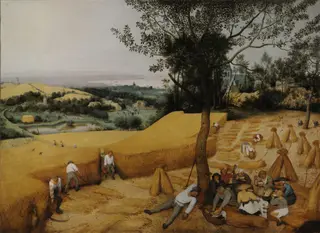 The Harvesters
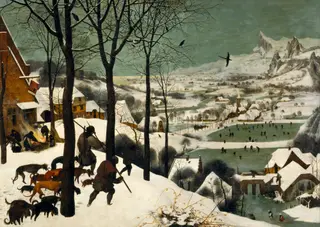 The Hunters in the Snow
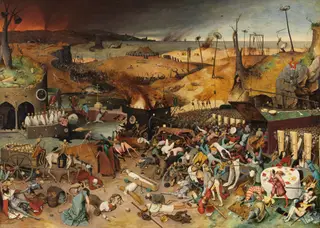 The Triumph of Death
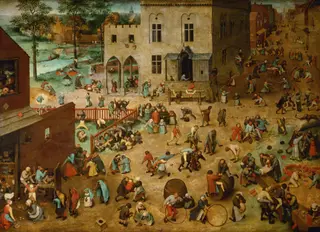 Children's Games
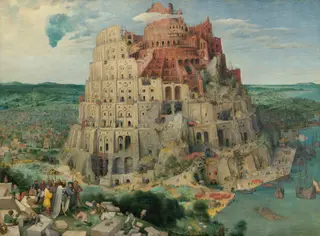 The Tower of Babel
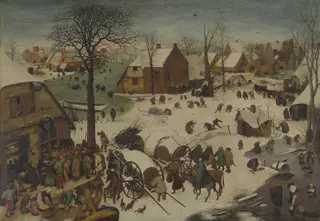 The People's Census at Bethlehem
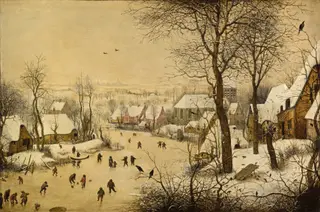 Winter Landscape with a Bird Trap
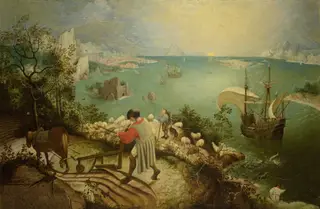 Landscape with the Fall of Icarus
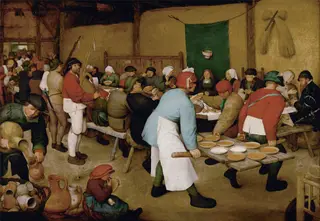 The Peasant Wedding
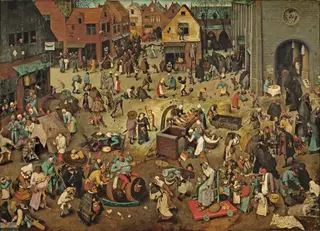 The Fight Between Carnival and Lent
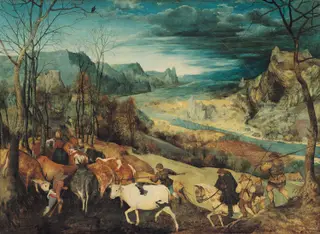 The Return of the Herd
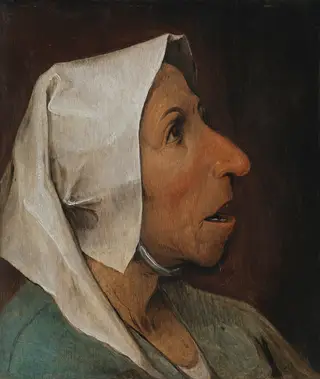 Head of Peasant
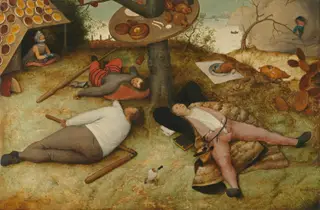 The Land of Cockaigne
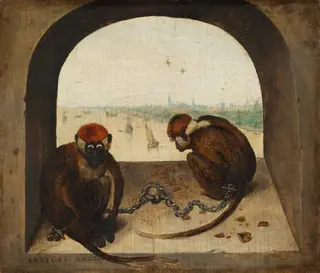 Two Chained Monkeys
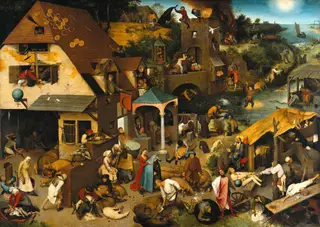 Netherlandish Proverbs
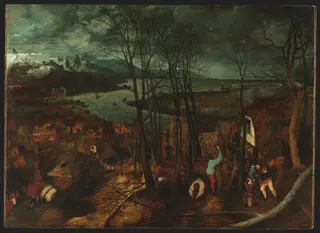 The Gloomy Day
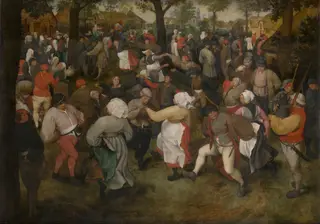 The Dance of the Bride
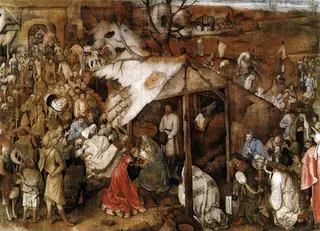 Adoration of the Magi
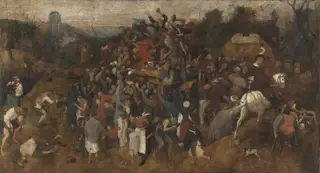 The Wine of Saint Martin's Day
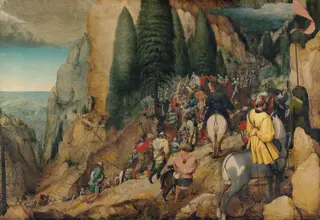 Conversion of Paul
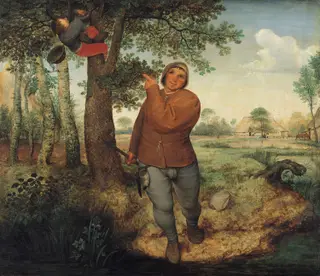 The Peasant and the Nest Robber
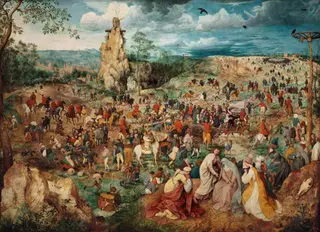 The Procession to Calvary
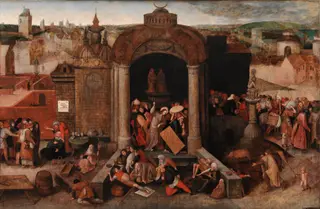 Christ Driving the Traders from the Temple
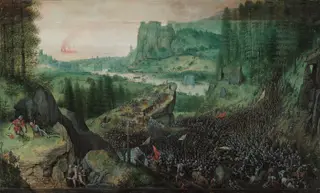 The Suicide of Saul
72 works in the catalog · 24 shown
Collections represented


Artists in a similar vein