Artwork
The Hunters in the Snow
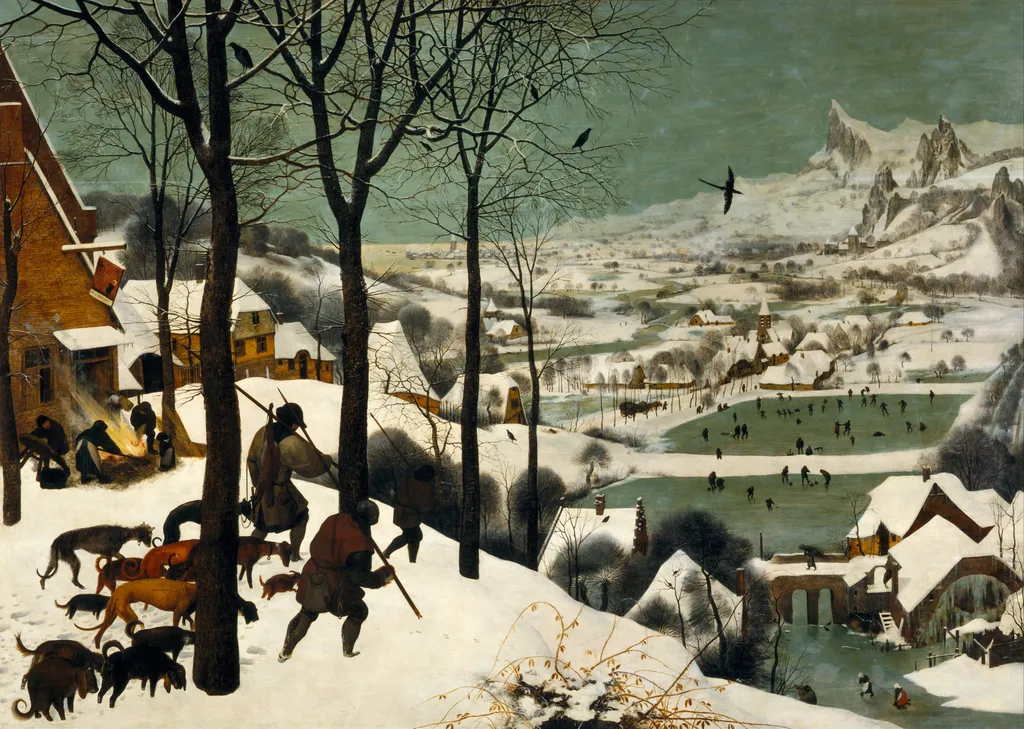
The Hunters in the Snow is an oil painting by the Northern Renaissance artist Pieter Brueghel I. It dates from 1565 and is held in the collection of the Kunsthistorisches Museum.
About this work
Three hunters trudge home through deep drifts above a Flemish village, shoulders bent and dogs trailing, with a single fox to show for the day.
Three hunters trudge home through deep drifts above a Flemish village, shoulders bent and dogs trailing, with a single fox to show for the day. Below, skaters glide across frozen ponds while villagers tend a fire outside the inn. Pieter Bruegel the Elder painted it in 1565 on an oak panel, signed 'BRVEGEL.
M.D.LXV' at lower center. Part of a cycle of seasonal pictures for the Antwerp merchant Nicolaas Jongelinck, it now hangs in the Kunsthistorisches Museum in Vienna.
Subject & Meaning
The painting depicts three hunters returning from an unsuccessful winter hunt, their dogs weary and only a small fox carcass in evidence; hare tracks in the snow underscore the failed expedition. The inn sign reading 'Dit is gulden Hert' (The Golden Hart) alludes to Saint Eustace, patron of hunters, yet its crooked hanging and the sparse catch comment on fortune's fickleness. Magpies, considered ill-omened in Dutch culture, and a bird trap near the composition's center suggest dangers of the season.
The work emphasizes humanity’s smallness against nature: figures appear as dark silhouettes in a vast, life-hostile landscape. As the winter panel in a series of months, it evokes the season's harshness, reflecting the contemporary Little Ice Age.
Technique & Style
The painting is executed in oil on a wood panel, measuring 117 × 162 cm. The composition is built on strong diagonal lines, leading from the descending hunters at left to the jagged mountain peaks, river, and frozen lake in the distance. The palette is dominated by muted whites, greenish grays, and earthy browns; figures and trees are rendered in dark tones that contrast with the snow-covered landscape. Bruegel achieves a convincing winter atmosphere without falling snow, instead layering nuanced whites and grays on roofs, branches, and walls to suggest a long-lasting snowfall.
The work is signed 'BRVEGEL. M.D.LXV' at bottom center. No shadows are cast, indicating an overcast sky or low sun.
Stylistically, the painting belongs to the Northern Renaissance, with detailed observation of rural life and a panoramic, inclusive composition that emphasizes the vastness of nature.
History & Provenance
Pieter Bruegel the Elder painted The Hunters in the Snow in 1565, as part of a series of six works depicting the seasons (or months) of the year. The painting was originally commissioned by the Antwerp businessman and art collector Nicolaes Jonghelinck, who displayed it in his country house, Ter Beken. In 1594, the series was given as a gift to Archduke Ernest of Austria, the Spanish governor of the Netherlands.
Following Ernest's death, an inventory of his estate on July 17, 1595, listed the six panels. The works then passed into the collection of Emperor Rudolf II, probably in Prague, and by 1659 they were recorded in the inventory of Archduke Leopold Wilhelm of Austria in Vienna. After a period of obscurity, the painting resurfaced and was noted in a museum catalog of 1884 as having been in the depot; it is now held by the Kunsthistorisches Museum in Vienna.
The painting is held in the collection of the Kunsthistorisches Museum in Vienna, Austria, where it is displayed in Room 10 under inventory number GG 1838. It has been part of the museum's holdings since the 17th century, having previously belonged to Archduke Leopold Wilhelm of Austria and earlier owners including Nicolaes Jonghelinck, Archduke Ernest of Austria, and Emperor Rudolf II. No specific public exhibition history is provided in the available sources.
Context
The Hunters in the Snow is a celebrated Northern Renaissance work and a key panel in Pieter Bruegel the Elder's cycle of seasonal paintings, illustrating December–January. Scholar Martin Kemp called it one of the most popular secular subjects for Christmas cards in his Nature essay. The painting has been extensively referenced in modern culture, featured in Andrei Tarkovsky's Solaris, Lars von Trier's Melancholia, and as the subject of a poem by William Carlos Williams.
Art historians also interpret it as a visual record of the Little Ice Age, noting the severe winter of 1564–1565. Its composition, with strong diagonals and muted grays, influences the tradition of winter landscapes, while its integration of labor and leisure reflects Bruegel's broader humanist and mannerist context within Flemish Renaissance painting.
Legacy
The painting has become one of the most reproduced winter scenes, often used on Christmas cards. It appears in numerous films: Andrei Tarkovsky's Solaris (1972) and The Mirror (1975), Lars von Trier's Melancholia (2011), Abbas Kiarostami's 24 Frames (2017), and Alain Tanner's Dans la ville blanche (1982). In literature, it inspired William Carlos Williams's poem "The Hunter in the Snow" and forms the cover for Claire Keegan's Small Things Like These.
The novel Headlong by Michael Frayn uses the painting as a plot device. A copy by Pieter Brueghel the Younger is held at the Tokyo Fuji Art Museum. The work is listed among BBC's 100 Great Paintings.
Overview
Pieter Bruegel the Elder's 1565 oil-on-oak panel, "The Hunters in the Snow," depicts a stark winter landscape. This Northern Renaissance painting is one of five surviving works from a larger series illustrating the seasons. It captures a moment of daily life in a Flemish village, contrasting the weary return of hunters with the lively activities of villagers below. The artwork is housed in the Kunsthistorisches Museum in Vienna.
Own this work as a print
Artist & collection

Artist
Pieter Bruegel (also Brueghel or Breughel) the Elder ( BROY-gəl, US also BROO-gəl; Dutch: ; c.