Begin with the knot that no painter in 1644 could untie. Qing dynasty painting inherited a problem before it inherited a brush. The masters of the fallen Ming had already said, with the air of a final verdict, what a mountain should look like, how a scholar's hut should sit among its pines, where the eye should be allowed to rest. The dynasty had collapsed under Manchu armies. The pictures it left behind had not collapsed with it. So the first question facing a painter in the new order was not how to paint. It was what to do about everything that had already been painted, and by men widely agreed to be unsurpassable.
This essay argues a single thing. The Qing was a two-century quarrel with its own predecessor over one question: does loyalty to the old masters mean reproducing them, or becoming as free as they once were? That sounds like a dispute about technique. It was really a dispute about what tradition is for. One camp answered that you honor the past by absorbing it so completely that your hand becomes a living archive of dead masters. The other answered that you honor the past by doing what those masters actually did, which was to ignore their own teachers and paint a self. A third party, the imperial court, refused the terms of the debate entirely and imported a foreign optics to settle it. The Qing never reached a verdict. Its greatness lies in how loudly, and for how long, it kept the argument open.
The inheritance nobody could refuse
The Manchus took Beijing in 1644 and founded a dynasty that would last until 1911. They were conquerors who admired what they had conquered, and under the long reigns of the Kangxi and Qianlong emperors the court became one of the great patrons of Chinese painting, as the Metropolitan Museum's survey of the period sets out. That patronage matters to the argument, because a conquered elite of scholar-painters now had to decide how to carry a Han Chinese tradition forward under a non-Han throne. For the loyalists, every brushstroke became a question of allegiance. To paint like the Yuan and Song masters was to keep a vanished China alive on paper. To paint a strange, distorted landscape was to refuse the new order's invitation to be comfortable.
Smarthistory frames the early Qing as a split into two camps, and it is the cleanest way to hear the quarrel. On one side stood the orthodox masters, who set out to revitalize painting through the close study and imitation of classical works. On the other stood the individualists, painters such as Shitao and Gong Xian, who treated the brush as personal expression and, often, as a vehicle of political protest under Manchu rule. Both sides claimed the same ancestors. Both insisted they were the true heirs. The orthodox accused the individualists of vanity. The individualists accused the orthodox of taxidermy. Read that way, the period stops being a quiet sequence of landscapes and becomes what it was, a long fight over the soul of a tradition.
The orthodox answer: copy your way back to freedom
The orthodox position is easy to caricature and hard to dismiss. Its leading figures, the so-called Four Wangs together with two close associates, believed that the Ming had grown slack precisely because it had stopped looking hard at the Song and Yuan. Their cure was not novelty. It was a deeper, more disciplined obedience. You learned the dry, raveled texture-strokes of one master, the wet rounded mountains of another, the spacing of a third, until you could summon any of them at will and, in the best cases, fuse them into a third thing that was somehow yours. The wager was counterintuitive. Total submission to the past, carried far enough, would loop back into freedom.
No one embodies the wager better than Wu Li, a painter who studied the orthodox method to the bone and then walked off the map of his own school by converting to Catholicism and training with Jesuits. He is the rare Qing master who stood in two of the period's three camps at once, which makes his quietest works the most revealing.
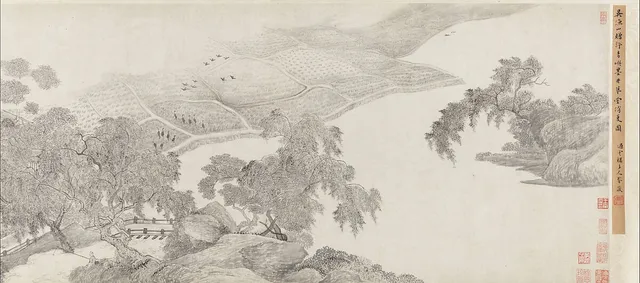
Look at Wu Li's Whiling Away the Summer at the Ink-Well Thatched Hut. It is a handscroll, which means it was never meant to be seen all at once. You open it hand over hand, and the picture arrives as time rather than as a view. The brushwork is dry and fibrous, built from short overlapping strokes that the orthodox manuals would name and number, yet the rhythm is unmistakably one man's pulse. The thatched hut sits low, half-screened by summer foliage, near the ink-well that gives the scene its title. Wu Li does not flood the space with the deep blue distances a Song court painter would have used to impress. He keeps the recession shallow and the ink restrained, so the eye stays close, among the leaves and the worn study, where a scholar would actually have spent a hot afternoon. The painting is an orthodox object made from borrowed strokes, and it is also a private room. That is the orthodox claim in one image. The dead masters are not a cage here. They are the alphabet in which Wu Li writes something only he could say.
The orthodox lineage is also where you find the period's great collaborators and specialists, painters trained to slot named manners together on demand. Yang Jin, a follower of the orthodox circle, shows the method at its most companionable. His Landscape with Figures sets herders and cattle into a riverside that is composed rather than observed, every passage answerable to a precedent. The genius of the orthodox school was to make that answerability feel warm instead of pedantic. Its limitation was that warmth could curdle into formula, and the next generation knew it.
The individualist answer: the brush as a protest
If the orthodox honored the old masters by becoming them, the individualists honored them by betraying them in exactly the way the old masters had once betrayed their own. Shitao's slogan, that the past must serve the present and not the other way round, is the manifesto. Gong Xian's black, depopulated mountains read as the landscape of a man who has decided the world is uninhabitable under the new flag. These were not eccentrics decorating the margins of a tradition. They were arguing that the tradition's true content was the freedom to break it, and that the orthodox had thrown away the one thing worth inheriting.
By the eighteenth century the individualist temper had migrated south to the prosperous salt-trade city of Yangzhou and hardened into a style. Zheng Xie, one of the painters later grouped as the Eccentrics of Yangzhou, made his living and his name on a deliberately narrow repertoire of bamboo, orchids, and rock. His Orchids and Bamboo is a handscroll where the plants are almost an excuse. The orchid leaves slash across the paper in long, loaded strokes that double as calligraphy, and Zheng Xie's own inscriptions crowd in beside them as equal partners, not captions. He trained as a magistrate and was dismissed for siding with famine victims against the state, and the picture carries that biography in its insolence. A clump of bamboo, in this tradition, is a gentleman who bends in the storm and does not break. Zheng Xie paints it as a man who has already paid for the metaphor.
The individualist freedom could go further still, into outright theater. Gao Qipei, an early-Qing eccentric, set the brush aside and painted with his own fingers, nails, and palm. A finger-painted beast is a joke and a dare and a serious argument all at once. It says the lineage of brush-types in the manuals is not sacred, that the picture lives in the seeing and not in the tool. The orthodox would have found it barbarous. That was the point.
A third front: the emperor's foreign eyes
While scholars in the south fought over how to inherit the Chinese past, the throne opened a second seam in the same wall. Western painting reached the Qing court through Jesuit missionaries, and that influence on imperial pictures rose under three emperors in particular, Kangxi, Yongzheng, and Qianlong, as Wikipedia's account of Western influence on Qing painting records. The decisive figure was the Italian Jesuit Giuseppe Castiglione, known in Chinese as Lang Shining, who served the court for more than fifty years and grafted linear perspective and modeled light onto Chinese formats and subjects. The court was, in effect, conducting its own version of the orthodox-individualist quarrel, but with a foreign vocabulary smuggled in. How much realism could a Chinese painting absorb before it stopped being one?
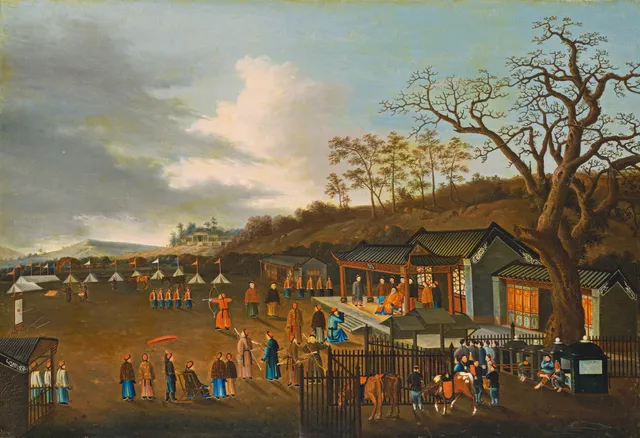
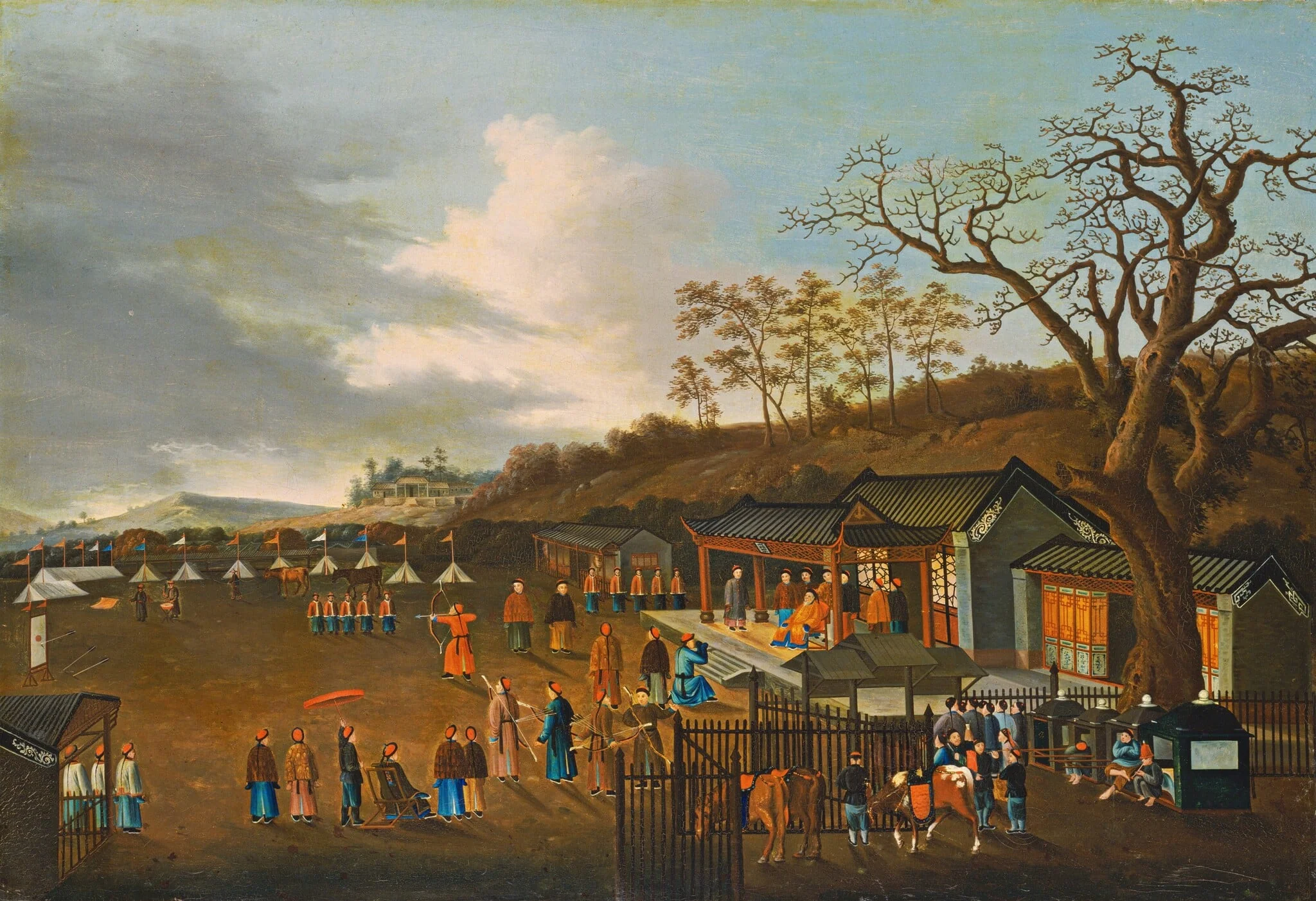
The court's answer is legible in a work like the Archery Contest attributed to a Qing court hand. Manchu identity was bound to the bow, and the painting takes the dynasty's founding skill as its subject. Look at how the figures are placed. The archers are individuated, their stances weighted and turned in space, the drawn bow described with a solidity that owes something to the Jesuit teaching of volume and shadow. The ground recedes in a way no pure literatus landscape would bother with, because the court wanted the event recorded, the spectacle made present, the emperor's martial world held up as fact. Yet the color stays flat and emblematic in the Chinese manner, and the composition reads in measured registers rather than through a single vanishing point. It is a hybrid that knows exactly what it is doing. The picture wants you to believe the men are real and to remember, at the same time, that you are looking at an ideal of dynastic vigor.
The court's outward gaze ran both directions. The Getty notes that copies of the Kangxi-era illustrations of farming and weaving, commissioned in 1696, were carried to Europe in the eighteenth century, where a scene of the emperor at the plow was reproduced in European prints, as its exhibition on China and paper documents. So the same decades that saw Jesuit perspective enter Beijing saw Chinese imperial imagery enter Paris. The argument with the past was happening inside a larger traffic of images that neither the orthodox nor the individualists fully controlled.
The court could also paint inward and small. The album leaf by Prince Yongxing, an imperial son and noted calligrapher, in our holdings as an untitled study, shows the throne in its scholar-amateur guise, taking up the literati brush as a sign of cultivation rather than command. And the documentary instinct that produced the Archery Contest also produced flat administrative pictures like the anonymous Map of the Grand Canal from Beijing to the Yangzi River, where painting and statecraft become one long, unrolling object. The Qing court wanted it all: the literatus, the realist, the cartographer.
What the archive remembers
Our own corpus lets you watch the seam between the dynasties rather than just read about it. Artifact World Gallery holds 385 Qing dynasty paintings across 11 venues, by 142 artists, with attribution dates spanning roughly 1506 to 1898. That starting year is the tell. 1506 sits deep inside the Ming, almost a century and a half before the Manchus took Beijing, and yet it falls inside the dated range of works the field reads as Qing. The argument, in other words, did not start in 1644. It started while the Ming was still standing, in the lineages and lifespans that bled across the political break. A dynasty changed in a single year. A way of arguing about the past took generations to turn over, which is exactly what a quarrel about inheritance should look like in the data.
The same spread of 142 hands across 11 institutions is a quiet rebuke to the tidy two-camp story. For every named master in the survey histories there are dozens of working painters, court specialists, regional professionals, gentleman-amateurs, who took positions somewhere between obedience and revolt. The individualist Zheng Xie accounts for three works in the corpus on his own; later Yangzhou-trained figures such as Wang Su carried the eccentric manner toward a broader market into the nineteenth century. The breadth is the historical fact the textbooks compress.
Works discussed in this article
The argument that never closed
It is tempting to score the quarrel. The individualists, with their cracked mountains and finger-painted beasts, look like the winners to a modern eye trained by Romanticism to prize the lone voice. That verdict flatters us more than it explains the Qing. The orthodox were not failures of nerve. They had grasped something the individualists sometimes missed, that a tradition strong enough to rebel against has to be kept alive by someone, and that copying is one of the deepest forms of attention a culture can pay to itself. The court, for its part, proved that a tradition can absorb a foreign optics without dissolving, that Castiglione's modeled light could enter a Chinese hall and leave the building still recognizably Chinese.
What makes the period worth your attention now is that it never settled. Wu Li copies his way toward a private summer afternoon. Zheng Xie slashes an orchid into a political act. A nameless court painter builds a real archer out of half-foreign shadow. Each is answering the same question, posed by the same vanished predecessor, and each answer remains legible on the paper as a position taken under pressure. Stand in front of a Qing painting and you are not looking at a style. You are overhearing a two-hundred-year conversation about what we owe the people who taught us, conducted by people who knew the throne was watching and the past was listening. The next brushstroke you study is somebody's reply.
Sources & further reading
- The Qing Dynasty (1644-1911): Painting — The Metropolitan Museum of Art, Heilbrunn Timeline of Art History
- Art of the Qing dynasty — Smarthistory
- Western influence on Qing dynasty paintings — Wikipedia
- China on Paper: European and Chinese Works — The J. Paul Getty Museum
- The Way of Chinese Painting (with selections from the Mustard Seed Garden manual) — Internet Archive