The painters now filed under the Symbolism movement never agreed on a subject, a palette, or a country. Gustave Moreau loaded his surfaces until they glittered like reliquaries. Pierre Puvis de Chavannes drained his until they read like dry plaster. Odilon Redon spent two decades working almost entirely in black. A survey treats them as a club of dreamers held together by sphinxes, severed heads, and women who are secretly ideas. That account explains the captions and very little of the paintings themselves. The claim this essay defends is narrower and more useful: what binds Symbolism is not its imagery but its craft. Each of these artists re-engineered the physical surface of the picture so that pigment would stop behaving like a window onto the visible world and start behaving like a sign.
Put method first and the movement snaps into focus. The Symbolist problem was material before it was literary. If a painting is meant to summon a mood rather than report a fact, the paint has to be stopped from doing what academic training had drilled into it, which was to dissolve into convincing flesh, air, and recession. So the Symbolists went at the surface itself. They revived tempera and distemper, pushed lithographic crayon and pastel into ground that oil had long owned, thickened or starved their grounds, and flattened depth on purpose. The shared aim, that a picture should suggest rather than describe, was reached by a dozen different hands solving the same technical puzzle. The label arrived late and from outside painting: the critic Jean Moréas coined it in 1886 to defend the verse of Mallarmé and Verlaine, as the Tate records, before anyone thought to pin it to a way of handling a brush.
The idea had to be built, not just imagined
In 1891 the critic Albert Aurier tried to set down what a Symbolist painting actually was, in the pages of the Mercure de France. His five adjectives have been quoted ever since: a true Symbolist work was idealist, symbolist, synthetist, subjective, and decorative. The first three describe what a picture should mean. The last two describe how it should be made. Subjective and decorative are instructions to the hand. They tell the painter to subordinate the optical truth of a scene to the felt truth of a temperament, and to treat the canvas as a designed flat plane rather than a staged box of air. A naturalist hides his facture so the illusion holds. A Symbolist lets the facture carry the message.
This is why the movement looks so incoherent from a distance and so consistent up close. Stand back and you see a sphinx here, a dead poet there, an island of cypresses. Lean in and you find the same conviction at work in the material: paint must be made strange enough that the eye cannot slide past it into a pretend world. The strangeness was achieved with old recipes and new tools. Tempera came back from the quattrocento. Distemper came over from theatre scenery and mural work. Lithography and pastel, both thought of as preparatory or minor media, were promoted to finished statements. Symbolism is, among other things, a history of materials being asked to do unfamiliar jobs.
Redon's blacks: the engineered void
No one shows the priority of method over motif more cleanly than Odilon Redon (1840-1916). For roughly the first half of his career he worked in what he called his noirs: charcoal drawings and lithographs in which a spider grins, a severed head floats, an eye rises like a balloon. The choice of black was not a mood. It was a technique for forcing suggestion. Charcoal can be smudged into a fog with no edge, then lifted with bread or eraser to leave a single bright void where a face or a flame should be. Lithographic crayon on stone holds a velvet density that oil cannot match. Redon spent years learning to make darkness legible, building creatures out of tone rather than line so that the viewer finishes the image and, in finishing it, owns the unease. The black came first; the monsters were what the black made possible.
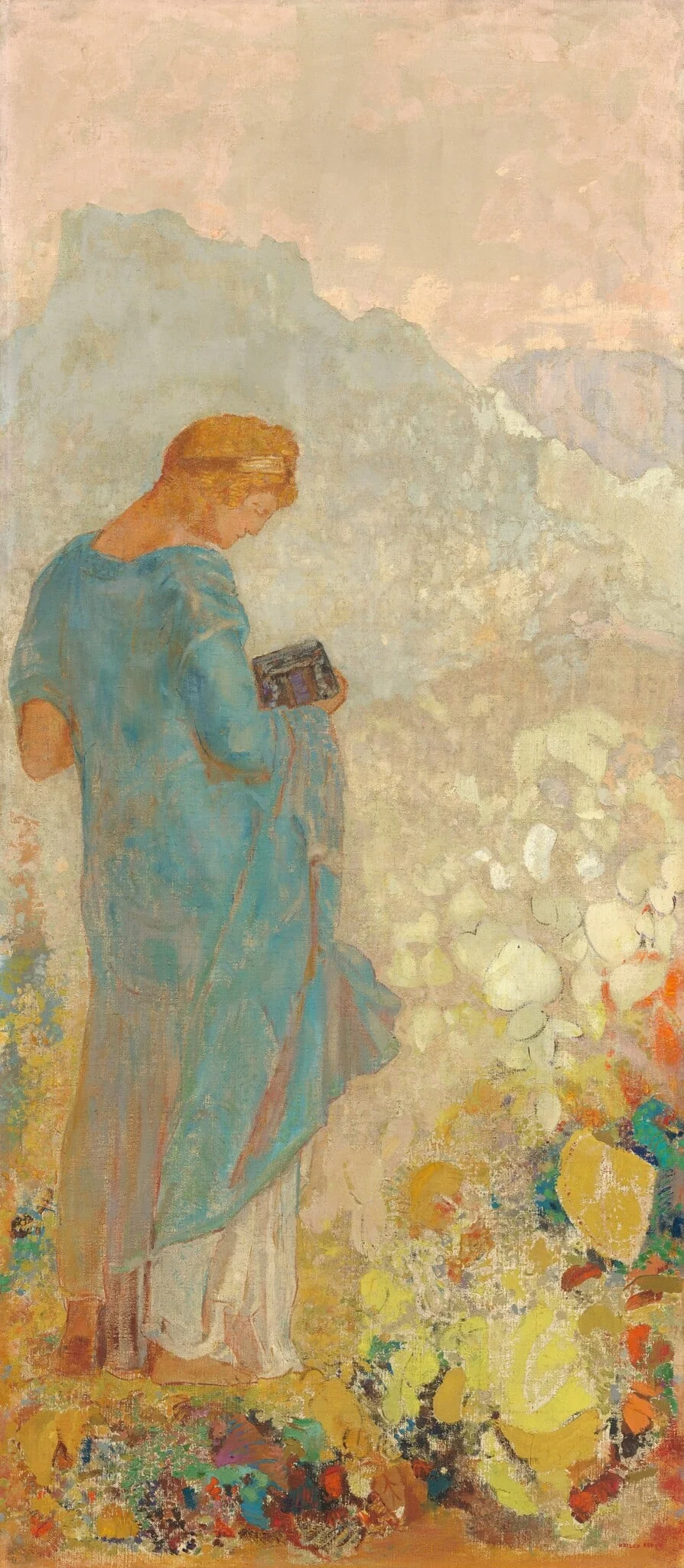
When Redon finally let color back in, after about 1890, he carried the lesson with him. He worked in pastel and in oils handled like pastel, dabbed and scumbled, so the surface stays powdery and porous and never resolves into glass. Pandora is the case to look at hard.
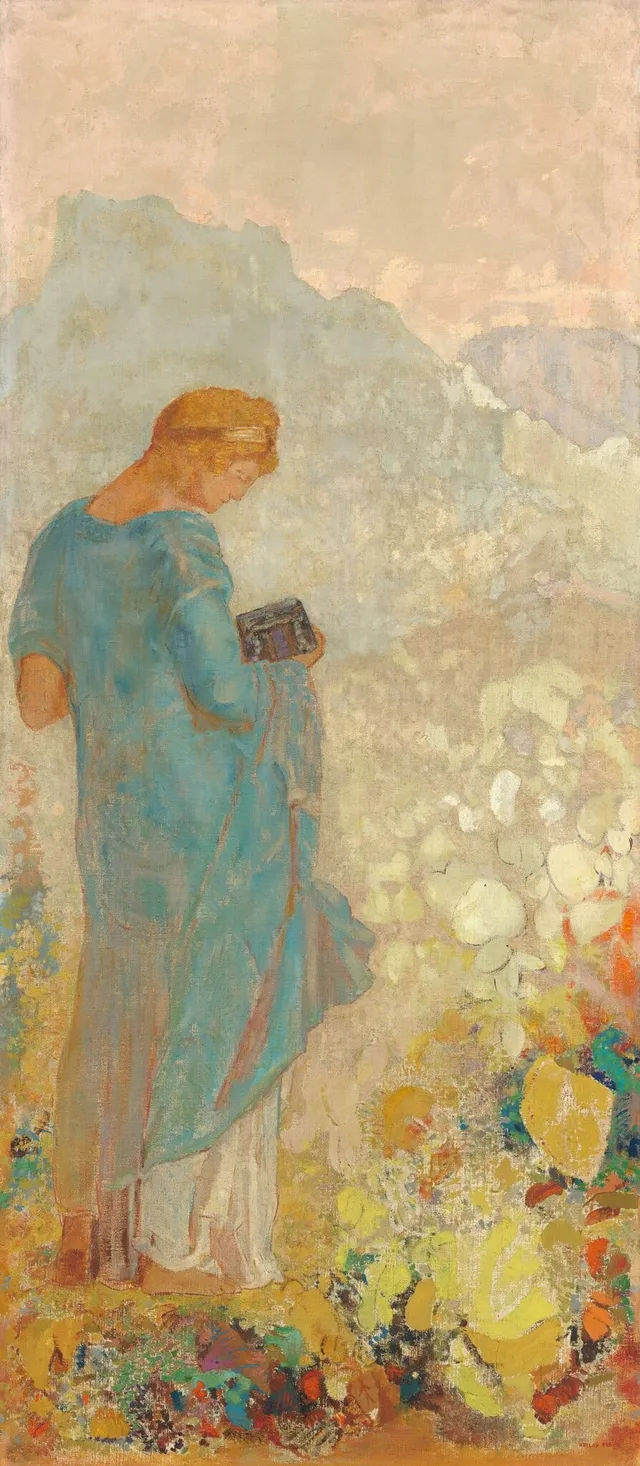
The first thing to notice in Pandora is that there is no floor. Redon gives the standing nude no horizon line, no cast shadow, no ground plane to press her weight against. She is set into a haze of blossom and blue-green light that crowds up to the very edges of her body and, in places, over them. Her contour goes soft at the shoulders and hip, so the flesh and the flowered air trade pigment. The box she carries sits low at her waist, barely a darker note among the scattered blooms, withheld rather than presented. There is no narrative instant, no lid lifting, no escaping evils. Redon has taken the most plotted myth in the catalogue and stalled it, because the color matters more to him than the story. The picture is built out of stippled, granular touches that never fuse, so the eye is kept at the surface and never permitted to fall through it into a deep illusionistic garden. The handling is the meaning. A woman made of the same loose color as the world around her cannot be read as a person in a place. She has to be read as an idea hovering in a mind.
The same porous touch governs The Chariot of Apollo, a subject Redon returned to often, where the horses and the sun become a single burst of pastel light with the drawing half-buried inside it. Apollo's triumph over darkness is also a private allegory of Redon's own move out of the noirs into color, and he tells it the only way he trusts, through the behavior of the medium rather than through gesture and anecdote.
Moreau's encrustation
Where Redon thinned and softened, Gustave Moreau, recorded by the Getty as French and active from 1826 to 1898, thickened and hardened. His pictures are famous for looking jewelled, and the look is a deliberate construction. Moreau built up his surfaces in layers of glaze and dense impasto, scratched into the wet paint with the butt of the brush, and dragged fine threads of pigment across darker grounds so that ornament seems to grow over the figures like coral or rust. He admired Persian miniatures, enamel, and Byzantine mosaic, and he wanted oil paint to do what those crafts did: to encrust a flat field with detail until it reads as a precious object rather than a glimpse of life.
Look at Oedipus and the Sphinx. The two protagonists are locked face to face on a narrow ledge, the sphinx's claws hooked into the hero's chest, and the confrontation should be the whole event. Yet Moreau pulls the eye everywhere but their gaze. He stacks a cliff of jewel-toned rock behind them, drops a fluted column down one side, litters the foreground with a corpse's pale feet, and gilds the sphinx's wings until they shimmer like cloisonné. Space is compressed almost to relief; the figures are pressed close to the picture plane and the depth behind them is a painted backdrop, not a real ravine. The handling holds the riddle on the surface, ornamental and arrested, because Moreau is not staging a fight but mounting an emblem. A glassy, encrusted finish keeps the scene from ever becoming an event you could walk into.
Böcklin's tempera and the cold flat distance
The Swiss painter Arnold Böcklin reached suggestion by yet another route: he went looking for an older chemistry of paint. Dissatisfied with the way oil yellows, darkens, and gleams, Böcklin experimented for years with tempera and with mixed emulsion grounds, hunting for a matte, even, almost frescoed finish that would hold its color and refuse a wet shine. The motive was not antiquarian. A surface without gloss reflects no studio light back at the viewer, so the painted scene sits behind the picture plane like a vision held at a fixed, unreachable distance. The technical decision produces the mood directly.
His most reproduced image, Isle of the Dead, depends on exactly that flatness. A white-shrouded figure stands in a small boat gliding toward a rocky islet ringed by sheer cliffs and a black grove of cypress. Böcklin paints the water as a still, unbroken sheet with almost no reflection, and the rock walls in broad even planes with their carved tomb-openings rendered as plain dark slots. Nothing sparkles. The whole scene is keyed to a narrow band of slate, ochre, and near-black, and the matte tempera-like surface absorbs the light rather than throwing it back, so the island seems sealed off behind a pane of cold air. The picture works as a threshold, and it works because the paint will not let you in.
Böcklin painted five versions of that island between 1880 and 1886, adjusting the framing and the light each time. The repetition is itself a tell about method. A storyteller paints a subject once. A craftsman returns to refine a controlled effect, the way a printer pulls successive states.
Puvis and the matte wall
If Böcklin chased the matte surface in easel pictures, Pierre Puvis de Chavannes built his whole manner out of mural craft. He was a decorator of public walls, and he wanted even his canvases to look like frescos: pale, chalky, evenly lit, with the pigment sitting flat against the weave the way distemper sits flat against plaster. He bleached his color toward a dry, limestone key, suppressed cast shadow, and arranged figures in shallow friezes parallel to the surface. The flatness was a discipline. A mural has to read at a distance, hold the architecture, and never punch an illusionistic hole in a load-bearing wall, so Puvis made calm, planar design into a positive value rather than a limitation.
His late summary, Inter artes et naturam, gathers quiet figures in a hazy Normandy landscape, a potter, a mother, a few strollers, spread across a long horizontal band of pale green and dust. There is no drama and no deep space; the figures are placed like notes on a stave, each given air, the color held to a soft mineral register. This restraint is what made Puvis the unlikely hinge of the avant-garde. Gauguin and the young Nabis studied his flat, decorative fields closely, and his matte friezes pointed toward the simplified, designed surfaces that would matter to the next generation far more than his mild allegories ever did.
What the archive shows about the method
The technical reading also explains the geography. Symbolism was never a single workshop with a house style; it was a loose international agreement about ends, reached by painters who could not have shared a palette if they tried. Artifact World Gallery's own holdings make that spread legible: 405 Symbolism works, drawn from 60 venues and 134 named artists, dated across the long arc from roughly 1850 to 1940. A century of production and well over a hundred hands, and almost no two of them touch a canvas the same way. Standard accounts of a movement lean on a signature look. The number here points the other direction, toward a movement defined by a problem rather than a manner, which is exactly what a method-first reading predicts.
That long tail also reaches across the Atlantic and into the twentieth century. The American Arthur Bowen Davies carried the dreamy, frieze-like idiom into the United States, where he helped organize the 1913 Armory Show even as he kept painting his own Arcadian processions. And the New York painter Bryson Burroughs, a curator at the Metropolitan Museum by day, built mythologies in a deliberately archaic, Puvis-pale key. His Eurydice Bitten by the Snake sets its fatal moment in flat, light-keyed tempera tones, the figures spaced like a low relief, the snake almost incidental. The handling is the inheritance. A painter need not have met Moreau or Böcklin to take up the Symbolist bet that surface, not anecdote, does the persuading.
Works discussed in this article
Method as inheritance
Reading Symbolism as a set of techniques rather than a set of subjects also clarifies what it handed forward. The usual story credits the Symbolists with a mood, a taste for decadence and dream that later painters borrowed and dressed up. The truer legacy is procedural. When a movement teaches that paint may be flattened, thickened, drained, or smudged into suggestion, and that the optical truth of a scene can be sacrificed to a temperament, it has loosened the contract that bound European painting to the visible since the Renaissance. The next generation took the loosened contract and ran. The Symbolist refusal of naturalism and of plain narrative, and its wager on the subjective rendering of an idea, fed directly into German Expressionism and into early abstraction, as the Metropolitan Museum notes. Once a surface is allowed to mean on its own terms, representation becomes optional.
You can see the bridge in the specific habits. Redon's powdery color fields, refusing to resolve, sit a short step from the floating color of the early moderns. Moreau, who taught Matisse and Rouault, sent his students out telling them to follow their own dream and to trust the decorative power of color, advice that is unimaginable from an academic of the previous generation. Puvis's pale, flat friezes gave Gauguin and the Nabis a usable model for a designed, non-illusionistic surface. None of this is about iconography. It is about what these painters discovered the paint could be made to do, then passed on as a working method.
So the right way to enter a Symbolist room in a museum is not to start with the labels and their litany of myths. Start with your eyes near the surface. Notice the dry matte chalk of a Puvis, the absorbing flat tempera of a Böcklin, the scratched and gilded crust of a Moreau, the granular pastel haze of a Redon. The subjects will still be strange. The strangeness was always a consequence, manufactured at the level of the material, by craftsmen who decided that a painting should stop pretending to be a window and admit, in every touch, that it is a made thing carrying a thought.
Sources & further reading
- Symbolism (art term) — Tate
- Symbolist painting — Wikipedia
- Gustave Moreau — The J. Paul Getty Museum
- Symbolism — The Metropolitan Museum of Art
- Odilon Redon — National Gallery of Art
- Symbolism — Smarthistory
- Symbolist Manifesto — Wikipedia
- Le symbolisme: essai historique sur le mouvement symboliste en France (1911) — Internet Archive