Artist
Romeyn de Hooghe
Netherlands
Romeyn de Hooghe is a Netherlands Baroque artist. 8 works are cataloged here, principally at National Gallery of Art.
Romeyn de Hooghe (bapt. 10 September 1645 – 10 June 1708) was a late Dutch Baroque painter, sculptor, engraver and caricaturist.
Overview
Romeyn de Hooghe (baptized 10 September 1645-10 June 1708) was a Dutch Golden Age printmaker, painter, sculptor, and caricaturist whose prolific output of over 3,500 prints made him one of the most versatile and influential graphic artists of the late Baroque period. Working primarily in Amsterdam and later Haarlem, he is best known for his political satires targeting Louis XIV of France and his propagandistic prints supporting William III of Orange. His work spanned allegory, history painting, cartography, and book illustration, and he has been recognized by historians as a foundational figure in modern political satire.
Biography & dates
De Hooghe was born in Amsterdam into a family originally from Ghent. He was baptized on 10 September 1645 and was the nephew of the painter Pieter de Hooch. In 1668 he traveled to Paris, where he encountered French art, an influence that would permeate his entire oeuvre. He became engaged to Maria Lansman of Edam in 1673, and their child was baptized in the Nieuwezijds Kapel in Amsterdam in 1674. According to the RKD, he was admitted to the Confrerie Pictura in 1662 and again in 1683 in The Hague. In 1675, the Polish King John III Sobieski ennobled him for his graphic depictions of the battles of Chocim and Terebovlia. He inherited his uncle Pieter de Hooch's house in 1687 and subsequently settled in Haarlem, where he established a drawing school at Nieuwe Gracht 13. De Hooghe also pursued academic studies, earning a doctorate in law from the University of Harderwijk in 1689. That same year, William III appointed him commissioner of mining in Lingen to design sculptures for the gardens of Het Loo. He died in Haarlem on 10 June 1708 and was buried there on 15 June.
Style & movement
De Hooghe operated within the late Dutch Baroque, producing work characterized as expressive, fantastical, wild, and baroque. His compositions have been compared to those of Aert de Gelder. He worked across an extraordinary range of media and functions: as etcher, draughtsman, painter, sculptor, medalist, goldsmith, enameler, and cartographer. His graphic style gave Baroque conventions what scholars have described as a documentary aspect. In addition to political propaganda, he produced erotic works, decorative borders for large-scale city maps, and illustrations for books on subjects as diverse as martial arts, the Bible, emblems, travel, heresies, and garden design. He also invented a method for printing on cotton and worked as a publisher of maps. His satirical approach was deliberately vulgar and personal, ridiculing Louis XIV through images of the monarch suffering from colic, astride monsters, or walking on crutches.
Major works
De Hooghe's output exceeded 3,500 prints, including political series such as the Spiegel der Fransse Tyranny (1673) and Schouburgh der Nederlantse Veranderinge (1674). His illustrated edition of Jean de La Fontaine's Contes et nouvelles en vers appeared in Amsterdam in 1685. The Hieroglyphica of Merkbeelden der oude volkeren, published in 1735, became a significant emblem book and source for classical mythology and iconography. He also produced De Bijbelsche Historien (1703), Spiegel van Staat des Vereenigde Nederlands (1706), and Esopus in Europa (1702) with Dirck Rembrantsz van Nierop. For the mayor's office in Enkhuizen, he painted large panels and in 1707 created a chimney piece and eight grisailles; he also made doors for the town hall in Alkmaar. His copperplate engraving The Battle of Chocim is held at the Wilanów Palace Museum. A collection of 59 prints on 67 sheets is housed at the Getty Research Institute in Los Angeles. The National Gallery of Art held a 2014-2015 exhibition devoted to his book illustrations.
Influences & students
De Hooghe's 1668 journey to Paris exposed him to French art, which influenced his subsequent work throughout his career. He may have been a pupil of Franciscus van den Enden and was friends with Hans Bontemantel and Adriaen Koerbagh. His atelier employed 36 assistants, indicating a substantial workshop operation. His documented pupils included Filibert Bouttats, Filibertus Bouttats, Frans Decker, François Harrewijn, Jacobus Harrewijn, Aernout Naghtegael, Laurens Scherm, and Adriaen Schoonebeek.
Legacy
De Hooghe's legacy rests primarily on his role as a pioneer of political graphic satire. Historian Simon Schama, writing after the 2015 Charlie Hebdo killings, identified him as "the first great modern graphic satirist," noting his enlistment by William III in propaganda warfare against Louis XIV. His prints depicting the conflict as a struggle between liberty and religious despotism circulated throughout Europe. Despite contemporary disapproval from Arnold Houbraken, who criticized his dissolute lifestyle and later engraving of shameful subjects, de Hooghe's influence on visual propaganda and satirical illustration proved enduring. His work is represented in major collections including the Rijksmuseum Amsterdam, and scholarly attention has grown significantly, with major exhibitions and monographic studies such as Meredith Hale's The Birth of Modern Political Satire (2020) and Henk van Nierop's De vernuftige etser (2019) reassessing his career.
Works by Romeyn de Hooghe
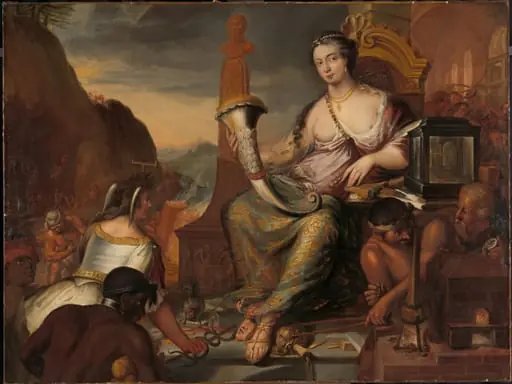 Allegory of Coinage
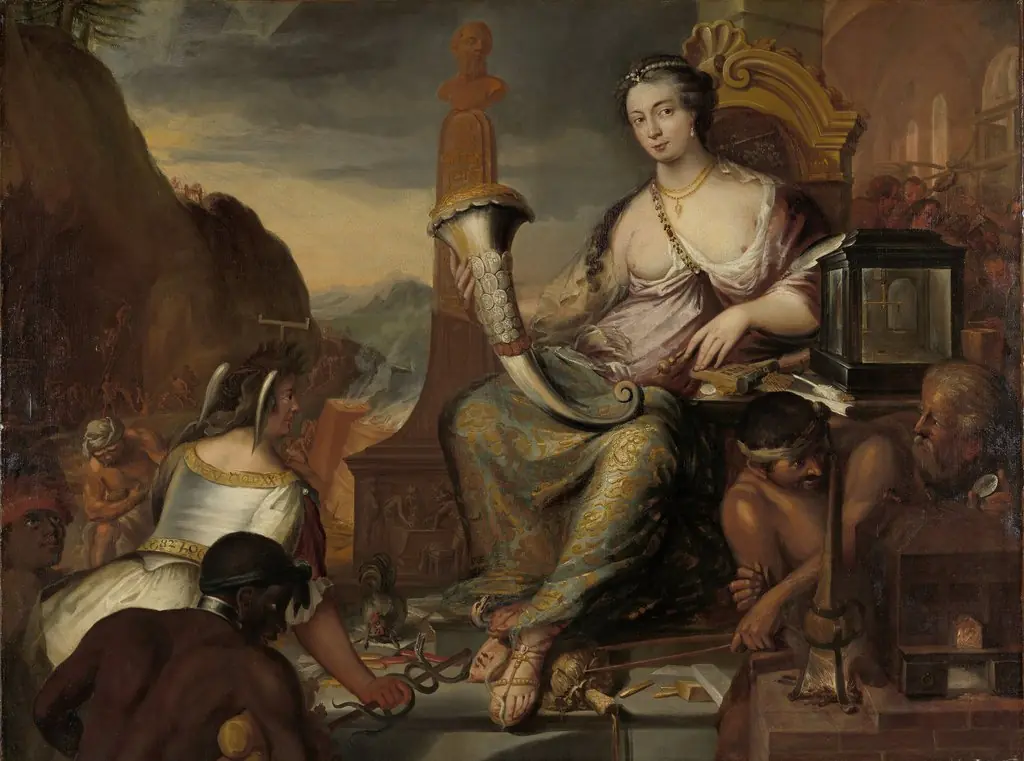 Allegory of coinage
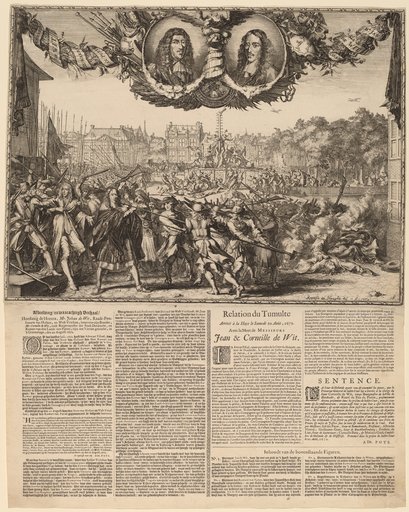
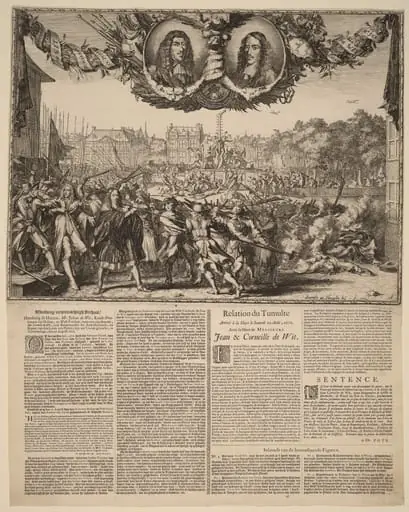 Afbeelding en waarachtigh Verhaal... (Representation of the True Story of Johan de Witt...)
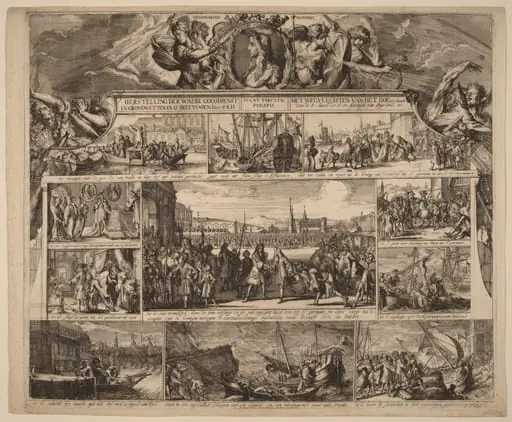 No Monarchy, No Popery
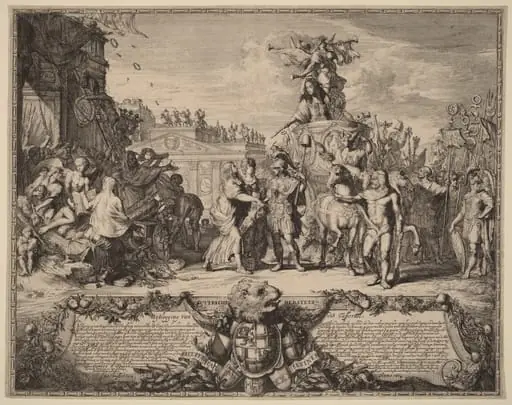 Uytrecht Herstelt (The Recapture of Utrecht, 1673)
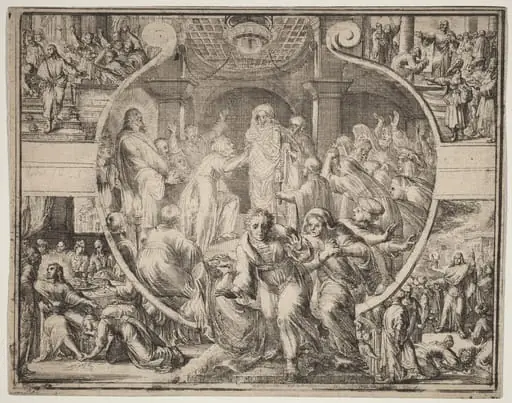 Raising of Lazarus with Scenes from the Life of Christ
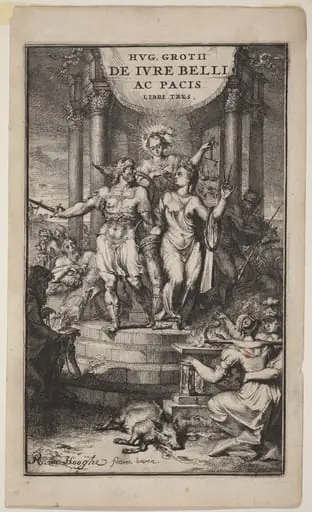 Law of War and Peace
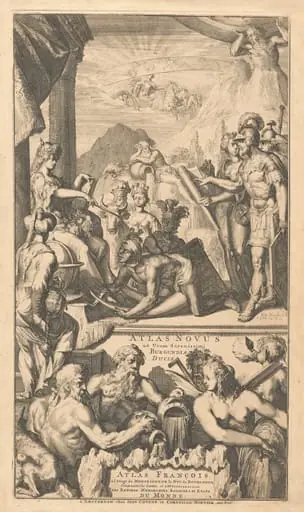 Title Page for “Atlas Novus (New Atlas)”
Collections represented


Artists in a similar vein