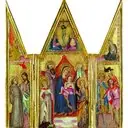
Artist
Andrea Vanni
![Scenes from the Passion of Christ: The Crucifixion [middle panel]](https://artifactworldgallery.com/img/andrea-vanni--scenes-from-the-passion-of-christ-the-crucifixion-middle-pan--abe5469a28e77ac7-w320.webp)
![Scenes from the Passion of Christ: The Descent into Limbo [right panel]](https://artifactworldgallery.com/img/andrea-vanni--scenes-from-the-passion-of-christ-the-descent-into-limbo-rig--9eb5d32175c31b6f-w320.webp)
![Scenes from the Passion of Christ: The Agony in the Garden, the Crucifixion, and the Descent into Limbo [entire triptych]](https://artifactworldgallery.com/img/andrea-vanni--scenes-from-the-passion-of-christ-the-agony-in-the-garden-th--1ebebae2d86a2ec2-w320.webp)
![Scenes from the Passion of Christ: The Agony in the Garden [left panel]](https://artifactworldgallery.com/img/andrea-vanni--scenes-from-the-passion-of-christ-the-agony-in-the-garden-le--2bad16de75eee8eb-w320.webp)
1332–1414
Andrea Vanni was a Byzantine icon painting artist. 12 works are cataloged here, principally at Museum of Fine Arts Boston. Andrea Vanni was born in Siena.
- Scenes from the Passion of Christ: The Crucifixion [middle panel]
- Scenes from the Passion of Christ: The Descent into Limbo [right panel]
- Scenes from the Passion of Christ: The Agony in the Garden, the Crucifixion, and the Descent into Limbo [entire triptych]
- Scenes from the Passion of Christ: The Agony in the Garden [left panel]
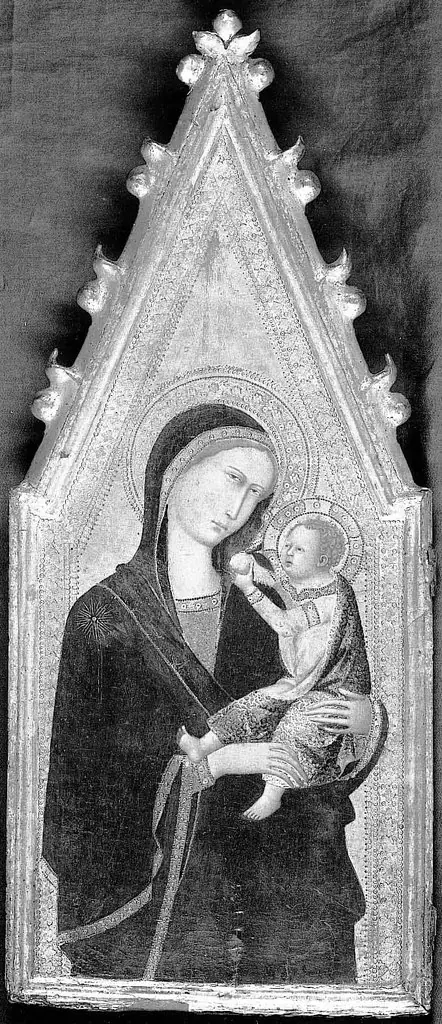 The Virgin and Child
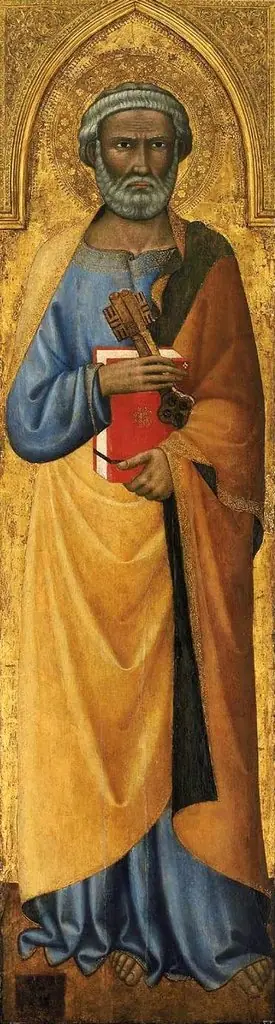 Saint Peter
Andrea Vanni (1332–1414) was an artist, born in Siena.
Overview
Andrea Vanni, also known as Andrea di Vanni d'Andrea Salvani, was an Italian painter and politician of the early Renaissance, active primarily in his native Siena from approximately 1332 until his death on 2 October 1413 or 1414. A member of the Sienese school, Vanni is known for panel paintings, polyptychs, and frescoes that reflect the lingering influence of Byzantine tradition as transmitted through Simone Martini and the Lorenzetti brothers. Though less celebrated than his contemporaries, he produced works of notable refinement and held significant civic office, making him a representative figure of the artist-citizen in fourteenth-century Italian republics. His most famous surviving work is the polyptych painted in 1379 for Santo Stefano alla Lizza in Siena.
Biography & dates
Vanni was born in Siena around 1332, the son of Vanni di Andrea (Salvani) and Giacoma di Vannuccio, who married in 1329. He had two brothers, Francesco and Cristoforo, both of whom also became painters. He married Petra Tavene, daughter of the notary Blasius Tavene, and had a daughter named Antonia. His earliest documented artistic activity dates to 21 July 1351, when he received payment for decorating two small chests for the Palazzo Pubblico. On 3 December 1353, he entered a two-year partnership with Bartolo di Fredi, renting a workshop together. He was admitted to the Arte dei Pittori, the Sienese painters' guild, in 1355 or 1356, with subsequent appearances in guild records in 1363, 1389, 1394, and 1402.
Vanni's political career is unusually well documented. In 1363, he participated in an uprising with Francesco Matarazzi against the newly elected podestà of Siena. He served as castellan of the fortress at Montalcino in 1364, and in 1368 helped expel the nobles of the Governo dei Tredici from government. He entered the Gran Consiglio della Repubblica in 1370, became Gonfaloniere of the Terzo di San Martino in 1371, and in 1372 traveled to Avignon as envoy to Pope Gregory XI, a mission he repeated in 1384. He served as Provveditore di Biccherna around 1377, joined the Balìa in 1378, and was named Capitano del Popolo in 1379. Between 1383 and 1385, he served as ambassador in Naples, where he also painted, and he is said to have worked in Sicily as well. He died in Siena on 2 October 1413 or 1414; earlier uncertainty about his place of death arose because his burial was not recorded in the San Domenico register, though his grave was later located in the cloister there.
Style & movement
Vanni belonged to the Sienese school and has been described as working in a Byzantine style that he sustained without fully renewing. His painting shows the influence of Simone Martini and the brothers Pietro and Ambrogio Lorenzetti, as well as possible influence from Barna da Siena. In his finest works, he displays linear elegance, rich chromaticism, and a delicate enamel technique built from multiple transparent glazes. His figures tend toward systematic elongation, with an increasingly pronounced disregard for modeled form in his later period. The silhouette-like quality of his designs, particularly evident in his polyptych for Santo Stefano alla Lizza, reveals his debt to Martini, while the stiffer, more upright poses and simpler drapery folds show Lorenzetti's influence. His faces, however, are distinctly his own: the Madonna in the Santo Stefano polyptych has a large round head, narrow eyes, delicate mouth, and firm chin. The Christ Child in that work is said to be modeled after the prototype for Martini's Majestas fresco in the Palazzo della Signoria. Vanni's limited use of chiaroscuro, confined mainly to faces and hands, gives his compositions a somewhat flat effect that aligns him with the conservative, late-Byzantine tendency in Sienese painting rather than with the emerging naturalism of the early Renaissance.
Major works
Vanni's most celebrated work is the polyptych of 1379 in the church of Santo Stefano alla Lizza in Siena, now transferred to the Baptistery. The central panel depicts the Virgin and Child enthroned against a gold background, with saints on the side panels. The work is notable for its silhouette-like design and the distinctive facial type of the Madonna. In Siena, only one work by his hand remains in its original location: an Enthroned Madonna in the transept of San Francesco. A St. Paul formerly in the Palazzo Pubblico was acquired by the Museum of Fine Arts, Boston, as a gift from Mrs. W. Scott Fitz before 2002.
His portrait of St. Catherine of Siena, located in the Basilica di San Domenico to commemorate the saint's life, dates to around 1380 and is considered a true portrait rather than merely a devotional image. A fragmented Crucifixion, originally in the church of Alborino, is now in the Istituto delle Belle Arti in Siena. Around 1400, he painted another portrait of St. Catherine with scenes from the life of St. James in the chapel of San Jacomo Intercisco, though these works have disappeared.
Other significant works include the Ascension of Christ (1355-1360) in the Hermitage, Saint Petersburg, previously attributed to Bartolo di Fredi; panels of a Passion polyptych in Washington (The Corcoran Gallery of Art); a Crucifixion with Saints in the Isabella Stewart Gardner Museum, Boston; a panel of St. James the Greater (circa 1365-1370) in the Museo di Capodimonte, Naples, originally part of a polyptych for the chapel of Casaluce in Aversa; and a Crucifixion with the Virgin, St. John the Evangelist, and St. Mary Magdalene in the Lindenau-Museum, Altenburg. The Mariazell treasury image in the Basilika Mariazell, attributed to him, was donated by King Louis I of Hungary and Poland. Additional works are preserved in the Uffizi, Florence; the Fogg Art Museum, Cambridge, Massachusetts; the Fitzwilliam Museum, Cambridge, England; the Ashmolean Museum, Oxford; and the Pinacoteca Nazionale, Siena.
Legacy
Vanni's posthumous reputation has been constrained by his relative obscurity compared to contemporaries such as Simone Martini and the Lorenzetti brothers, and by the limited number of securely attributed surviving works. His significance lies less in artistic innovation than in his exemplification of the late-Byzantine strain in Sienese painting and of the dual career of artist and statesman that was possible in fourteenth-century Italian city-states. His political career, exceptionally well documented, has in some ways overshadowed his artistic one in historical accounts.
The scholarly literature on Vanni includes foundational studies by F. Mason Perkins (1903), John Pope-Hennessy (1939, 1943), and the collaborative work with Millard Meiss on St. John the Evangelist (1956). His works are now dispersed across numerous public and private collections in Europe and the United States, with significant holdings in the Pinacoteca Nazionale, Siena; the Museum of Fine Arts, Boston; the Isabella Stewart Gardner Museum; the Fogg Art Museum; and the Hermitage, Saint Petersburg. The attribution of certain works remains debated, including the fresco of St. John the Baptist in Basciano, which some scholars assign to Andrea Gallerani. His market presence today is limited by the rarity of works coming to auction and the scholarly caution surrounding attributions.
Works by Andrea Vanni
- Scenes from the Passion of Christ: The Crucifixion [middle panel]
- Scenes from the Passion of Christ: The Descent into Limbo [right panel]
- Scenes from the Passion of Christ: The Agony in the Garden, the Crucifixion, and the Descent into Limbo [entire triptych]
- Scenes from the Passion of Christ: The Agony in the Garden [left panel]
- The Virgin and Child
- Saint Peter
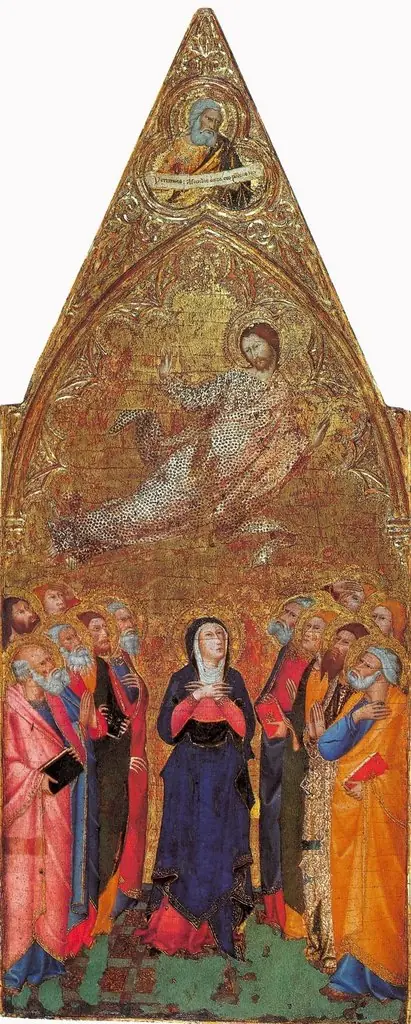 Ascension
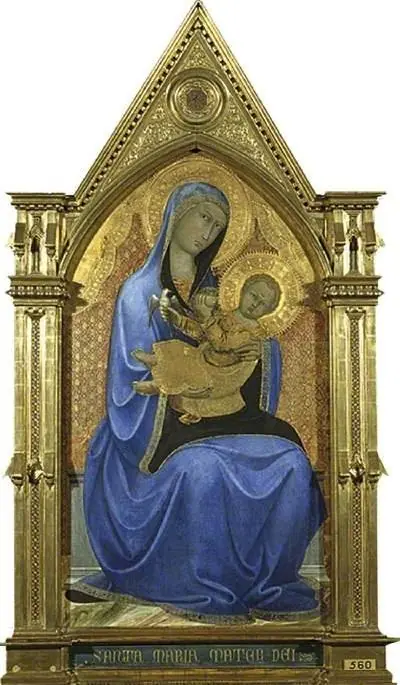 Virgin and Child
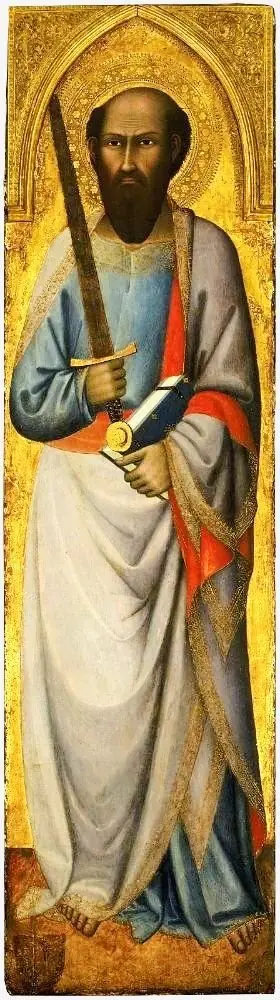 St Paul
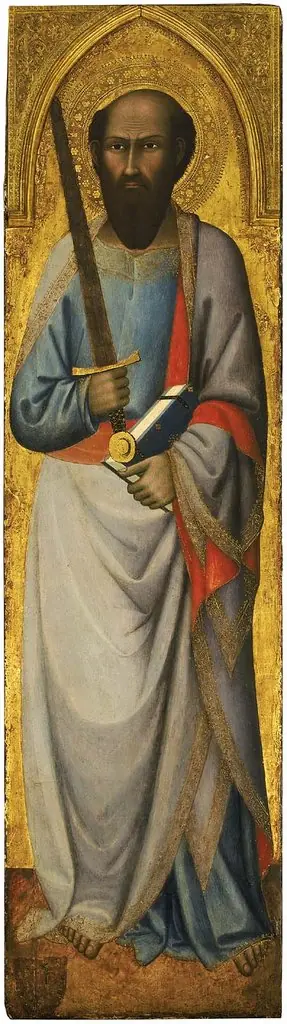 Saint Paul
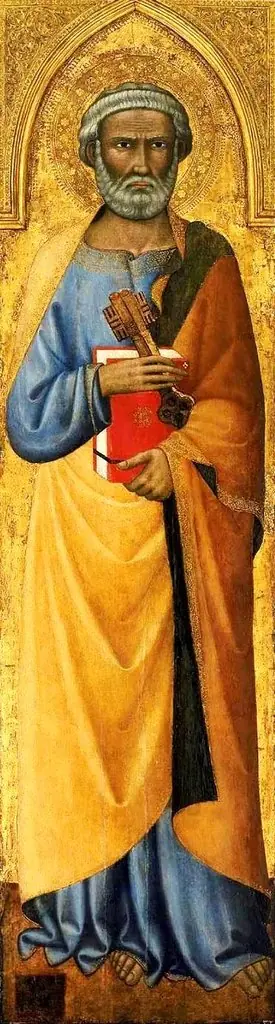 St Peter.
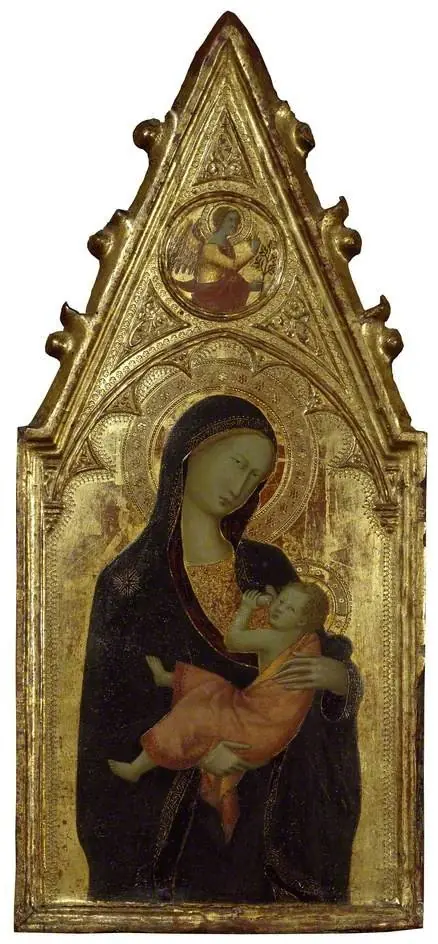 The Virgin and Child with the Angel of the Annunciation in the Gable
Collections represented


Artists in a similar vein
Artist