Artist
Paul Baudry

France
Paul Baudry is a France Academic Art artist. 5 works are cataloged here, principally at Cleveland Museum of Art.
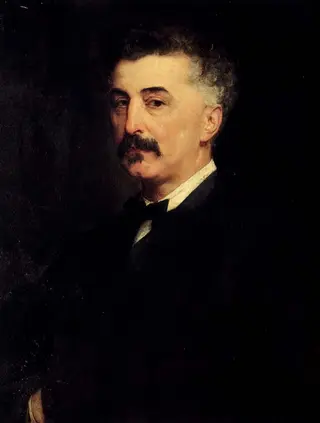
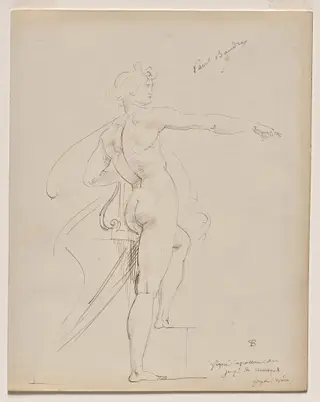
Paul Baudry (1828–1886) was a French artist.
Overview
Paul-Jacques-Aimé Baudry (7 November 1828-17 January 1886) was a French painter and a leading exponent of academic art during the Second Empire. Born in La Roche-sur-Yon in the Vendée, he trained at the École des Beaux-Arts under Michel Martin Drolling and won the Prix de Rome in 1850. Baudry achieved prominence through mythological and allegorical paintings marked by elegant draftsmanship and vibrant color, but his most enduring achievement lies in monumental mural decorations, above all the ceiling and wall paintings in the foyer of the Paris Opéra Garnier, which occupied him for ten years. A member of the Académie des beaux-arts, he embodied the opulent cultural ambitions of mid-19th-century France, though his reputation later receded with the rise of Impressionism.
Biography & dates
Baudry came from a modest family in La Roche-sur-Yon; his father, Jacques Baudry, was a clog maker. At about age twelve, he became fascinated by the life of Joan of Arc after receiving a book about her. He studied drawing locally with Antoine Sartoris, a teacher at the lycée, and in 1844 a municipal scholarship arranged by Sartoris enabled him to travel to Paris. On 16 April 1845 he enrolled at the École des Beaux-Arts, entering the studio of Michel Martin Drolling; Antoine Sartoris is also named among his teachers. He won the petit Prix de Rome in 1847, which came with a travel stipend, and the grand Prix de Rome in 1850, sharing the prize with William Bouguereau, for Zenobia Found by Shepherds on the Banks of the Araxes. This victory granted him a prolonged stay at the French Academy in Rome, where he remained for nearly four years copying antique sculpture and studying Renaissance masters, especially Correggio, Raphael, and Titian. He returned to France at the turn of 1850-1851 and established himself in Paris as an independent painter. From 1866 to 1874 he worked on the decoration of the Opéra Garnier foyer, and in 1870 he traveled to London to copy Raphael's cartoons at the South Kensington Museum and to Venice to prepare for this task. He also painted two ceilings in the William K. Vanderbilt House in New York. In 1870 he was elected to the Académie des beaux-arts, succeeding Jean-Victor Schnetz. He married Éléonore Gardon on 22 October 1885; the couple had two children. In his final years he lived rather withdrawn and painted little. He died suddenly in Paris on 17 January 1886 at 70 bis rue Notre-Dame-des-Champs, while preparing a commission to decorate the Panthéon with scenes from the life of Joan of Arc. He was buried in the Père-Lachaise Cemetery, where his funeral monument was erected in 1890.
Style & movement
Baudry is classified within the academic art movement and is regarded as one of its most celebrated representatives under the Second Empire. His style was from the first strictly academic, emphasizing elegance, grace, and polished finish, though critics have noted a certain lack of originality. During his Italian residence he absorbed strong inspiration from Renaissance art, particularly the mannerism of Correggio, whose influence is visible in the luminous colors and delicate forms of his early Salon submissions. He also looked to Paolo Veronese and Francesco Primaticcio, especially in his depictions of the Muses for the Opéra Garnier. His preferred subjects were mythological, allegorical, or fanciful, treated with idealized beauty and technical precision. He executed portraits of prominent contemporaries with a blend of realism and idealization. In mural painting he demonstrated a particular gift for color and large-scale composition, creating immersive decorative programs that celebrated music, dance, and law through allegory.
Major works
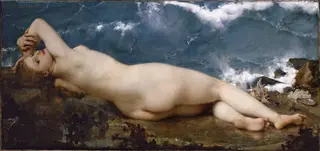
Baudry's painted oeuvre spans oil paintings, portraits, and extensive decorative cycles. Early notable works include The Martyrdom of a Vestal Virgin and The Child, exhibited at the Salon of 1857 and purchased for the Luxembourg, as well as Leda, St John the Baptist, and a Portrait of Beul, which earned a first prize that year. The Pearl and the Wave (1862) remains among his most celebrated canvases for its sensuous mythological treatment. His sole major historical painting, Charlotte Corday (1860), depicting the assassin of Marat, is held by the Musée des Beaux-Arts de Nantes. His mural commissions include frescoes for the Paris Court of Cassation, the château de Chantilly, the Hôtel Fould (1854), the Hôtel Galliera (1863), and the Hôtel de la Païva. The decorations of the foyer of the Opéra Garnier, completed in 1872 after ten years of labor, comprise more than thirty paintings including ceiling compositions such as Melody and Harmony, Tragedy and Comedy, and Parnassus, alongside wall scenes illustrating the effects of dance and music and the triumph of beauty. For the Cour de Cassation he painted La Glorification de la Loi (1879-1881). He also produced the design for the 100-franc banknote issued by the Banque de France.
Influences & students
Baudry's formative training came from Michel Martin Drolling and Antoine Sartoris. His aesthetic development was profoundly shaped by his study of Italian Renaissance masters during his Roman sojourn, above all Correggio, whose mannerist grace and coloristic luminosity left a lasting imprint. He also studied and copied works by Raphael, Titian, Veronese, and Michelangelo. Charles Mengin is recorded as his pupil. Among his contemporaries, he maintained professional relationships with Paul Dubois and Marius Jean Mercié, who later collaborated on his tomb monument, and with his brother Ambroise Baudry, an architect and archaeologist, who designed the Père-Lachaise monument. Jean-Léon Gérôme, a fellow academic painter, created the statue erected in Baudry's honor at La Roche-sur-Yon in 1897.
Legacy
During his lifetime Baudry enjoyed considerable official recognition. He was named a knight of the Legion of Honour in 1861, advanced to officer in 1869, and to commander in 1875. In 1878 he became a member of the Royal Academy of Science, Letters and Fine Arts of Belgium, and in 1878 also an honorary member of the K. K. Akademie der bildenden Künste in Vienna. After his death, his colleagues Paul Dubois and Marius Jean Mercié, together with his brother Ambroise Baudry, erected his funeral monument in Père-Lachaise Cemetery in 1890; the monument, featuring a bust by Dubois and allegorical bronzes by Mercié, was designated a historic monument in 1983. A statue by Jean-Léon Gérôme was unveiled at La Roche-sur-Yon in 1897 in the presence of President Félix Faure, with a speech by Ernest Hébert. Posthumously, Baudry's reputation declined as academic art fell out of favor with the ascendancy of Impressionism and modernism. The 1911 Encyclopædia Britannica already characterized his talent as somewhat lacking originality. Nevertheless, his mural decorations, particularly those at the Opéra Garnier, remain intact and testify to the decorative ambitions of Second Empire France.
Works by Paul Baudry
Collections represented


Artists in a similar vein