Artwork
The Pearl and the Wave
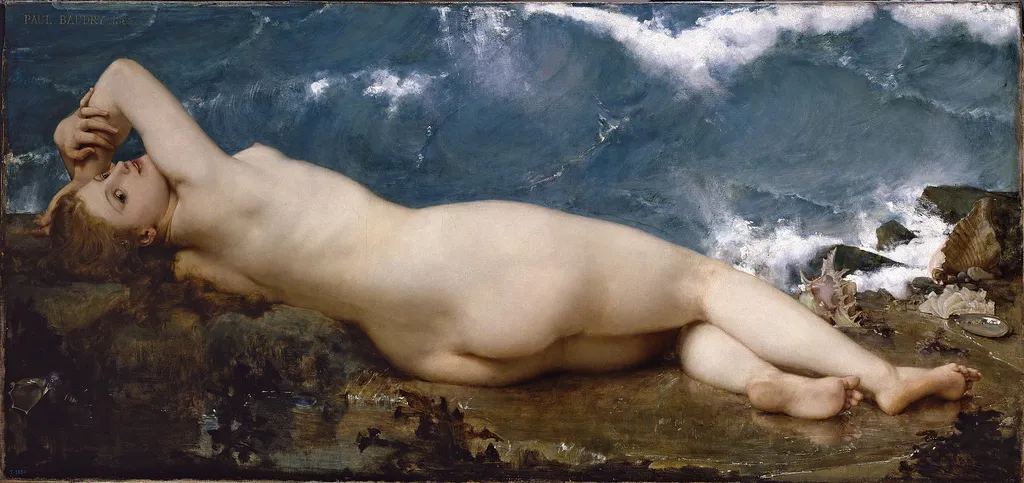
The Pearl and the Wave is an oil painting by the Academic Art artist Paul Baudry. It dates from 1862 and is held in the collection of the Museo del Prado.
About this work
A nude woman rests on a rocky shore while the sea breaks into foam behind her. Baudry painted it in 1862, turning her head so she looks back over her shoulder. The title calls her the pearl, tying her to the shimmering water.
Subject & Meaning
Art historians interpret the composition as catering to a voyeuristic gaze, presenting the subject in a sluggish pose for the viewer's gratification.
Painted in 1862, the work depicts a nude woman reclining on a rocky shoreline with breaking waves in the background. Her body is turned away, yet she gazes backward over her shoulder toward the viewer with a slight smile and parted lips. Although originally exhibited with the subtitle 'Persian Tale,' the artist later admitted this narrative framework was invented and not based on any actual fable.
The figure is rendered with pearly highlights and surrounded by blue tones. Art historians interpret the composition as catering to a voyeuristic gaze, presenting the subject in a sluggish pose for the viewer's gratification. Contemporary critic Jules-Antoine Castagnary suggested the figure represented a Parisian milliner waiting for a wealthy traveler, stripping the scene of mythological pretense to reveal a modern, provocative reality beneath the academic technique.
Technique & Style
La Perle et la Vague is an oil‑on‑canvas work (oil paint on canvas) produced in 1862 and classified as an academic nude. The composition places a nude woman reclining on a rocky shoreline, her head turned backward over the shoulder, lips slightly open, while waves break behind her; the figure is rendered with subtle linear modeling, a visible dimple in the shoulder, and a graceful, slim yet well‑rounded physique. Baudry’s technique employs pearlescent touches to suggest flesh and foam, creating a solid yet mysterious modelling and a “perfection of delicate surface.”
The painting’s color palette features delicate blues and luminous highlights, contributing to its elegant formal balance. The work has been preserved in the Museo del Prado since its acquisition by Empress Eugénie de Montijo in 1863, later passing to Ramón de Errazu, indicating sustained conservation.
History & Provenance
The painting titled The Pearl and the Wave was created in 1862 by French academic artist Paul‑Jacques‑Aimé Baudry. It debuted at the Salon of 1863, where it attracted considerable attention. In that year Empress consort Eugénie de Montijo purchased the work for 20,000 francs, making it her second most expensive acquisition.
The canvas remained in her collection until 1898, when collector Ramón de Errazu bought it in New York for 43,000 francs and later bequeathed it to the Museo del Prado, where it has been part of the museum’s French paintings wing since. The work is presently housed in the Museo del Prado in Madrid.
Created in 1862, Paul-Jacques-Aimé Baudry's painting debuted at the Salon of 1863, where it attracted significant contemporary attention. That same year, Empress Eugénie de Montijo acquired the work for 20,000 francs, marking it as her second most expensive purchase of the period. In 1898, the Spanish collector Ramón de Errazu purchased the canvas in New York for 43,000 francs; it was his final acquisition and the most costly and reputed piece he owned.
Upon his death, Errazu bequeathed the artwork to the Museo del Prado in Madrid. Currently held within the museum's collection of French artists, the oil on canvas measures 83.5 by 178 centimeters.
Legacy
The painting quickly became celebrated for its technical mastery and the sensual poise of its nude figure, a reputation that persisted through 19th‑century criticism and later scholarship. Contemporary reviewers such as Kenyon Cox praised it as “the most perfect painting of the nude” of the century, noting its graceful attitude, subtle modelling and luminous surface. Art historian Bailey Van Hook later identified it as a key example of the voyeuristic tradition in academic nudity.
After Empress Eugénie de Montijo acquired it in 1863 for 20,000 francs, the work entered the Prado collection, where its high purchase price and subsequent resale by Ramón de Errazu for 43,000 francs reinforced its status as a benchmark of French academic art and a reference point for studies of gender, spectacle and the market for erotic imagery.
Overview
Paul-Jacques-Aimé Baudry completed The Pearl and the Wave, an oil painting, in 1862. This work depicts a nude female figure reclining on a rugged coastal landscape. The composition places her at the edge of the sea, where waves break against the shore, creating a dynamic backdrop for the serene figure. The painting is also known by the alternative title, The Wave and the Pearl.
Artist & collection