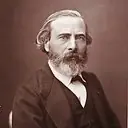
Artist
Francis Davis Millet

United States
Francis Davis Millet is an United States Impressionism artist. 3 works are cataloged here, principally at Museum of Fine Arts Boston.
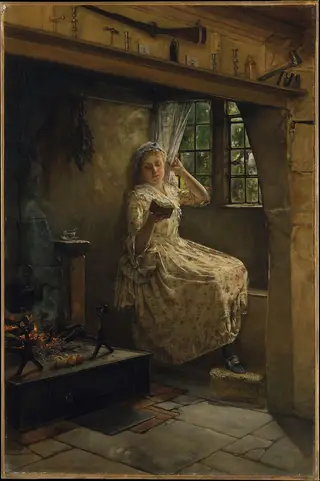
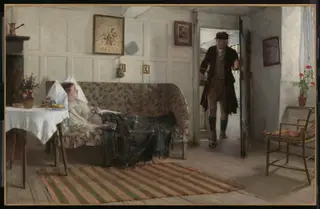
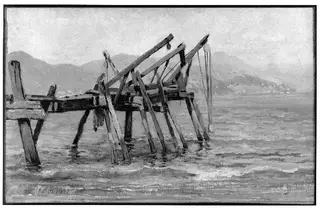
Francis Davis Millet (November 3, 1848 – April 15, 1912) was an American academic classical painter, sculptor, and writer who died in the sinking of the RMS Titanic.
Overview
Francis Davis Millet (1846 or 1848-1912) was an American academic painter, sculptor, muralist, writer, and arts administrator whose multifaceted career bridged the Atlantic art worlds of the late nineteenth and early twentieth centuries. Born in Mattapoisett, Massachusetts, he trained at Harvard University and the Royal Academy of Fine Arts in Antwerp, where he won unprecedented medals in successive years. Millet produced genre paintings, monumental murals for state capitols, and decorative programs for world's fairs, while simultaneously working as a war correspondent, translator, and institutional leader. His death in the sinking of the RMS Titanic on April 15, 1912, returning from Rome where he served as director of the American Academy, cut short a career that had already shaped American art through his roles as trustee of the Metropolitan Museum of Art, founder of the American Federation of Arts, and vice chairman of the U.S. Commission of Fine Arts.
Biography & dates
Millet was born in Mattapoisett, Massachusetts, to Asa Millet, a surgeon, and Hulda Allen Byram. Most sources give November 3, 1846 as his birthdate, though a diary kept during his military service indicates November 3, 1864 was his sixteenth birthday, suggesting 1848. At age fifteen, he enlisted in the 60th Massachusetts Infantry as a drummer boy and later served as surgical assistant to his father during the American Civil War. He graduated from Harvard University with a Master of Arts degree in 1869, then worked as a reporter and editor for the Boston Courier and as correspondent for the Boston Daily Advertiser at the Philadelphia Centennial Exposition in 1876. His formal art training began with lithography under D. C. Fabronius, followed by enrollment at the Royal Academy of Fine Arts in Antwerp in 1871, where he studied under Jozef van Lerius and Nicaise de Keyser. He won a silver medal in his first year and a gold medal the second, becoming the first student to achieve this distinction. During the Russo-Turkish War of 1877-78, he served as war correspondent for the New York Herald, London Daily News, and London Graphic, earning decorations from Russia and Romania for bravery and aid to wounded soldiers. In 1879, Millet married Elizabeth ('Lily') Greely Merrill in Paris; Mark Twain and Augustus Saint-Gaudens served as witnesses, with Twain as best man. The couple had four children, though their first son, Edwin Abbey Millet, died in infancy in 1881. Their daughter Katherine (Kate) later modeled for John Singer Sargent. Millet's administrative career included serving as director of decorations for the 1893 World's Columbian Exposition in Chicago, where he oversaw the decorative appearance of the buildings. He worked on multiple international expositions in Vienna, Chicago, Paris, and Tokyo as juror, administrator, muralist, and advisor. He helped found the School of the Museum of Fine Arts, Boston, and was instrumental in appointing Emil Otto Grundmann as its first head. From 1904 to 1911, he served as secretary of the American Academy in Rome, and in 1910 became a founding member and vice chairman of the U.S. Commission of Fine Arts. In 1911, he became chief administrator of the newly combined Schools of Fine Arts and Classical Studies in Rome. On April 10, 1912, Millet boarded the RMS Titanic at Cherbourg with his friend Major Archibald Butt. He was last seen helping women and children into lifeboats. His body was recovered by the cable ship Mackay-Bennett and buried in Central Cemetery, East Bridgewater, Massachusetts.
Style & movement
Millet's artistic development moved from early genre painting toward classical academicism and the 'Grand Manner,' with increasing emphasis on mural and decorative work in his later career. His early training in Antwerp grounded him in European academic traditions, while his studios in Rome and Venice during the 1870s exposed him to classical influences. The Dutch source notes that John Singer Sargent had significant influence on his painting style, which evolved toward a pronounced classical aestheticism.
His early paintings frequently employed vivid blood red, a color he attributed to his Civil War experience assisting his father in surgery. His genre works combined meticulous detail with narrative approach, capturing everyday life and historical moments with realism and elegance. As his career progressed, decorative ambitions increasingly eclipsed easel painting. He worked in encaustic, a technique he had learned in Europe and which he employed in the 1876 Trinity Church murals with John La Farge.
Millet's mural work included the ceiling of the Call Room of the U.S. Custom House in Baltimore, Maryland, and monumental history paintings for the Minnesota and Wisconsin state capitols. The Minnesota State Capitol commission, obtained through architect Cass Gilbert, included The Treaty of Traverse des Sioux and The Fourth Minnesota Regiment Entering Vicksburg for the Governor's Reception Room. His approach to these works combined historical research, including study of Plains Indian textiles at the Smithsonian, with classical composition, though his efforts at regional accuracy were sometimes imperfect.
As an arts administrator, he helped establish an artists' colony at Broadway, Worcestershire, where Sargent worked nearby. He also designed medals, including the 1907 Civil War Medal and 1908 Spanish Campaign Medal at the request of the U.S. Army and War Department.
Major works
Millet's extant works span genre painting, portraiture, mural decoration, and design. His paintings are held in major collections including the Tate Gallery, London (Between Two Fires); the Museum of Fine Arts, Boston (The Granddaughter, Seacoast); the Brooklyn Museum (An Autumn Idyll, 1892); and the Detroit Institute of Arts (Reading the Story of Oenone, 1893). His 1877 portrait of Samuel L. Clemens (Mark Twain) is a notable example of his portraiture.
His mural and decorative commissions include the Trinity Church, Boston (1876, with John La Farge); the ceiling of the Call Room, U.S. Custom House, Baltimore; and monumental history paintings for the Minnesota State Capitol (The Treaty of Traverse des Sioux and The Fourth Minnesota Regiment Entering Vicksburg) and Wisconsin State Capitol. The Park Avenue Armory (formerly Seventh Regiment Armory) Veterans Room in New York features a 'History of War' frieze completed with George Ewell under the direction of Louis C. Tiffany Associated Artists.
In 2015, his murals were exhibited in Cleveland, Ohio. Many of his paintings remain in private collections, with locations documented in the Athenaeum registry.
Influences & students
Millet's artistic formation combined American and European training. His teachers at the Royal Academy of Fine Arts in Antwerp, Jozef van Lerius and Nicaise de Keyser, provided his foundational academic instruction. His friendship with John La Farge led to their collaboration on the Trinity Church murals, where Millet contributed his European-acquired knowledge of encaustic technique. John Singer Sargent influenced his painting style, particularly his movement toward classical aestheticism, and the two maintained close professional and personal ties; Sargent frequently used Millet's daughter Kate as a model. Millet's circle included Augustus Saint-Gaudens, whom he first met in Rome in 1873-74, and with whom he maintained a lifelong friendship. Mark Twain's attendance at his wedding attests to his literary connections. In England, he was part of prominent society with friends including Edwin Austin Abbey and Elihu Vedder. He was also close to the Huxley family. His influence extended through institutional channels: he helped obtain the appointment of Emil Otto Grundmann, an acquaintance from his Antwerp days, as first head of the School of the Museum of Fine Arts, Boston. He was among the founders of that school, along with La Farge and William Morris Hunt. His establishment of the Broadway artists' colony in Worcestershire created a gathering place for American artists in England. As trustee of the Metropolitan Museum of Art and through his role in the American Federation of Arts, he influenced the institutional recognition of American art as fine art rather than decorative art.
Legacy
Millet's death in the Titanic disaster fixed his public memory in tragedy, but his institutional legacy proved more enduring. In 1913, the Butt-Millet Memorial Fountain was erected in President's Park near the White House in Washington, D.C., commemorating both men. A bronze bust memorializes him in Harvard University's Widener Library. Lych Gates at Broadway Churchyard, Worcestershire, also honor his memory.
His probate, registered in London on November 13, 1912, listed effects in England of £4,474.1.11d. His widow, Lily Millet, was the primary beneficiary. A limited edition biography, Soldier of Fortune: F.D. Millet by Joyce Sharpey-Schafer, was published privately and is now out of print.
Scholarly reassessment of his career has been ongoing. The Francis Davis Millet Catalog (fdmillet.org) serves as a central resource for research on his work. Curators at the Metropolitan Museum of Art, where he served as trustee, have emphasized his role in helping American art achieve recognition as fine art internationally. Sylvia Yount, Lawrence A. Fleischman Curator in Charge at the Met, has discussed his key influence in moving American art out of the 'decorative arts' category. Stephanie L. Herdrich, Curator of American Painting and Drawings, has addressed how Millet and the Met led the movement to accept American art as fine art through pioneering collections and exhibitions.
His institutional contributions persisted through the organizations he helped establish: the American Federation of Arts, the U.S. Commission of Fine Arts, and the American Academy in Rome. He was elected to the American Academy of Arts and Letters in 1908 (or 1910, sources vary), part of an expansion to recognize leading painters. His papers and records are held in the Archives of American Art.
Works by Francis Davis Millet
Collections represented


Artists in a similar vein