Artist
Daniël Mijtens
Dutch Republic
Daniël Mijtens is a Dutch Republic Dutch Golden Age artist. 2 works are cataloged here, principally at Rijksmuseum.
Daniël Mijtens the Younger (Dutch pronunciation: ; 7 August 1644 in The Hague – buried on 23 September 1688 in The Hague) was a Dutch Golden Age painter and the son of Daniel Mytens the Elder, although some early sources indicate that his father was Jan Mijtens. His year of birth is sometimes given as 1636 or 1647.
Overview
Daniël Mijtens the Younger (7 August 1644, buried 23 September 1688) was a Dutch Golden Age painter active in The Hague, known for mythological subjects, interior decorations, and portraits. Born into a family of court painters, he trained in his father's workshop before travelling to Italy in 1666, where he joined the Bentvueghels and absorbed Italianate influences. Upon his return to The Hague, he became a founding member of the Confrerie Pictura and co-founded the drawing academy that would evolve into the Royal Academy of Art. His work bridges Dutch tradition and Italianate classicism, and he played a significant institutional role in shaping artistic life in The Hague during the late seventeenth century.
Biography & dates
Mijtens was baptised on 7 August 1644 in The Hague. His parentage has been debated: most sources identify him as the son of Daniel Mytens the Elder, court painter in The Hague, though some early sources name Jan Mijtens as his father; the Dutch Wikipedia specifies Johannes Mijtens as his father and notes that the elder Daniël Mijtens was his great-uncle. According to the RKD, he was a pupil of his father and his uncle. In 1666 he travelled to Italy, where according to Arnold Houbraken's biography he befriended Carlo Maratta and studied with Johann Carl Loth. In Rome he joined the Bentvueghels, a society of Dutch and Flemish artists, taking the nickname "Bontekraay" (The Hooded Crow), reportedly on account of his cheerful and boisterous character. He returned to The Hague by 1672, when he became one of the 48 signatories of the founding charter of the Confrerie Pictura, a painters' society. In 1682 he co-founded the Haagsche Teekenacademie, the precursor to the Royal Academy of Art, alongside Willem Doudijns, Robbert Duval, and Theodor van der Schuer. He served as dean of the Confrerie Pictura in 1688, the year of his death. He was buried in The Hague on 23 September 1688.
Style & movement
Mijtens worked in the Dutch Golden Age tradition but with pronounced Italianate influences absorbed during his Roman sojourn. His ceiling decoration for the guild meeting room in the Boterwaag (Butter Exchange) in The Hague, executed in a style similar to that of Carlo Maratta, demonstrates his engagement with Italian classical composition and allegorical subject matter. The four corner pieces of this ceiling were divided among Mijtens, Theodor van der Schuer, Augustinus Terwesten, and Robbert Duval. He is also recorded as having worked on decorations at Huis Honselaarsdijk. His known oeuvre encompasses mythological subjects, religious themes, interior decorations, and portraits, reflecting the versatile demands of Hague patronage. The Italian Wikipedia notes that his most important work in The Hague was this ceiling decoration, which adapted Maratta's manner to a Dutch institutional setting.
Major works
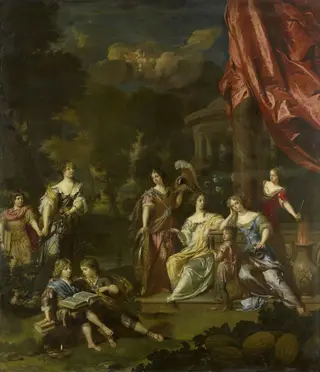
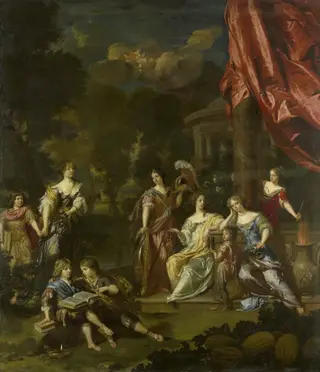
The most fully documented surviving work by Mijtens is an allegorical group portrait dated 1679, now in the Rijksmuseum, Amsterdam, acquired in 1972. The painting depicts the children of Diederic Pietersz van Leyden van Leeuwen (1628-1682), burgomaster of Leiden, and his wife Alida Paets (1635-1673). The family resided at the Huis van Leyden on the Rapenburg in Leiden. The composition shows the children in a garden setting beside a classical temple: Maria (born 1654), Alida (born 1660), Theodora Catharina (born 1661), Bernardina (circa 1662-1716), Suzanna (1664-1712), Adriaan Willem (1667-1688), Pieter (1666-1736), and Lodewijk (1668-1697). This work exemplifies Mijtens's skill in combining portraiture with allegorical and architectural elements. His ceiling paintings for the Boterwaag in The Hague, though less well documented in terms of survival, represented a major commission within the city's artistic infrastructure.
Influences & students
Mijtens's formation was fundamentally familial: he trained first with his father, the Hague court painter, and subsequently with his uncle. His Italian period in 1666 brought him into contact with major figures of the Roman art world. Carlo Maratta, the leading painter in Rome at the time, became a friend and influence; Johann Carl Loth, the German painter working in Venice and Rome, was another teacher. The Bentvueghels provided a network of northern artists in Italy that shaped his professional identity. Mijtens in turn transmitted this synthesis of Dutch and Italian training to his own pupils: Lourens Bruyning, Nicolaes Hooft, Mattheus Terwesten, and Elias Vinie. Through these pupils and his co-founding of the drawing academy, he contributed to the institutional continuity of Hague painting across generations.
Legacy
Mijtens's posthumous reputation rests on his institutional contributions to The Hague art world and his role in introducing Italianate classicism into Dutch decorative painting. The Haagsche Teckeningacademie he co-founded in 1682 evolved into the Koninklijke Academie van Beeldende Kunsten, ensuring his lasting influence on Dutch artistic education. His pupils carried forward his teaching, though none achieved major independent fame. The Rijksmuseum's acquisition of his 1679 group portrait in 1972 secured scholarly attention to his work. Art market records indicate his presence on Artnet and other databases, though his paintings remain relatively rare on the market. The confusion over his parentage in early sources, and the alternative birthdates sometimes cited (1636 or 1647), suggest that his biography became obscured soon after his death, a common fate for artists whose workshop production was absorbed into family or regional traditions.
Works by Daniël Mijtens
Collections represented

Artists in a similar vein
Artist