Artist
Christopher Pearse Cranch

United States
Christopher Pearse Cranch is an United States American Impressionism artist. 2 works are cataloged here, principally at Museum of Fine Arts Boston.
Christopher Pearse Cranch (March 8, 1813 – January 20, 1892) was an American writer and artist often associated with Transcendentalism and the Hudson River School.
Overview
Christopher Pearse Cranch (March 8, 1813, January 20, 1892) was an American writer and artist whose career bridged Transcendentalist intellectual circles and the landscape traditions of the Hudson River School and the Barbizon school. Though he began as a Unitarian minister, Cranch spent approximately two decades in Italy and France studying painting, producing landscapes, caricatures, and literary works across multiple genres. He is remembered both for his visual art, including a celebrated caricature of Ralph Waldo Emerson's "transparent eyeball," and for his poetry, children's fiction, and translations. His dual identity as a Transcendentalist intellectual and practicing artist places him among the more unusual figures of nineteenth-century American culture.
Biography & dates
Cranch was born on March 8, 1813, in Alexandria, Virginia, into a prominent family; his father, William Cranch, served as Chief Judge of the United States Circuit Court of the District of Columbia, and his brother John became a painter. After graduating from Columbian College (now George Washington University) in 1835, Cranch attended Harvard Divinity School and became a licensed Unitarian minister. He preached in Providence, Andover, Richmond, Bangor, Portland, Boston, Washington, and St. Louis. Through his Harvard connections, including John Sullivan Dwight and Theodore Parker, he encountered Unitarianism and the Transcendentalist movement. He read Emerson's Nature by December 1836 and from June 1837 served as substitute editor of the Western Messenger, reviewing Emerson's 1837 Phi Beta Kappa address, "The American Scholar." His Transcendentalist associations diminished his ministerial prospects, and by 1839 he had returned to Boston, disillusioned with his western飘 experiences in the west. In 1843 he married Elizabeth DeWindt. Cranch left the ministry to pursue the arts, spending roughly twenty years in Italy and France. He returned to the United States in 1863 with his family; their son George enlisted in the Union Army and was killed shortly thereafter. Cranch spent his final decades in Cambridge, Massachusetts, contributing to Harper's, The Atlantic, Putnam's, and Lippincott's, and publishing three books of poetry. He died at his Cambridge home on January 20, 1892, and was buried at Mount Auburn Cemetery in Massachusetts. His daughter Caroline became a painter.
Style & movement
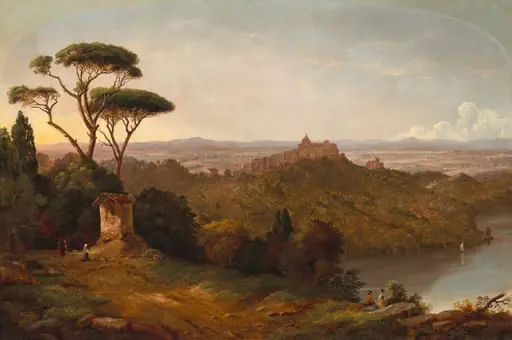
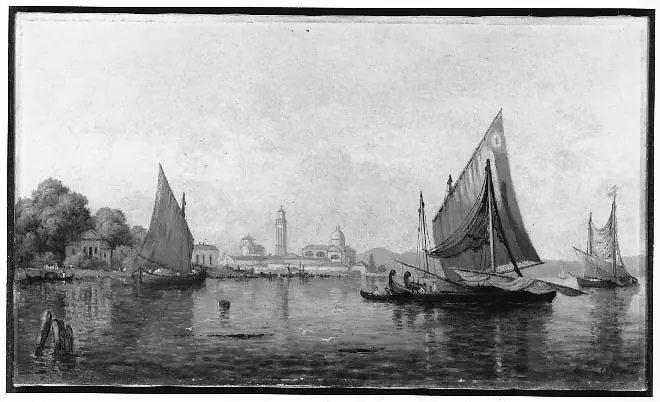
Cranch's artistic practice encompassed landscape painting, caricature, and occasional historical subjects. His landscapes aligned with the Hudson River School tradition of Thomas Cole and with the Barbizon school in France, characterized by naturalistic outdoor scenery. Later in life he produced scenes of Venice and Italy, reflecting his extended European residence. In caricature, he created hand-drawn illustrations of Emerson, later bound as Illustrations of the New Philosophy: Guide. His most recognized image in this genre depicts creatively interprets Emerson's concept of the "transparent eyeball" from Nature. As a writer, Cranch worked across poetry, children's fantasy, translation, and editorial commentary, publishing in The Harbinger and The Dial. His 1875 collection The Bird and the Bell with Other Poems and 1887's Ariel and Caliban with Other Poems appeared alongside his translation of Virgil's Aeneid (1872) and children's books including The Last of the Huggermuggers (1855) and its sequel Kobboltozo (1857).
Major works
Cranch's literary publications include Poems (1844), The Last of the Huggermuggers, A Giant Story (1855), Kobboltozo, A Sequel to the Last of the Huggermuggers (1857), The Aeneid of Virgil (translation, 1872), Satan: A Libretto (1874), The Bird and the Bell with Other Poems (1875), and Ariel and Caliban with Other Poems (1887). His poem "Enosis," sent to Emerson for The Dial on March 2, 1840, has been identified as perhaps his most well-known verse. In visual art, his caricature of Emerson's "transparent eyeball" remains his most widely remembered image. His landscape paintings, including scenes of Venice and Italy and a depiction of the burning of P. T. Barnum's American Museum in New York City, have received scholarly attention; a 2007 exhibition at the Lyman Allyn Art Museum, At Home and Abroad: The Transcendental Landscapes of Christopher Pearse Cranch (1813-1892), examined this aspect of his output. Specific current locations for individual paintings are not recorded in the available sources.
Influences & students
Cranch's intellectual formation drew upon his Harvard Divinity School contacts, particularly John Sullivan Dwight and Theodore Parker, who introduced him to Unitarianism and Transcendentalist circles. Ralph Waldo Emerson exercised profound influence over Cranch's thinking and artistic subjects; Cranch not only reviewed Emerson's work but devoted significant creative energy to visual interpretations of Emersonian philosophy. Thomas Cole and the Hudson River School, along with the French Barbizon school, shaped his landscape painting. The sources do not record formalized teaching relationships or pupils under Cranch's direct instruction, though his daughter Caroline Cranch became a painter, suggesting artistic influence within his family. His brother John Cranch also pursued painting.
Legacy
Cranch's posthumous reputation rests on his unusual position at the intersection of American Transcendentalism and nineteenth-century visual culture. His daughter Lenora Cranch Scott compiled The Life And Letters Of Christopher Pearse Cranch in 1917, preserving documentary material. Modern scholarship has increasingly examined his landscape painting; the 2007 exhibition At Home and Abroad: The Transcendental Landscapes of Christopher Pearse Cranch (1813-1892) at the Lyman Allyn Art Museum, with accompanying catalogue by Nancy Stula, Barbara Novak, and David M. Robinson, represented a significant reassessment of his artistic achievement. Paul Hay and John Hay's 2022 chapter on "The Patriotic Singer: Christopher Pearse Cranch's American Aeneid" examined his translation work. His election as Associate Academician of the National Academy of Design in 1850 and full Academician in 1864 marked contemporary professional recognition. Today, his papers and correspondence offer primary material for scholars of Transcendentalism, while his paintings and caricatures occupy a niche position in studies of American art.
Works by Christopher Pearse Cranch
Collections represented


Artists in a similar vein