Artist
Johann Koerbecke
Germany
Johann Koerbecke is a Germany Northern Renaissance artist. 7 works are cataloged here, principally at Art Institute of Chicago.
Overview
Johann Koerbecke (c. 1415/20, Coesfeld or Münster, 13 June 1491, Münster) was a German late Gothic painter of the Westphalian School, recognized as the first named painter from Westphalia. Active primarily in Münster, he played a pivotal role in introducing Netherlandish realism into regional German painting, blending the vibrant color and detailed observation of Flemish masters with local Westphalian traditions. His principal surviving work, the dispersed Marienfelder Altar of 1457, stands as a landmark of mid-fifteenth-century panel painting north of the Alps.
Biography & dates
Koerbecke's life is documented almost entirely through Münster civic records. He first appears in 1443, when he and his wife Elsa took possession of his father Heinrich's house and workshop in Münster; Heinrich, also a painter, had died in 1442, and his presence in the city is attested from 1435. Johann likely trained with his father or another local master during the 1430s. Between 1453 and 1484 he is repeatedly mentioned in Münster documents, including invoices for altarpieces and as witness to marriages and legal contracts. In 1460 he was listed as a member of the Confrérie de Notre-Dame de l'église Saint-Gilles, indicating his standing within the bourgeoisie. His death on 13 June 1491 was recorded in Münster, though an obituary noted Coesfeld as his origin, a reference that may apply to his family rather than himself. Elsa retained the house and workshop until selling it around 1495 to the sculptor Heinrich Brabender. The couple had two sons: Heinrich, who entered the clergy, and Hermann, who followed his father as a painter.
Style & movement
Koerbecke was the first painter in Westphalia to employ the Netherlandish style introduced by Robert Campin and developed by Jan van Eyck and Dirk Bouts. This approach is characterized by bright colors, meticulous attention to surface detail, individualized physiognomies, and an intuitive rather than mathematically constructed perspective. His work builds upon the legacy of Conrad von Soest and shows stylistic affinities with Stefan Lochner. The Langenhorst Altar panels (c. 1440-50), with their Passion scenes set against gold grounds, demonstrate his early synthesis of Flemish naturalism with traditional Gothic formats: precise rendering of fabrics and weaponry, lively heads, and landscape elements that open the pictorial space. In the Marienfelder Altar of 1457, the exterior panels display greater stylistic modernity, while the interior scenes maintain a more conservative, solemn character closer to Lochner and von Soest.
Major works
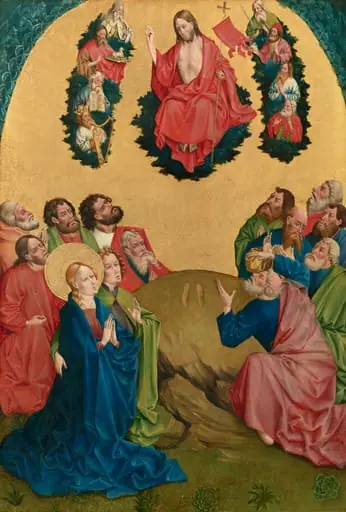
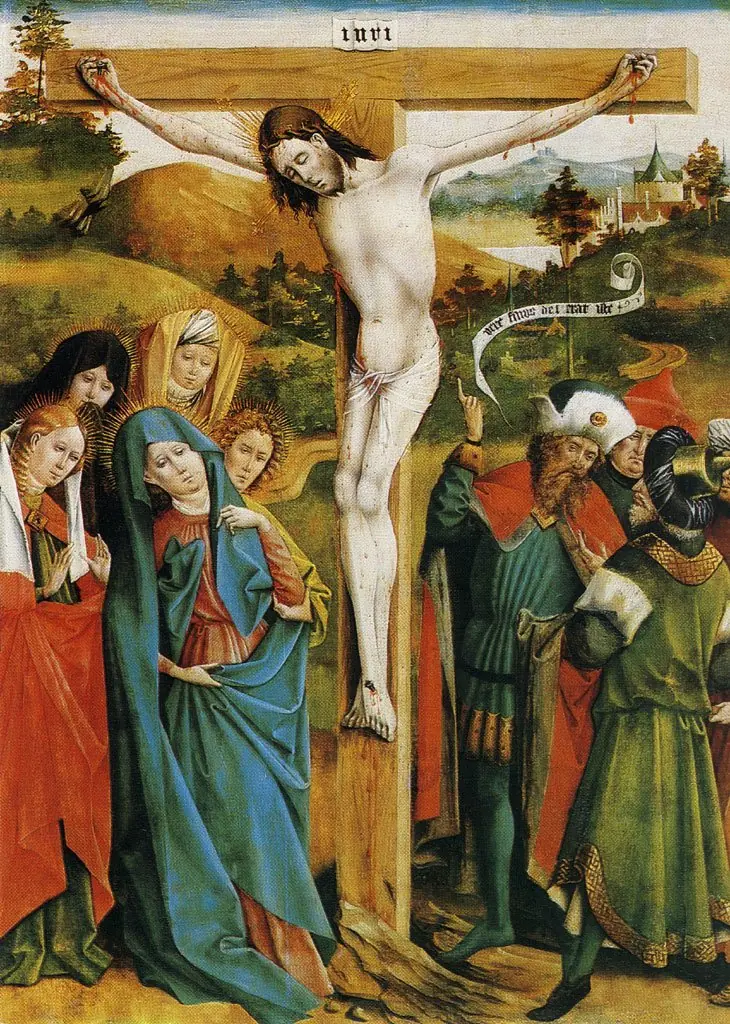
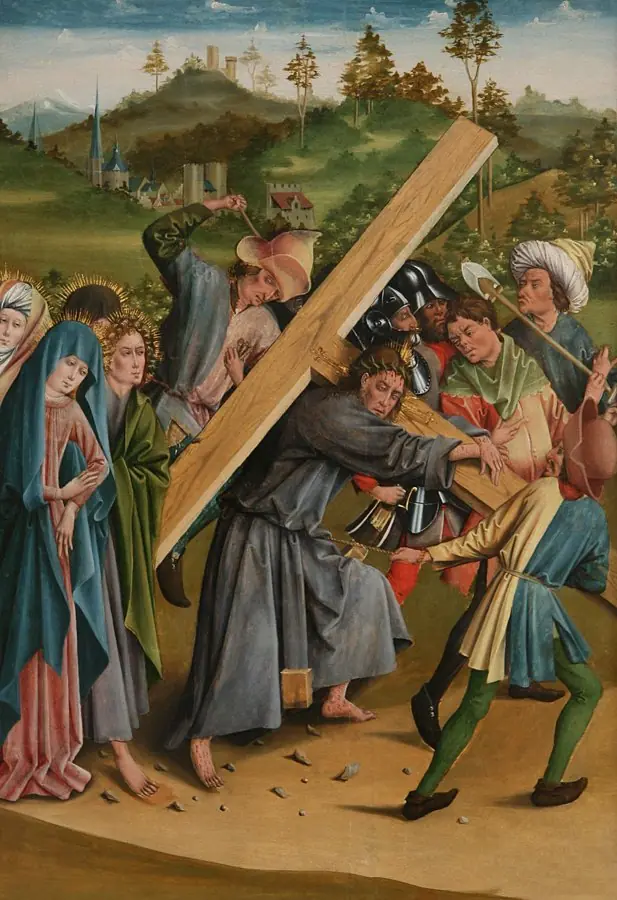
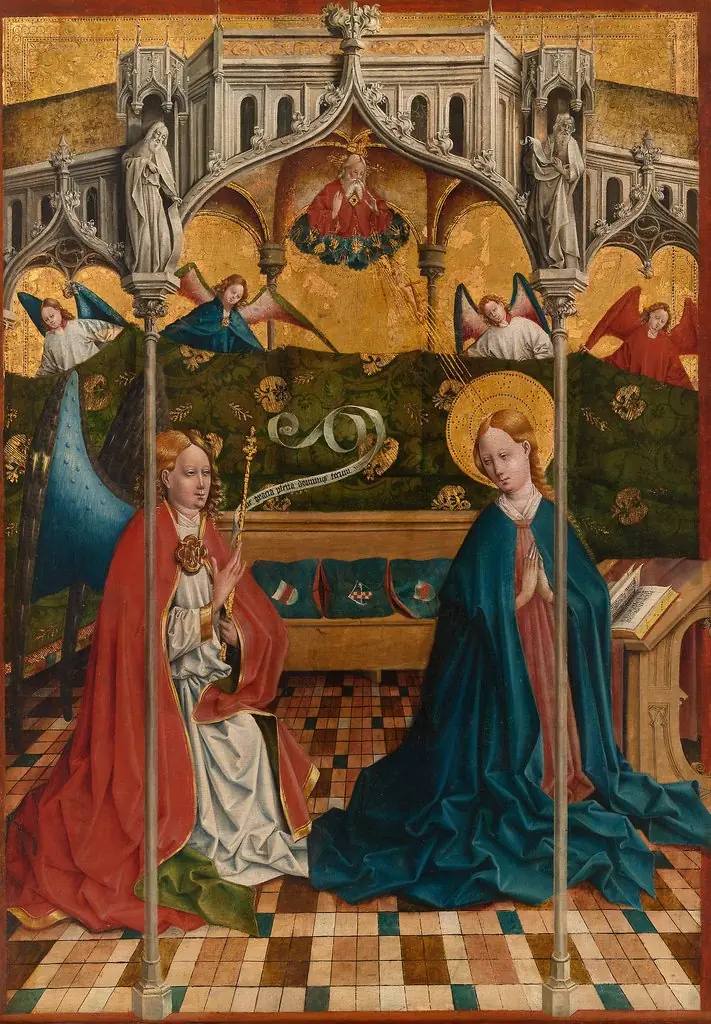
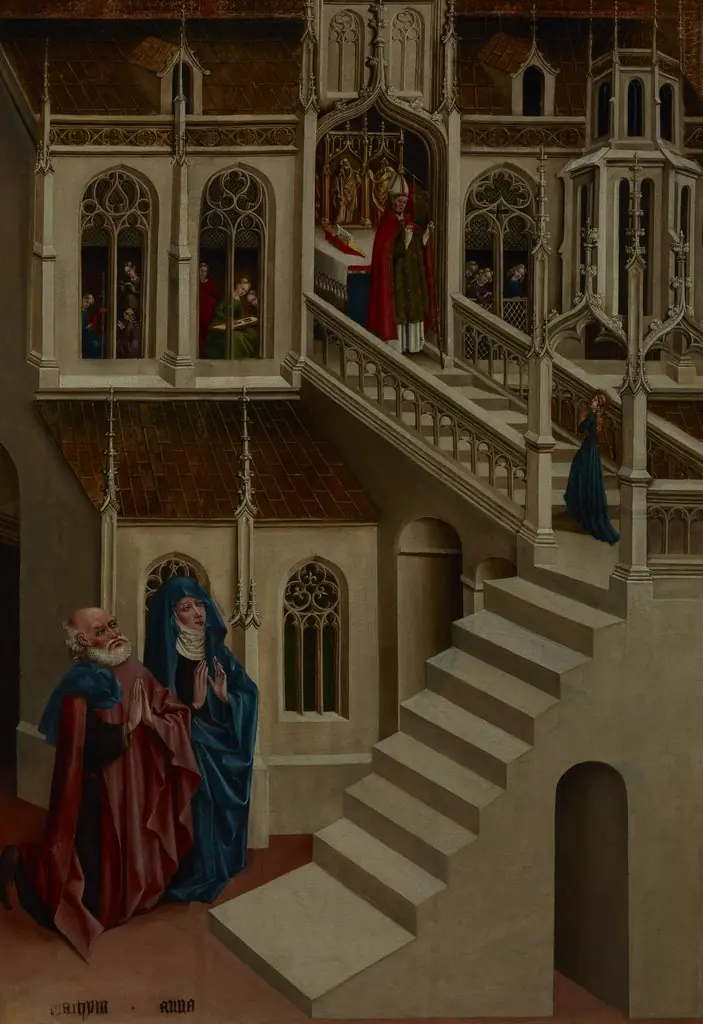
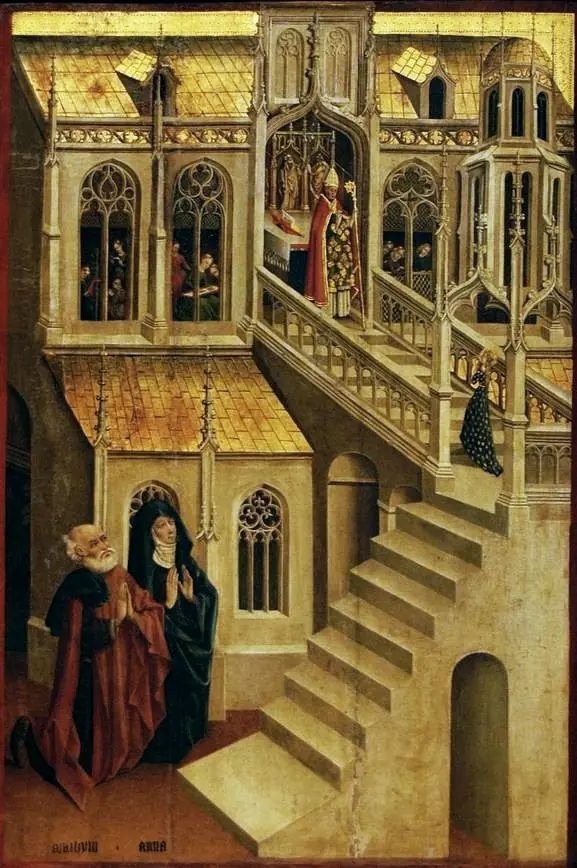
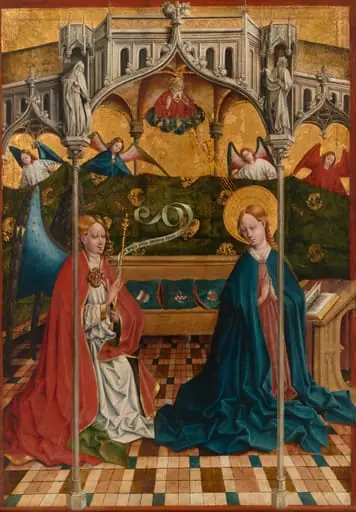
The Marienfelder Altar, commissioned in 1457 by Abbot Arnold of Bevern for the high altar of the Cistercian abbey church at Marienfeld (now part of Harsewinkel), constitutes Koerbecke's undisputed masterpiece. Originally a winged altarpiece with sixteen painted panels flanking a central reliquary shrine, it was dispersed after the monastery's dissolution in 1803. The exterior wings depict the Passion of Christ: the Betrayal of Judas, Christ before Pontius Pilate, the Flagellation, and the Mocking of Christ on the left; the Carrying of the Cross, Crucifixion, Entombment, and Resurrection on the right. The interior panels present the Life of the Virgin: the Presentation of Mary, Annunciation, Nativity, and Adoration of the Magi on the left; the Presentation in the Temple, Virgin and Child in Glory, Ascension, and Assumption on the right. Six panels are held by the LWL-Landesmuseum für Kunst und Kulturgeschichte in Münster. Other panels reside in the Pushkin Museum, Moscow; the Staatliche Museen, Berlin; the Musée Calvet, Avignon; the National Museum, Kraków; the Art Institute of Chicago; the Germanisches Nationalmuseum, Nuremberg; the National Gallery of Art, Washington; and the Museo Thyssen-Bornemisza, Madrid. The Adoration of the Magi panel is lost. Copies arranged in their original configuration are displayed in the present Abbey Church. The Langenhorst Altar wings (c. 1440-50), also in Münster, represent his earliest attributed work. A later altarpiece of c. 1470 depicting scenes from the life of Saint John the Baptist is divided between Münster and The Hague. The Amelsbüren Altar and the Steinhagen Altar are attributed to his workshop or circle. A panel at the Cleveland Museum of Art, formerly assigned to Koerbecke, has been tentatively reattributed to an unnamed Master.
Influences & students
Koerbecke's artistic formation drew upon multiple sources. His father Heinrich provided his initial training in the Münster workshop tradition. Stylistically, he was deeply influenced by Conrad von Soest, the leading Westphalian painter of the preceding generation, and by the Cologne master Stefan Lochner, whose solemn, coloristic approach resonates in Koerbecke's more conservative compositions. The decisive influence, however, came from Netherlandish painting: Robert Campin's innovations, transmitted through the work of Jan van Eyck and Dirk Bouts, provided the model for his naturalistic detail and luminous palette. Koerbecke is believed to have collaborated with two significant anonymous masters active in his region: the Master of the Schöppingen Altarpiece and the Master of 1473, both associated with Münster. His own workshop trained at least one direct successor in his son Hermann, who continued the family profession.
Legacy
Koerbecke's historical significance rests on two achievements: he was the first painter from Westphalia whose name can be attached to specific works, and he was the principal conduit through which Netherlandish Renaissance realism entered Westphalian art. His documented social position, bourgeois prosperity, and repeated civic commissions indicate that he enjoyed considerable prestige during his lifetime. Posthumously, the dissolution of Marienfeld Abbey in 1803 scattered his masterpiece across European and American collections, ensuring his reputation would be reconstructed through museum attributions and scholarly detective work rather than continuous local tradition. The concentration of six Marienfelder panels in Münster's LWL-Landesmuseum has facilitated modern study of his oeuvre, while individual panels in major institutions from Moscow to Chicago secure his place in surveys of Northern European painting. The tentative reattribution of the Cleveland panel illustrates the ongoing uncertainties surrounding works from his later career. His legacy is thus that of a regional pioneer whose integration of Flemish innovation with Westphalian tradition established a model for subsequent generations of German painters.
Works by Johann Koerbecke
Collections represented


Artists in a similar vein