Artwork
The Ascension
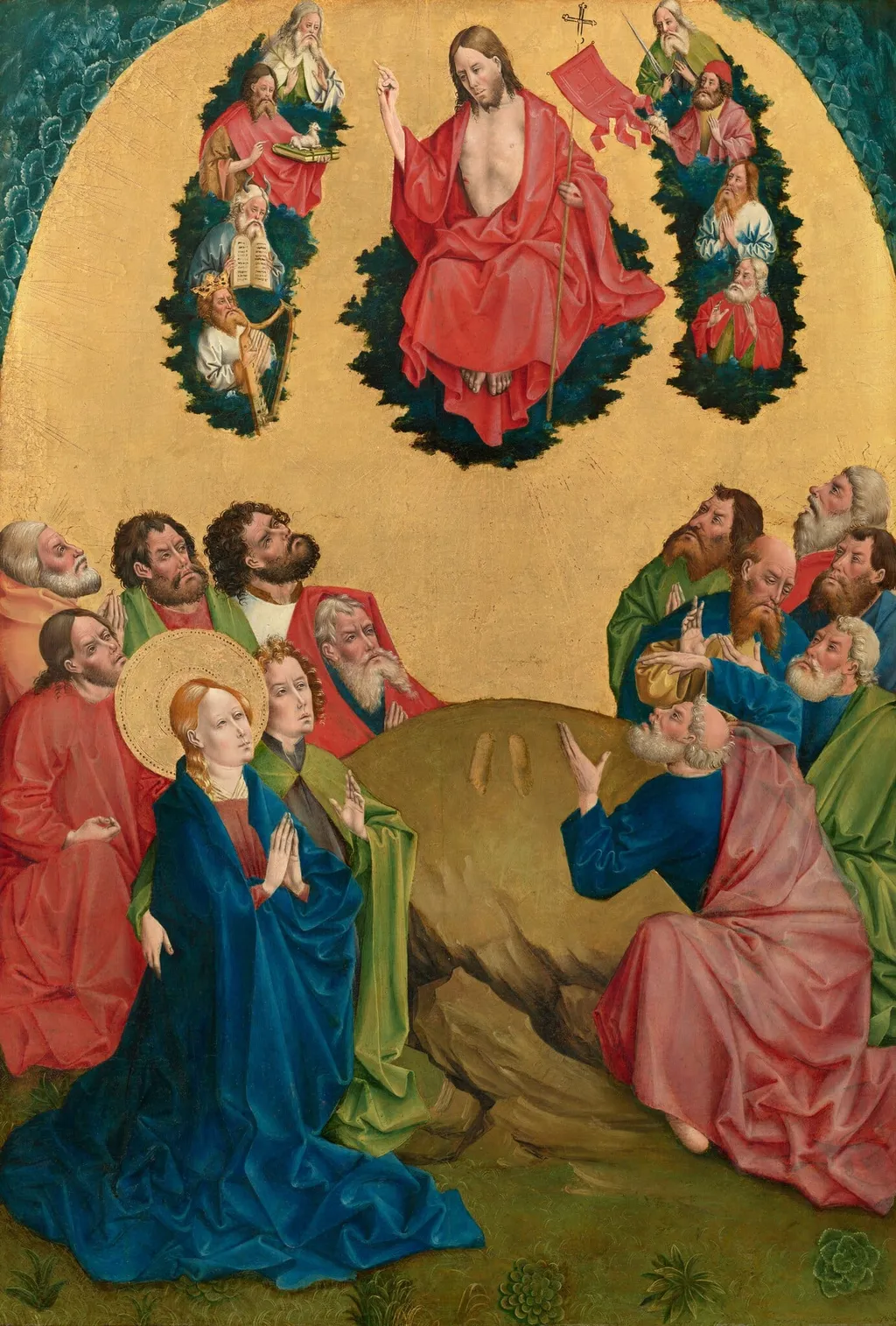
The Ascension is an oil painting by the Northern Renaissance artist Johann Koerbecke. It dates from 1456 and is held in the collection of the National Gallery of Art.
About this work
Subject & Meaning
Below them, the Virgin Mary occupies a central position, her open arms and upward gaze emphasizing her role as intercessor and model of faith for viewers.
The Ascension depicts the biblical event of Christ’s bodily ascent into heaven, forty days after the Resurrection. In Koerbecke’s rendering, Christ appears in a mandorla of light borne aloft by angels, a conventional motif signifying divine glory and the transition from earthly presence to heavenly glory. The apostles below look upward in varied gestures of wonder and supplication, underscoring the moment’s spiritual significance.
Below them, the Virgin Mary occupies a central position, her open arms and upward gaze emphasizing her role as intercessor and model of faith for viewers.
Technique & Style
Johann Koerbecke's The Ascension, created in 1456, is executed in tempera on a wooden panel. The work measures 92.7 cm in height and 64.8 cm in width. Originally serving as a component of the high altar for the Cistercian Cloister at Marienfeld, the painting was completed in 1456 and formally installed in February 1457.
The piece belongs to the religious genre and depicts the Ascension of Jesus, reflecting the stylistic conventions of mid-15th-century German panel painting.
History & Provenance
Created by Johann Koerbecke in 1456, The Ascension served as a component of the high altar for the Cistercian abbey church at Marienfeld, near Münster. The altarpiece was completed during the 1456–1457 period and formally installed on February 6, 1457. The work remained in this ecclesiastical setting until 1803.
By 1912, it was held in the collection of Charles Léon Cardon in Brussels. It later passed through the hands of Rudolph Chillingworth, who sold it at auction in Lucerne on September 5, 1922. Jacob Walter Zwicky acquired the painting following the sale and retained it until 1955, when it was purchased by M. Knoedler & Co. in New York.
The Samuel H. Kress Foundation bought the work in 1957, eventually gifting it to the National Gallery of Art in Washington, D.C., in 1959 via exchange.
The Ascension is held at the National Gallery of Art in Washington, D.C., where it forms part of the Samuel H. Kress Collection. It was acquired by the Kress Foundation in 1957 and transferred to the museum by gift in 1959; the sources do not specify an individual accession number. Prior to its American ownership, the panel was shown in Brussels in 1912 as no. 2051 in the Exposition de la Miniature at the Palais Goffinet, displayed with the Cardon collection.
Context
Painted by Johann Koerbecke in 1456, The Ascension originally served as part of the high altar for the Cistercian abbey church at Marienfeld, near Münster. Its installation in February 1457 marked the completion of a significant religious commission within the Westphalian region. The work reflects the tradition of reliquary altars practiced by the Cistercian order during the fifteenth century.
Scholarly attention to the piece includes Johannes Sommer's 1937 monograph identifying Koerbecke as the Master of the Marienfeld Altar, alongside later studies by Jochen Luckhardt examining the altarpiece's liturgical context. Early twentieth-century exhibitions, such as the 1912 Brussels display, initially misattributed the work to an anonymous Swabian school before its provenance and authorship were clarified through subsequent research.
Legacy
The Ascension, a tempera panel painted by Johann Koerbecke in 1456, was originally installed on the high altar of the Cistercian cloister at Marienfeld and later entered private collections before being acquired by the Samuel H. Kress Foundation in 1957 and gifted to the National Gallery of Art in 1959. Its public display in a 1912 Brussels exhibition and subsequent inclusion in the Kress Collection contributed to a renewed scholarly appreciation of Koerbecke’s work and of late medieval German religious painting. The painting’s presence in a major American museum has made it a reference point for studies of Cistercian altar art and of 15th‑century devotional imagery.
Overview
Johann Koerbecke, a German painter from the Westphalian School, completed The Ascension in 1456. This religious panel painting, executed in tempera, exemplifies the Northern Renaissance movement. It visually recounts the biblical event of Christ's ascent into heaven, a common theme in devotional art of the period.
Own this work as a print
Artist & collection
Artist
Johann Koerbecke (c. 1415/20, Coesfeld or Münster - 13 June 1491, Münster) was a German Gothic painter of the Westphalian School. He is believed to have worked with the Master of the Schöppingen Altarpiece and the…

 Altarpiece from Thuison-les-Abbeville: The Ascension
 The Life of Mary: the Assumption of Mary (verso: lower half of the Coronation of Mary)
 Death of the Virgin
 Agony in the Garden with donor Louis I of Orléans
 Der zwölfjährige Jesus im Tempel
 Panels from the High Altar of the Charterhouse of Saint-Honoré, Thuison-les-Abbeville: Pentecost
 The Miracle of Pentecost
 Death of the Virgin
 Passion Retable: The washing of the apostles feet