Artwork
Crucifixion of Christ
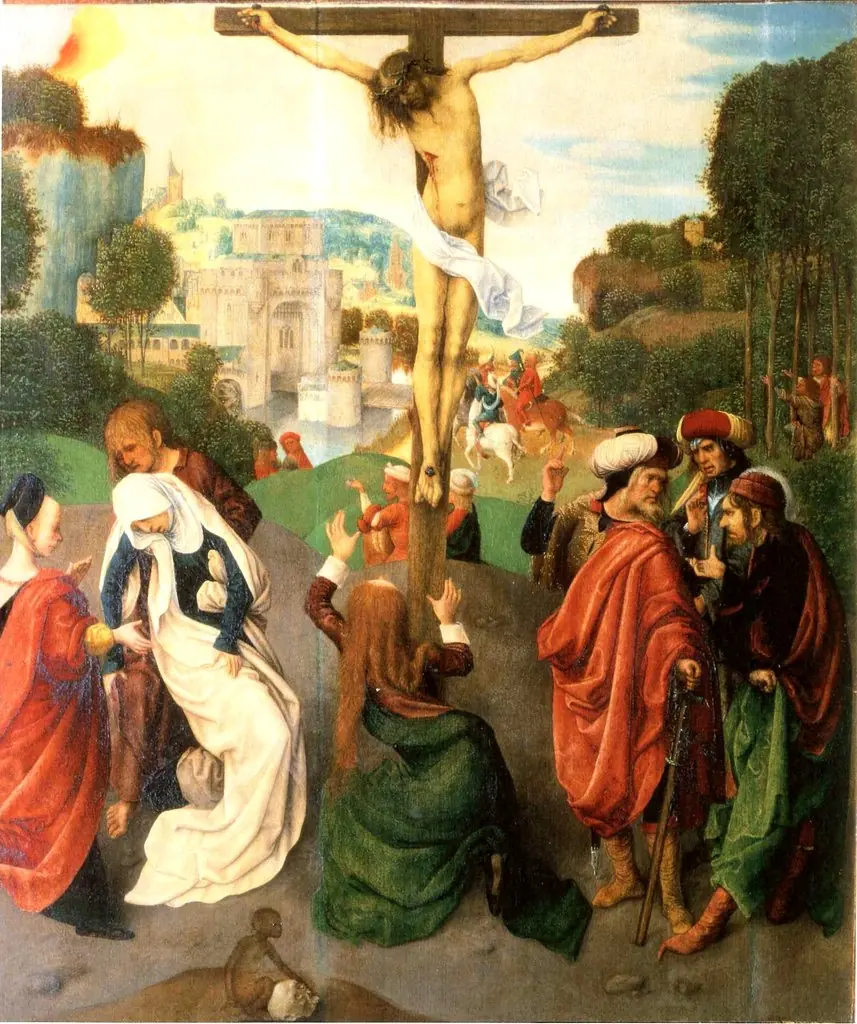
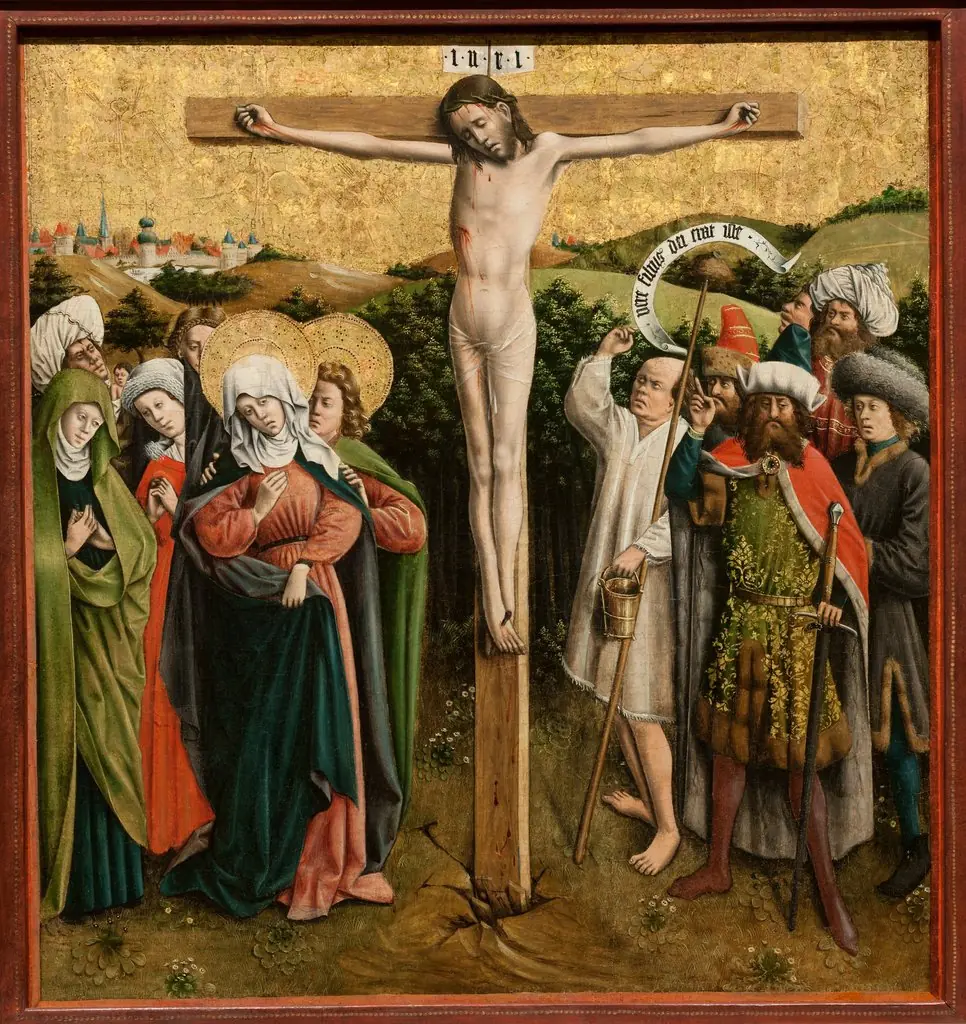
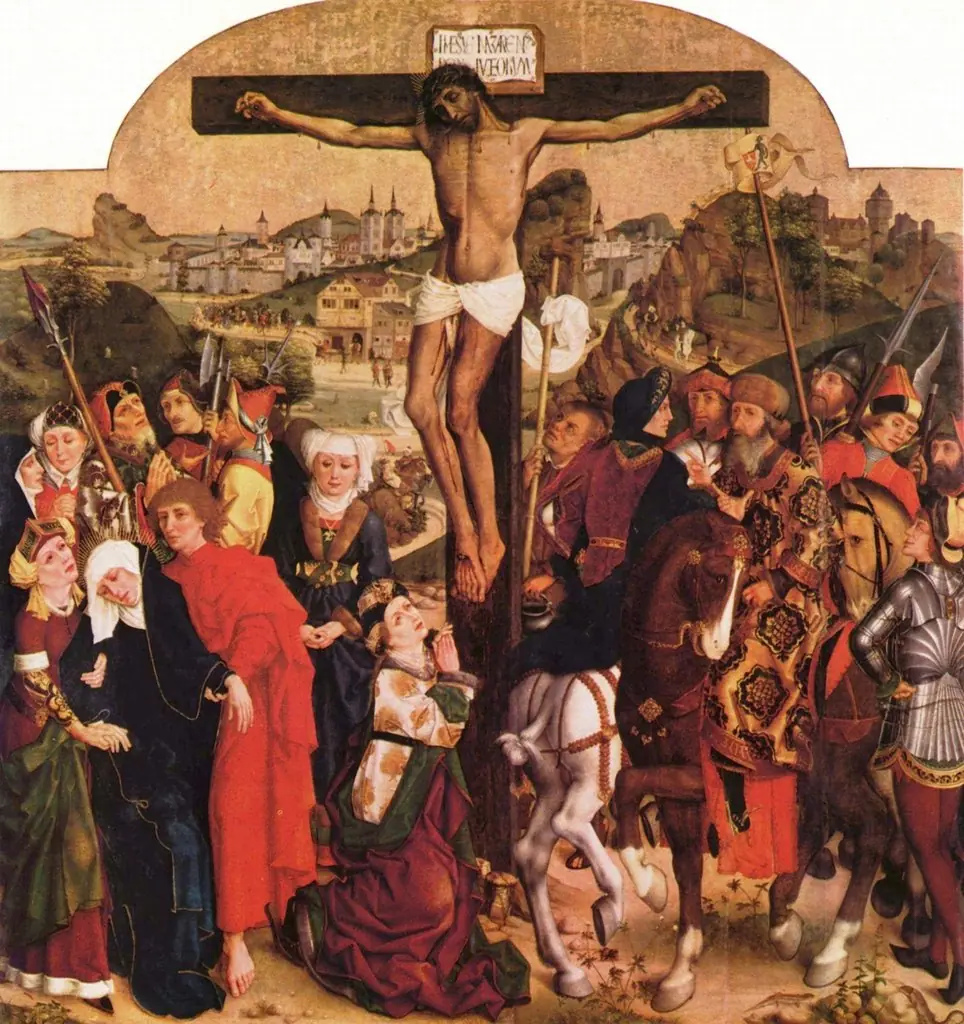
Crucifixion of Christ is a tempera painting by the Northern Renaissance artist Johann Koerbecke. It is held in the collection of the Gemäldegalerie Berlin.
About this work
Overview
The Crucifixion of Christ is a tempera painting on oak panel by the German Gothic painter Johann Koerbecke, created around 1457 to 1500.
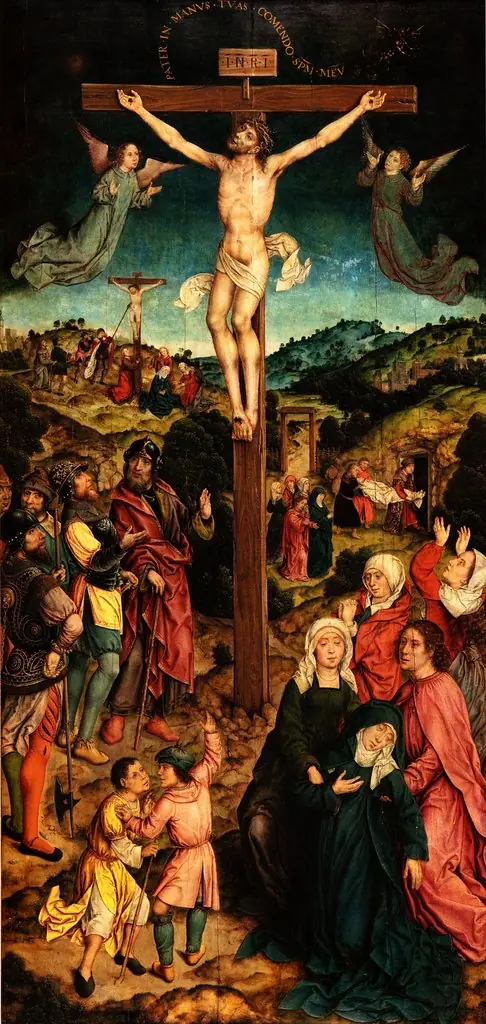
The Crucifixion of Christ is a tempera painting on oak panel by the German Gothic painter Johann Koerbecke, created around 1457 to 1500. Measuring 90 by 62 centimeters, the work depicts the crucified Christ flanked by mourners and onlookers in a detailed landscape setting. It originally formed part of the Marienfelder Altar, a sixteen-panel altarpiece commissioned for Marienfeld Abbey in Harsewinkel. Today the painting resides in the Gemäldegalerie Berlin, where it is held as a significant example of Westphalian late medieval painting and Koerbecke's principal documented commission.
Subject & Meaning
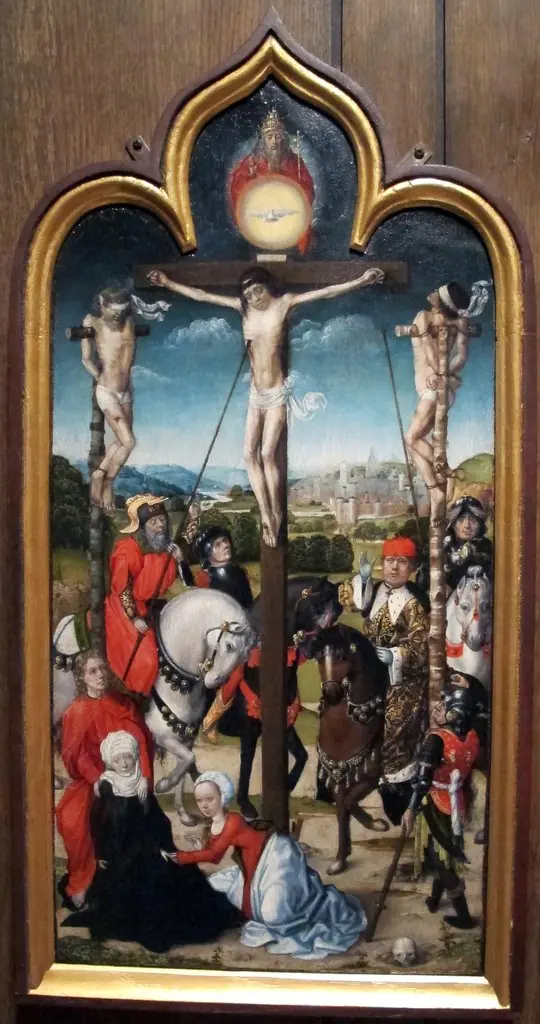
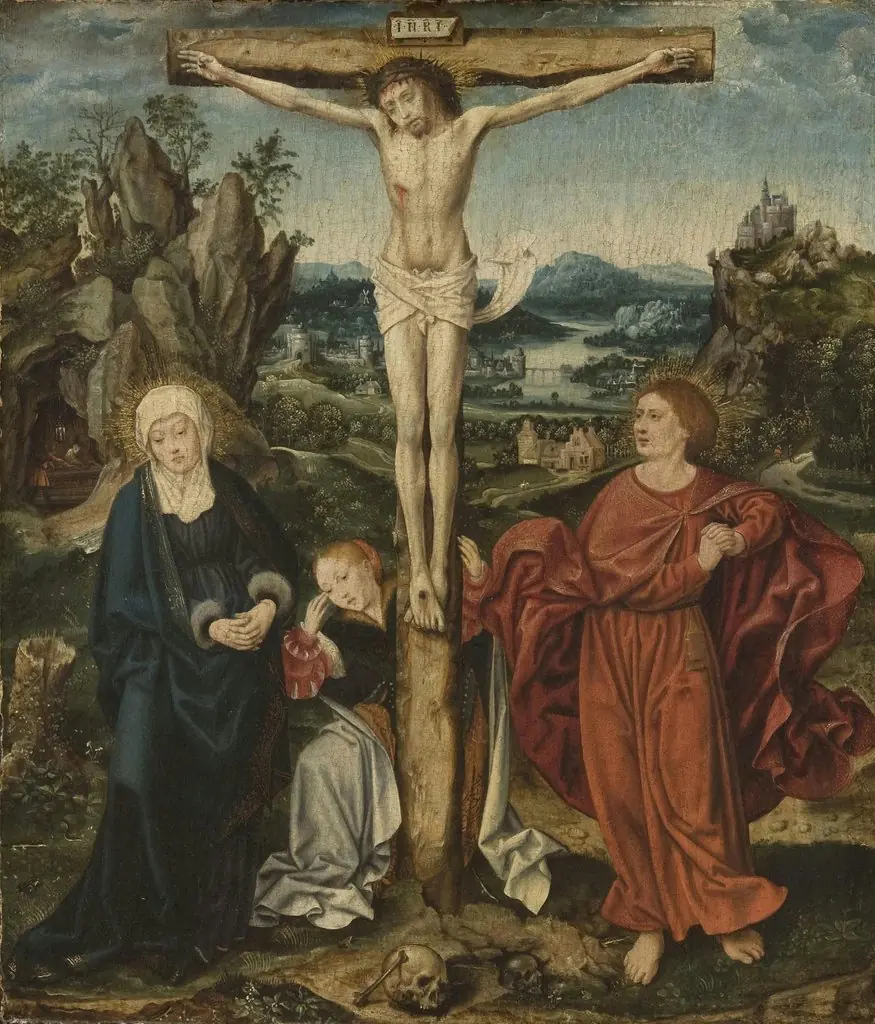
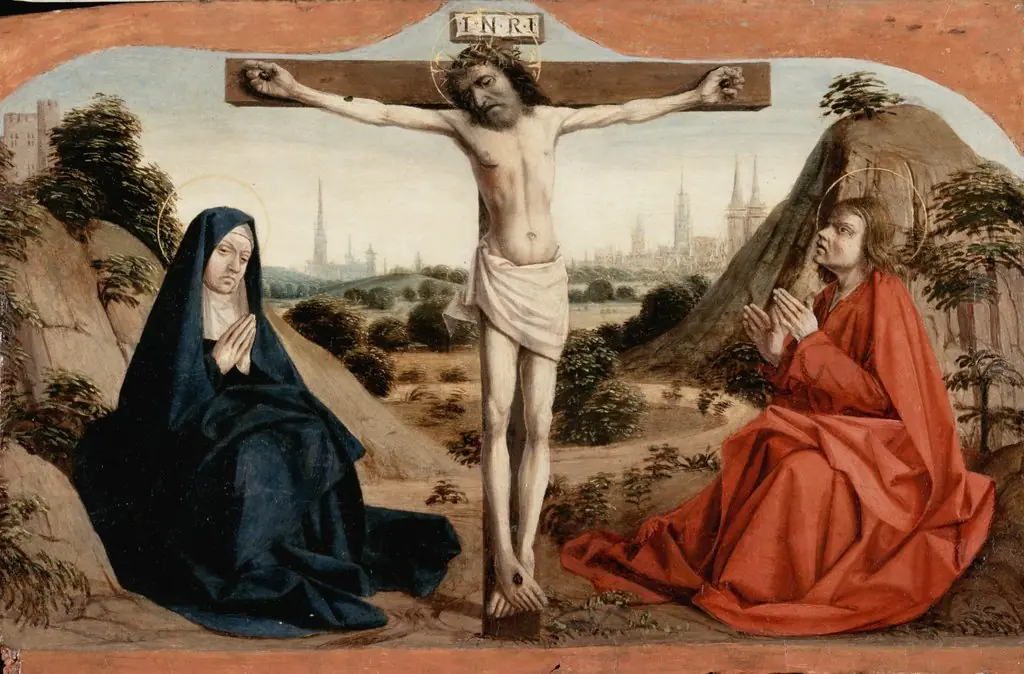
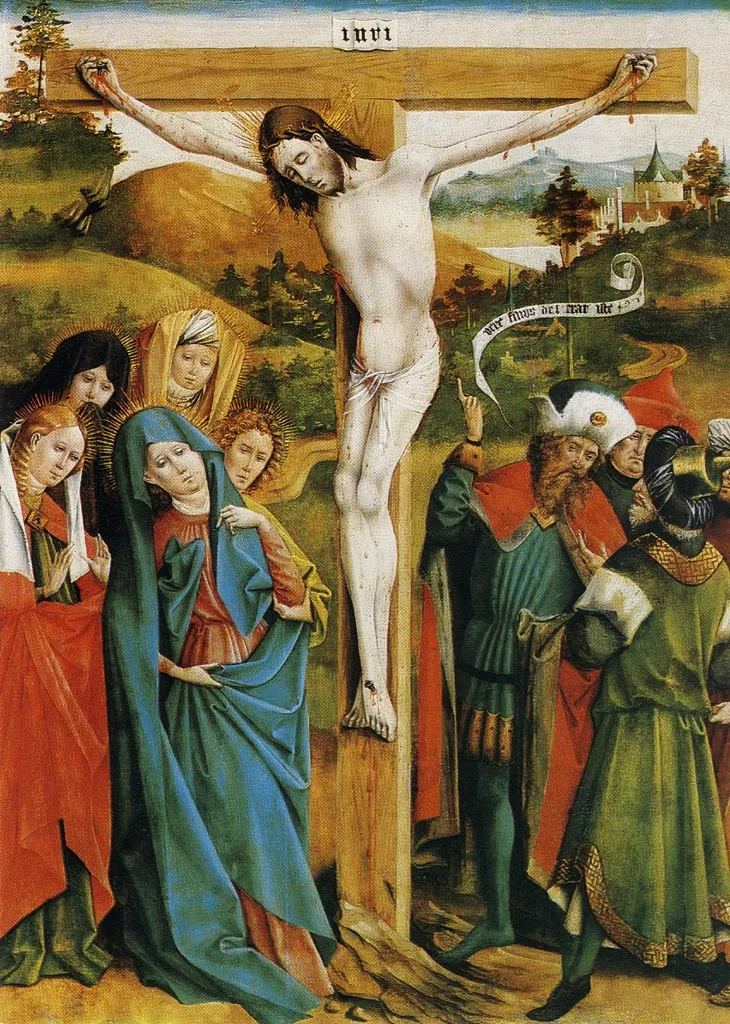
The painting presents the biblical crucifixion of Jesus Christ according to the narrative found in all four Gospels. At the center, Christ hangs on the cross with arms outstretched, head tilted to his right, wearing the crown of thorns and a cloth about his hips. A small plaque above his head bears the inscription INRI, the Latin abbreviation for Jesus Nazarenus Rex Iudaeorum. Blood issues from his hands, feet, and side, marking the physical reality of his suffering. To the left, five haloed figures gather in mourning, including a woman in blue and red robes who collapses forward, supported by others, representing the traditional group of pious women and Saint John at the foot of the cross. To the right, three men in elaborate costumes stand near the cross, one pointing upward while holding a scroll, another raising a hand to his face, figures that may represent theIjewish elders or Roman soldiers depending on interpretive tradition. The background landscape with rolling hills, scattered trees, a winding path, and distant buildings places the sacred event within a recognizable, earthly setting, a characteristic development in Northern European painting that encouraged devotional engagement by making the biblical past visually accessible.
Technique & Style
Koerbecke executed the work in tempera on oak panel, a support and medium standard for Northern European panel painting of the period. The palette features deep blues, reds, and greens against golden browns, with smooth modeling and fine detail in drapery and faces. Light falls evenly across the composition, creating soft shadows that give the figures volume without dramatic contrast. This handling reflects the Netherlandish style introduced to the region by Robert Campin and developed by Jan van Eyck and Dirk Bouts, which Koerbecke was the first Westphalian painter to adopt. The attention to individual facial characteristics, the intuitive approach to spatial depth, and the bright, saturated colors all mark his engagement with this innovative tradition. The even light and meticulous surface detail serve the devotional function of the image, inviting prolonged contemplation of the sacred narrative.
History & Provenance
The painting was one of sixteen panels on the flaps of the Marienfelder Altar, commissioned in 1457 for the church at Marienfeld Abbey in Harsewinkel. Johann Koerbecke's documented activity between 1453 and 1484 in Münster, including invoices for altarpieces, establishes his professional standing and capacity to undertake such a major commission. The abbey and monastery were dissolved in 1803, after which the panels were scattered across collections internationally. Six panels entered the Westphalian State Museum of Art and Cultural History, while others traveled as far as Moscow and Chicago, including one at the National Gallery of Art in Washington, D.C. The present painting was acquired by the Gemäldegalerie Berlin, where it remains today. Copies arranged according to the original altarpiece configuration are displayed in the current Abbey Church at Marienfeld.
Context
Johann Koerbecke, born around 1415 or 1420 in Coesfeld or Münster and active until his death in 1491, was the first named painter from Westphalia and a central figure of the Westphalian School. He is believed to have collaborated with the Master of the Schöppingen Altarpiece and the Master of 1473, and his training likely came from his father Heinrich and another local artist in the 1430s. His adoption of Netherlandish techniques placed him at the forefront of artistic innovation in northwestern Germany, bridging the International Gothic and the emerging naturalism of the Northern Renaissance. The Marienfelder Altar represents his most significant surviving project, demonstrating how regional workshops could assimilate and transmit broader European stylistic developments. The dispersal of the altarpiece panels after 1803 reflects the widespread disruption of ecclesiastical collections during the Napoleonic secularizations, a fate shared by countless medieval and early modern religious artworks.
Legacy
The Crucifixion of Christ survives as a touchstone for understanding the transmission of Netherlandish painting methods into German regional workshops during the fifteenth century. As part of the Marienfelder Altar, it preserves evidence of Koerbecke's artistic achievement at a scale and complexity that few other works by him can match, given that few works after 1470 can be securely attributed to him. The scattered panels, now reunited only in copy at the modern Abbey Church, illustrate both the vulnerability and the enduring scholarly interest in dismembered altarpieces. The painting's residence in the Gemäldegalerie Berlin ensures its accessibility for study and public engagement, while its provenance traces the broader patterns of cultural patrimony redistribution in European history. Within the larger tradition of crucifixion imagery, Koerbecke's panel exemplifies the late medieval shift toward naturalistic detail and emotional engagement that would profoundly influence subsequent generations of Northern European painters.
Artist & collection
Artist
Johann Koerbecke (c. 1415/20, Coesfeld or Münster - 13 June 1491, Münster) was a German Gothic painter of the Westphalian School. He is believed to have worked with the Master of the Schöppingen Altarpiece and the…