Artwork
Pietro Moscati
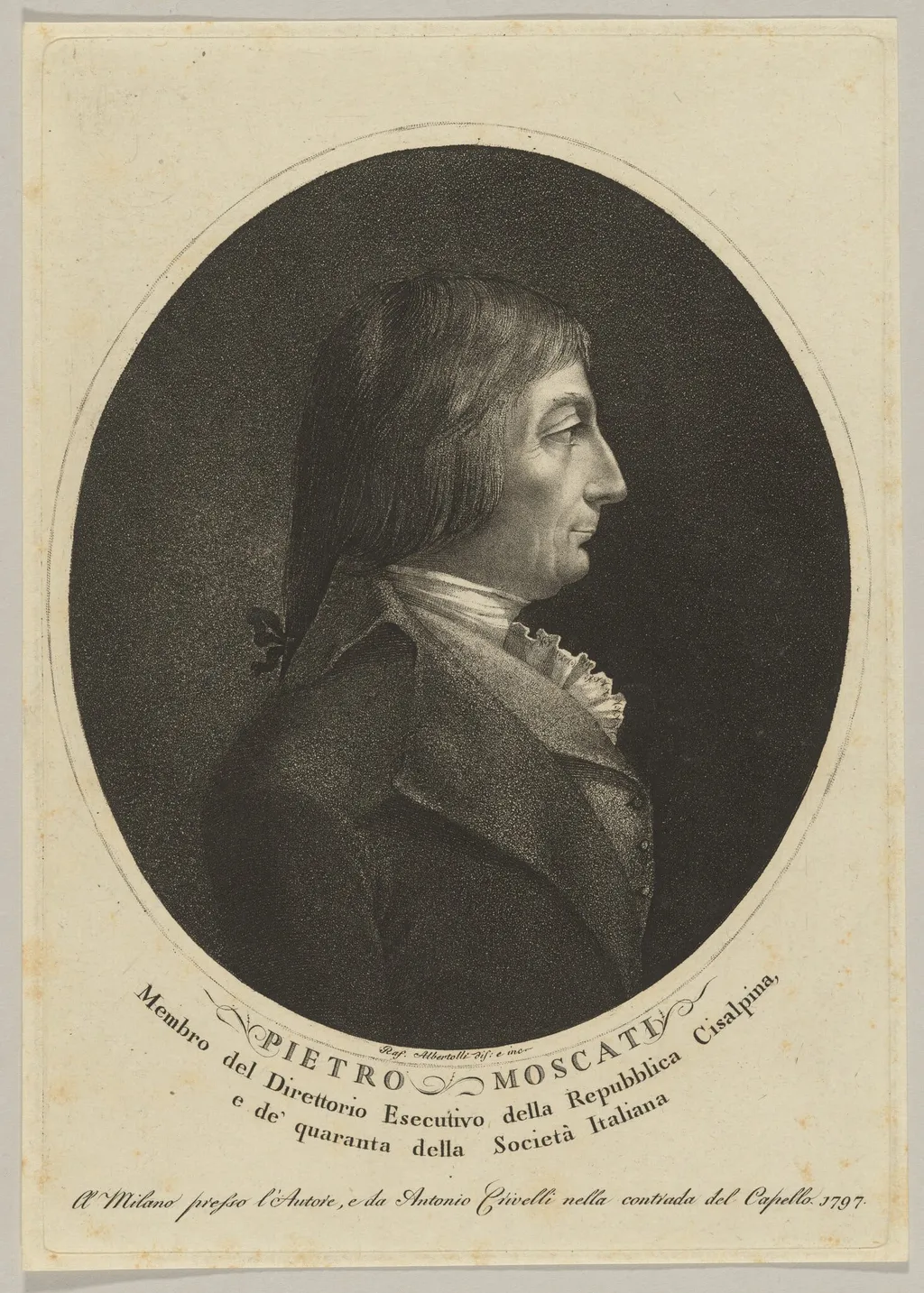
Pietro Moscati is an ink print by the Romanticist artist Raffaeli Albertolli. It dates from 1797 and is held in the collection of the National Gallery of Art.
- Inscription
- Inscribed:recto: in plate, below portrait: Raf. Albertolli dis: e inc. / PIETRO MOSCATI / Membro del Direttorio Esecutivo della Repubblica Cisalpina, / e de' quaranta della Società Italiana / A Milano presso l’Autore, e da Antonio Crivelli nella contrada del Capello 1797
- Markings
- Marked:verso: Damiano Muoni (Lugt 3781)
About this work
Overview
, and reflects the precision and tonal subtlety characteristic of late 18th-century reproductive printmaking.
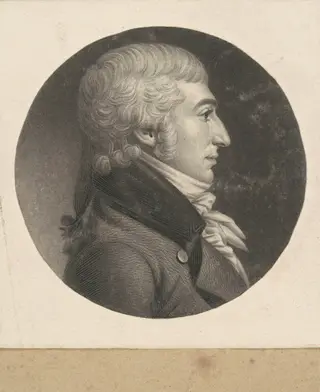
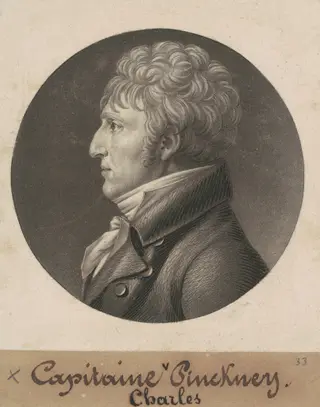
This black-and-white print, created in 1797, depicts Pietro Moscati in profile, facing left. Executed in etching and aquatint with roulette on laid paper, it presents a tightly framed portrait of the subject’s head and shoulders against a dark, unmodulated background. The work is held in the collection of the National Gallery of Art in Washington, D.C., and reflects the precision and tonal subtlety characteristic of late 18th-century reproductive printmaking.
Subject & Meaning
Pietro Moscati, an Italian physician and naturalist, is portrayed without overt symbolism or contextual elements. The focus remains on his dignified bearing and distinctive facial features, short, curly hair and a high-collared coat suggest professional status. The absence of narrative or setting emphasizes his identity as an individual of intellectual standing, typical of portrait prints intended for scholarly or familial circulation.
Technique & Style
The portrait employs etching for fine linear detail and aquatint to achieve gradations of tone, particularly in the shadowed areas of the coat and hair. The roulette tool adds texture to the background, enhancing the sense of depth and framing the figure within a soft, circular vignette. The paper’s slight yellowing and texture are consistent with period laid paper, reinforcing the work’s material authenticity and handcrafted process.
History & Provenance
Created by Raffaeli Albertolli in 1797, the print was likely produced as part of a series documenting notable figures of the time. It entered the National Gallery of Art’s collection through established acquisition channels, though its earlier ownership history prior to the 20th century is not publicly documented. Its preservation reflects its value as a representative example of Italian printmaking from the late Enlightenment era.
Context
In the late 1700s, portrait prints like this one served as accessible means of disseminating likenesses of public figures, especially among educated circles. The use of etching and aquatint aligned with technical advances that allowed for greater tonal nuance than line engraving alone. Moscati’s depiction fits a broader trend of honoring scientists and physicians through visual portraiture during a period of growing public interest in empirical knowledge.
Legacy
Though not widely reproduced or exhibited beyond institutional collections, the print remains a quiet testament to the intersection of science and visual culture in Enlightenment Europe. It preserves the likeness of a lesser-known but respected intellectual, offering insight into how professional identity was visually constructed in pre-photographic society.
Own this work as a print
Artist & collection