Artwork
Saint Jerome in the Wilderness
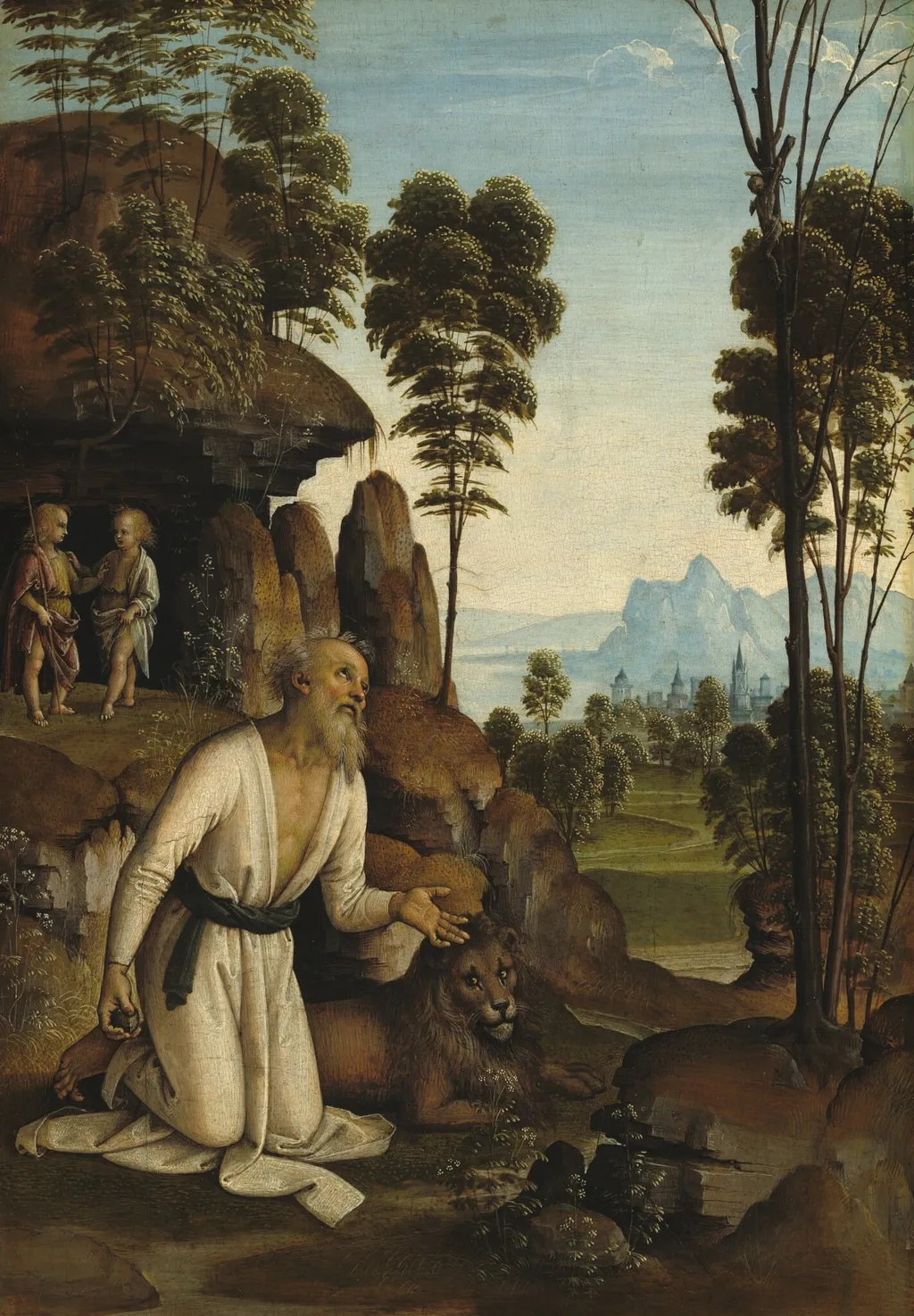
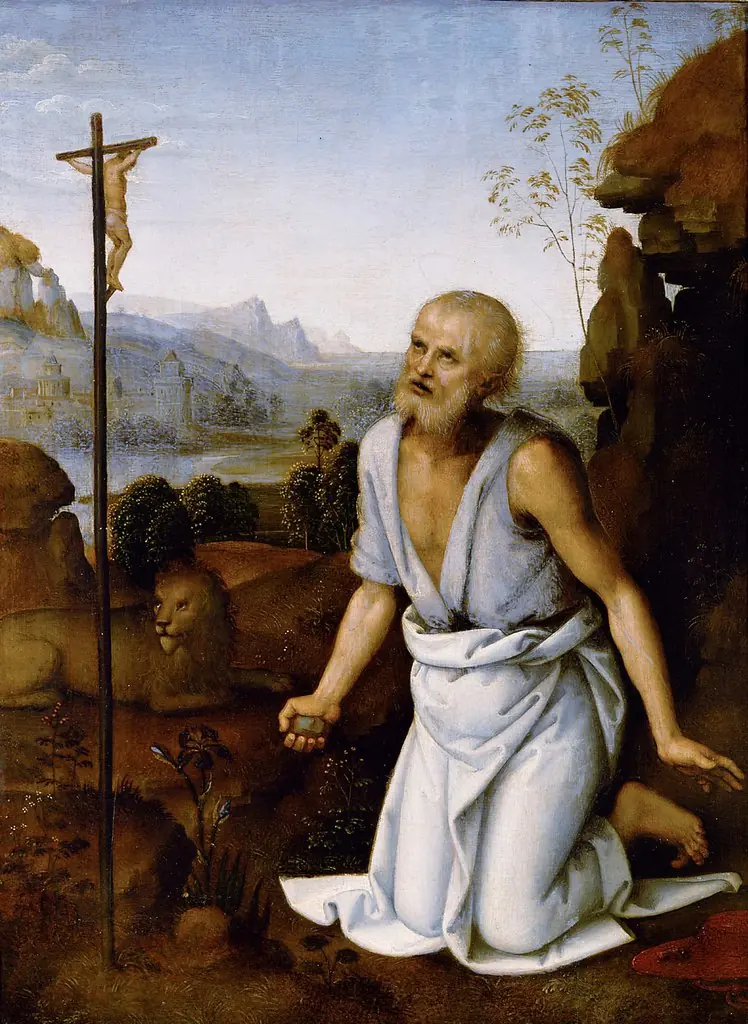
Saint Jerome in the Wilderness is a tempera painting by the Italo Byzantine artist Follower of Pietro Perugino. It dates from 1495 and is held in the collection of the National Gallery of Art.
About this work
Subject & Meaning
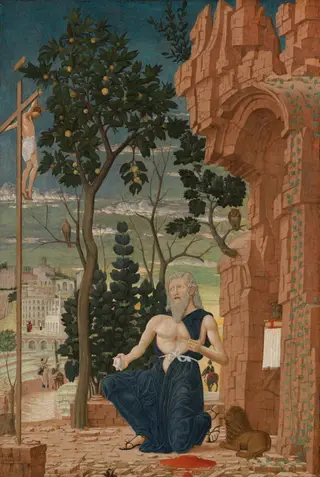
The painting depicts Saint Jerome, a subject identified through the figure's iconographic attributes and confirmed by the work's title and main subject designation. According to an 1857 description by Gustav Friedrich Waagen, the panel shows a landscape with Saint Jerome positioned on the right, holding a stone in his left hand while performing penance before a small crucifix affixed high upon a tree. These attributes are standard markers of Jerome's iconography: the stone is the instrument of his self-mortification in the wilderness, and the crucifix is the focus of his penitential meditation.
The pairing of hermit-like penance with the wilderness setting reflects the ascetic tradition surrounding Jerome's later years, when, according to hagiographic tradition, he withdrew from worldly life to atone through physical austerity and devotional contemplation. The work thus represents Jerome not as a scholar or church father but as the penitent hermit of the desert, embodying themes of repentance, withdrawal from worldly temptation, and solitary devotion to Christ.
Technique & Style
The stylistic handling has been linked by early observers to the circle of Timoteo Viti, though the artist remains officially anonymous.
Saint Jerome in the Wilderness is executed in tempera on a poplar panel support, a traditional medium for Italian Renaissance painting. The work measures 60 centimeters in height and 41.9 centimeters in width. Painted circa 1495, the piece depicts the saint performing penance in a landscape setting, with the figure positioned on the right side holding a stone while facing a small crucifix attached high upon a tree.
The stylistic handling has been linked by early observers to the circle of Timoteo Viti, though the artist remains officially anonymous. The composition focuses on the religious subject of Jerome within a wilderness environment, utilizing the tempera medium to render the figures and landscape details characteristic of late 15th-century devotional art.
History & Provenance
Created circa 1495, this tempera on poplar panel depicts Saint Jerome and is attributed to an unknown artist, though sometimes associated with Timoteo Viti. The documented ownership chain begins with Sir Thomas Gage Saunders Sebright, 8th Baronet, at Beechwood Park, Hertfordshire, by 1856. It passed by descent to Sir Giles Edward Sebright, 13th Baronet, and was sold at Christie, Manson & Woods in London on July 2, 1937.
Following this auction, the work was acquired by Count Alessandro Contini Bonacossi in Florence, who sold it to the Samuel H. Kress Foundation in New York on October 20, 1937. The Kress Foundation subsequently gifted the painting to the National Gallery of Art in Washington, D.C., in 1939. While a 1937 bill of sale mentions a prior provenance linking the work to Count B. Pinamonte of Ferrara, later scholarship has identified this specific claim as spurious.
Saint Jerome in the Wilderness is held by the National Gallery of Art in Washington, D.C., as part of the Samuel H. Kress Collection. The painting was gifted to the museum by the Kress Foundation in 1939. Prior to entering the museum's collection, the work was at Beechwood Park in Hertfordshire, where it was observed by Gustav Friedrich Waagen during his visits in 1854 and 1856.
It was later sold at auction by Christie, Manson & Woods in London on July 2, 1937, before being acquired by the Kress Foundation later that year.
Context
The critical reception and historical attribution of Saint Jerome in the Wilderness have been subjects of scholarly debate. When Gustav Friedrich Waagen observed the panel in the Sebright collection in the mid-nineteenth century, he initially questioned a possible attribution to Raphael but ultimately concluded the style most closely resembled Timoteo Viti. The painting's historical context was further complicated by a supposed Ferrara provenance attached to the 1937 Contini Bonacossi sale; however, later scholarship dismissed this origin as spurious.
While the work is now generally classified as anonymous, it remains situated within the broader stylistic milieu of late fifteenth-century Italian religious painting. Through its acquisition by the Samuel H. Kress Foundation and placement in the National Gallery of Art, it endures as a documented example of shifting attributions and provenance challenges in art history.
Overview
This painting, titled "Saint Jerome in the Wilderness," is rendered in tempera on a poplar panel. It depicts Saint Jerome, a prominent figure in Christian history, as a solitary hermit within a desolate, rocky landscape. The artwork conveys a sense of quiet contemplation, presenting the saint in simple attire amidst natural elements. The composition emphasizes solitude and spiritual reflection.
Artist & collection
Artist