Artwork
Saint Jerome penitent
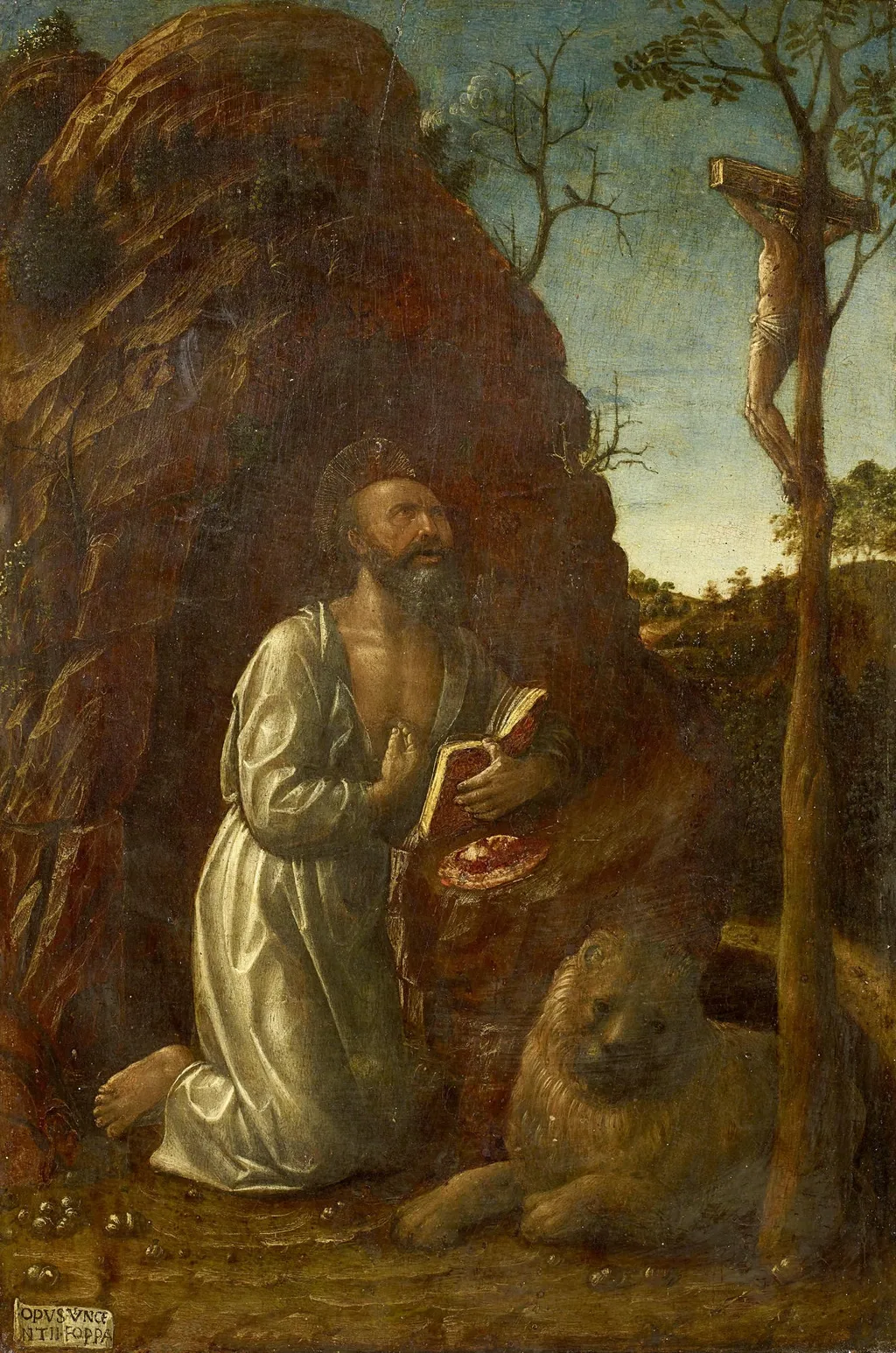
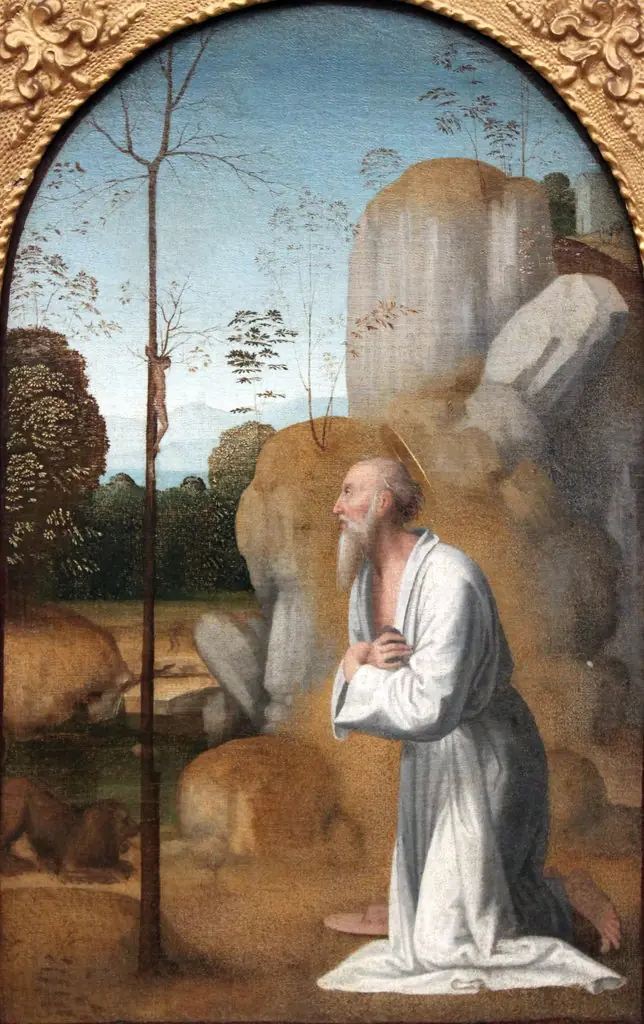
Saint Jerome penitent is a tempera painting by the Italo Byzantine artist Vincenzo Foppa. It dates from 1500 and is held in the collection of the Accademia Carrara. Created in 1500, this tempera panel portrays a kneeling saint set against a rocky landscape under a clear sky.
About this work
Overview
Created in 1500, this tempera panel portrays a kneeling saint set against a rocky landscape under a clear sky. The figure, cloaked in a white robe and crowned with a halo, holds an open book while a lion rests at his feet. A crucifix stands behind him, anchoring the composition within a Christian devotional context.
Subject & Meaning
The work represents Saint Jerome, traditionally shown as a hermit scholar translating the Bible. The open book alludes to his biblical work, while the lion references the legend of him taming a wild animal. The kneeling posture and surrounding crucifix emphasize penitence and contemplation, underscoring the saint’s role as a model of piety.
Technique & Style
Executed in temperate tempera, the painting displays the crisp, linear qualities typical of the Italo‑Byzantine tradition. The medium allows for fine detail in the saint’s features and the texture of the rocky ground, while the limited palette yields a luminous surface. The composition balances flat decorative elements with a modest sense of spatial depth.
History & Provenance
Attributed to Vincenzo Foppa, a prominent painter of the Early Lombard School, the panel is part of the collection of the Accademia Carrara in Bergamo. Foppa, active in the late 15th and early 16th centuries, worked extensively for the Sforza court before returning to his native Brescia, where he likely produced this work.
Context
The painting reflects the transitional period in northern Italian art when Renaissance naturalism began to merge with lingering Byzantine influences.
The painting reflects the transitional period in northern Italian art when Renaissance naturalism began to merge with lingering Byzantine influences. Foppa’s depiction of Saint Jerome aligns with contemporary devotional trends that favored intimate, contemplative images for private worship, while the inclusion of symbolic elements such as the lion and crucifix adheres to established iconographic conventions.
Own this work as a print
Artist & collection
Artist
Vincenzo Foppa (Brescia, c. 1427–1430 – Brescia, c. 1515–1516) was an Italian painter from the Renaissance period. While few of his works survive, he was an esteemed and influential painter during his time and is…