Artwork
William Burrows
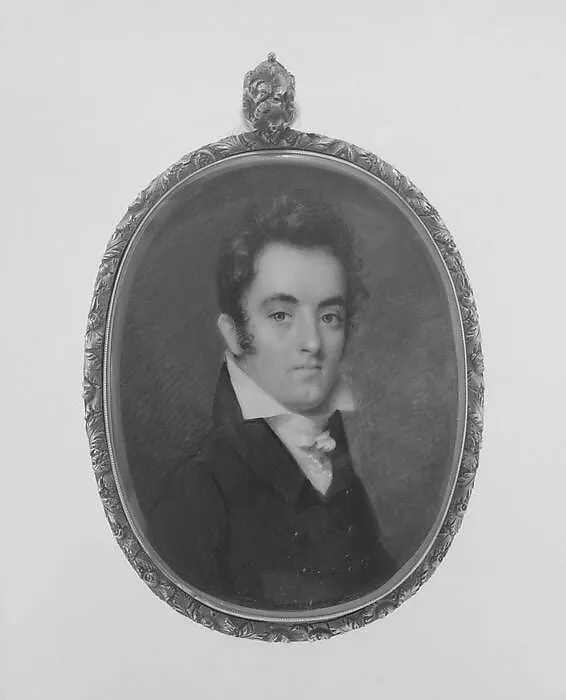
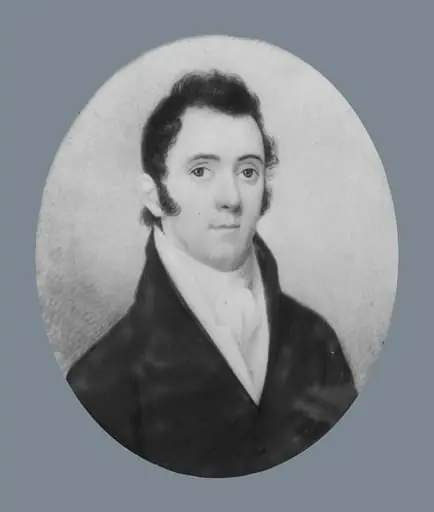
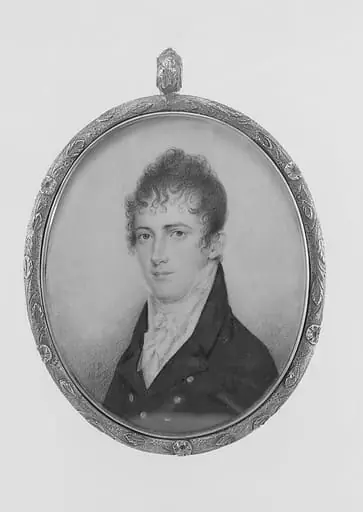
William Burrows is a watercolor painting by the American Folk Art artist Anson Dickinson. It dates from 1810 and is held in the collection of the Metropolitan Museum of Art.
About this work
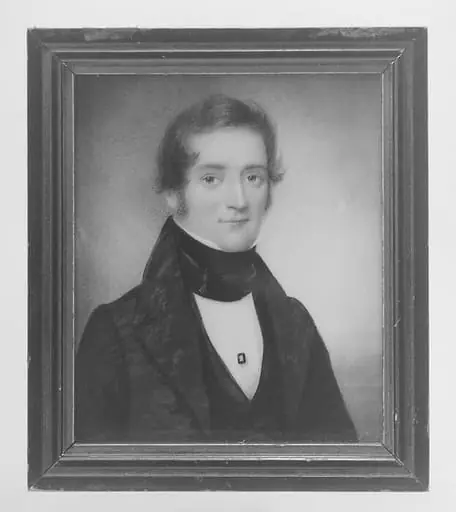
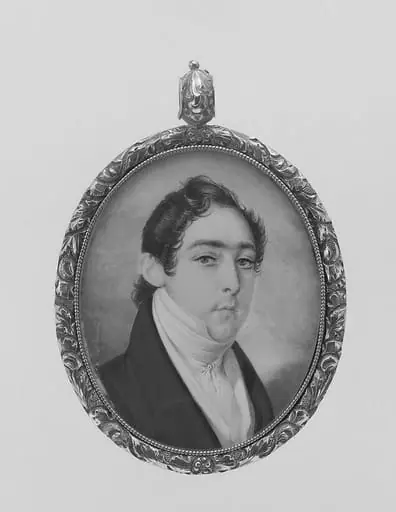
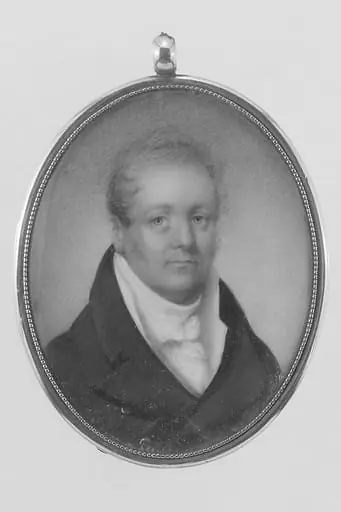
A young man in a dark coat and white shirt sits for a tiny portrait, his face smooth and his eyes steady. Anson Dickinson painted it in 1810 in watercolor on ivory, a surface that lets light glow through the paint and warms the skin. Such miniatures made quick, portable keepsakes for soldiers and sailors heading out.
Subject & Meaning
The portrait depicts William Ward Burrows II, a figure associated with early American military leadership.
The portrait depicts William Ward Burrows II, a figure associated with early American military leadership. Rendered in watercolor on ivory by Anson Dickinson in 1807, the miniature emphasizes the sitter’s identity through direct facial representation and formal attire, consistent with elite portrait conventions of the period. The work’s focus on an individual rather than allegorical or narrative elements suggests a commemorative purpose, likely intended to preserve Burrows’s likeness for private or institutional memory.
As a portrait, it functions primarily as a record of identity and status, with no overt symbolic or iconographic program beyond the sitter’s recognizable presence.
Technique & Style
The portrait of William Burrows is executed in watercolor on ivory, a miniature format suited to intimate portraiture. The support of ivory, paired with the translucent handling of watercolor, allowed for delicate tonal modulation and fine detail characteristic of early nineteenth-century American miniature painting. The work measures 7.3 cm in height by 5.7 cm in width, confirming its small-scale, portable format.
Held in the collection of the Metropolitan Museum of Art, the piece is classified within The American Wing and is dated to 1807. No specific condition notes are recorded in the available sources.
History & Provenance
The portrait of William Ward Burrows II was created in 1807 by the artist Anson Dickinson. Executed as a watercolor on ivory, the work measures 7.3 centimeters in height and 5.7 centimeters in width. It currently resides in the collection of the Metropolitan Museum of Art, where it is classified within the American Wing.
The artwork serves as a formal representation of its subject, William Ward Burrows II, capturing the individual in a portrait genre typical of the early nineteenth century. No specific details regarding the original commissioning party, the precise date of acquisition by the museum, or the intermediate ownership chain between the sitter and the current institution are recorded in the available documentation.
The watercolor on ivory portrait of William Burrows by Anson Dickinson is held by the Metropolitan Museum of Art, where it belongs to the institution's American Wing collection. Created in 1807, the work measures 7.3 by 5.7 (units unspecified in the source) and depicts William Ward Burrows II. No inventory or accession number is recorded in the available sources, and no exhibition history is documented beyond its current placement in the museum's holdings.
Context
An 1807 watercolor on ivory by Anson Dickinson portrays William Ward Burrows II, a notable early American political figure. The painting is part of The American Wing at the Metropolitan Museum of Art, where it is classified as a portrait and studied as an example of early Republic portraiture. Its creation during the Federal period reflects the emergence of a distinct American visual identity, while its technical execution on ivory demonstrates the influence of European miniaturist traditions in the United States.
Scholars reference the work when examining the development of portraiture in the young nation and its role in shaping public perception of political leaders.
Overview
Painted in 1810 by Anson Dickinson, this miniature portrait depicts William Burrows, a young man presented in a three-quarter view against a neutral background. The work is executed in watercolor on ivory, a support characteristic of the American miniature tradition that Dickinson mastered. The translucent nature of the ivory allows light to pass through the watercolor layers and reflect back, creating a luminous quality that enhances the realism of the sitter's complexion.
Burrows is shown wearing a dark coat and a high-collared white shirt, typical of early nineteenth-century men's fashion. Dickinson renders the face with smooth, delicate brushwork, capturing a steady, direct gaze that conveys a sense of quiet dignity. Unlike the oil-on-canvas portraits common in larger formats, this small-scale work was designed for intimate viewing and personal commemoration.
Created during the height of the miniature portrait craze in the United States, this piece exemplifies Dickinson's skill in adapting European techniques to American subjects, establishing him as a leading figure in early American portraiture.
Artist & collection

Artist
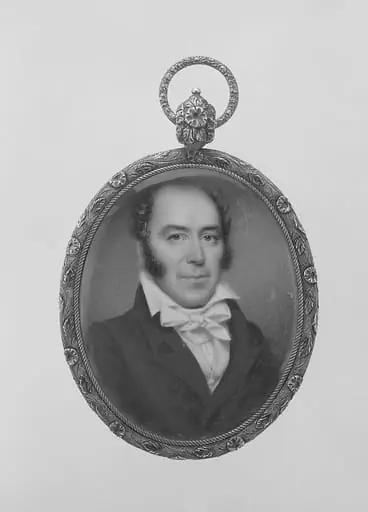
Anson Dickinson (19 April 1779 – 9 March 1852) was an American painter of miniature portraits who achieved fame during his lifetime, producing a very large number of works, but who is now largely forgotten.