Artwork
Part of the quadrangle of Exeter College
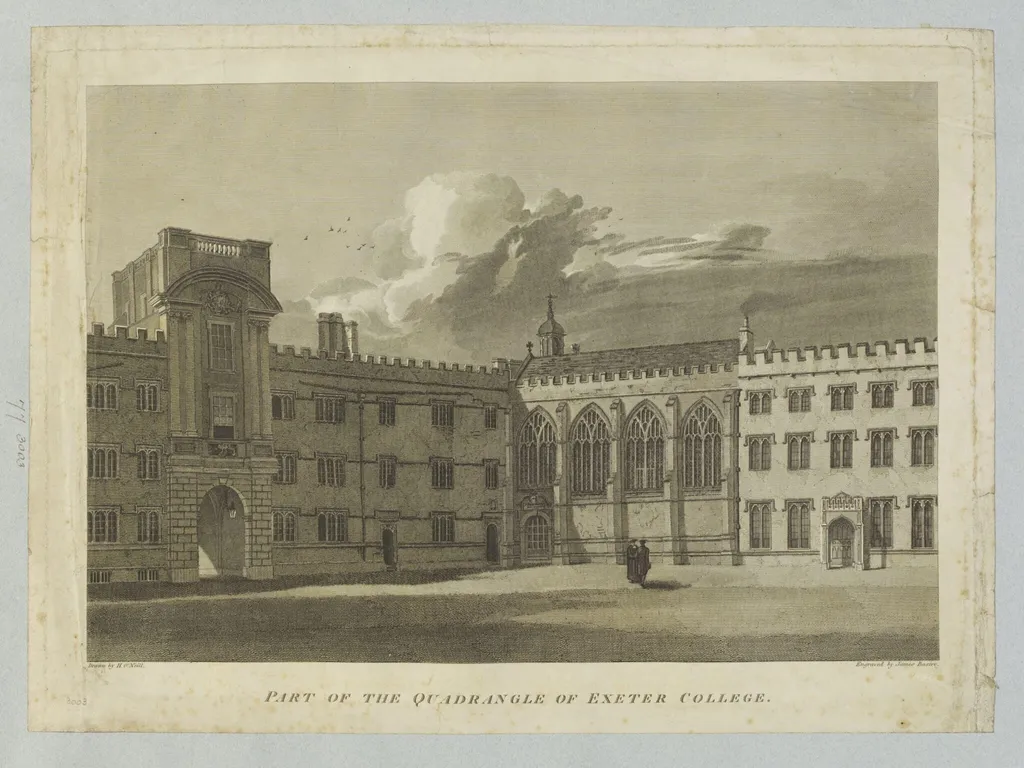
Part of the quadrangle of Exeter College is a print by the Romanticist artist James Basire. It dates from 1813 and is held in the collection of the Victoria and Albert Museum. This print captures a portion of Exeter College’s quadrangle at the University of Oxford.
About this work
Overview
This print captures a portion of Exeter College’s quadrangle at the University of Oxford. Created for the 1813 Oxford Almanack, it was produced by James Basire the Younger from a drawing by H. O’Neill. Executed as a fine-line engraving on paper, the work serves as a topographical record rather than a decorative piece, reflecting the Almanack’s purpose of documenting academic architecture.
Subject & Meaning
The cloudy sky adds a quiet, contemplative mood, aligning with early 19th-century sensibilities that valued order and quiet reverence in institutional spaces.
The scene portrays the college courtyard with students and staff gathered near a stone building featuring a prominent arched entrance and a slender tower. The inclusion of figures suggests daily academic life, grounding the architecture in human activity. The cloudy sky adds a quiet, contemplative mood, aligning with early 19th-century sensibilities that valued order and quiet reverence in institutional spaces.
Technique & Style
Rendered in fine-line engraving, the print relies on precise cross-hatching and delicate linework to define stone textures, window patterns, and architectural details. The composition is balanced and restrained, avoiding dramatic lighting or emotional intensity. This method was typical of topographical printmaking, prioritizing accuracy over expressive flourish, though the atmospheric sky hints at emerging Romantic sensibilities.
History & Provenance
The print was commissioned as part of the 1813 Oxford Almanack, an annual publication featuring engravings of Oxford’s colleges. James Basire the Younger, a noted engraver from a family of printmakers, translated H. O’Neill’s original drawing into a reproducible format. Copies were distributed to subscribers, making this a widely circulated, though not individually celebrated, record of collegiate architecture in the early 1800s.
Context
Produced during a period of renewed interest in Oxford’s medieval heritage, the print reflects broader efforts to document and preserve institutional architecture. While Romanticism was influencing landscape art elsewhere, this work remains grounded in documentary tradition. Its purpose was not to evoke emotion but to serve as a reliable visual archive for academic and civic audiences.
Legacy
Though not widely exhibited today, the print remains a valuable resource for historians studying Oxford’s architectural development. It exemplifies the role of printmaking in preserving institutional identity during a time of academic reform. Its modest scale and functional intent contrast with later, more interpretive depictions, offering a quiet but enduring record of college life in the early 19th century.
Own this work as a print
Artist & collection
Artist
James Basire etched scenes with fine lines in the late 1700s to early 1800s. He made prints like “The Stoning of St. Stephen,” a dramatic religious scene in black ink on paper, and “Part of the quadrangle of Exeter…

 Merton College, Oxford
 Magdalen College, Oxford
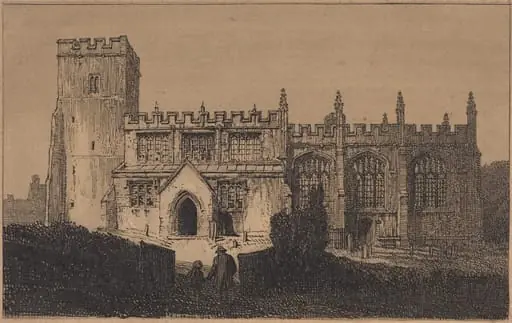 North Marston Church
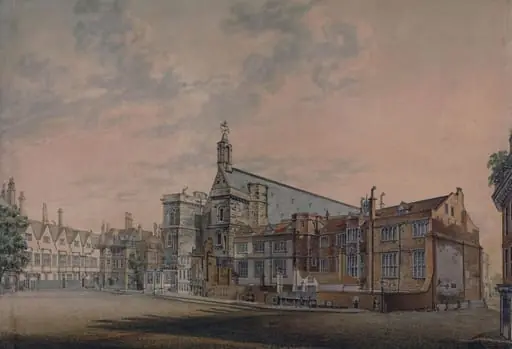 New Palace Yard with the Augmentation Office as in 1793 and the Offices of the Exchequer
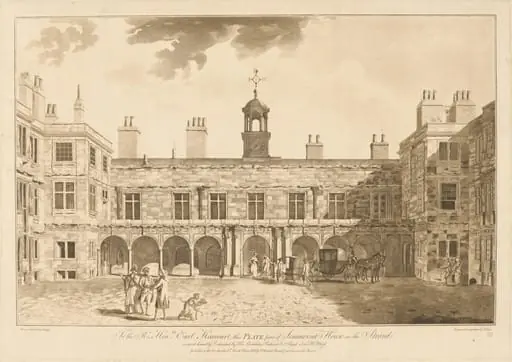 The Inner Courtyard of Old Somerset House in the Strand
![Prospect of the Entrance into the Tower [of London] taken from the back of the Stone Kitchen, by Paul Sandby](https://artifactworldgallery.com/img/paul-sandby--prospect-of-the-entrance-into-the-tower-of-london-taken-from--b35494ee95d2329d-w320.webp) Prospect of the Entrance into the Tower [of London] taken from the back of the Stone Kitchen
Prospect of the Entrance into the Tower [of London] taken from the back of the Stone Kitchen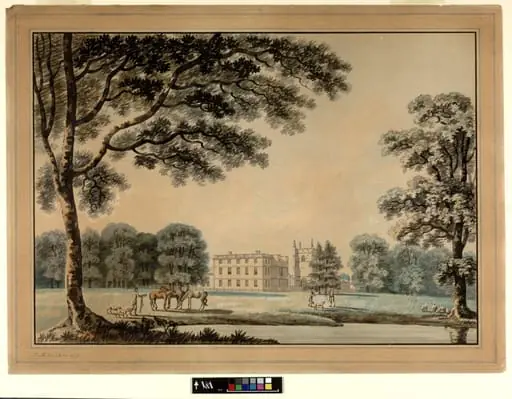 A Country House and Park, probably Norton Hall, near Sheffield
 All Souls' College, Oxford
 Untitled
 Esperanza, Church