Artwork
Coridone, Lover of Corisca
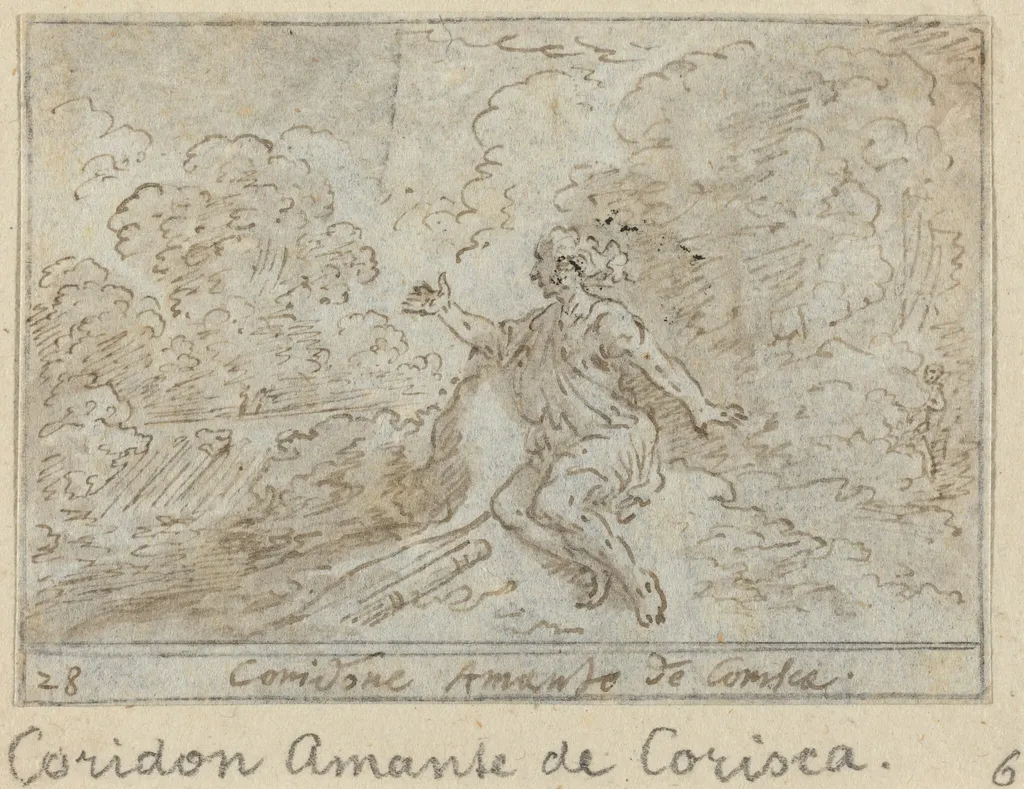
Coridone, Lover of Corisca is an ink drawing by the Baroque artist Johann Wilhelm Baur. It dates from 1640 and is held in the collection of the National Gallery of Art.
- Inscription
- Inscribed:across bottom in brown ink: 28 Coridone Amante di Corisca.
About this work
Subject & Meaning
The subject matter is strictly bound to the literary context of the play rather than a standalone mythological event.
The drawing depicts the character Corydon, a shepherd from Giovanni Battista Guarini's pastoral play Il pastor fido. Created by Johann Wilhelm Baur in 1640, the work illustrates a specific narrative moment from this literary source, focusing on the figure of the lover within the pastoral tradition. As part of a series dedicated to Guarini's text, the image serves as a visual interpretation of the play's themes, capturing the emotional or dramatic essence of Corydon's role as the suitor of Corisca.
The subject matter is strictly bound to the literary context of the play rather than a standalone mythological event.
Technique & Style
The drawing is executed in pen with brown ink and brown wash on laid paper, a technique typical of mid-seventeenth-century European draftsmanship.
Handling is precise and linear, with controlled hatching in the wash to model form and volume. The composition is tightly framed, emphasizing the figure’s gesture and drapery through economical, confident strokes.
The sheet’s small dimensions (6.4 × 9.1 cm) and the use of laid paper support a function as an autonomous study or preparatory vignette rather than a large-scale composition.
History & Provenance
The drawing Coridone, Lover of Corisca by Johann Wilhelm Baur is dated to 1640 and is executed in pen, brown ink with brown wash on laid paper. It belongs to a series illustrating scenes from Giovanni Battista Guarini’s Il pastor fido. The work is held in the collection of the National Gallery of Art, Washington, D.C., where it is catalogued as NGA 41764.
The drawing is held by the National Gallery of Art, Washington, D.C., where it is accessioned as NGA 41764. Executed in 1640, the sheet measures 6.4 cm in height and 9.1 cm in width. The work has not been recorded as included in any subsequent exhibitions in the available documentation.
Legacy
The drawing Coridone, Lover of Corisca was created by Johann Wilhelm Baur in 1640 and is part of the series Giovanni Battista Guarini's "Il pastor fido"; its subject derives from the pastoral poem "Il pastor fido," and the work is held in the collection of the National Gallery of Art in Washington, D.C. The piece has been cited in scholarship concerning Baur’s role in the development of Baroque drawing practice, influencing later artists who engaged with mythological and literary themes in pen and ink. Its inclusion in major exhibitions of 17th‑century drawings has contributed to a renewed appreciation of Baur’s technical innovation and narrative depth.
Overview
Created in 1640, this drawing by Johann Wilhelm Baur presents the pastoral figure Corydon seated beneath a tree, flute in hand, surrounded by foliage and wildlife. Executed with pen and brown ink complemented by a brown wash on laid paper, the work exemplifies the intimate scale and narrative focus typical of 17th‑century book illustration.
Own this work as a print
Artist & collection
Artist
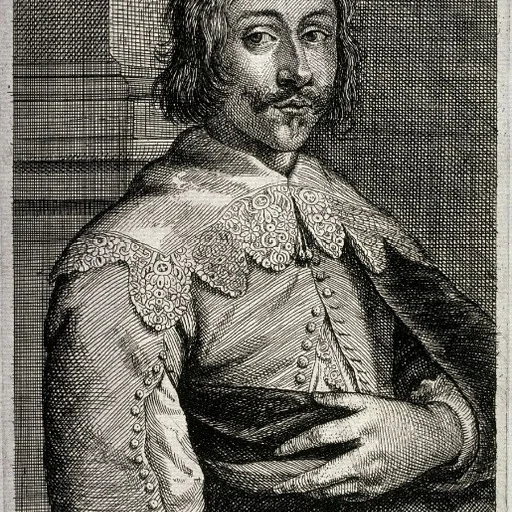
Johann Wilhelm Baur, Joan Guiliam Bouwer, or Bauer (Strasbourg, 31 May 1607 - Vienna, 1 January 1640) was a German engraver, etcher and miniature painter. He is famous for a series of illustrations of Ovid's Metamorphoses.

![Angel from the Assumption [recto], by Augustin Pajou](https://artifactworldgallery.com/img/augustin-pajou--angel-from-the-assumption-recto--59871eebf02790c8-w320.webp)
![Penitent Magdalene with Angels in a Landscape [recto], by Donato Creti](https://artifactworldgallery.com/img/donato-creti--penitent-magdalene-with-angels-in-a-landscape-recto--329b67c038e377df-w320.webp)