Artwork
Ergasto and Corisca
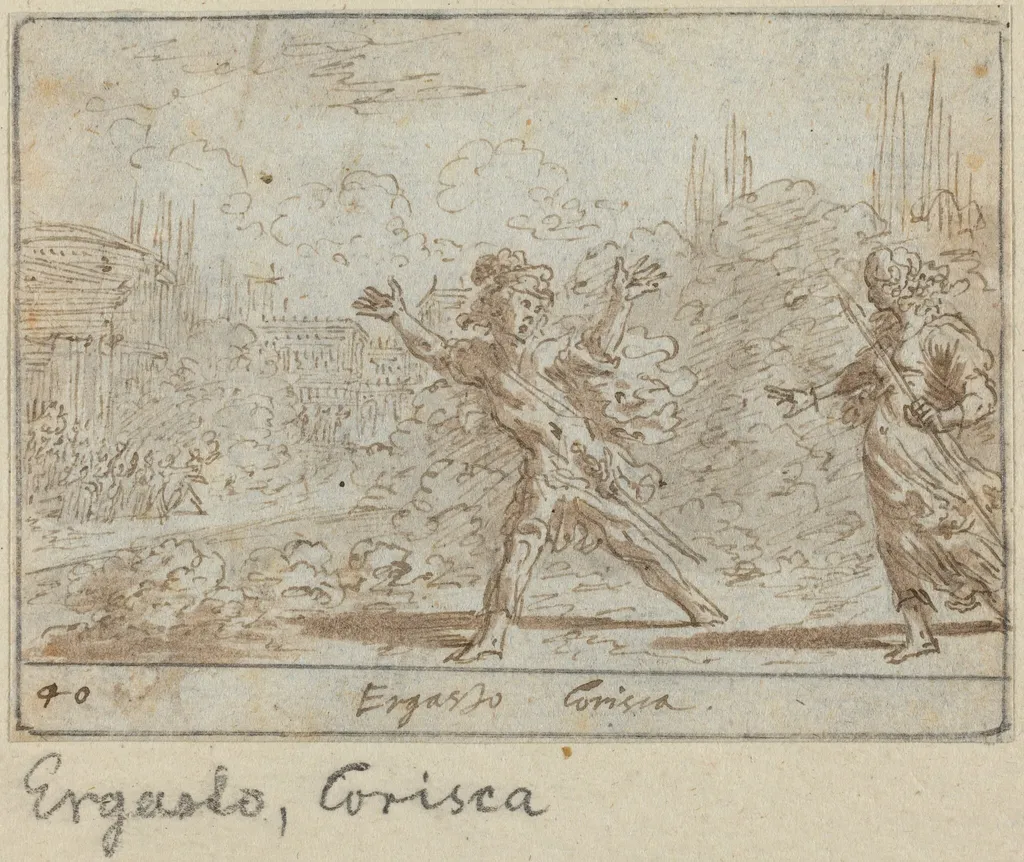
Ergasto and Corisca is an ink drawing by the Baroque artist Johann Wilhelm Baur. It dates from 1640 and is held in the collection of the National Gallery of Art.
- Inscription
- Inscribed:across bottom in brown ink: 40 Ergasto Corisca
About this work
Subject & Meaning
The work specifically depicts the characters Ergasto and Corisca, capturing a moment from the literary narrative through pen and brown ink with wash.
Johann Wilhelm Baur's 1640 drawing illustrates a scene from Giovanni Battista Guarini's pastoral play Il pastor fido. The work specifically depicts the characters Ergasto and Corisca, capturing a moment from the literary narrative through pen and brown ink with wash. As part of a series dedicated to illustrating Guarini's text, the image functions as a visual interpretation of the play's dramatic events.
The iconography centers on these two figures, representing their roles within the broader context of the seventeenth-century pastoral genre.
Technique & Style
Executed in 1640, this work is a drawing created with pen and brown ink, enhanced by the application of brown wash. The artist applied these materials onto a support of laid paper. Stylistically, the piece functions as an illustration for Giovanni Battista Guarini's literary work Il pastor fido, specifically depicting the characters Ergasto and Corisca.
The composition measures 6.5 cm in height and 9 cm in width, reflecting the intimate scale typical of such illustrative sheets from this period.
History & Provenance
Johann Wilhelm Baur created this drawing in 1640 as part of a series illustrating Giovanni Battista Guarini's pastoral tragicomedy Il pastor fido. The work depicts the characters Ergasto and Corisca from the play. Executed in pen and brown ink with brown wash on laid paper, the drawing measures 6.5 by 9 cm. It is now held in the collection of the National Gallery of Art in Washington, D.C., where it is catalogued as NGA 41767.
The drawing is held in the collection of the National Gallery of Art, Washington, D.C., with the accession number NGA 41767.
It has been exhibited as part of the series Il pastor fido by Giovanni Battista Guarini, including a display in the Gallery’s holdings of drawings by Johann Wilhelm Baur.
Overview
Johann Wilhelm Baur, a German artist active in the early‑17th century, produced the drawing Ergasto and Corisca in 1640. Executed with pen and brown ink, enriched by a brown wash on laid paper, the work measures a modest size typical of his intimate studies. It captures a moment from the pastoral drama Il pastor fido, focusing on the interaction between the two titular figures.
Context
Baur’s career unfolded in a milieu that valued the translation of literary texts into visual form. His engagement with both classical mythology and contemporary drama reflects the broader Baroque interest in dramatizing emotion and narrative. Ergasto and Corisca thus exemplifies how artists of the period used drawing to explore literary subjects beyond the more common mythological cycles.
Own this work as a print
Artist & collection
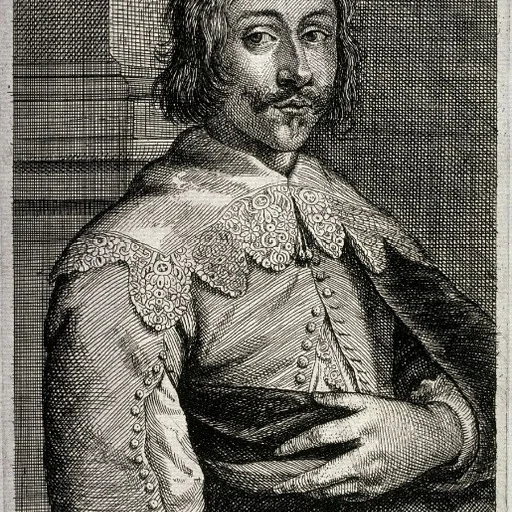
Artist
Johann Wilhelm Baur, Joan Guiliam Bouwer, or Bauer (Strasbourg, 31 May 1607 - Vienna, 1 January 1640) was a German engraver, etcher and miniature painter. He is famous for a series of illustrations of Ovid's Metamorphoses.