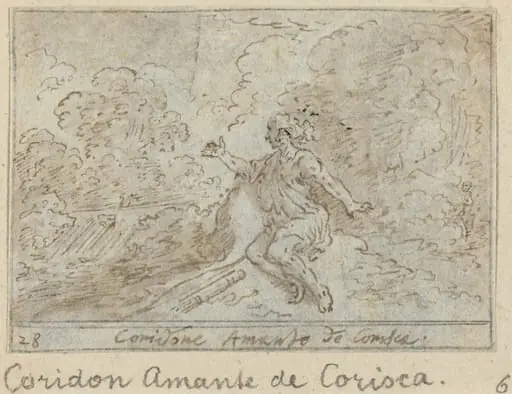
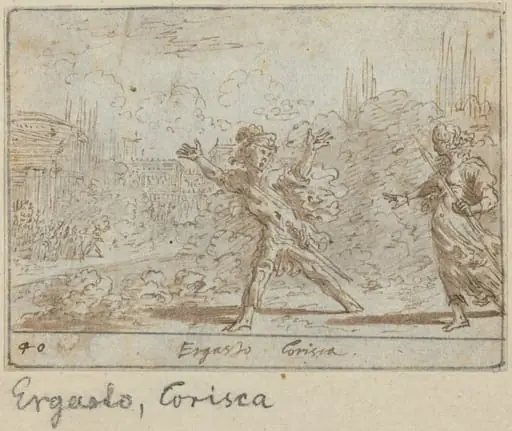
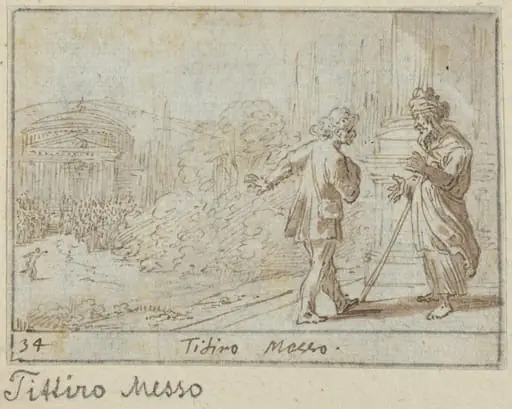
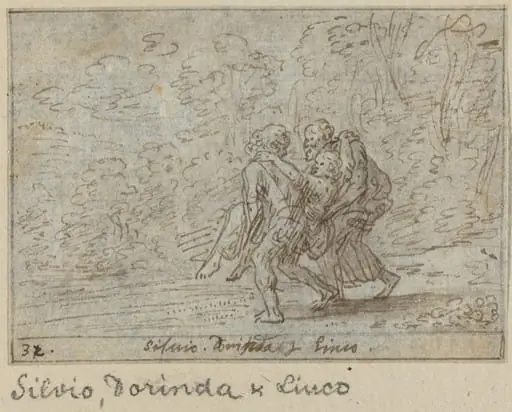
Artwork
Corisca
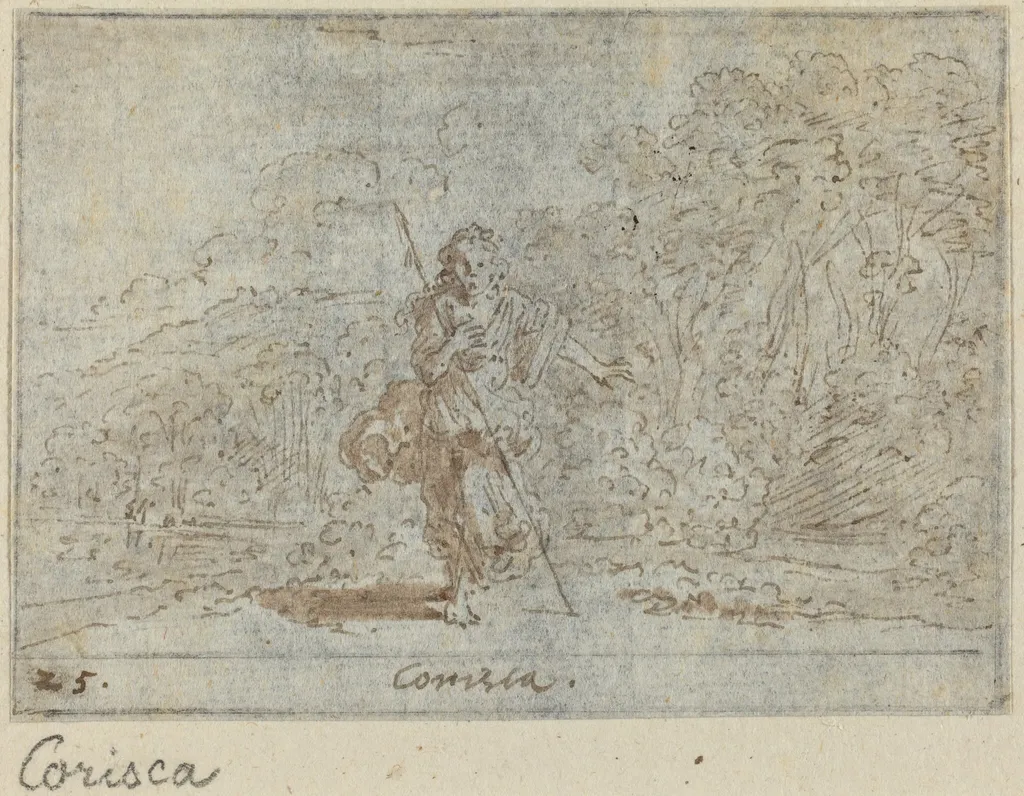
Corisca is an ink drawing by the Baroque artist Johann Wilhelm Baur. It dates from 1640 and is held in the collection of the National Gallery of Art.
- Inscription
- Inscribed:lower left in brown ink: 25.; lower center in brown ink: Corisca.
About this work
Overview
Corisca is a small but significant drawing by the German artist Johann Wilhelm Baur, executed in 1640 in pen and brown ink with brown wash on laid paper.
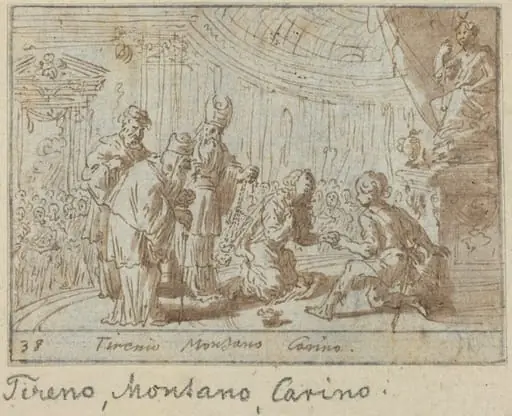
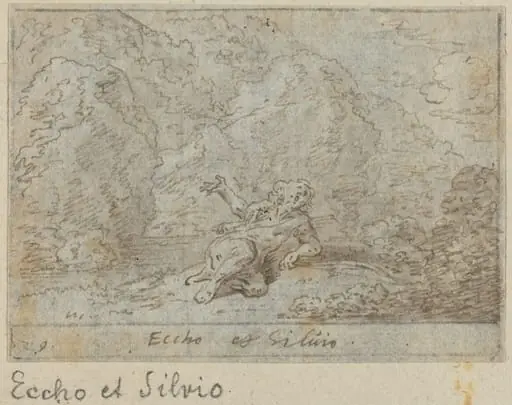
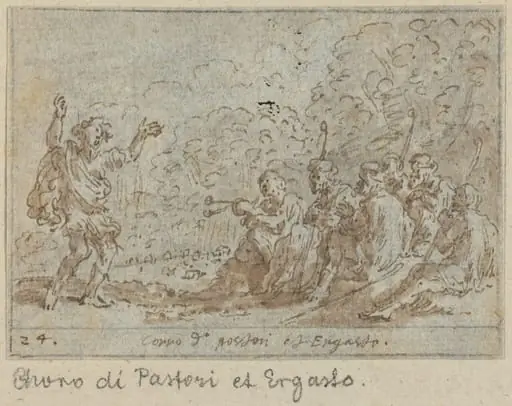
Corisca is a small but significant drawing by the German artist Johann Wilhelm Baur, executed in 1640 in pen and brown ink with brown wash on laid paper. Measuring 6.4 by 9.1 centimeters, it is held in the collection of the National Gallery of Art in Washington, D.C., under accession number 1952.8.41. The work belongs to a series of illustrations devoted to Giovanni Battista Guarini's pastoral tragicomedy Il pastor fido, one of the most popular and influential stage works of the late Renaissance and early Baroque periods. As a preparatory drawing by a leading illustrator of his generation, Corisca exemplifies Baur's skill in distilling literary character into economical visual form and contributes to our understanding of how classical and contemporary literature were transmitted through graphic art in seventeenth-century Europe.
Subject & Meaning
The drawing depicts Corisca, a character from Guarini's Il pastor fido, a pastoral tragicomedy first published in 1590 and widely performed and adapted across Europe in the following decades. Corisca appears as a single female figure standing in a wooded landscape, positioned slightly left of center. She wears flowing classical drapery and holds a staff or spear in her right hand, while her left arm crosses her torso. Her head turns to her left, looking downward, suggesting a moment of contemplation or perhaps the scheming disposition for which the character is known in the play. The inscription "Corisca" appears twice: in brown ink at lower center and again in graphite on the mount beneath the image, while the number "25." at lower left indicates its place within the larger series. The wooded setting with loosely sketched trees and foliage, denser to the right and more open to the left, provides the pastoral atmosphere appropriate to Guarini's Arcadian setting. The restrained palette of brown ink, gray wash, and off-white paper reinforces the drawing's function as a working illustration rather than an independent artistic statement, prioritizing clarity of narrative identification over decorative elaboration.
Technique & Style
Baur executed Corisca with pen and brown ink with brown wash on laid paper, a combination typical of his graphic work and well-suited to the demands of book illustration. The technique is linear and sketch-like, with quick pen strokes establishing the figure's form and diluted wash creating atmospheric depth in the landscape background. Darker brown tones define the figure's form and the shadow beneath her feet, while light gray wash in the sky provides minimal cloud definition. A dark border line frames the composition, giving the sheet a finished appearance despite its preparatory character. The overall finish suggests a working drawing intended for further development, whether as the basis for an engraving or as a study within a larger illustrative project. This economical yet expressive handling aligns with Baur's reputation as a miniaturist and illustrator who could convey narrative essentials with remarkable brevity. The small scale of the sheet, 6.4 by 9.1 centimeters, reflects the intimate format of many of his drawings and the practical constraints of book production in his era.
History & Provenance
The drawing is dated to 1640, near the end of Baur's short life. He was born in Strasbourg in 1607 and died in Vienna in 1642, leaving a substantial body of work despite his early death. The National Gallery of Art acquired Corisca as part of a larger group of works, and it entered the collection with accession number 1952.8.41. The credit line and specific provenance details prior to acquisition are not fully documented in the available sources, though the work's presence in a major American collection by the mid-twentieth century reflects the broader dispersal of Northern European drawings across Atlantic collections in that period. The drawing has been cited in scholarly literature, notably appearing in Thomas Dacosta Kaufmann's 1985 census of drawings from the Holy Roman Empire in North American collections, published in Central European History. As part of the National Gallery's holdings, it remains accessible to researchers studying Baur's work, the illustration of Italian Renaissance literature in Northern Europe, and the broader field of seventeenth-century graphic art.
Context
Johann Wilhelm Baur occupied a significant position in the cultural networks of early seventeenth-century Europe. After training with the miniaturist Friedrich Brentel in Strasbourg, he undertook a Grand Tour to Rome, where he worked for patrons including the art-loving Cassiano dal Pozzo. According to the biographer Arnold Houbraken, Baur developed his skills in watercolor and perspective rendering of architectural subjects, while Cornelis de Bie recorded his association with Karel Škréta, a member of the Bentvueghels, the society of Dutch and Flemish artists in Rome. Baur himself was likely a member of this influential group, though his nickname within it remains unrecorded. His career combined the roles of draughtsman, painter, and printmaker, with particular success as an illustrator of classical texts. He produced drawings and engravings for editions of Ovid's Metamorphoses and Virgil's Aeneid, works that demonstrated his ability to synthesize Italianate composition with Northern graphic precision. The Il pastor fido series, to which Corisca belongs, represents another facet of this illustrative practice, engaging with contemporary rather than ancient literature. Baur's work for the Habsburg court, including his final commission from Ferdinand III, testifies to the esteem in which he was held by major patrons. His sudden death in Vienna in 1642 cut short a career that had already achieved considerable distinction.
Legacy
Baur's illustrations, including those for Ovid and Virgil, achieved wide circulation through engraving and were reprinted and copied well after his death, contributing to a shared European visual vocabulary for classical mythology and literature. The Corisca drawing, as part of the Il pastor fido series, participates in this broader project of making literary culture visually accessible. The series itself reflects the enduring popularity of Guarini's play, which remained a touchstone for European drama, opera, and visual art throughout the seventeenth and eighteenth centuries. Baur's relative obscurity in modern art historical scholarship, noted by recent commentators, contrasts with the contemporary recognition of his compositional inventiveness and technical accomplishment. The survival of Corisca and related drawings in the National Gallery of Art ensures their continued availability for study, while their small scale and preparatory character offer valuable insight into the working methods of a professional illustrator in the competitive print culture of the early Baroque period. As an artifact of the transmission of Italian Renaissance pastoral drama to Northern European audiences, the drawing also illuminates the cosmopolitan circuits of artistic and literary exchange that defined European culture in this era.
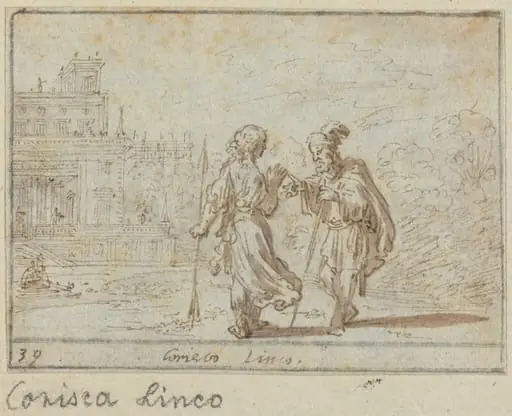
Own this work as a print
Artist & collection
Artist
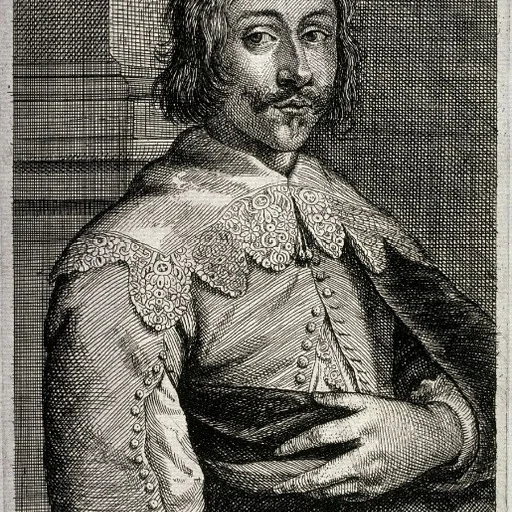
Johann Wilhelm Baur, Joan Guiliam Bouwer, or Bauer (Strasbourg, 31 May 1607 - Vienna, 1 January 1640) was a German engraver, etcher and miniature painter. He is famous for a series of illustrations of Ovid's Metamorphoses.