Artwork
Moon
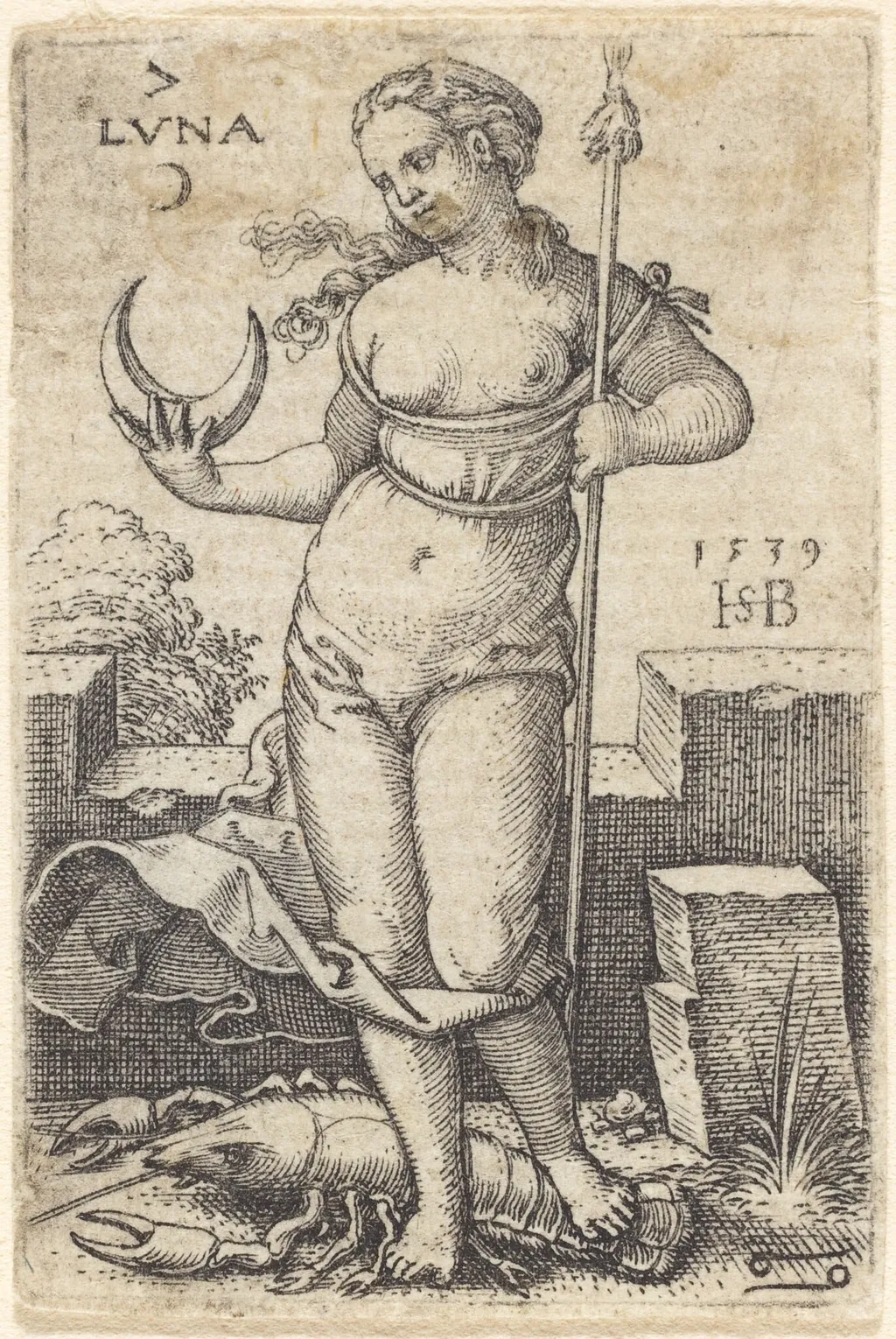
Moon is an ink print by the Renaissance artist Sebald Beham. It dates from 1539 and is held in the collection of the National Gallery of Art.
About this work
Overview
This piece reflects his technical discipline and alignment with the legacy of Albrecht Dürer, emphasizing intricate line work over grand scale.
Created in 1539 by Sebald Beham, Moon is a small-scale engraving that exemplifies the precision and intimacy characteristic of German printmaking in the early 16th century. Beham, a member of the group known as the Little Masters, specialized in finely detailed works on modest dimensions. This piece reflects his technical discipline and alignment with the legacy of Albrecht Dürer, emphasizing intricate line work over grand scale.
Subject & Meaning
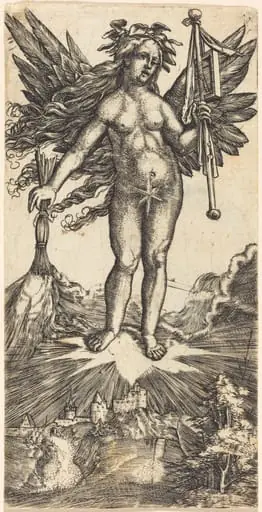
The figure depicted is Luna, the Roman moon goddess, identified by the inscription at the top. She stands barefoot on rugged terrain, cradling a crescent moon in one hand while holding a tall staff. A cow rests nearby, and a modest structure appears in the distance.
Her upward gaze suggests a celestial function, perhaps guiding night’s passage or overseeing lunar cycles. The imagery draws on classical mythology adapted into a quiet, contemplative scene.
Technique & Style
Beham employed fine, controlled engraving lines to model form and texture with remarkable subtlety. The folds of the woman’s drapery, the roughness of the rock, and the soft contours of the cow are rendered through delicate hatching and cross-hatching. Shading is achieved not by tone but by the density and direction of incised lines, demonstrating the precision possible in metalplate engraving. The composition remains compact, focused, and deliberately restrained.
History & Provenance
The engraving was produced during Beham’s mature period in Nuremberg, a center of printmaking innovation. Though no early ownership records are widely documented, the work aligns with the commercial print market of the time, where small engravings were collected by educated patrons. Its survival in multiple institutional collections suggests it was reproduced and circulated in the decades following its creation.
Context
In early 16th-century Germany, mythological and allegorical subjects were popular in prints, serving both intellectual and decorative purposes. Artists like Beham responded to humanist interests by reinterpreting classical themes in accessible, finely crafted formats. The emphasis on detail and miniature scale reflected a broader cultural shift toward private contemplation and the collecting of art as objects of connoisseurship.
Legacy
Beham’s Moon stands as a representative example of the Little Masters’ contribution to Northern Renaissance printmaking. While overshadowed in popular memory by larger-scale works, his engravings preserved a tradition of meticulous craftsmanship and mythological inquiry. The piece continues to be studied for its technical finesse and its role in bridging classical iconography with early modern visual culture.
Own this work as a print
Artist & collection
Artist
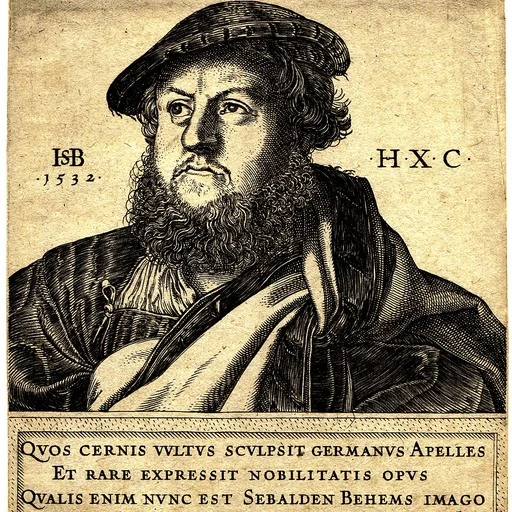
Sebald Beham (1500–1550) was a German painter and printmaker, mainly known for his very small engravings.