Artwork
Vue des Remparts de Sonnenstein (View of the Ramparts of Sonnenstein)
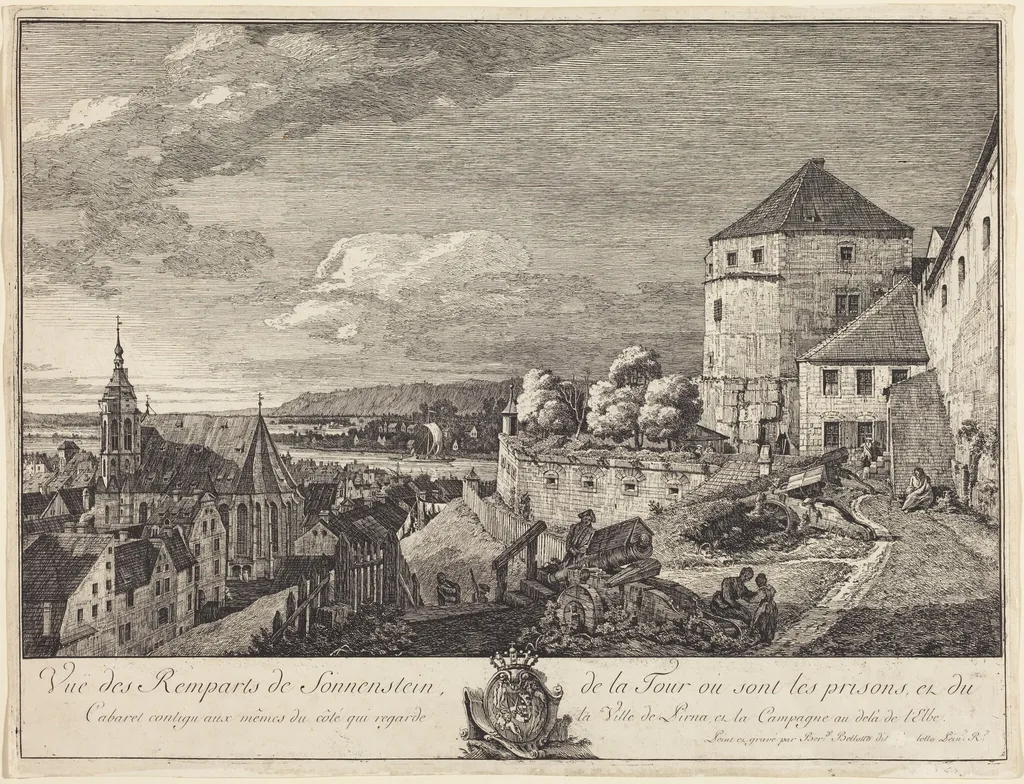
Vue des Remparts de Sonnenstein (View of the Ramparts of Sonnenstein) is an ink print by the Baroque artist Bernardo Bellotto. It dates from 1751 and is held in the collection of the National Gallery of Art.
- Inscription
- Inscribed:lower center in plate: Vue des Remparts de Sonnenstein de la tour ou sont les prisons, et du / Cabaret contigu aux même du côté qui regarde la Ville de Pirna, et la Campagne au delà de l'Elbe; lower right in plate: Peint et gravé par Berd. Bellotto dit [missing]letto Pein P.
About this work
Overview
Created in 1751, this etching by Bernardo Bellotto depicts the fortified hilltop complex of Sonnenstein, located near Pirna in Saxony. Rendered in monochrome on laid paper, the work presents a precise architectural view, emphasizing the layered topography of the site. The composition balances natural terrain with man-made structures, capturing the quiet decay of a once-militant stronghold.
Subject & Meaning
The scene centers on the remnants of a medieval fortress, its ramparts and tower rising above a cluster of modest dwellings and a church.
The scene centers on the remnants of a medieval fortress, its ramparts and tower rising above a cluster of modest dwellings and a church. Ruins in the foreground suggest abandonment, while the two figures seated near the broken wall imply contemplation or rest. The inclusion of a river in the distance anchors the site within its regional geography, reinforcing the work’s function as a topographical record rather than a romanticized vision.
Technique & Style
Bellotto employed fine, controlled etching lines to model form and texture, rendering individual stones, shadows, and surface irregularities with meticulous care. The use of hatching and cross-hatching creates depth and volume, giving the stone walls a tactile presence. The sky is lightly stippled, allowing clouds to suggest movement without distracting from the architectural precision that defines the composition.
History & Provenance
Bellotto produced this print during his early travels through Saxony, likely as part of a commission or personal study of regional fortifications. It was made before his later, more famous works in Dresden and Vienna. The etching was likely circulated among collectors and architects interested in accurate depictions of Central European sites, reflecting the 18th-century fascination with documented landscape.
Context
In mid-18th-century Europe, topographical prints served both documentary and aesthetic purposes. Bellotto’s work aligns with a tradition of architectural recording favored by patrons and scholars. Sonnenstein, though diminished in military use by this time, retained symbolic weight as a relic of regional power, making it a fitting subject for an artist known for his fidelity to place.
Legacy
This etching contributes to Bellotto’s reputation as a precise observer of urban and rural architecture. Though less celebrated than his oil paintings, such works demonstrate his skill in translating three-dimensional space into two-dimensional line. They remain valuable references for historians studying the built environment of Saxony in the Enlightenment era.
Own this work as a print
Artist & collection

Artist
Bernardo Bellotto, was an Italian urban landscape painter or vedutista, and printmaker in etching famous for his vedute of European cities – Dresden, Vienna, Turin, and Warsaw.

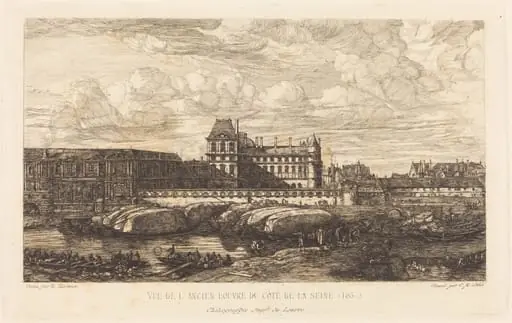
- L'ancien Louvre d'après une peinture de Zeeman, 1651 (The Old Louvre, from a Painting by Zeeman, 1651)
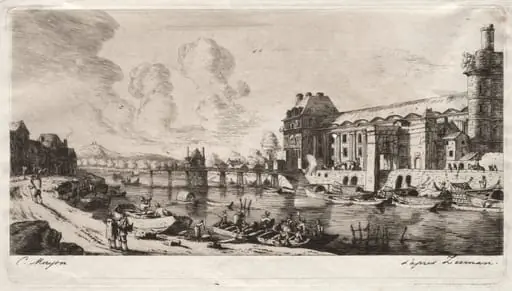 The Pavillon de Mademoiselle and part of the Louvre
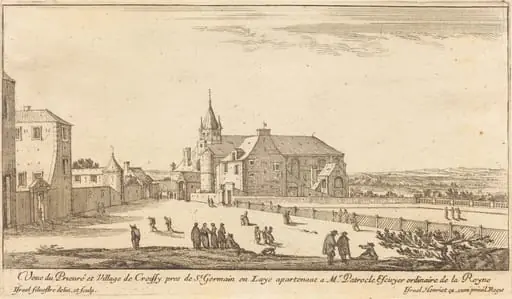 Veue de Prieure et Village de Croissy
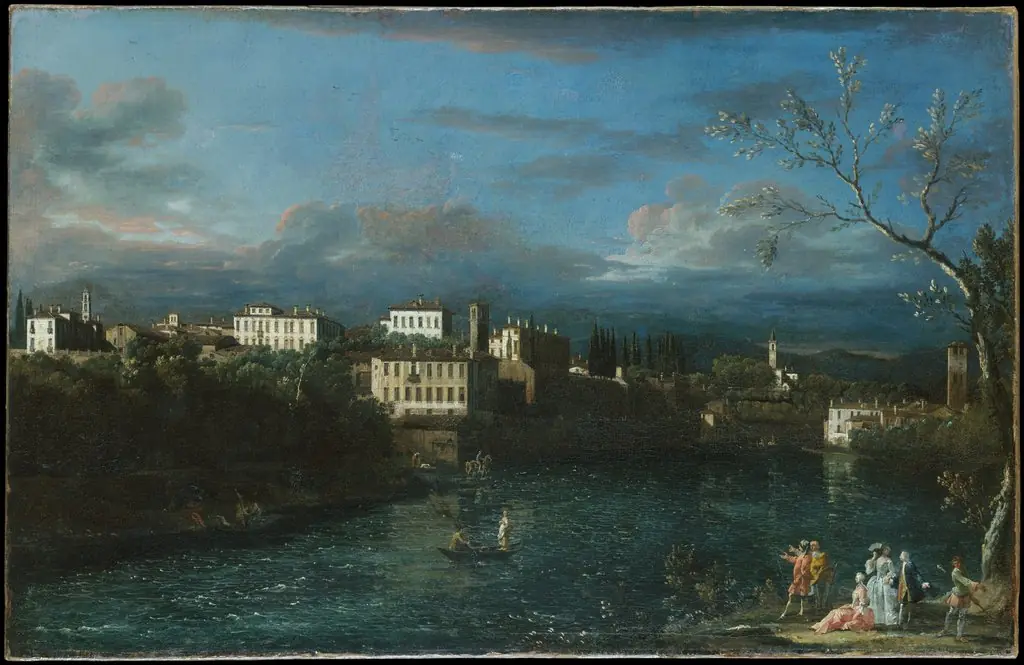
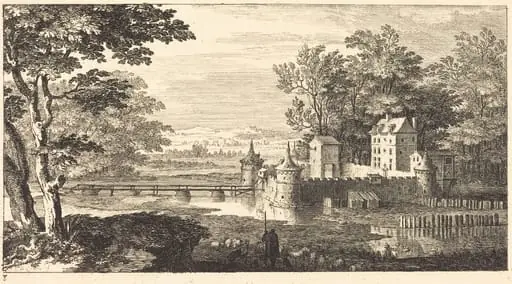 Landscape with Chateau
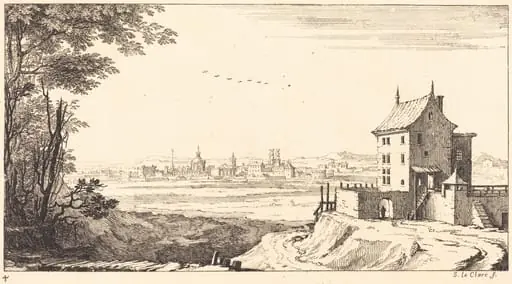 Landscape with City in Distance
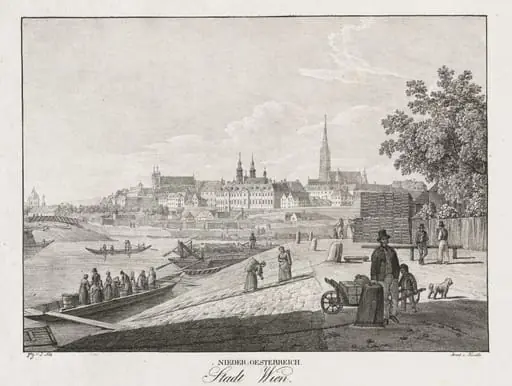 Nieder-oesterreich, Stadt Wien
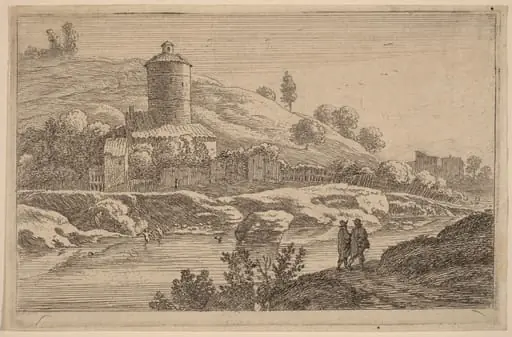 Round Tower near the Tiber
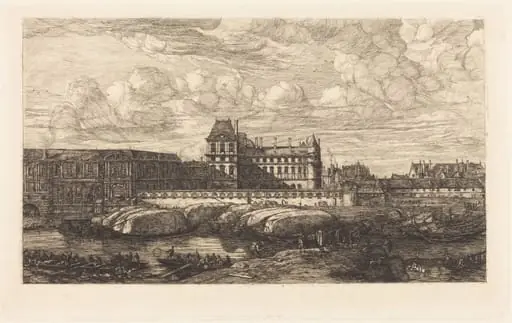 L'ancien Louvre d'après une peinture de Zeeman, 1651 (The Old Louvre, from a Painting by Zeeman, 1651)
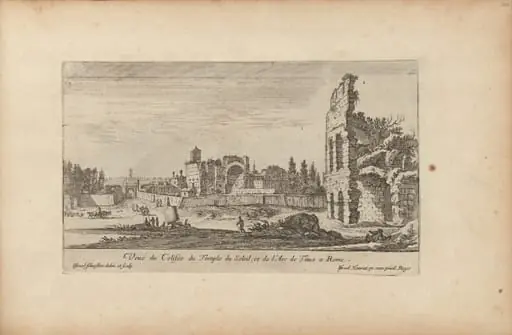 Veuë du Colisée du Temple du Soleil, et de l'Arc de Titus a Rome
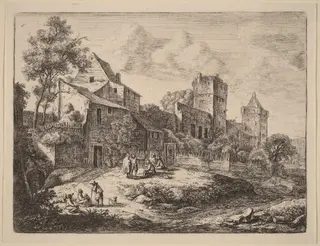 Square in Front of an Inn
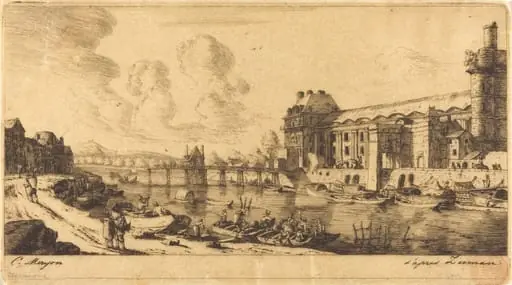 Le Pavillion de Mlle. et une partie du Louvre
 Small Town (Town Gate at Gorkum?)